
11 Hunter.io Alternatives for Finding Work Emails (2026)
Julien K.Published Updated

Key takeaways:
- Hunter publishes a price but not a match rate. Its billing rule is clear, one credit per email found and nothing charged when nothing comes back, and it scores each address for confidence rather than claiming a coverage figure.
- Every tool here charges nothing when an email lookup finds nothing, us included, and Apollo.io goes further by billing only once an address verifies. The exception is ours: a live profile fetch returning nothing still costs 2 credits.
- Dropcontact and LeadMagic publish self-reported figures with no method behind them, 99% validity and 97% accuracy respectively. Three put money behind theirs: Findymail refunds credits when a list bounces above 5%, Anymail Finder claims 97%+ delivery with credits back after review, and UpLead returns credits under its 95% accuracy guarantee.
- A verified address is a statement about the moment it was checked, not a guarantee. The SMTP standard itself says a server may answer that an address is merely "apparently valid", which is why the wrong-answer rate matters as much as the match rate.
Hunter.io does one job cleanly. Give it a domain and it returns the addresses it knows; give it a name and a company and it guesses the pattern, scoring each result. The free tier is real at 50 credits a month, the API reaches every plan including that one, and unlimited users share a single credit pool instead of paying for seats.
People start looking for Hunter.io alternatives for three reasons, and price is rarely the first. Some need phone numbers, which Hunter does not sell. Some need coverage where pattern-based finding struggles. And some have found that an address marked deliverable still bounced, which is a different complaint and the one worth taking seriously. The wider email finder tools market splits along those lines.
This guide compares eleven tools on what decides your bill: what counts as a found email, whether a miss is billed, and whether the vendor publishes a figure you can check. Reverse Contact is ours, so it leads, and the numbers that do not flatter us are in the table alongside everybody else's. Every price here came off the vendors' own pricing pages and documentation during October 2026.
Where Hunter Runs Out of Road
Hunter is unusually honest about its own billing, which makes the gaps easy to name without guessing.
It sells no phone numbers and no job history. It does sell a company database, sequences and a company enrichment API, but if your record needs a mobile or a current job title none of that helps. On that shape Hunter is one step of a workflow rather than the workflow.
Monthly credits reset and do not carry. A quiet month is money gone on monthly billing, though annual billing grants the whole year's allowance up front. Starter runs $49 a month, or $34 on annual billing, for 2,000 credits; Growth is $149 or $104 for 10,000; Scale is $299 or $209 for 25,000. The free plan gives 50 a month.
Pattern-based finding is strongest where naming is predictable. Working out that a company uses firstname.lastname@ and applying it across a list is efficient, and it degrades wherever names transliterate more than one way or departments differ.
It publishes no match or coverage rate. It does publish a bounce rate below 1% on addresses its verifier marks valid, and otherwise scores each address individually, which is arguably more honest, but it does mean there is no single number to set against a rival's claim.
One team on r/GrowthHacking put the frustration plainly, saying they had been using Hunter to find and verify emails, found it inaccurate for their list, and needed something that could handle bulk uploads. That is one team's experience rather than a measurement, and coverage always varies by segment.
The complaint still points at the right question: an address that arrives marked valid and then bounces costs far more than the credit that bought it. A tool from the broader email verification tools category solves half of that, since checking an address you hold is a different job from finding the right one.
What Counts as a Found Email
This is the part nobody puts on a pricing page, and it decides whether a cheap credit is actually cheap.
When a finder says an address is deliverable, it has checked the syntax, confirmed the domain accepts mail, and opened a conversation with the receiving server about that specific mailbox. The last step is the one that wobbles.
The SMTP specification is explicit that a server may not have verified anything. A mail exchanger that cannot check a mailbox in real time answers with a 252 code meaning the address is only apparently valid, and the standard warns that implementations must not appear to have verified addresses that are not, in fact, verified.
Catch-all domains push this further. A server set to accept mail for every address at a domain answers yes to anything, so a finder gets a positive response for a mailbox that does not exist. Good tools flag these rather than counting them as wins, which is how two vendors report very different coverage on one list and both describe what they measured honestly.
Here is what each step in that chain actually proves.
| Check | What it proves | What it does not |
|---|---|---|
| Syntax | The address is well formed | That anyone holds it |
| DNS and MX records | The domain accepts mail | That this mailbox exists |
| SMTP conversation | The server accepted the recipient | Anything at all on a catch-all domain |
| Catch-all detection | The server says yes to everything | Which of those answers are real |
| Risk scoring | It looks like a working business mailbox | That it is still live next month |
None is wasted and none adds up to a promise, which is why two numbers matter rather than one: the match rate says how often something came back, the wrong-answer rate how often it was the wrong person.
A tool that answers for 95% of your list and is wrong on a tenth of those has handed you more cleanup than a tool that answers for 70% and is right nearly every time. Our own email finder API runs these checks at the moment of the request rather than trusting a stored result.
So headline percentages tell you very little. Running the same 200 rows through two tools and counting both numbers tells you what you need.
The 11 Best Hunter.io Alternatives
Here is the whole field at a glance, with the billing rule most likely to surprise you set beside the entry price.
| Tool | Best for | Pricing (from) | Is a miss charged? | Published figure |
|---|---|---|---|---|
| Reverse Contact | Email finding inside software | Credit packs from $100 | No on email and phone lookups | 93% email coverage on clean inputs |
| Apollo.io | Data and outreach in one seat | $49/seat/mo billed annually | Only when an email verifies | 84% email match rate |
| Snov.io | Finding and sending together | $29.25/mo billed annually | No | Over 98% accuracy, no method given |
| Findymail | A bounce-rate refund | $41/mo billed yearly | No | Under 5% bounce rate or credits back |
| Anymail Finder | A published benchmark | $19/mo billed yearly | No | 86.4% coverage at 98.9% accuracy |
| Prospeo | A free tier that finds | $37/mo billed yearly | No | 98% accuracy across all fields |
| Dropcontact | European records held in Europe | €24/mo billed yearly | No, misses are re-credited | 99% validity, self-reported |
| RocketReach | Refunds on failed lookups | $33/mo billed annually | No, the lookup is refunded | 90% to 98% deliverability |
| UpLead | Email and mobile in one credit | $74/mo billed annually | Only on a Valid Only export | 95% data accuracy |
| LeadMagic | Success-only billing on every lookup | $83/mo billed yearly | No, except the job-change check | 97% accuracy, self-reported |
| Icypeas | The cheapest published entry | $15.83/mo billed yearly | No | 79% find rate, 1.33% bounce |
We put ourselves first because this is our product, and said so rather than hiding it. The rest runs from the broad platforms that replace more than Hunter, down to the specialist finders that do one thing for less. A similar spread shows up among Lusha alternatives, where the unit of sale varies more than the data does.
1. Reverse Contact
Best for: Email finding inside software, not a browser tab.
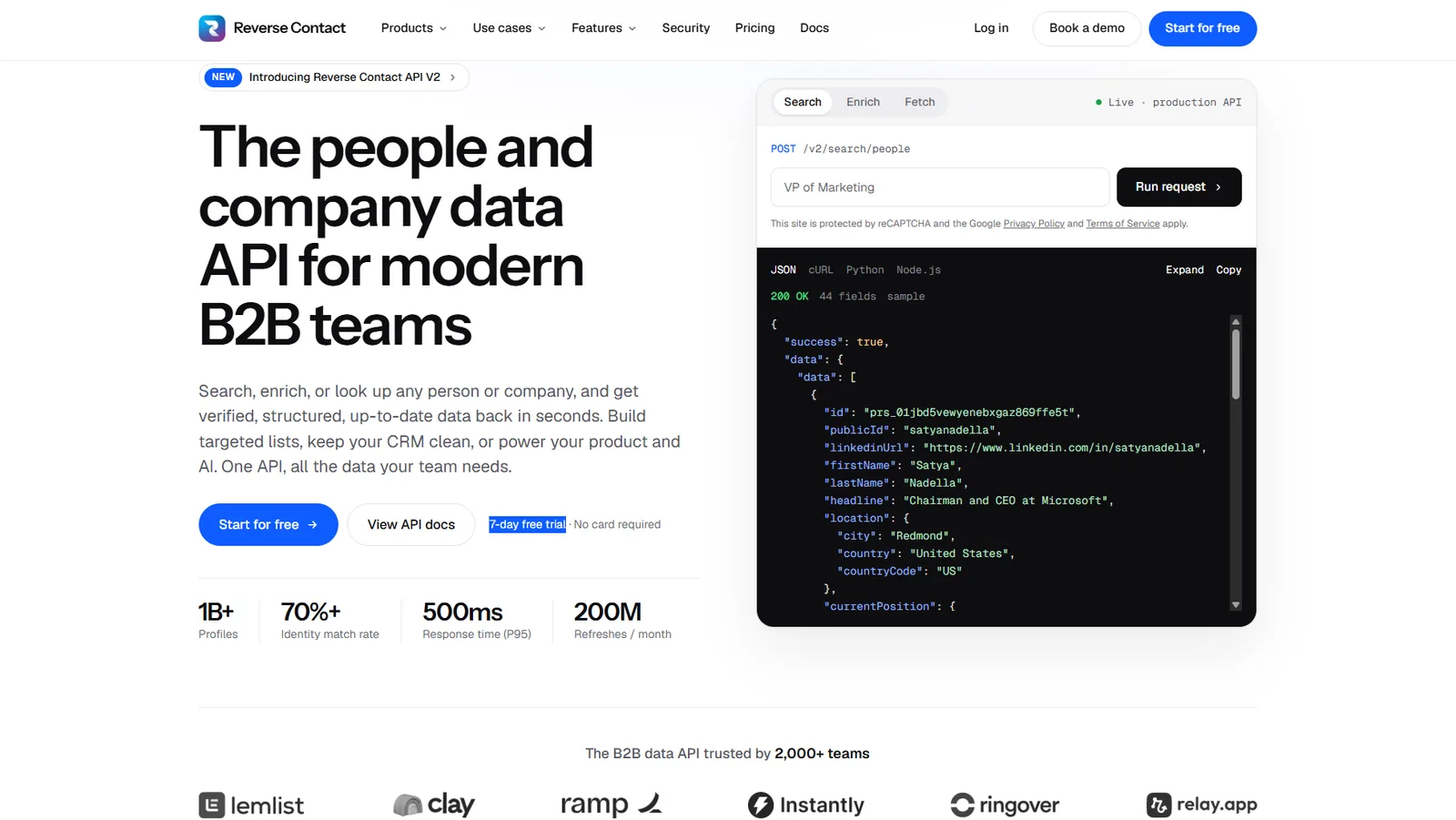
Overview: Of the Hunter.io alternatives gathered here, this is the one you never log into. Reverse Contact is an API, with no extension and no prospecting dashboard anywhere in it. Code sends an identifier or a filter set and a structured profile comes back.
Email finding is one call inside a larger surface. Send a name and a company domain and you get a business email, validated at the moment you ask rather than read from a stored list. Syntax, the domain's mail records, an SMTP check and catch-all detection all run before anything is returned.
The same surface runs in the other direction, turning an address you already hold into a person through a reverse email lookup, which is the half of the problem Hunter does not address at all. What comes back is the profile as we hold it, and our data coverage report shows how complete that tends to be: in the October 2026 snapshot, 90% of quality profiles carried a current title and employer.
That live validation is why an email call takes seconds rather than milliseconds. A cached profile read comes back in about half a second; live retrieval is slower and arrives asynchronously.
The cold email platform Instantly shows the shape at volume. It spots incomplete lead records after a user imports a list, queues them, and calls us in the background so enrichment never holds the user up. The AI writing from the context that comes back is Instantly's own, not part of what we supply.
Key features:
- An email costs 3 credits and is charged only when one is found.
- Four ways in: an address, a person's name plus the company domain, a company on its own, or a filter set spanning 30+ criteria.
- A
/checkcall that costs nothing and reports when the record was last rebuilt. - Phone lookups at 20 credits, billed when a lookup finds a number.
- One response shape across REST, webhooks, CSV upload and MCP.
Pricing: Everything bills on results. A $100 pack starts you with no subscription attached, and its credits stay good for three months from purchase, oldest drawn down first. Three monthly tiers lift the meter in stages: $249 for profile lookups, $449 adding search, $699 adding enrichment from an email or a name. Emails, phones and live re-fetches stay metered throughout. Those tiers license your own team's use, and a Platform agreement covers showing the data to customers, priced on application.
Pros: A failed email or phone lookup costs nothing, every check runs when you ask rather than being inherited from storage, credits carry a stated three-month life, and headcount never enters the bill
Cons: Nothing for a rep to click, so it replaces Hunter's data and not its habit; a phone lookup costs 20 credits against 3 for an email; a live profile fetch that returns nothing still costs 2 credits; coverage is strongest in the Americas and Europe and thinnest across Asia-Pacific
How to start using it:
- Open an account; the trial credits need no card.
- Send 200 real rows and write down two numbers rather than one: addresses returned, and addresses belonging to the right person.
- Divide credits spent by usable records returned. That figure, not the pack price, is your real cost.
- Run the identical list through Hunter and compare both numbers side by side.
- If your customers will see the data, raise Platform with us before you build.
Why it's a good Hunter.io alternative: The email is one field of a full profile rather than the whole product, and the validation happens while you wait rather than at some point before you asked. What you give up is the browser workflow Hunter is built around.
Final verdict: Right when the lookups happen inside software and the volume is real. Wrong if someone needs a search box.
2. Apollo.io
Best for: One subscription covering data and sending.
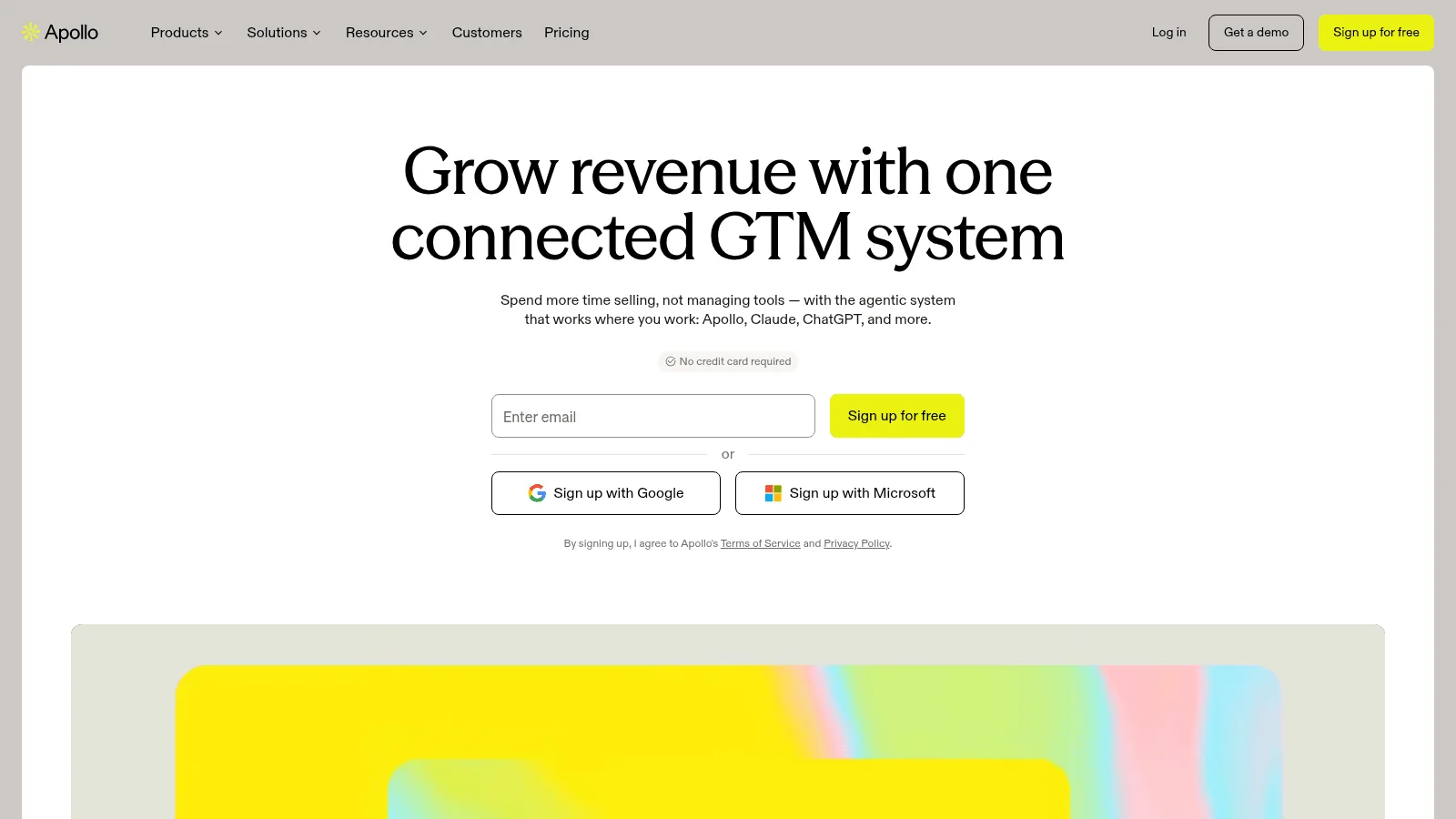
Overview: Apollo wraps a contact database around a sequencer, a dialer and a light CRM, so it absorbs Hunter and the tool you were sending from into one line on the invoice.
Key features:
- Emails draw a single credit; phone numbers draw eight.
- The search covers 240M+ contacts and 30M+ companies.
- Credits return on anything that bounces inside 30 days.
Pricing: Paid seats cost $49, $79 and $119 a month on annual billing for Basic, Professional and Organization, the last of which insists on three seats. Free accounts carry 900 credits per seat per year, granted monthly. Its own help pages publish an 84% email match rate.
Pros: A genuinely free tier, published rates, outreach included, a refund window on bounces
Cons: Every unused credit lapses when the cycle closes, including add-on purchases, and the allowance is tied to how many seats you bought rather than how much work you have
Why buyers shortlist it: No other published price puts a database and a sender together this cheaply.
Final verdict: Strong value when a whole team uses it. Poor value when two people need a large allowance.
3. Snov.io
Best for: Finding and sending from the same account.
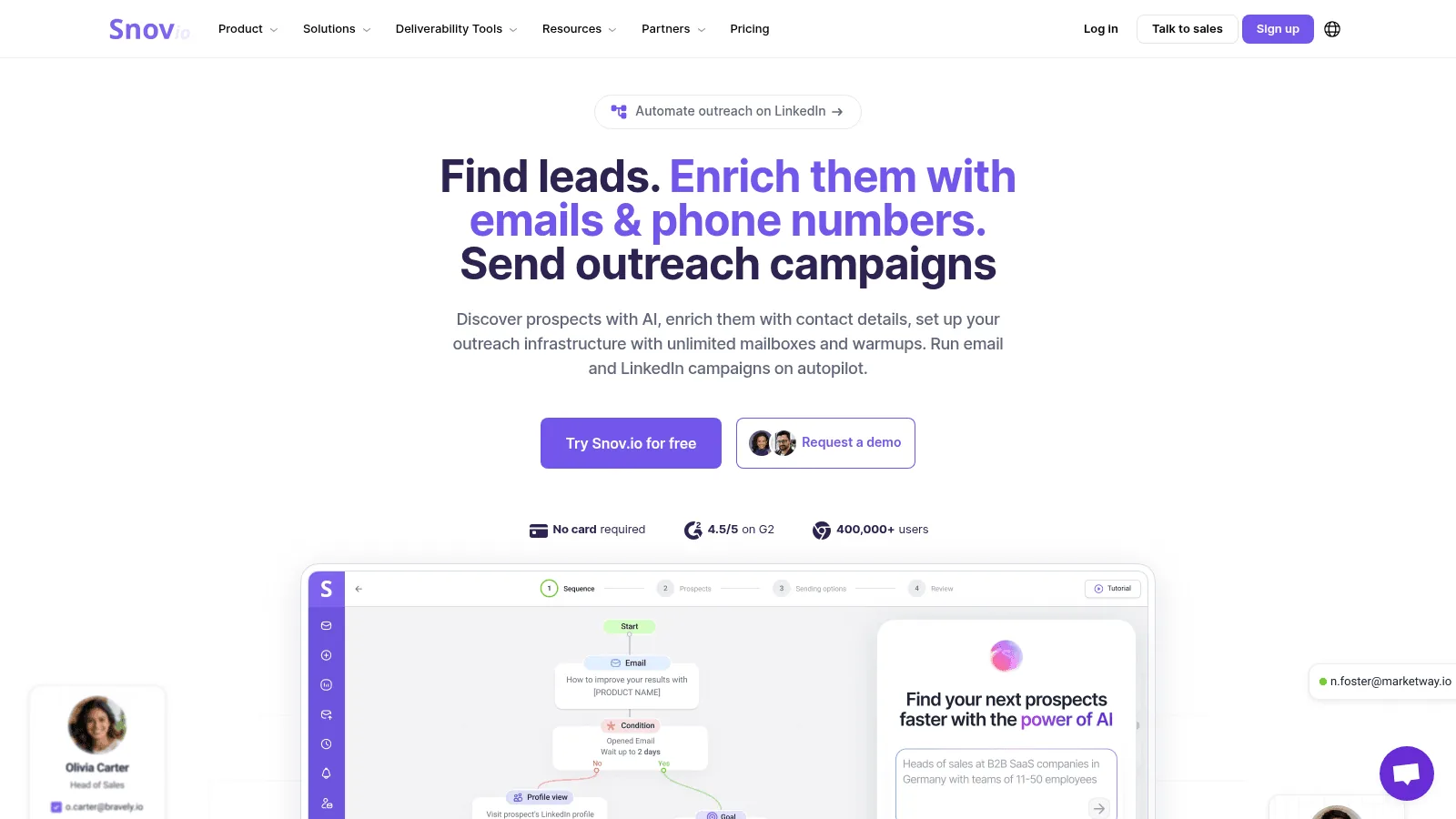
Overview: Snov.io sits close to Hunter in shape, adding an email sender, warm-up and a lightweight CRM on top of the finder and verifier.
Key features:
- One credit covers an email verification or a prospect returned.
- Unlimited team seats on every paid plan, so the credit pool is the only meter.
- API and webhooks from the entry tier.
Pricing: The free trial carries 50 credits and renews monthly without API or export access. Starter is $39 a month for 1,000 credits, Pro S is $99 for 5,000, and annual billing saves 25%. Its FAQ claims over 98% accuracy on the email finder without publishing a method.
Pros: Unlimited seats, sending included, a low published entry price, API from the first paid tier
Cons: Phone enrichment runs on separate tokens, 10 with Wiza or 22 with Zeliq, and an address it returns as unverifiable still costs a full credit, while the free trial excludes the API entirely, so you cannot test the integration you intend to build
Why buyers shortlist it: Of the like-for-like swaps here, it is the one that also sends the email.
Final verdict: A sensible move for a small outbound team. Less so for a product team that only wants the data.
4. Findymail
Best for: A bounce-rate guarantee in writing.
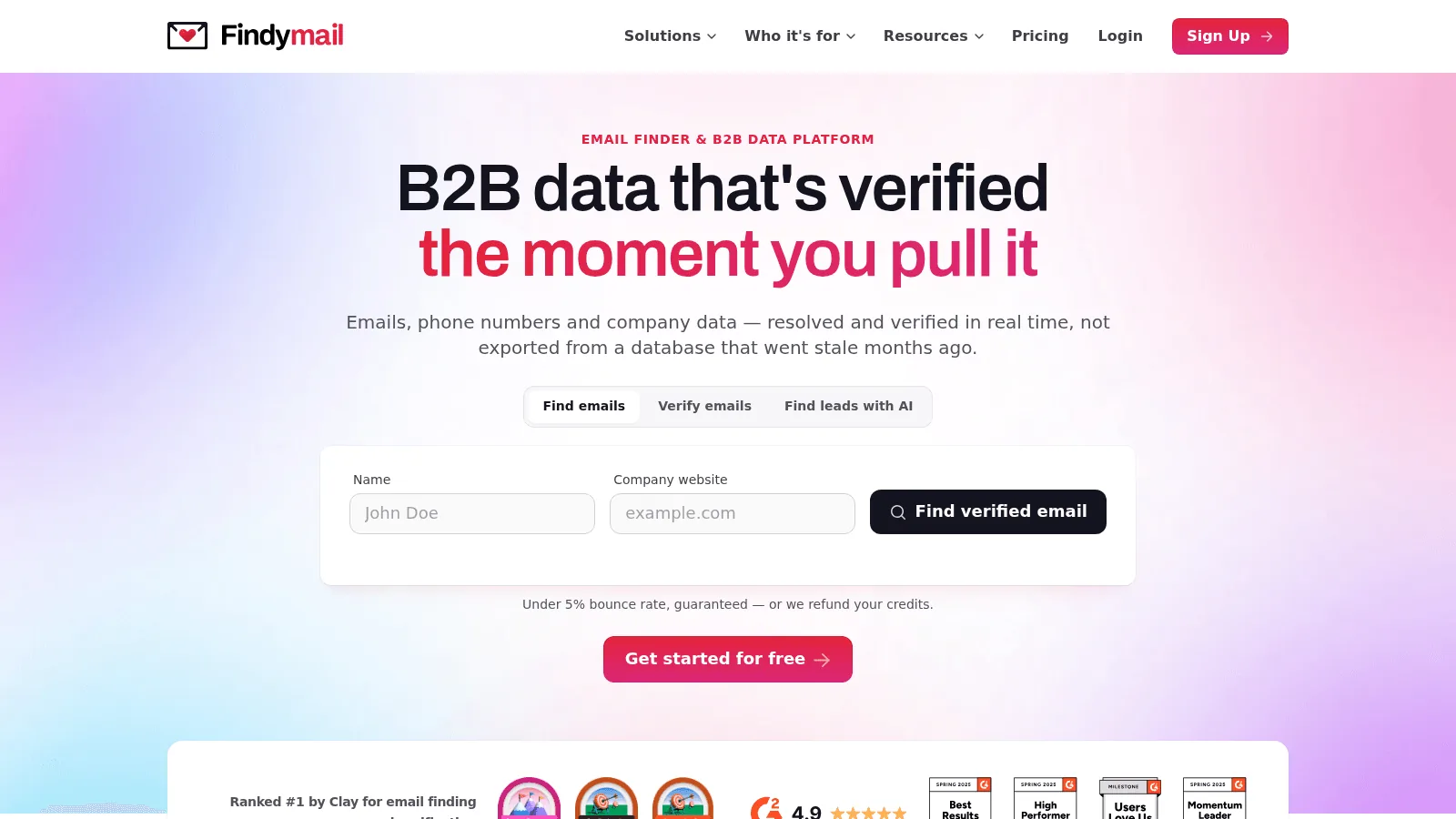
Overview: Findymail competes on the number that actually hurts, promising a bounce rate under 5% and refunding credits when a list exceeds it.
Key features:
- One credit per email, ten per phone number, with nothing charged on a miss.
- Credits roll over up to twice the plan allowance.
- The mobile finder covers non-EU numbers only.
Pricing: Credit plans start at $49 a month for 1,000 credits, or $41 on yearly billing, rising through $99 for 5,000 and $249 for 15,000. Its pricing page now opens on seat-based usage plans at $99, $399 and $999 for one, five and twenty seats, with the credit ladder behind a link.
Pros: A refund tied to a measurable outcome, generous rollover, no per-seat charge on the credit plans
Cons: The default pricing view shows seat plans with no credit counts attached, which makes the cheaper credit ladder easy to miss, and European mobile numbers are out of scope
Why buyers shortlist it: The guarantee converts a vague accuracy claim into a refund you can collect.
Final verdict: Good for cold outbound where deliverability is the whole game. Weaker if you need phones in Europe.
5. Anymail Finder
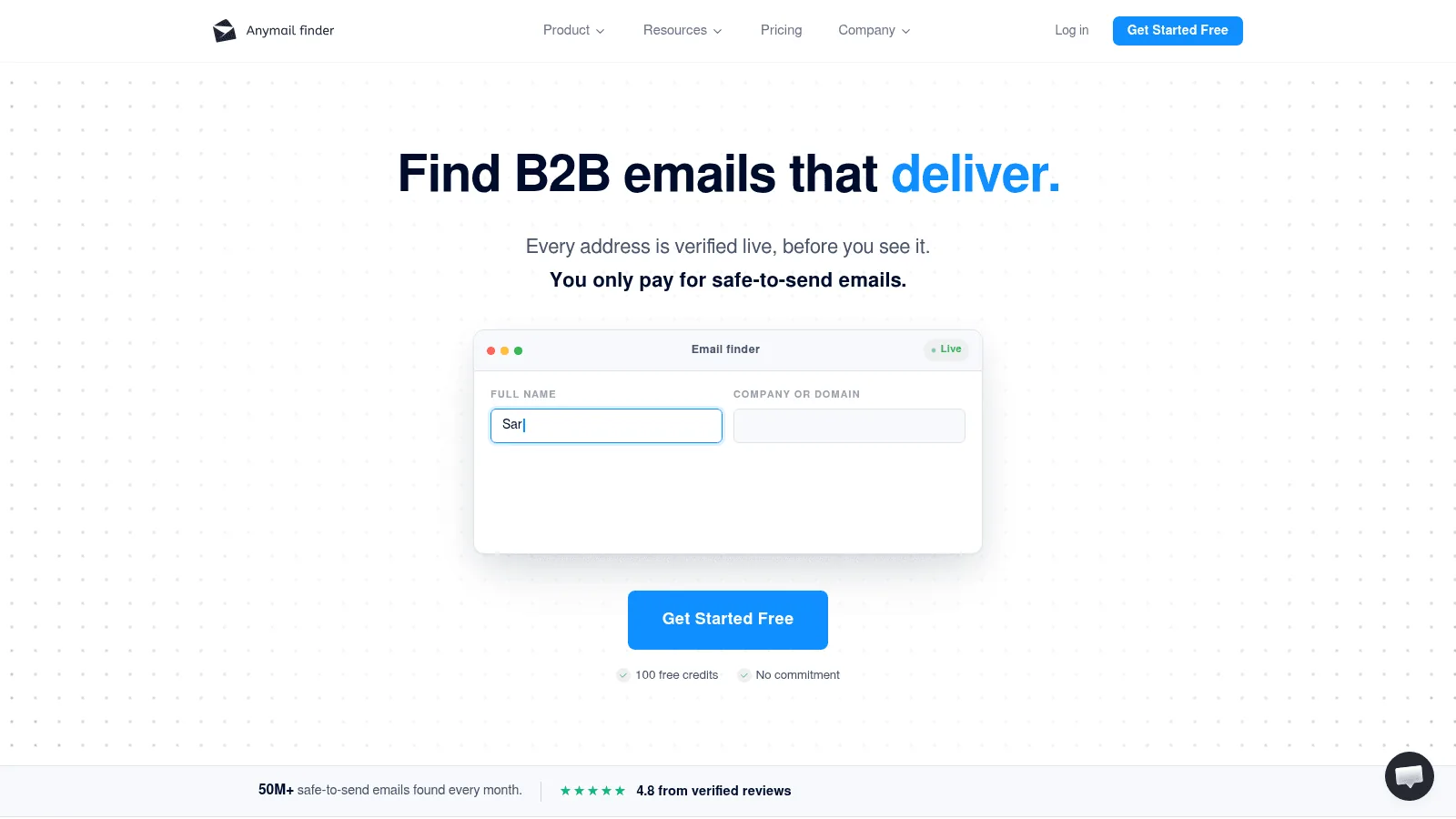
Best for: A vendor that publishes its own benchmark.
Overview: Anymail Finder is email only, like Hunter, and competes by showing its working rather than widening its scope.
Key features:
- One credit per verified email found, two for a decision-maker search, a fifth of a credit to verify.
- Credits roll over for as long as the subscription runs.
- API access on every plan, including the smallest.
Pricing: Monthly packs run $29 for 400 credits, $49 for 1,000, $89 for 2,000, $149 for 5,000 and $199 for 10,000, with larger plans from $299 a month and one-off packs from $1,090 for 100,000 credits, before tax. A one-time 100 free credits needs a card for verification but is not charged. It publishes 86.4% verified coverage at 98.9% accuracy from its own 14-tool benchmark across 5,000 B2B contacts, plus a 97% delivery guarantee with credits back on a bounce.
Pros: A stated test set and method, rollover while subscribed, cheap entry, API everywhere
Cons: Email only with no phone numbers at all, and the benchmark is the vendor's own rather than an independent one, so treat it as a claim they have committed to rather than a neutral result
Why buyers shortlist it: The closest match on method, though at 400 credits for $29 it runs about three times Hunter's price per email.
Final verdict: A clean trade if email is genuinely all you need. Not a platform.
6. Prospeo
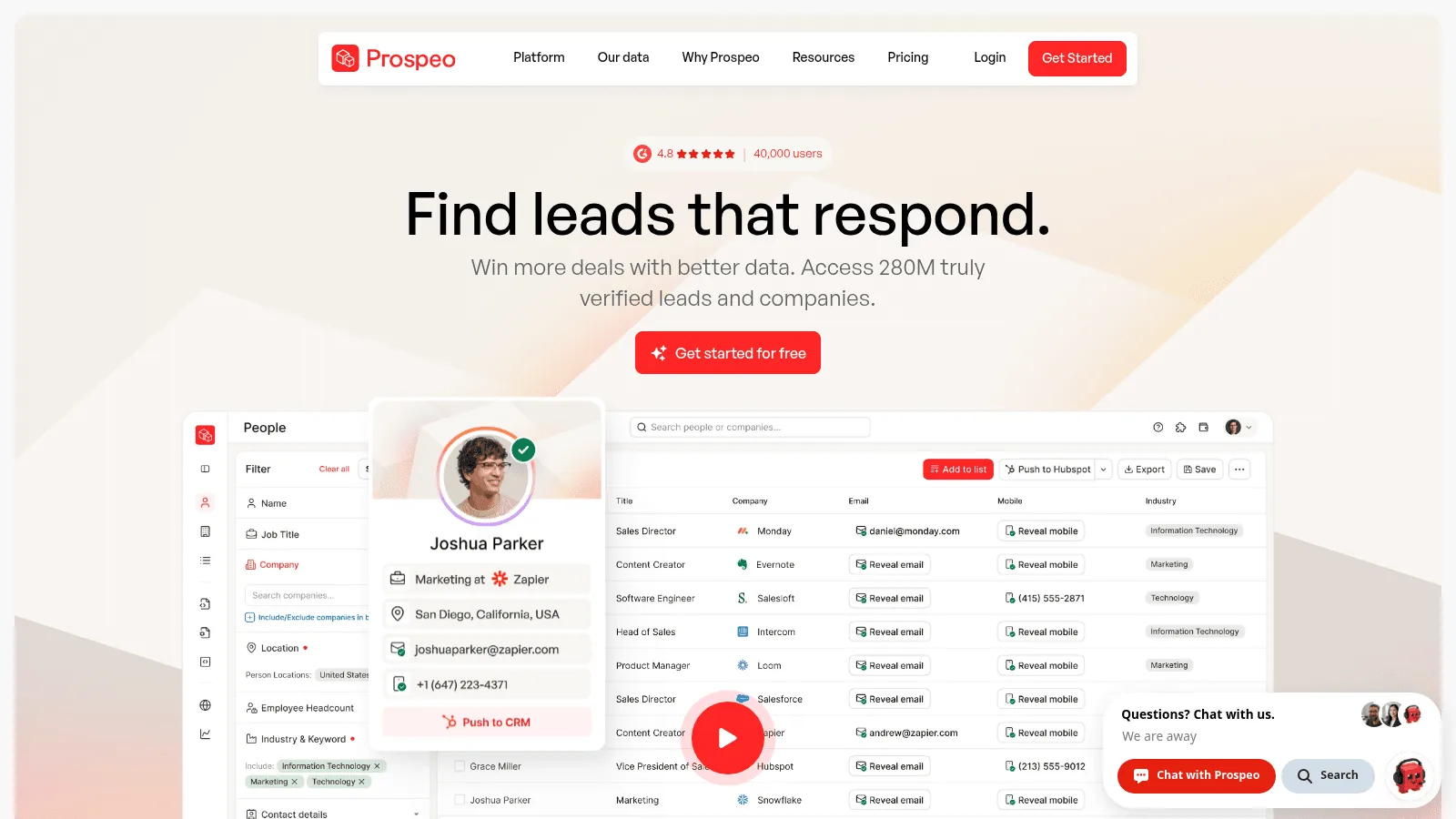
Best for: A free tier that finds rather than just verifies.
Overview: Prospeo is a straightforward finder with a free plan large enough to test a real list before paying.
Key features:
- One credit per verified email, ten per mobile number.
- 100 free credits a month, permanently, though without API access.
- Credit add-ons from 1,000 for $10.
Pricing: Starter is $49 a month, or $37 on yearly billing, for 2,000 credits; Growth is $99 or $74 for 5,000; Pro is $249 or $187 for 15,000. Pricing is per user. Its data page claims a 98% accuracy rate across all fields.
Pros: A real free allowance, cheap top-ups, published per-credit costs
Cons: Credits do not roll over at all, the API starts at the first paid tier so the free plan cannot test an integration, and pricing is per user rather than per account
Why buyers shortlist it: The free tier is big enough to answer the only question that matters before you spend, and MCP is included on it even though the REST API is not.
Final verdict: Good for a solo operator or a trial. Awkward for a team, because every user needs a plan.
7. Dropcontact
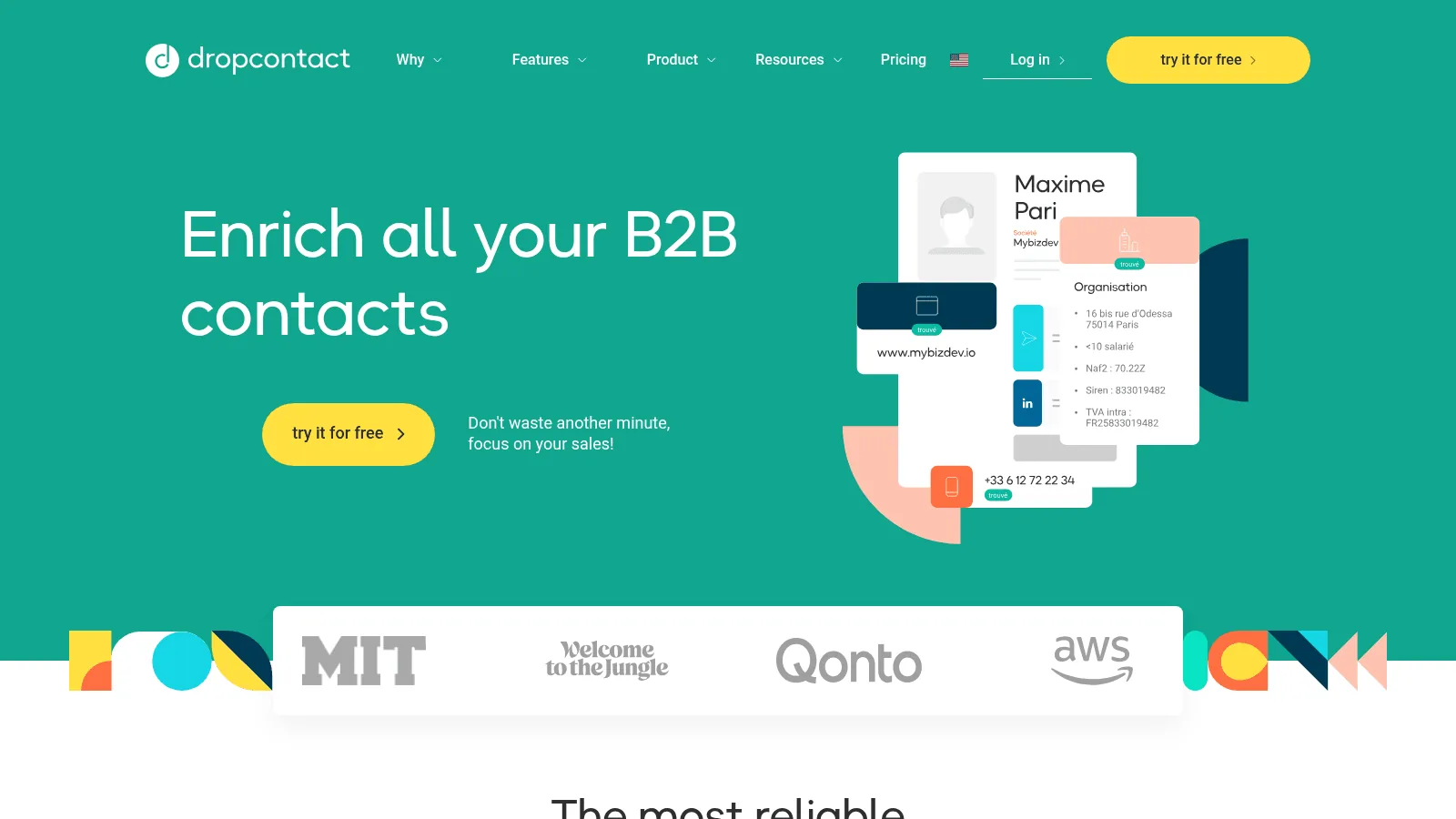
Best for: European records and data held in Europe.
Overview: Dropcontact is a French enrichment service that cleans and completes records rather than only hunting addresses, and it sells itself on handling European data under European rules.
Key features:
- Pay on success, with an email that is not found credited back.
- Native integrations with Pipedrive and HubSpot.
- API and MCP access from the entry plan.
Pricing: The page opens on the monthly toggle with the volume dropdown already at 4,000 credits, showing €79 and €120, which is not the floor. Starter is 500 credits at €29 a month, or €24 billed yearly, and Growth is €35 or €29. There is no free plan, only 50 credits on the trial button.
Pros: European hosting and support, success-only billing, CRM integrations that work without glue code
Cons: Credit carry-over, company data and change detection all start at Growth rather than Starter, and the pricing page defaults to a mid-range volume that makes the service look three times more expensive than its actual entry point
Why buyers shortlist it: The shortest shortlist when both the records and the regulator sit in Europe, with processing on its own algorithms on EU servers.
Final verdict: Strong for EU-centric workflows. Less compelling for a US-only list.
8. RocketReach
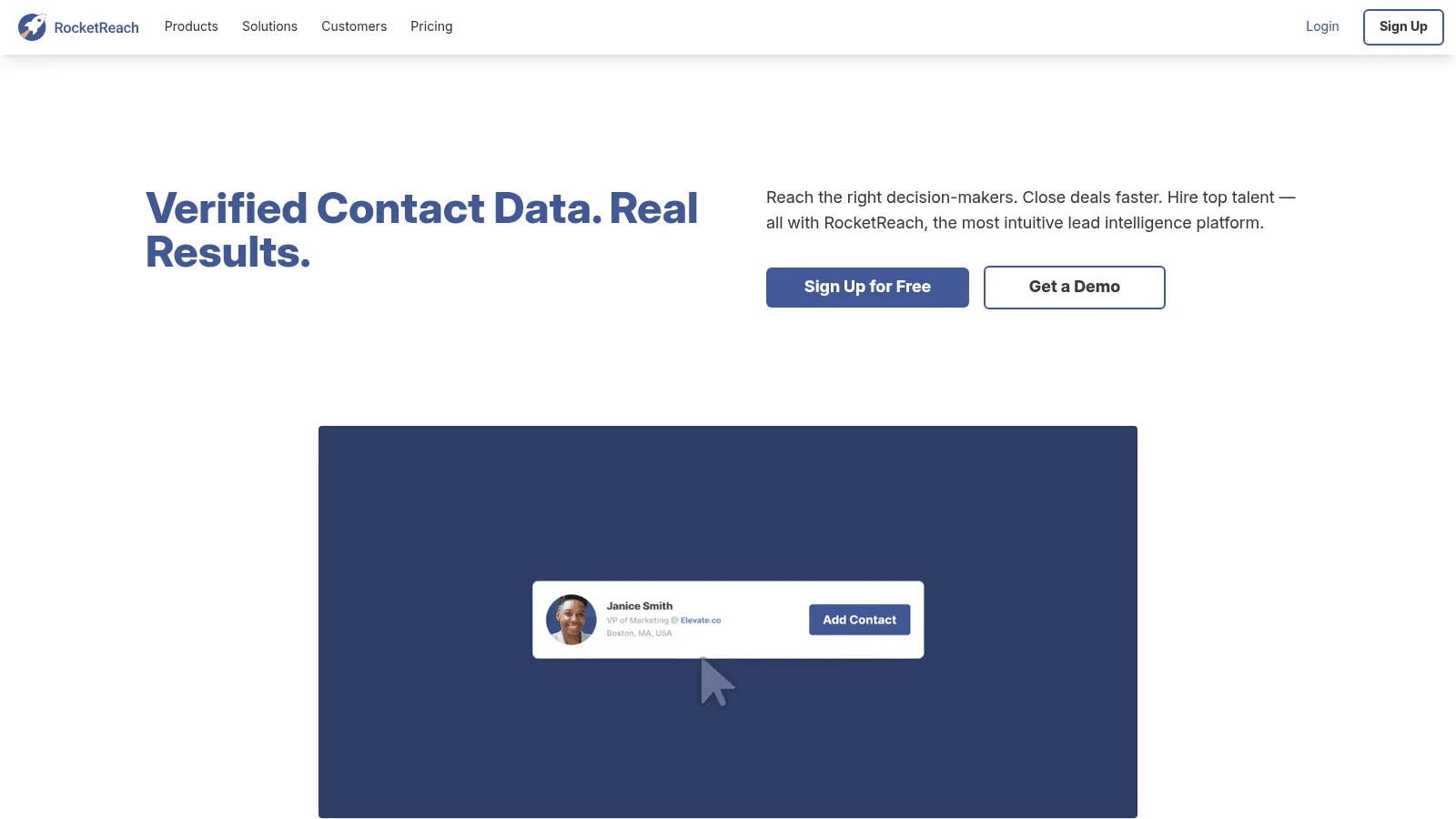
Best for: Paying only for the lookups that worked.
Overview: RocketReach meters whole lookups instead of individual fields, so a success hands over every contact detail it holds on that person for one charge.
Key features:
- A lookup is spent only if an email or phone is found and verified, otherwise it is refunded.
- MCP and API access on every paid tier.
- Monthly plans allow 100, 250 or 1,000 lookups.
Pricing: Annual billing runs $33 a month for Essentials, which is email only, $75 for Pro with phones, and $142 for Ultimate. Month to month those become $69, $119 and $209. Annual plans advertise unlimited lookups while holding exports to a yearly ceiling that rises with the tier. Its pages state deliverability between 90% and 98% on verified emails.
Pros: An explicit refund rule, email and phone in one charge, API on every paid plan
Cons: Pricing is per seat, the annual "unlimited" headline is bounded by an export cap most buyers do not notice, and the cheapest tier excludes phone numbers entirely
Why buyers shortlist it: Paying only for lookups that worked is the simplest cost model here.
Final verdict: Good for individual researchers. Expensive once several people need accounts.
9. UpLead
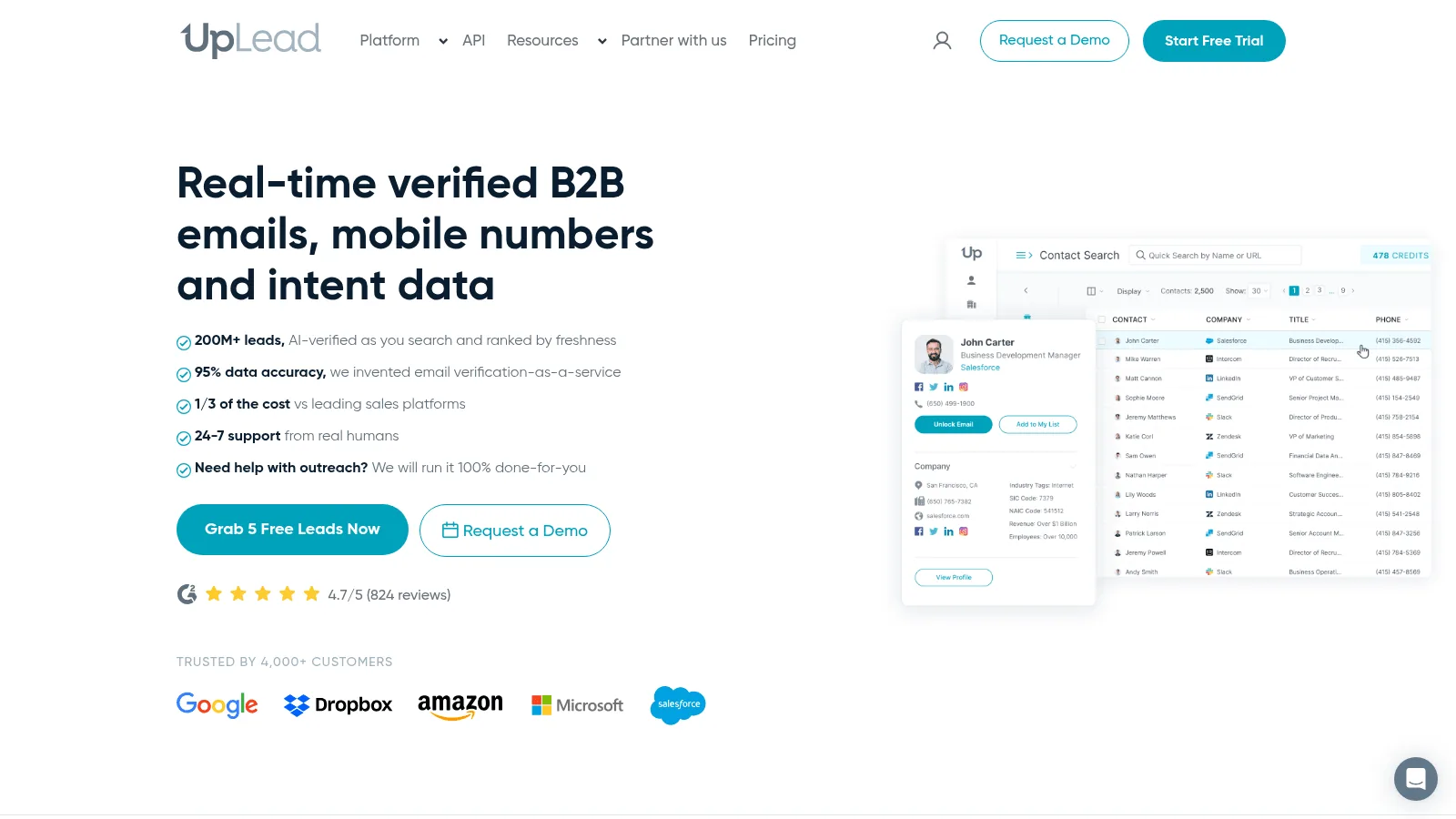
Best for: An accuracy promise with a credit behind it.
Overview: UpLead is a searchable database rather than a pattern-based finder, verifying emails as you export, with a Valid Only mode that withholds invalid addresses rather than billing for them.
Key features:
- One credit buys a contact, with the email and mobile together rather than separately.
- 200M+ records behind the search filters.
- Extra credits at $0.60 or $0.50 each depending on plan.
Pricing: Two tiers are published and both are single-seat: Essentials at $99 month to month, falling to $74 on a year's commitment that grants 2,040 credits, and Plus at $199 or $149. The third, Professional, is quoted, annual, and the only one with the full API. The trial runs seven days and carries five credits. Its published accuracy claim is 95%.
Pros: Email and mobile bundled into one charge, a Valid Only export that skips invalid addresses, a large searchable database
Cons: Essentials and Plus are single-user accounts, full API access sits behind an annual, quote-only tier, and the five-credit trial is too small to measure a hit rate on your own list
Why buyers shortlist it: Bundling the mobile into the same credit makes the per-contact cost easy to forecast.
Final verdict: Sound for a solo seller who wants search. Hard to justify for a team or a build.
10. LeadMagic
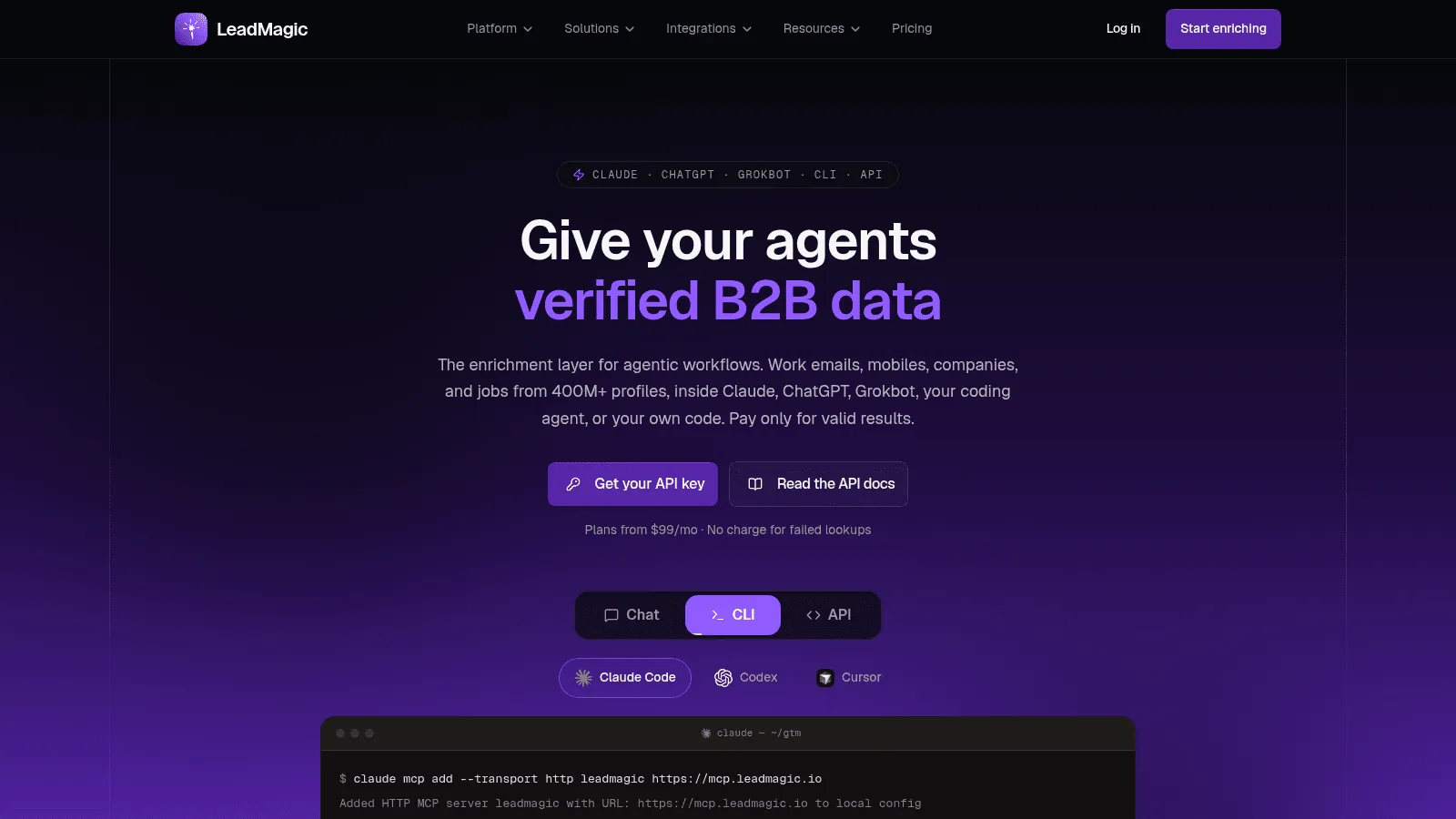
Best for: Success-only billing across every type of call.
Overview: LeadMagic is API-first and applies the same rule everywhere: you are charged when something comes back and not when it does not.
Key features:
- One credit an email, a quarter for a validation, five a mobile, three for a job-change check.
- Every plan opens the REST API, the MCP server, the CLI and CSV upload.
- 400M+ people records and 25M+ companies.
Pricing: Essential is $99 a month, or $83 annually, for 5,000 credits; Growth is $249 or $208 for 20,000; Professional is $499 or $416 for 50,000. Monthly plans bank up to twice the allowance, while annual credits do not roll over at all.
Pros: Consistent success-only billing, every delivery method on every tier, cheap validation calls
Cons: No free plan or free credits of any kind, so the first test costs money, and from the $499 tier upward every workspace user needs a paid seat at $49 a month
Why buyers shortlist it: The billing rule is the same on every endpoint, which makes a workflow easy to cost.
Final verdict: A good fit for developers who want one predictable rule. Less so for anyone who needs to trial before buying.
11. Icypeas
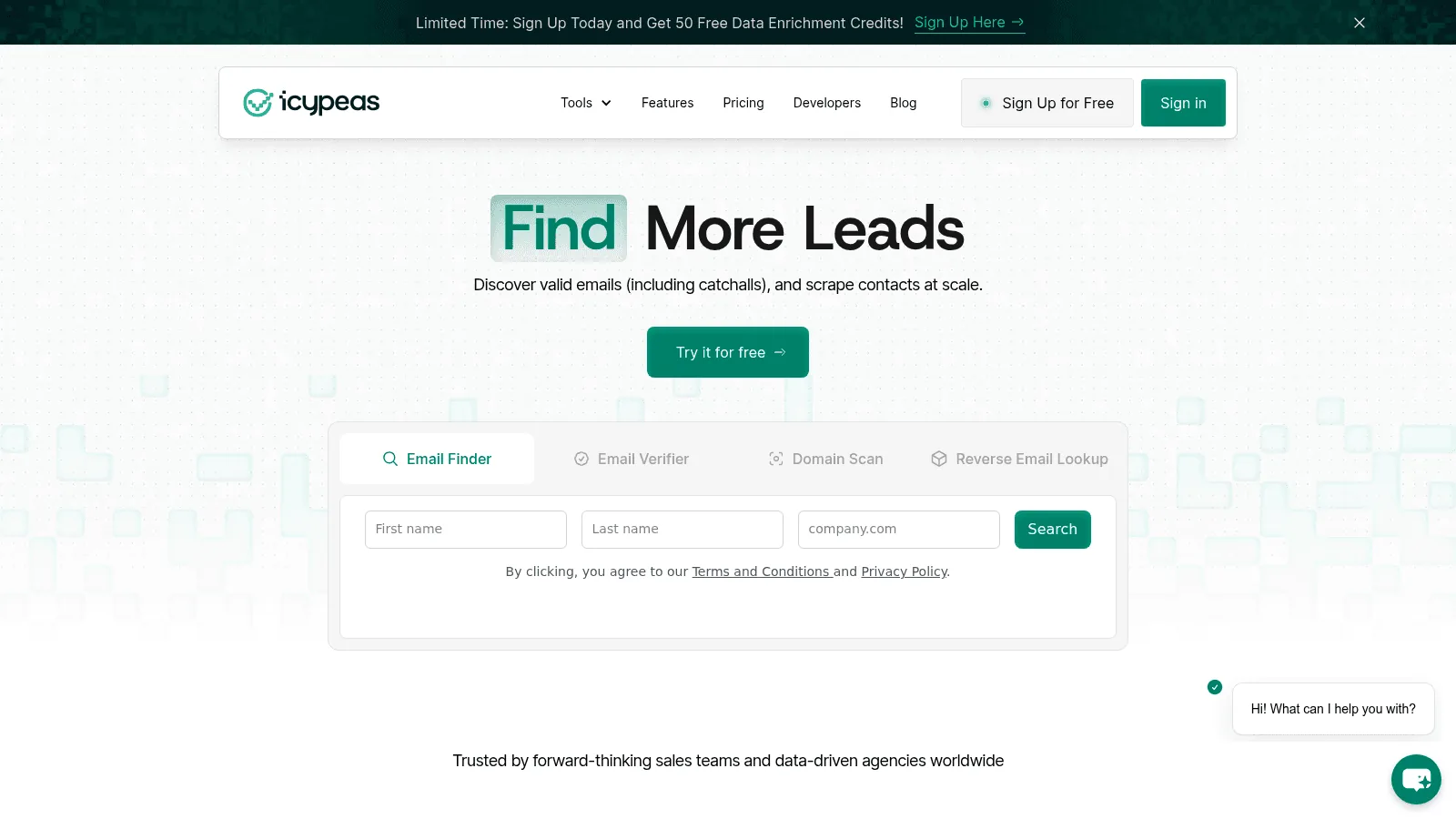
Best for: The lowest published entry price here.
Overview: Icypeas is a French finder and verifier competing on price per credit, with a published benchmark it invites you to check.
Key features:
- One credit per email found, a tenth of a credit to verify one.
- Credits never expire, which is rare in this market.
- API and MCP on every tier.
Pricing: Basic is $19 a month plus VAT for 1,000 credits, Premium $39 for 4,000, Advanced $89 for 10,000 and Hypergrowth $499 for 100,000, with yearly billing saving 20%. Signup carries 50 free credits. Its own benchmark, run on 300 prospects and 536 sent messages, reports a 79% find rate tying with Wiza and Dropcontact, and the lowest bounce rate in the test at 1.33%.
Pros: The cheapest entry on this list, credits that never expire, API on every plan, a benchmark with a stated sample
Cons: The phone finder is still listed as coming soon, so this is email only today, and prices are quoted before VAT, which adds to the headline for European buyers
Why buyers shortlist it: At $19 for 1,000 credits it is cheap enough to run alongside an incumbent rather than instead of it.
Final verdict: Excellent value for email work. Not a complete contact-data source.
Testing an Email Finder on Your Own List
Vendor accuracy claims are measured on the vendor's test set, not yours. The only number that transfers is the one you generate.
Build a test set you can score
Take 200 rows where you already know the answer: current customers, past colleagues, anyone whose address you can confirm independently. A list you cannot grade shows you the match rate and hides the wrong-answer rate, which is the half that costs money.
Run the identical rows through every tool on the same day. Then count three things: how many addresses came back, how many were correct, and how many credits each tool spent getting there.
Price the miss, not the credit
Divide credits consumed by correct records returned. Because almost everyone here bills only on a result, your hit rate costs you coverage rather than money, and it is the wrong-answer rate that inflates the real price: every incorrect record is a credit spent plus the work of undoing it.
That division is also the honest answer to "how many credits will we need", because consumption depends on your hit rate, which depends on your inputs. A full name with a company domain resolves far more reliably than a name alone, and there is no way to know your own number before you run the test. Buy the smallest pack first.
Count the cost of a wrong address
A bad address is not a wasted credit, it is a deliverability problem. Mailbox providers now police this directly: Microsoft requires domains sending more than 5,000 messages a day to Outlook to pass SPF, DKIM and DMARC, and from May 2025 began rejecting non-compliant mail outright with a 550 error rather than filing it in junk. Its hygiene guidance in the same notice is blunt about removing invalid addresses regularly to cut complaints and bounces.
So the real cost of a cheap, inaccurate finder is not the credits. It is the sending reputation you spend working through its mistakes, and reputation is slow to rebuild.
One recruiting founder we spoke with made the same point from the user's side, saying the emails their search tool surfaced "are the ones that kind of bounce back the most". That is why email enrichment stayed a separate line on their budget.
Teams at scale stop treating finding and verifying as two purchases. Building both into one call through a documented API removes the step where a stale verified flag gets trusted a month later.
Choosing Between Them
Pick on the thing that broke, not the headline rate.
If phone numbers were the gap, RocketReach and UpLead fold them into a single charge, while LeadMagic spends 5 credits on a mobile and Apollo.io 8. If deliverability was the gap, Findymail and Anymail Finder both put a refund behind their numbers.
If budget was the gap, Icypeas at $19 and Dropcontact at 24 euros are the cheapest published entries here, and Prospeo's free tier costs nothing to test. If Europe was the gap, Dropcontact is built for it, and if you want one vendor for data and sending, Snov.io and Apollo.io both do the whole job.
And when the lookups happen inside your own software, that is the ground we are built for. Grab a free API key, run 200 of your own rows, and settle your true cost per correct record before anyone commits to a year.
FAQs
What is the best free Hunter.io alternative?
Prospeo gives the largest standing allowance at 100 credits a month, or 1,200 a year. Apollo.io's 900 per seat per year is smaller but renews per seat and includes sequencing; Snov.io's trial carries 50.
Neither of those last two opens the API, so neither lets you test an integration. On our side it is trial credits and no card rather than a free plan, and we would rather name that accurately than inflate the comparison.
Do Hunter.io alternatives charge when no email is found?
Almost none of them do. Snov.io, Findymail, Anymail Finder, Prospeo, Dropcontact, LeadMagic and Icypeas all state that a lookup returning nothing costs nothing, and RocketReach refunds it. UpLead is the exception: its Valid Only export withholds invalid addresses, but its other two export modes bill for them.
Apollo.io is stricter again, charging only once an address verifies. On our side an email or phone lookup that finds nothing is free, though a live profile fetch returning nothing still costs 2 credits, which we would rather say than bury.
Which Hunter.io alternatives include phone numbers?
Apollo.io at 8 credits, LeadMagic at 5, Findymail at 10 for non-EU numbers, Prospeo at 10, RocketReach from its Pro tier, UpLead bundled into the contact credit, and ourselves at 20. Snov.io uses separate tokens with no published rate.
Icypeas still lists its phone finder as coming soon, and Anymail Finder sells email only, as Hunter does. Most vendors here charge a multiple for a mobile, because the number is harder to find and ages faster once found; RocketReach and UpLead are the exceptions, folding it into one charge.
Is a verified email address guaranteed to work?
No, and no reputable vendor claims otherwise. Verification describes the moment of the check: a mailbox can be closed the next day, and a catch-all domain will accept mail for addresses that do not exist. The SMTP standard itself allows a server to report an address as only apparently valid. Treat a verification as evidence rather than a promise, and watch your bounce rate as the real measure.
How do Hunter.io alternatives compare on price per email?
At entry tiers on annual billing, Icypeas is cheapest per email at about $0.016, LeadMagic just behind at $0.017, Prospeo near $0.019, Snov.io about $0.029, Findymail $0.041 and Anymail Finder $0.048. Icypeas is cheapest of all one tier up, at roughly a cent.
For seat-based tools like UpLead and Apollo.io a per-email figure means nothing until you know your headcount. None of that matters until you factor in your hit rate and whether failures get billed. The market for Seamless.AI alternatives spreads the same way, because what a credit buys shifts from one vendor to the next.
The data layer behind your GTM engine
Access fresh people and company data through one API and power every enrichment, prospecting, and automation workflow.
- Profiles
- 800M+
- Refreshes / month
- 200M
- Response time (P95)
- 500ms