Top 18 Data Enrichment APIs for 2024


Quick Summary
Bad B2B data can send leads to the wrong salesperson and provide incorrect information. A data enrichment API helps by checking a name, email, or company domain and providing updated details like job title, company information, and technology used. Three options to consider are Reverse Contact, People Data Labs, and ZoomInfo.
The Top 3 at a Glance
These three cover the main options: a flexible API, a developer-focused data platform, and a leading enterprise solution.
Why Most Data Enrichment APIs Still Leave You Guessing
Outdated or incorrect customer data can make sales teams lose valuable time and miss the right opportunities. Different data APIs solve this in different ways. Some are designed for sales teams using tools like a Chrome extension, while others are built for developers who need reliable data directly inside their products.
This guide compares 12 APIs based on their pricing, how they deliver data, the quality of their data, and which type of team they are best suited for.
Why Listen to Us?
We’re Reverse Contact, a People and Company Data API built for RevOps, sales ops, and product teams that don’t want to sign an annual contract before knowing if the data works for them. More than 300 million enrichment requests are processed every month, with 98.2% uptime and response times under 4 seconds at the 95th percentile.
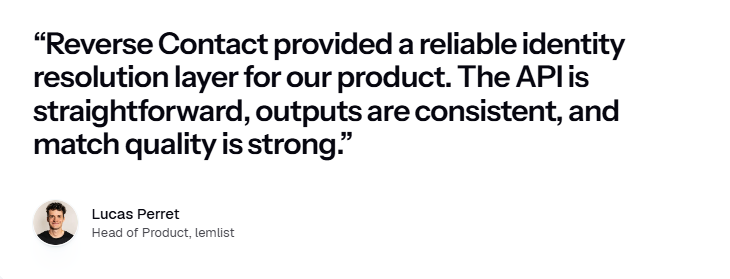
Gitpod’s data team uses us to keep identity data consistent across systems, while lemlist’s Head of Product, Lucas Perret, chose us because the enrichment layer stayed reliable without constant monitoring.
We’re rated 4.6 out of 5 on G2 across 107 reviews.
What Is a Data Enrichment API?
A data enrichment API is a tool you can use with an email, company domain, or name. It provides verified contact details, job title, company size, or tech stack, depending on the provider. It’s the gap between a static list that goes stale on export and a live lookup that’s current every time you call it.
Providers generally use three approaches:
- Database-first: Data is stored and updated regularly (weekly/monthly). Fast, but some data may become outdated.
- Live retrieval: Data is fetched when you make the request. Slower, but usually more up to date.
- Hybrid: Checks the database first and fetches fresh data if the information is missing or outdated.
Choose based on whether you care more about speed or fresh data.
Delivery method matters just as much as the data itself. A real-time API suits product features and CRM enrichment. CSV uploads suit large or historical lists. Webhooks deliver results without holding up your workflow. And MCP lets an AI agent pull enrichment mid-conversation instead of waiting on a batch job. A provider that only offers one of these will eventually box you in.
Most providers still bill by the credit, one credit per matched record, with no charge for an empty result. Coverage, freshness, and delivery method vary a lot between them, and that’s what the twelve entries below break down.
Why This Matters for RevOps and Product Teams
- Routing breaks when job titles become outdated. A rule based on “VP of Sales” may stop working when that person gets promoted or changes roles.
- Personalization can fail without warning. Outdated information may not show an error, but it can result in generic or incorrect messages.
- CRM data becomes outdated over time. People change jobs, companies change domains, and old data quickly loses its value.
- Product teams need data they can easily use in their products. This requires a well-documented API instead of a spreadsheet that needs to be cleaned and updated manually.
- Compliance can limit your options. GDPR and CCPA requirements mean some data providers may not work the same way in every region.
The right data provider helps keep your sales, CRM, and product data accurate, fresh, and reliable.
The 12 Best Data Enrichment APIs
1. Reverse Contact
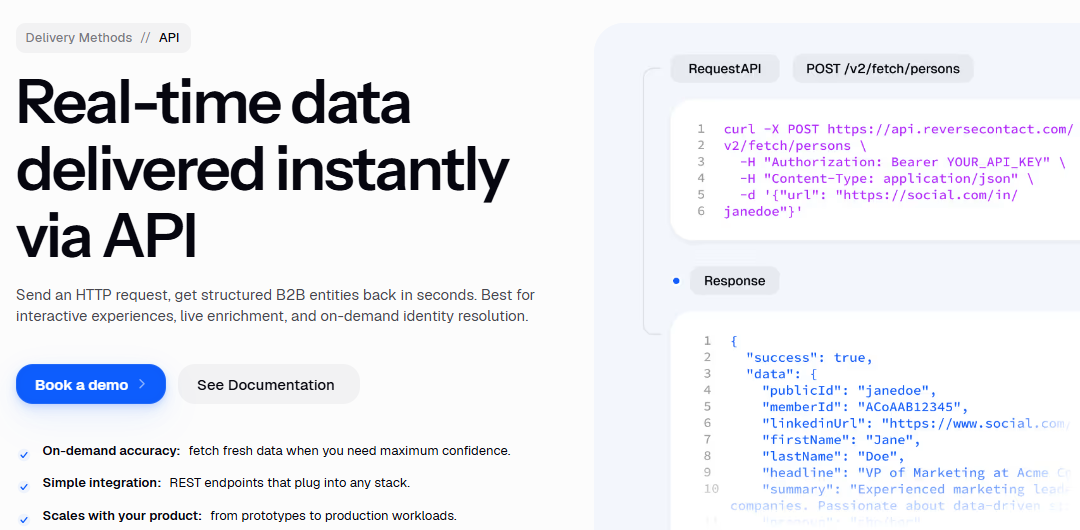
Reverse Contact is a people and company data API built for RevOps, sales ops, and product teams who need to search, match, and enrich records without an annual contract in the way. We run at under 4 seconds response time (95th percentile) with 98.2% uptime.
The clearest differentiator is delivery flexibility. We deliver through API, webhooks, CSV, or an MCP connection built for an AI agent that needs a lookup mid-conversation. Beyond the pay-as-you-go API, we also sell standalone Companies, Employees, and Jobs datasets.
Key Features
- Person Enrichment API: Get a person’s job title, seniority, and verified email using a single identifier.
- Company Enrichment API: Get company details, including firmographics and technographics, using a company domain.
- CSV Enrichment: Enrich existing lists directly without writing any integration code.
- Webhook Delivery: Automatically re-enrich records when the source information changes.
- MCP Support: Allow AI agents to access and query data in real time during a conversation.
- Standalone Datasets: Access Companies, Employees, Jobs, and global datasets in JSON or Parquet formats for easy warehouse loading.
Pricing
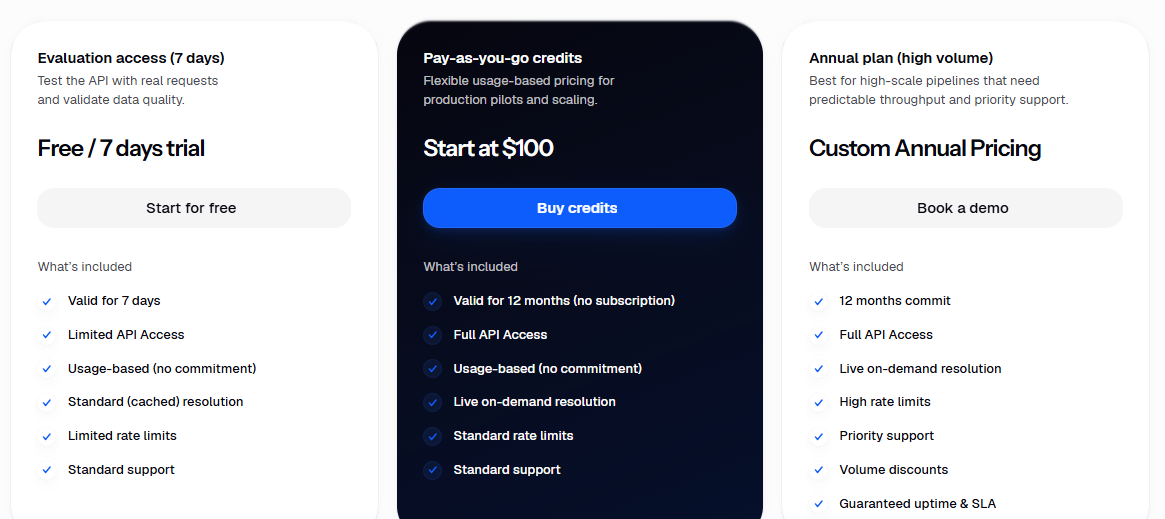
- Evaluation access: free for 7 days, cached resolution, limited rate limits
- Pay-as-you-go: from $100, valid 12 months, no subscription, full API access with live on-demand resolution
- Annual plan: custom pricing for high-volume pipelines, with priority support and a guaranteed uptime SLA
Rating: G2, 4.6/5 (107 reviews)
Pros
- Full API access from a single $100 purchase, no subscription needed
- Delivers through API, webhook, CSV, or MCP, fitting your stack instead of the other way around
- Publishes actual uptime and response time instead of a vague claim
- Null-on-uncertain matching means fewer false positives reach your workflow
- Standalone datasets give you a warehouse-loading option alongside the live API
Cons
- Credits expire after 12 months, so low-volume users need to plan usage rather than buy and forget
2. People Data Labs
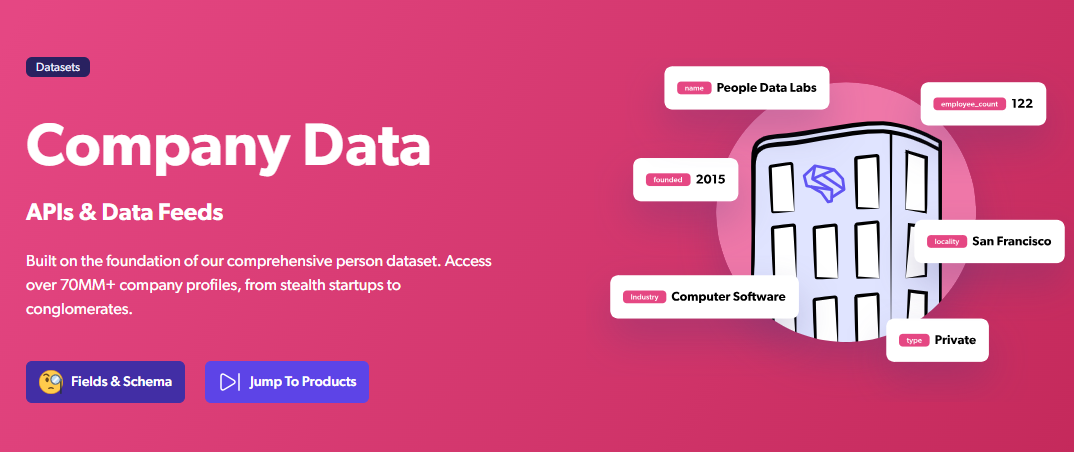
People Data Labs sells raw, developer-facing data through a documented REST API, with code samples in Python, Node.js, Ruby, Go, and cURL. Person and company lookups bill from separate credit pools, and every has a match confidence score, so an engineering team can set its own accuracy threshold instead of trusting a black box. The database covers 1.5 billion-plus person profiles.
Key Features
- Person Enrichment: Find job title and other professional details using an email address or LinkedIn URL.
- Company Enrichment: Get company information and firmographics using a company domain.
- Confidence Scoring: Each matched record includes a confidence score to show how reliable the match is.
- Bulk Enrichment: Upload and process multiple records at once instead of making individual API calls.
Pricing
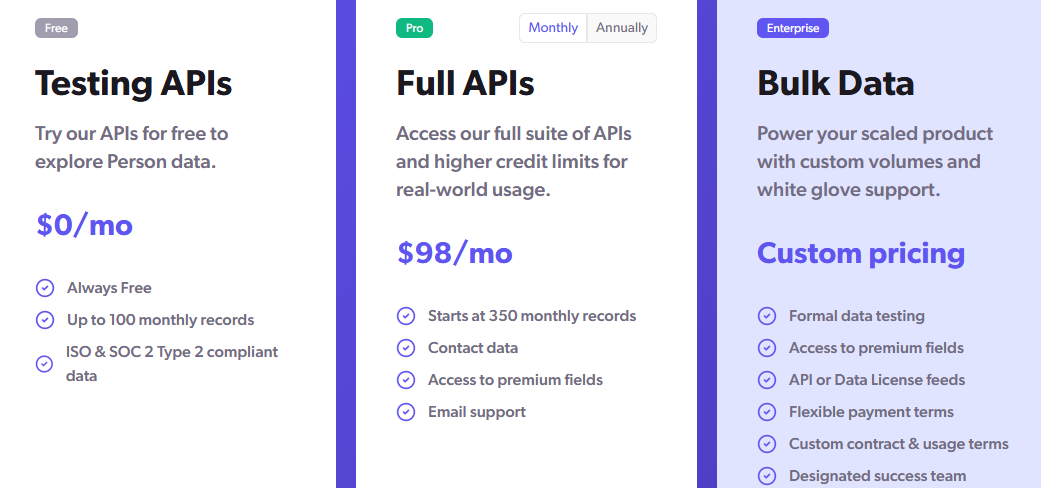
- Free tier included for testing match quality before you pay
- Pro: from $98/month for 350 person credits, billed per successful match only
- Enterprise: custom pricing for volume beyond 100k credits
Rating: G2, 4.3/5
Pros
- Confidence scores on every record, not a single pass or fail match
- Well-documented REST API with code samples across five languages
- Only charges credits on a successful match, so a miss costs nothing
Cons
- Person and company credits bill separately, complicating budgeting
- Per-credit pricing isn’t shown until you’re already inside a plan
- No Chrome extension, sequencer, or CRM UI if you need more than raw API access
3. ZoomInfo
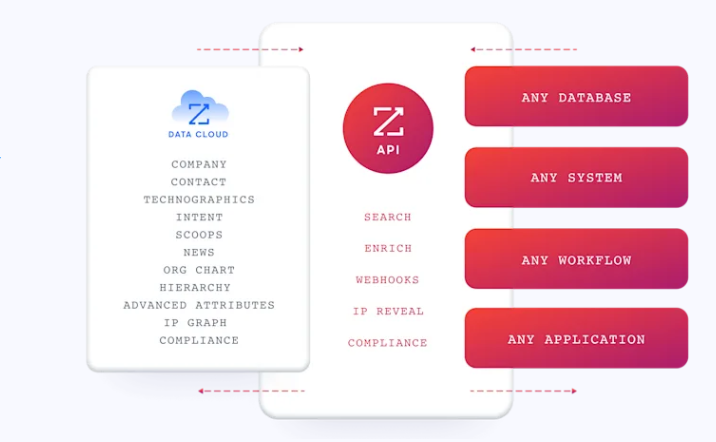
ZoomInfo is the dominant platform, with well over 9,000 G2 reviews backing that scale. It’s built around verified emails and direct-dial phones, layered with intent signals, technographics, and org charts. It doesn’t publish self-serve pricing, so every plan runs through sales as an annual contract instead.
Key Features
- Contact Database: Get verified emails and direct-dial phone numbers at scale.
- Intent Signals: Identify companies that are actively researching relevant topics.
- Technographics: See which tools and technologies your target companies are using.
- CRM Enrichment: Automatically update Salesforce and HubSpot data on a set schedule.
Pricing
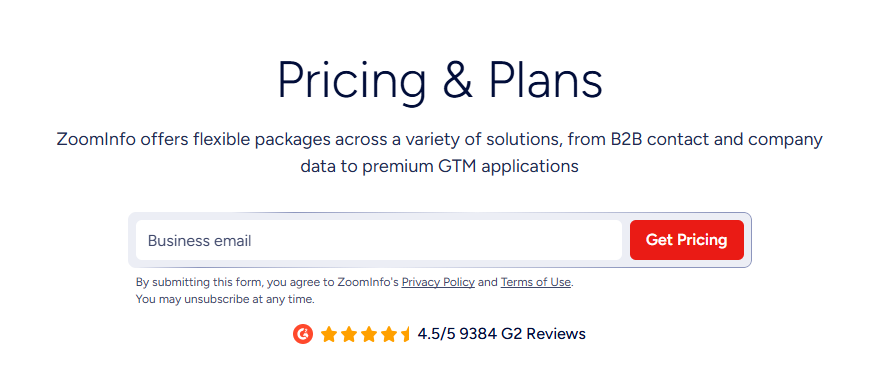
Not published on ZoomInfo’s own pricing page; every plan is quoted through sales as an annual contract
Rating: G2, 4.5/5 (9384 reviews)
Pros
- Has intent data smaller providers don’t have
- Direct-dial phone coverage most smaller providers can’t match
- Technographic, intent, and org-chart data all live in the same interface
Cons
- No public pricing, so you can’t compare costs
- Built around an annual contract, which isn’t a great fit for testing small
- Overwhelming feature surface for teams under 200 people
4. Clearbit (Breeze Intelligence by HubSpot)
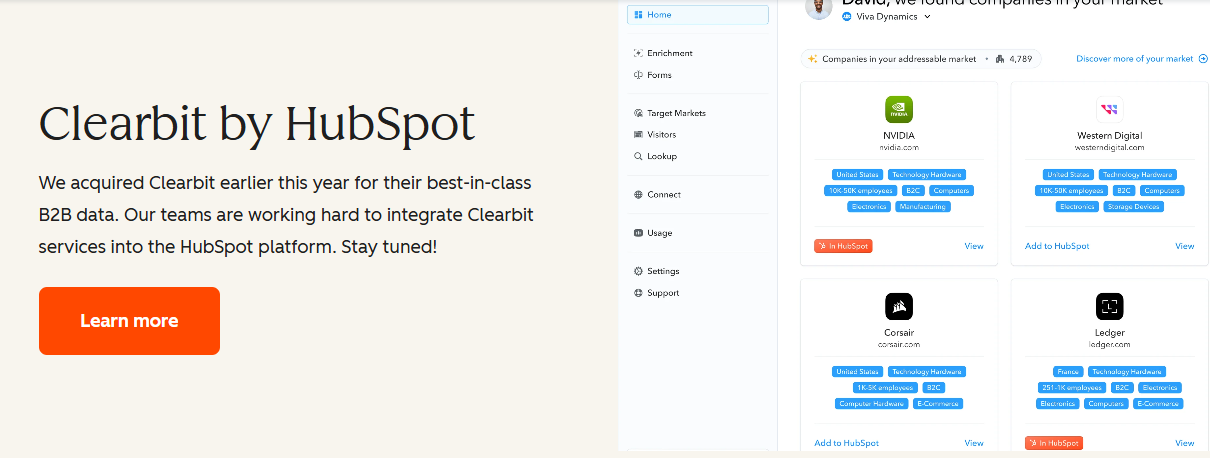
Clearbit was acquired by HubSpot and now ships as Breeze Intelligence, with no standalone plan for new customers. It still offers enrichment, but its value shows up almost entirely for teams already running HubSpot, since scoring and routing wire directly into that CRM.
Buying-intent detection turns anonymous visitors into identified accounts, which isn’t something most tools on this list do.
Key Features
- CRM Auto-Enrichment: Automatically add company and person details to new HubSpot records.
- Buying Intent: Identify companies visiting your website, even when the visitors are anonymous.
- Form Shortening: Ask for just an email address and automatically fill in the remaining details.
- Native HubSpot Routing: Score and route leads directly through HubSpot workflows.
Pricing
- Requires a paid HubSpot subscription; Breeze Intelligence add-on starts around $45–$50/month for 100 credits
- Runs on HubSpot Credits: roughly $10 per 1,000 credits, and one standard enrichment consumes 10 credits
- Included credits scale by HubSpot tier, from 500/month on Starter up to 5,000–10,000/month on Enterprise, depending on Hub
- Standard firmographic enrichment is now bundled free with paid Core Seats, so light use may not need the add-on at all
Rating: G2, 4.4/5
Pros
- Buying-intent detection from anonymous visitors, rare on this list
- Deep native integration for teams already standardized on HubSpot
- Standard enrichment now bundled with paid HubSpot seats at no extra credit spend
Cons
- No standalone API since the HubSpot acquisition
- Two separate credit systems (Breeze Intelligence credits and HubSpot Credits) make it confusing
- Most of the value stays inside HubSpot
5. Coresignal
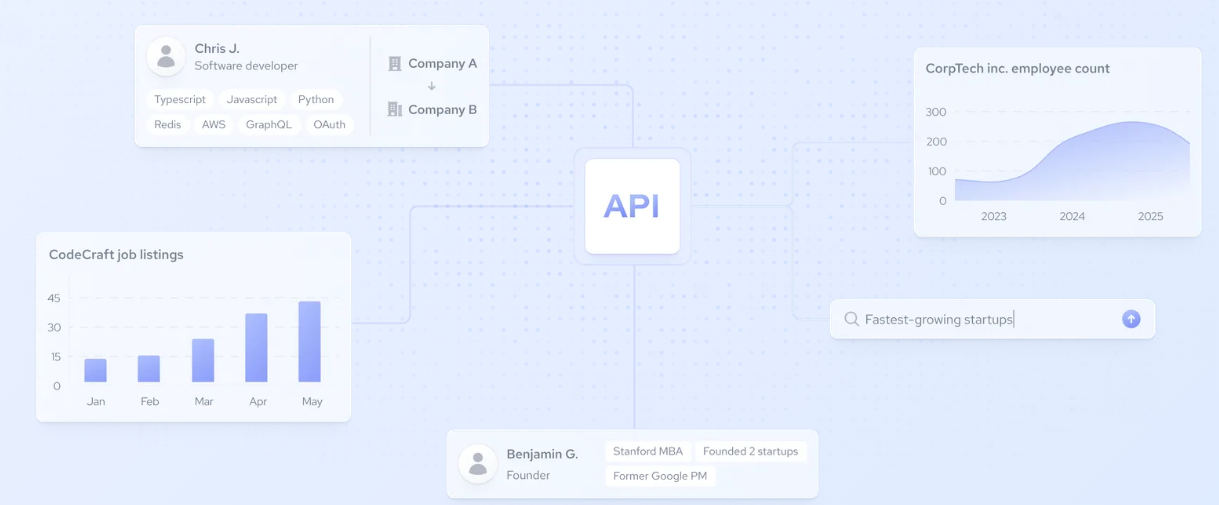
Coresignal leans toward bulk data delivery, with a self-service dashboard covering Company, Employee, and Jobs APIs plus a newer Agentic Search API for natural-language queries. It’s one of the few providers here that publishes its full pricing ladder, from an entry tier up through enterprise-scale credit packs, without a sales call standing in the way.
Key Features
- Multi-source Database APIs: Company, Employee, and Jobs data across dedicated endpoints
- Agentic Search API: Natural-language search available from the Growth tier up
- Elasticsearch DSL access: For teams that want direct query control
- Bulk datasets: Company, employee, and job posting data for warehouse loading, from $1,000/month
Pricing
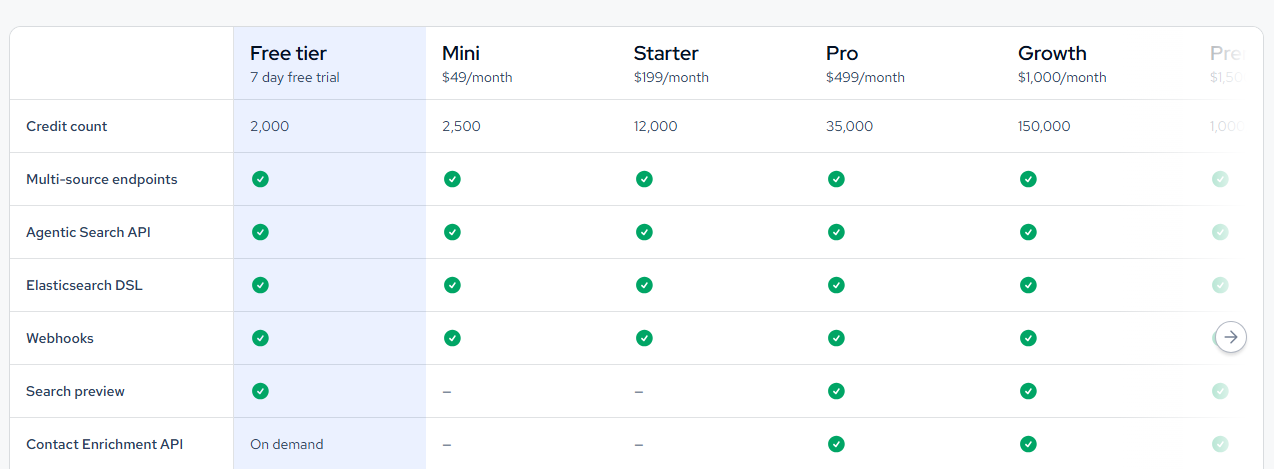
- Free tier: 7-day trial, 2,000 credits
- Mini: $49/month, 2,500 credits
- Scales through Starter, Pro, and Growth up to Elite: $5,000/month, 10,000,000 credits
Rating: not confirmed on G2.
Pros
- Transparent, published pricing at every tier, from $49/month to enterprise contracts
- Agentic Search API brings natural-language querying to the enrichment layer itself
- Both live API access and bulk dataset delivery are available from the same provider
Cons
- Affordable entry tiers lose unused credits every month
- Search-layer features aren’t unlocked until the upper tiers
- Built for bulk delivery more than low-latency single lookups
6. Prospeo
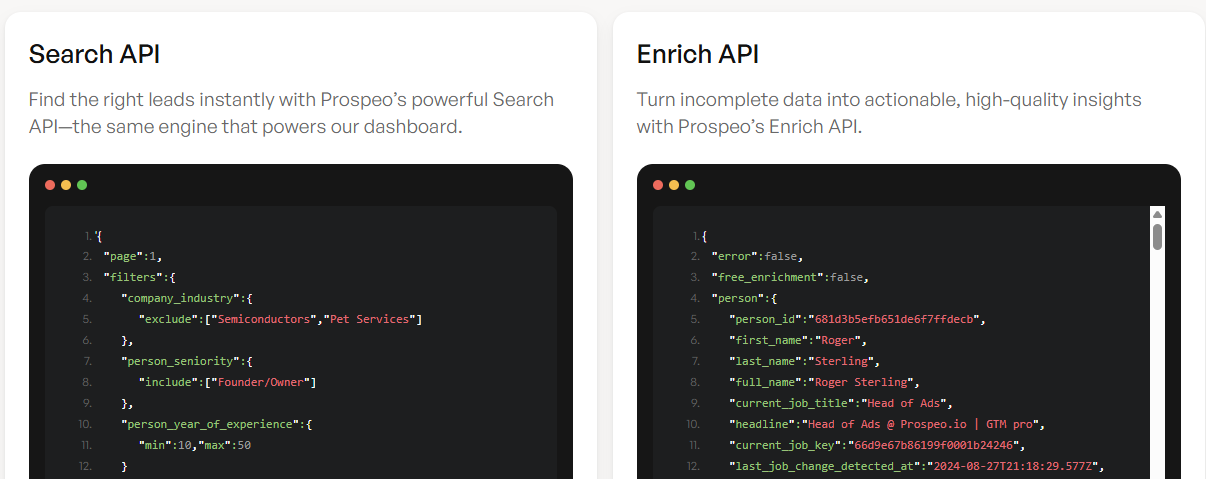
Prospeo has rebuilt its platform with V2 and is now much more than just an email finder. It offers sales intelligence features like intent topics, advanced filters, CSV enrichment, and API access. Higher plans add HubSpot and Salesforce integration, duplicate control, and job-change tracking.
If you looked at Prospeo before 2026, it’s worth taking another look at the updated platform.
Key Features
- Credit-Based Search: All plans include API access, CSV enrichment, and advanced search filters, starting with the Starter plan.
- Intent Topics: Track buying signals with 3 topics on the Free plan, increasing to 12 on the Pro plan.
- CRM Sync: Connect directly with HubSpot and Salesforce from the Growth plan onwards.
- Job Change Tracking: Get alerts when contacts change jobs or roles, available from the Growth plan onwards.
Pricing
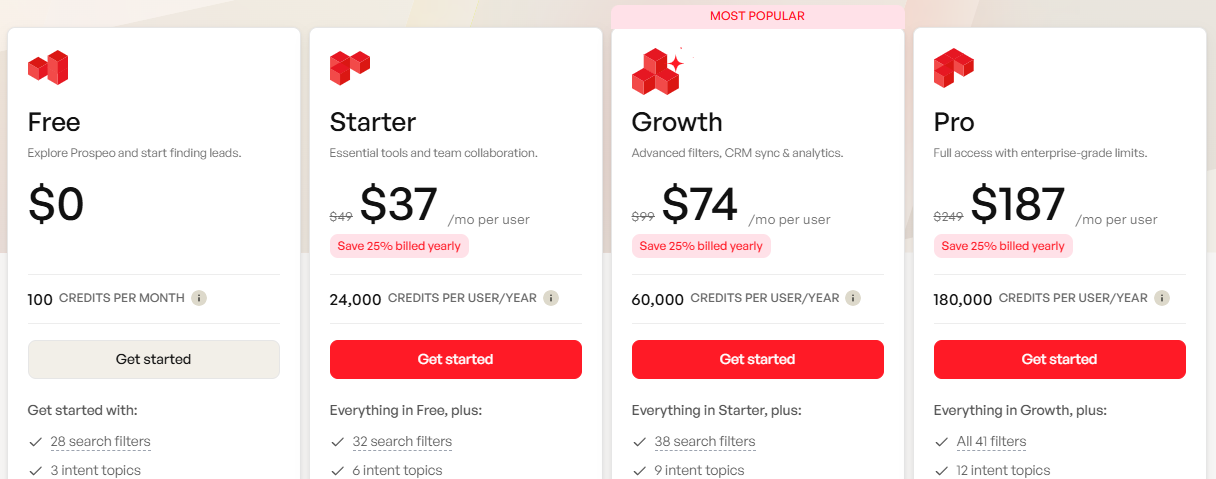
- Free: $0/month
- Starter: $37/month, down from $49/month
- Growth: $74/month, down from $99/month
- Pro: $187/month, down from $249/month
Rating: G2, 4.5/5
Pros
- Every paid plan now includes API access, not just the top tier
- Intent topics and job-change tracking put it closer to a sales-intelligence platform than a narrow finder
- Native HubSpot and Salesforce sync from the Growth plan removes a middleware step
Cons
- Credits are priced per user, so a growing team’s bill scales with headcount
- The V1-to-V2 migration changed plan names and limits
- Published dollar pricing isn’t easily verifiable outside the app
7. ContactOut
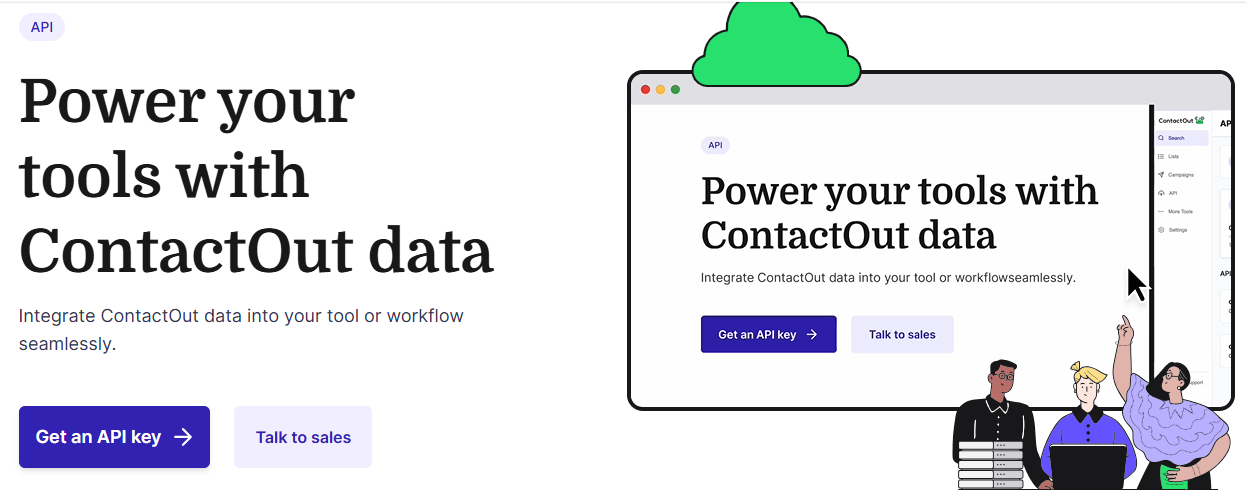
ContactOut started as a Chrome extension for recruiters, since added an API and bulk licensing. Its paid tiers don’t bundle everything together. There’s an email-focused Sales plan, and a Recruiter plan with ATS integrations and a larger profile license.
Key Features
- Chrome Extension: Find contact details directly from LinkedIn profiles.
- API Access: Available with the Recruiter and Team plans.
- ATS Integrations: Connect with popular ATS platforms to support recruiting workflows.
- Bulk Data: Access a database of over 700 million profiles on higher-tier plans.
Pricing
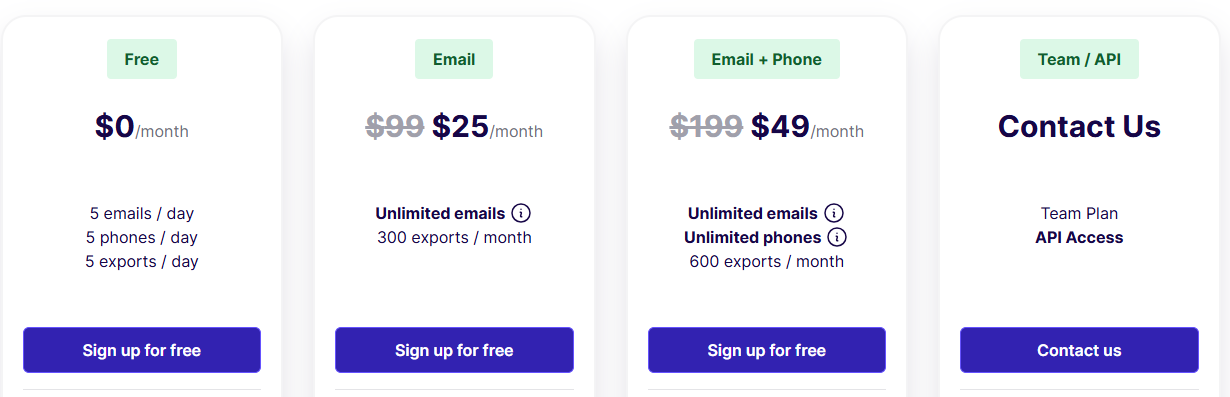
- Free: $0/month
- Email: $25/month, Unlimited emails, 300 exports/month, Chrome Extension & Search Portal.
- Email + Phone: $49/month, Unlimited emails & phone numbers, 600 exports/month, Chrome Extension & Search Portal.
- Team / API: Custom pricing. Includes API access, 20% more data coverage, 700M+ profile bulk license, Salesforce/ATS integrations, and team management.
Rating: G2, 4.5/5
Pros
- Pricing split by exactly which data type you need, rather than one bundled tier
- ATS integrations that make it genuinely recruiting-first
- 700M+ profile license available on higher tiers for bulk sourcing
Cons
- API access isn’t available until the higher Recruiter and Team tiers
- Built on LinkedIn-sourced profiles, so coverage is thinner for smaller companies
- Pricing beyond the two main tiers is hard to verify
8. Lusha
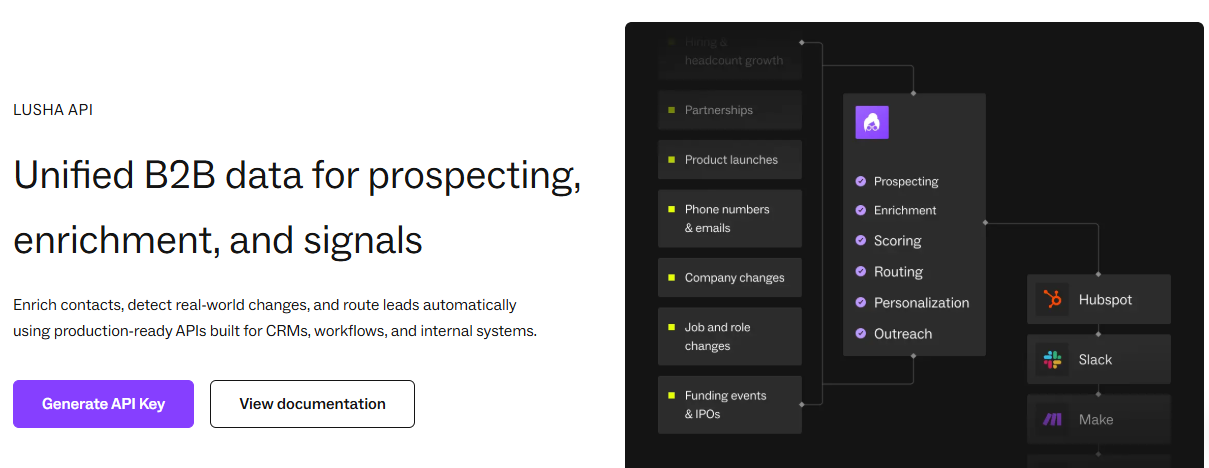
Lusha is a B2B sales intelligence platform that helps sales teams find contact and company information quickly. It is especially useful for prospecting through LinkedIn and company websites, with tools for contact discovery, CRM integration, and AI-powered workflows.
Key Features
- Chrome Extension: Find contact details directly from LinkedIn or company pages.
- CRM Integrations: Connect Lusha with Salesforce, HubSpot, and other CRM platforms.
- Credit-Based Reveals: Email lookups generally use 1 credit, while phone lookups use 5–10 credits depending on the plan.
- MCP & AI Integration: Connect AI assistants to Lusha data through MCP.
Pricing
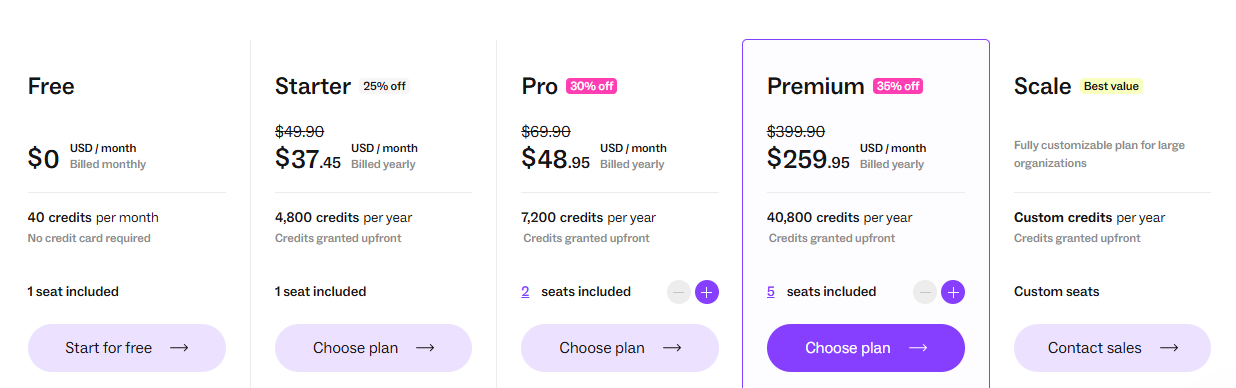
- Free: $0/month, 40 credits/month.
- Starter: $37.45/month, 400 credits/month, prospecting, email & phone data, browser extension
- Pro: $48.95/month, 600 credits/month, advanced prospecting, CRM integrations, bulk export & team features
- Premium: $259.95/month, higher credit allowance, advanced filters, enrichment, team management & analytics
- Scale: Custom pricing, unlimited/custom credits, API access, etc.
Rating: G2, 4.3/5
Pros
- Easy to research before buying due to large clientbase
- Deep CRM integrations that fit an existing workflow fast
- A genuinely usable free tier for light prospecting
Cons
- Priced per seat, so a growing team’s bill climbs with headcount
- Phone credits cost several times more than email credits
- API access isn’t part of the entry-level plan
9. Crunchbase
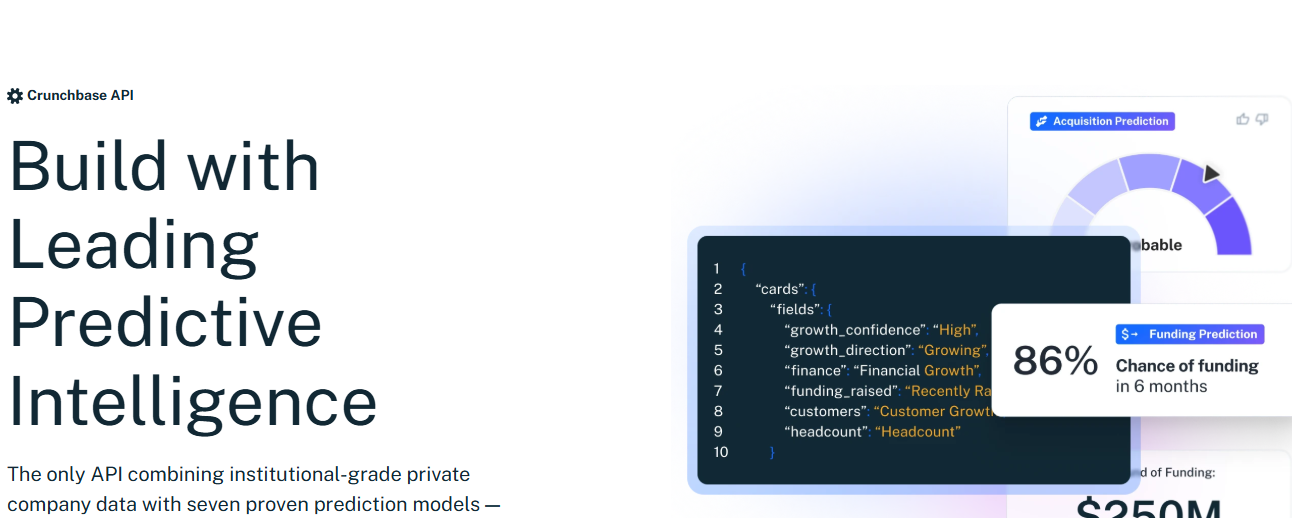
Crunchbase is built around company and funding intelligence rather than person-level contact data, and its product line now explicitly includes a Data Enrichment offering alongside Crunchbase Pro, Business, and API access.
It’s a strong fit for enriching accounts on investment stage, though it won’t give you a job title or an email.
Key Features
- Funding Data: Get details on investment rounds, investors, and acquisitions.
- Crunchbase API: Use Crunchbase data directly in your own product or CRM.
- Data Enrichment: Add company details, including firmographics and funding information, to existing records.
- Real-Time Alerts: Get notified when tracked companies raise funding or have other major updates.
Pricing
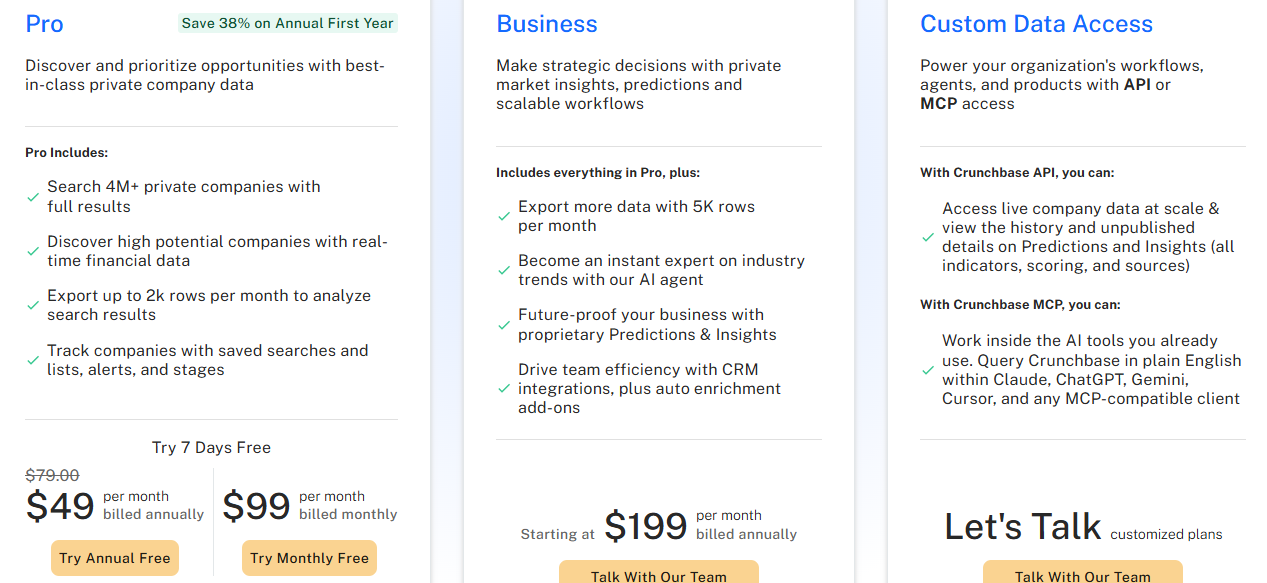
- Free tier available for basic firmographic lookup
- Pro: $99/month billed monthly, or roughly $49/month billed annually
- Business: $199/ month billed annually
- Custom: Talk to sales
Rating: G2, 4.4/5
Pros
- The strongest funding and investor data on this list
- A usable free tier for light research, not a hard paywall
- Now sells Data Enrichment as its own product line, not just a research dashboard
Cons
- No contact-level data; needs pairing with another tool for emails or phones
- API and Business access are priced separately from the Pro subscription
- Coverage outside North America is thinner than the US dataset
10. FullContact
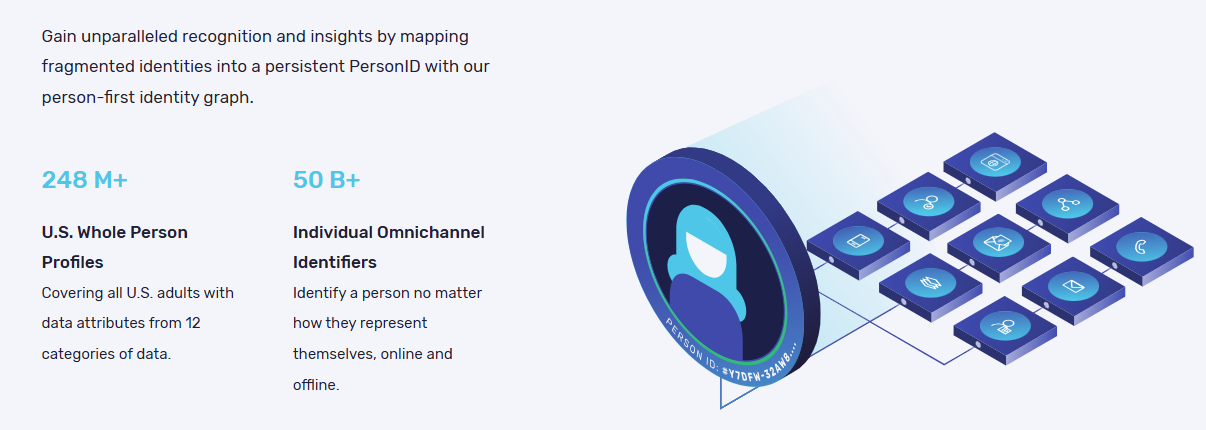
FullContact focuses on identity resolution, matching fragmented records, an email here, a device ID there, into one unified profile. It’s a stronger fit for a CDP than a rep who just needs to enrich a lead list, and it isn’t trying to be a general-purpose enrichment API.
Key Features
- Enrich API: Add contact and company details to existing records.
- Resolve: Combine customer and prospect data from different systems into one PersonID.
- Acumen: Identify high-intent website visitors without relying on third-party cookies.
- Identity Stream: Build and manage your own first-party identity graph.
Pricing
Not published on the pricing page.
Rating: G2, 4.3/5
Pros
- Built for unifying fragmented identity data, a genuinely different job than list enrichment
- Cookieless visitor identification as third-party cookies keep shrinking
- Only charges on successful matches, in principle keeping cost tied to results
Cons
- No published self-serve pricing anywhere, so budgeting needs a sales call
- Overkill if you just need to enrich a contact list rather than unify identity graphs
- Match rates in the 45–50% range come up often enough in reviews to plan around
11. Datanyze
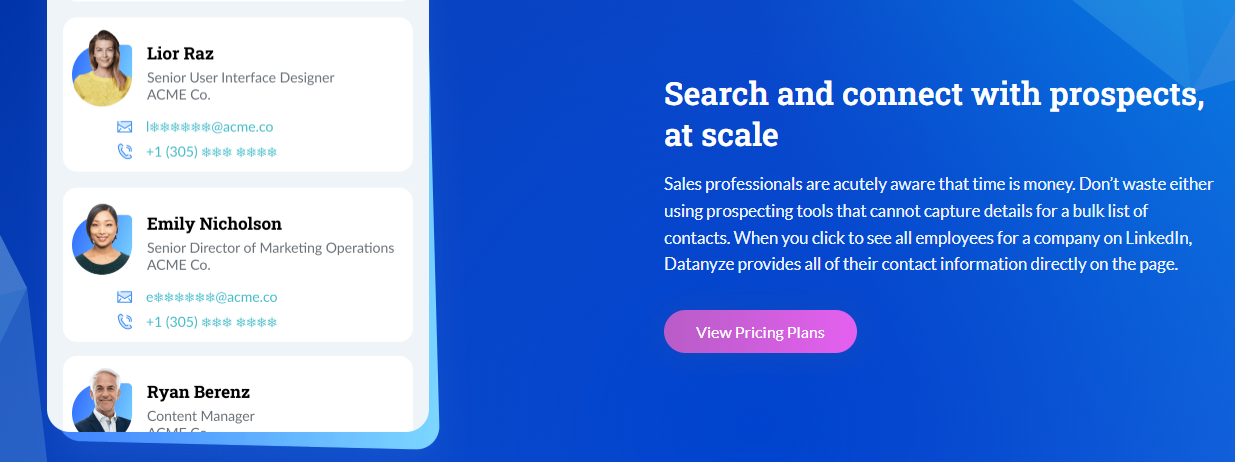
Datanyze is a lighter tool built around a Chrome extension and technographic data. It’s not an API-first product, and unlike several others on this list, it publishes its self-serve pricing in full, no sales call required to see a number.
Key Features
- Chrome extension: Reveal contact info from a company site or LinkedIn.
- Technographic data: See what tools a target company runs.
- Directories: Browse pre-built lists by industry or technology.
- Annual rollover: Nyze Pro annual plans include a full year of credits upfront.
Pricing
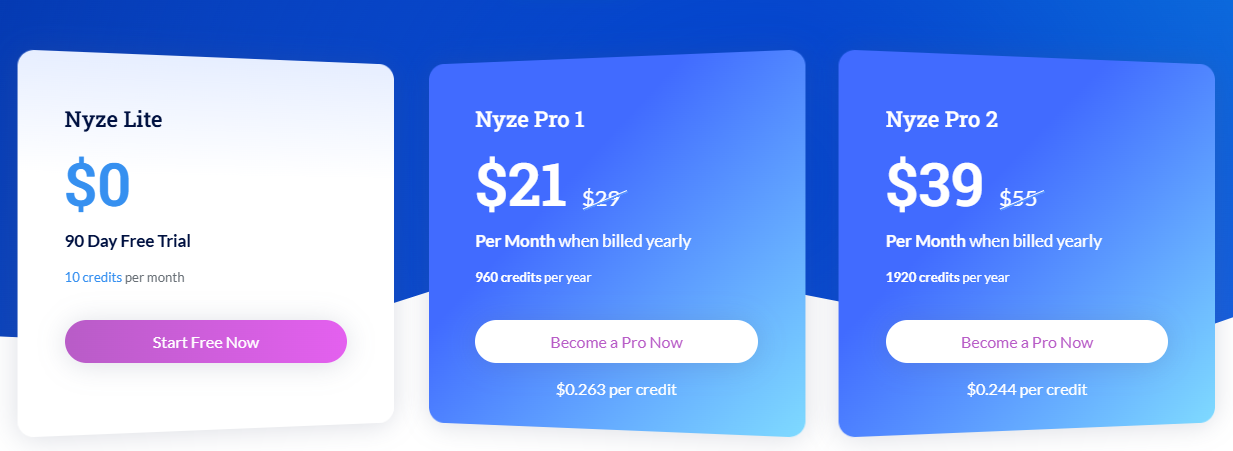
- Nyze Lite: $0/month, 90-day free trial, 10 credits/month
- Nyze Pro 1: $21/month, 960 credits/year, 1 credit = 1 contact reveal, Chrome Extension & Directory access
- Nyze Pro 2: $39/month, 1,920 credits/year, higher contact reveal capacity, Chrome Extension & Directory access
Rating: G2, 4.1/5.
Pros
- A genuinely long 90-day free trial, longer than most here
- Published, self-serve pricing at every tier, no sales gate
- Technographic data included, useful for qualifying on tech stack
Cons
- Low G2 rating
- Built around a browser extension, so it isn’t an API-first product
- Credit volumes are modest even on Pro 2, so heavy users will burn through fast
12. Pipl
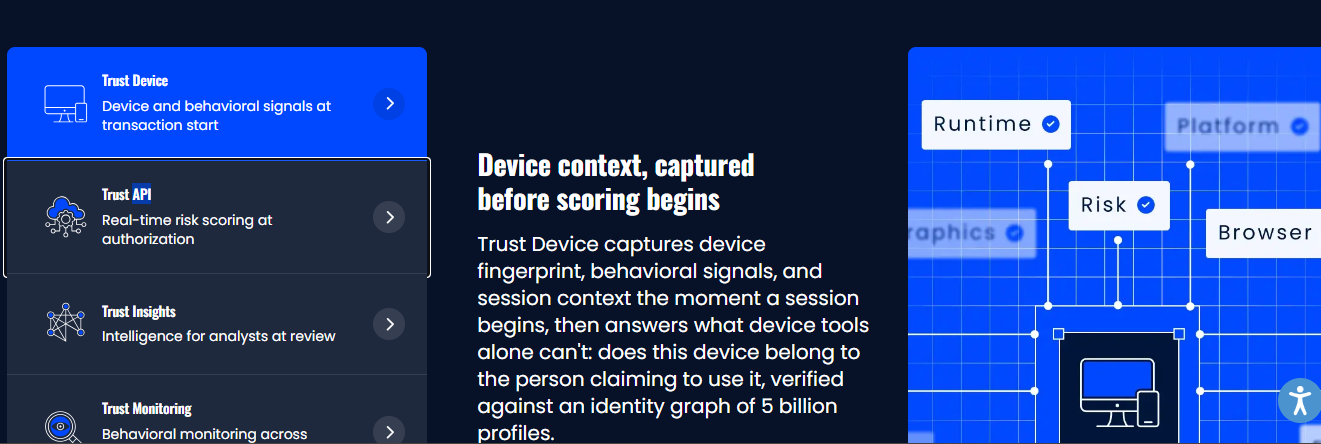
Pipl isn’t built for sales enrichment. It’s built for fraud prevention and identity verification. It belongs on this list because it confirms a person is who they claim to be before you approve a transaction, not because it competes for the same use case as the rest.
Key Features
- Identity verification API: Matches an email, phone, or name against an identity graph.
- Risk scoring: Flags high-risk identities for payment or signup flows.
- Real-time access: Built for inline calls during a live transaction.
- Bundled suites: Capabilities grouped into pricing suites, not line items.
Pricing
Not published; enterprise-only, quoted per use case
Rating: G2, 4.4/5
Pros
- Purpose-built for fraud and identity risk
- Real-time scoring built to run inline during a transaction
- Identity graph depth that general-purpose enrichment APIs don’t attempt
Cons
- No public pricing
- The wrong tool if what you need is sales contact enrichment
- Enterprise-only positioning rules out testing at small scale
Selection Criteria: How We Evaluated
We compared each provider based on four key areas:
- Pricing: Is the price clearly published, or do you need to contact sales?
- Delivery options: Does it support APIs, CSV, webhooks, MCP, or other methods?
- Data quality: What match rates and coverage does the provider claim, and how specific are those claims?
- Best fit: What is the tool actually designed for, and does it fit the use case?
The goal was to compare each provider based on what it actually does best, rather than simply ranking it by popularity.
How to Choose
The right provider depends on what you need it for. Here’s a quick way to narrow it down:
- Want to test before committing? Reverse Contact and People Data Labs offer pay-as-you-go options without requiring a sales call.
- Already using HubSpot? Clearbit is a good fit because it connects directly with HubSpot.
- Need large-scale enterprise data? ZoomInfo is better suited for companies that need broad US coverage and can commit to an annual contract.
- Building AI agents or AI products? Reverse Contact and Coresignal offer options designed for AI-based lookups.
- Need bulk data for a database or warehouse? Coresignal and Reverse Contact offer dataset options for larger data needs.
- Want clear, upfront pricing? Datanyze and Coresignal publish their pricing without requiring a sales conversation.
Start with your specific use case, then choose the provider that fits it best.
FAQs
What’s the difference between a data enrichment API and a data enrichment tool?
An API integrates directly into a product or CRM for live lookups. A tool is usually a Chrome extension a rep uses manually. Reverse Contact offers both, so you don’t have to pick just one.
How much does a data enrichment API typically cost?
It varies by provider. Pay-as-you-go APIs like Reverse Contact and People Data Labs start around $100 and $98. Suites like ZoomInfo won’t give you a published price at all, only a custom quote.
Do data enrichment APIs charge for failed lookups?
Most don’t. The common model only charges a credit on a matched record, so an empty query doesn’t cost you anything on most of these platforms.
Is a bigger database always better?
A provider with a smaller database and a strong match rate on your specific ICP can outperform a much larger one that wasn’t built around your record types. It’s the match rate on your actual records that counts, not the raw size of the database.
Can a data enrichment API help with GDPR or CCPA compliance?
Enrichment alone doesn’t make you compliant, but the provider matters. Look for one that publishes GDPR alignment, CCPA alignment, and a documented data processing agreement.
Choosing the Right Data Enrichment API
The best provider depends on your use case, budget, and how you plan to use the data. For teams that want to test without a long-term commitment, build enrichment into a product or AI workflow, or simply need fresh people and company data, Reverse Contact is a strong option. It offers pay-as-you-go pricing starting at $100, with API, webhook, CSV, and MCP support.
Try Reverse Contact’s pay-as-you-go plan and test the data with your own use case. Without signing an annual contract.


The data layer behind your GTM engine
Access fresh people and company data through one API and power every enrichment, prospecting, and automation workflow.


