
10 Best AI Prospecting Tools in 2026 for B2B Teams
Julien K.Published
Key takeaways:
- AI prospecting tools split into three layers: the data an agent reads (Reverse Contact), the research and workflow tools that turn it into lists (Clay, Apollo.io, Unify, Common Room, Amplemarket), and the autonomous AI SDRs that write and send (Reply.io's Jason, AiSDR, Artisan, 11x).
- Three of the 10 publish a free plan (Clay, Apollo.io and Unify), and two publish no price at all (Artisan and 11x). Paid plans start at $20 per seat (Unify), and Common Room's entry tier tops the published prices at $2,500 a month.
- An agent is only as good as the person record it starts from. Test every tool on accounts you already know, and count wrong people separately from blanks.
- Read the billing basis before comparing: Apollo.io, AiSDR, Clay and Reply.io quote a lower price for yearly billing, while Amplemarket and Common Room publish annual terms only.
Most AI prospecting tools promise the same thing: describe your buyer, and software finds the people, researches them and writes the first email. What they rarely say is how current the person data is and how the agent handles an ambiguous match.
This guide compares 10 AI prospecting tools for B2B teams by the job each one does, what it costs on both billing toggles where a vendor shows two, and where it falls short. We checked every price and feature on vendor sites between October 7 and 9, 2026. We didn't run any of the 10 on a live list, so treat every figure, ours included, as the vendor's own claim.
Before the list, a disclosure: Reverse Contact is ours, and it's ranked #1. It's the data layer under these tools rather than an AI SDR, and its weak spots go in the same Cons field as every other entry's.
What Are AI Prospecting Tools?
AI prospecting tools use large language models (the technology behind ChatGPT and Claude) to do the early part of sales development: picking accounts, finding the right people, researching them and drafting outreach. Some only help a rep do those steps faster. Others run the whole loop on their own.
Underneath, every one of them needs the same raw material: an accurate record of who a person is, where they work now and how to reach them. That's why AI tools sit inside the wider lead generation stack rather than replacing it. The AI decides and writes; something else has to supply the facts.
The tools in this list fall into three layers:
- The data layer returns person and company records to whatever asks, whether that's your code, an agent or another tool.
- The research and workflow layer, where most AI prospect research tools sit, turns that data into lists, scores and drafts, with a human approving the output.
- The autonomous AI SDR layer runs outbound end to end: it picks prospects, writes, sends, answers replies and books meetings.
Most teams use one tool from the second or third layer, with data built in or bought separately.
Agentic Search, MCP and AI SDRs in Plain Words
Agentic search lets you describe who you want in a sentence, such as "IT directors at mid-sized hospitals in Germany", and the tool turns that into search filters and returns matching people. Our agentic search API works this way, and Apollo.io, Unify and Reply.io offer their own versions inside their apps.
MCP (Model Context Protocol) lets an AI assistant like ChatGPT or Claude reach out to another tool while it works. If a data provider runs an MCP server, you can ask your assistant to look someone up and it fetches the record itself instead of guessing from memory.
An AI SDR is a software agent that does a sales development rep's job. It chooses who to contact, writes each message, sends it, handles replies and books the meeting.
Why the Data Underneath Decides the Output
An AI agent can write a fluent email about the wrong person. If the record says someone is still VP of Sales at a company they left eight months ago, the agent will congratulate them on a quarter they never worked, in perfect English.
Agents also still fail often on ordinary tasks. Stanford's 2026 AI Index reports that AI agents jumped from 12% to about 66% task success on OSWorld, a benchmark of real computer tasks, and notes they "still fail roughly 1 in 3 attempts on structured benchmarks." With agents still failing about a third of the time on their own, there's no room for a second failure caused by a stale record.
Buyers building on agents put it more bluntly: tools are only as good as the data and context that feed them. Builders also find that generative AI web search can give a reasonable-sounding answer to "who runs this company", but that answer is hard to verify.
A structured record with a last-updated date is easier to trust than a paragraph an agent wrote from search results, which makes it the first thing to look for in any AI prospecting tool B2B buyers shortlist.
Experimenting is running far ahead of scaling. In McKinsey's State of AI survey of 1,993 participants, 23% said their organizations are scaling an agentic AI system somewhere, and another 39% said they had begun experimenting with AI agents. Yet in any single business function, no more than 10% said their organizations were scaling agents.
Practitioners see the gap too. One commenter on Reddit wrote that most AI SDR setups "still run on weak or generic signals so you just get faster bad outreach," and that if the data and routing layer is off, "automation just scales noise instead of pipeline." That's one person's experience, but it matches what we hear from teams evaluating data enrichment tools for their agents.
How We Chose These AI Prospecting Tools
AI features now appear in most lead generation tools, so we kept only tools where AI does the research, targeting or outreach itself, and that publish enough on their own site to compare.
For each one we recorded the layer it sits in, the lowest published price with its billing basis, whether there's a free plan or trial, and one real limit taken from its own pages. Those are the four facts we'd want before picking an AI prospecting tool. B2B demos rarely cover all four.
We dropped Persana AI, which appeared in early research. Its homepage announces that it's joining Rox, and its own blog says the Persana platform is being sunset for current customers, so it's no longer something you can buy. Common Room took its place as the closest signal-led alternative.
The 10 Best AI Prospecting Tools Compared
Here are all 10 at a glance: the layer each one covers, its best use, its main limit, the cheapest plan it prints and whether you can start free. Each price carries the billing basis the vendor gives.
| Tool | Layer | Best for | Main limitation | Pricing (from) | Free plan or trial |
|---|---|---|---|---|---|
| Reverse Contact | Data | Person and company data inside agents and products | Someone must connect the API or MCP; email-based enrichment unlimited only on Max | $100 credit packs; plans from $249/month | Free trial credits, no card |
| Clay | Research and workflow | Custom research columns with Claygent | HTTP API needs Growth | $167/month billed annually ($185 monthly) | Free plan |
| Apollo.io | Research and workflow | Data, AI and sending in one cheap login | Credits expire each billing cycle | $49/seat/month billed annually ($65 monthly) | Free plan |
| Unify | Research and workflow | Reps running their own AI outbound | Open API and webhooks only on Business | $20/seat/month billed monthly | Free plan, up to 3 seats |
| Common Room | Research and workflow | Signal-led selling with agents on top | One priced tier, annual only | $2,500/month billed annually | None published |
| Amplemarket | Research and workflow | Mid-size teams consolidating outbound tools | Annual term from the first plan | $600/month on an annual term (2 users) | Free trial on all plans |
| Reply.io (Jason AI SDR) | Autonomous AI SDR | AI SDR inside a full sequencing platform | Priced by contacts, so volume raises the bill | $500/month billed annually ($800 monthly) | 14-day platform trial (Jason not specified) |
| AiSDR | Autonomous AI SDR | Founders testing an AI SDR month to month | 200 researched contacts on Solo | $200/month billed yearly ($250 monthly) | Free setup, no card; pay to launch |
| Artisan | Autonomous AI SDR | Teams wanting a managed AI BDR rollout | No published price | Quote only | None published |
| 11x | Autonomous AI SDR | Larger teams automating outbound and calls | No published price, demo first | Quote only | None published |
Reverse Contact leads because it's ours. The other nine are grouped by layer, research tools first and AI SDRs last. Within each group, tools you can start on a free plan or a month-to-month price come before annual-contract or quote-only ones.
The AI Prospecting Tools, Reviewed
Every entry follows the same pattern, so you can compare them quickly: the job, the price, the catch and the buyer it fits.
1. Reverse Contact
Best for: The data layer under AI prospecting
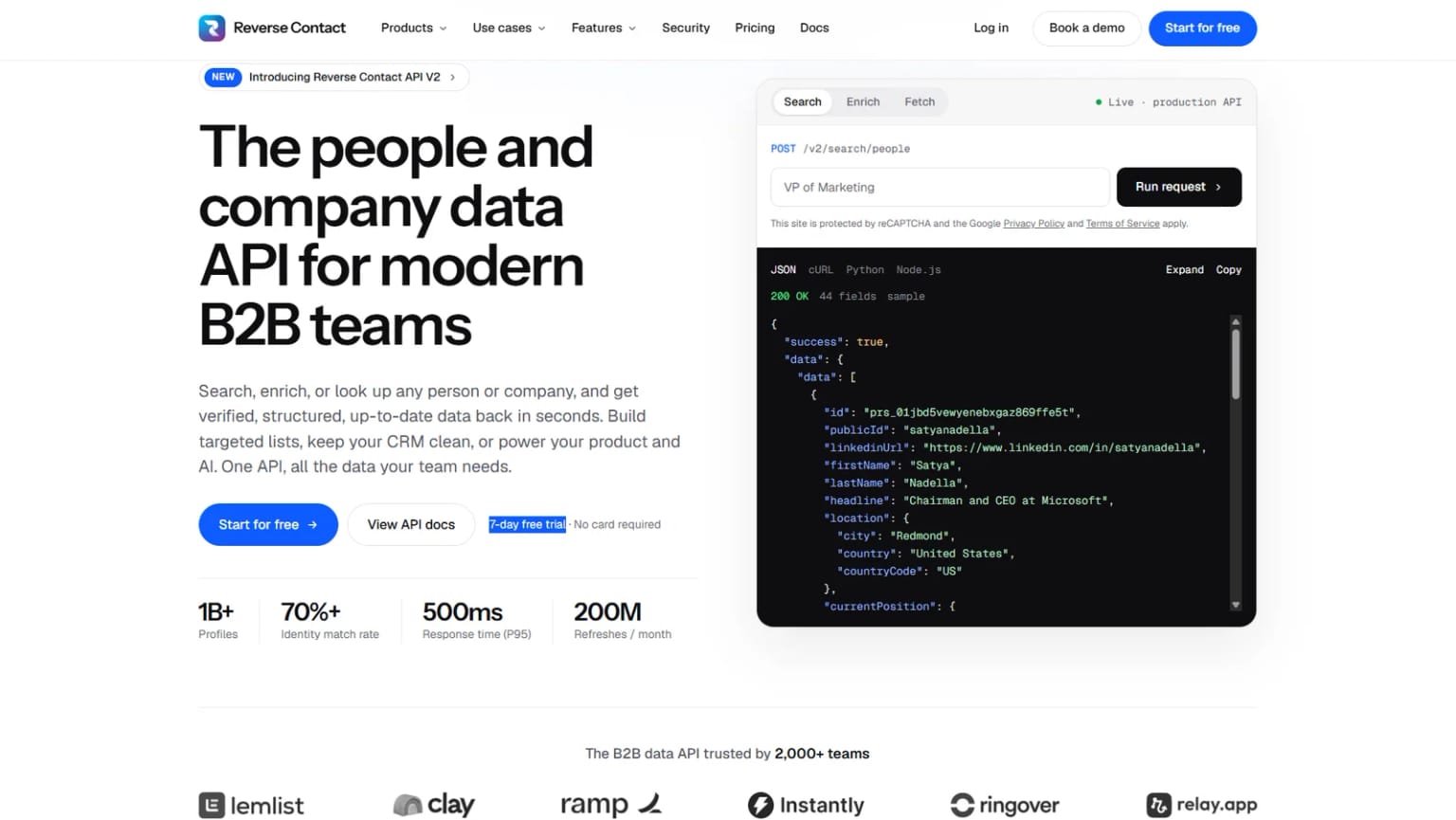
Overview: Reverse Contact is an API for people and company data (an interface your software calls to get records back). Hand it an email, someone's name and their employer's web address, or one sentence describing who you're after, and it returns a structured profile in the same JSON shape (a standard text format software reads) every time, the design we rebuilt the API around as V2 in March 2026.
We supply the context agents read rather than building agents ourselves, and a fixed shape matters most when an agent is calling, because the model finds the same fields in the same place every time. Our MCP server lets ChatGPT, Claude and agent frameworks call the API directly, and the rc command-line tool covers scripts. Teams on Clay can use our maintained app there, and n8n connects through an HTTP step.
Instantly is a good example of where we sit. Leads often reach its platform as an email and a first name, so records with gaps wait in a background queue that asks our API to fill them before Instantly's AI drafts anything. That adds up to between 2 and 4 million enrichment requests a month through Reverse Contact.
If we can't pin down who someone is, Instantly doesn't hold the campaign; it simply writes that email with lighter personalization.
We'd rather return nothing than data that fails our checks, and if an email could belong to more than one person, we can hand the agent the possible matches instead of picking one.
Key features:
- Agentic search turns one sentence into a people search, and a refused prompt costs nothing.
- Lookalike search returns profiles similar to one seed profile.
- Enrichment from an email, a name plus domain, or a company domain fills the context an AI writer needs.
- A free freshness check shows when a full profile was last refreshed, so you choose the fast cached copy or a live lookup, which runs as a background job (often tens of seconds, sometimes several minutes) and arrives by webhook.
- The email finder validates each address at request time and costs 3 credits per email found; the phone finder costs 20 credits per lookup that finds a number.
- The same records arrive over REST, webhooks (results pushed to your server when ready), CSV enrichment or MCP, so an agent and a pipeline read one format.
Pricing: Pay-as-you-go credit packs start from $100. Go ($249 a month) gives you unlimited profile fetches by URL or ID and free freshness checks. Plus ($449) adds unlimited people and company search, agentic and lookalike search included, and Max ($699) lifts the limit on enriching from an email, a full name or a company domain. Each is billed monthly with no annual commitment, and live re-fetches, emails and phones always use credits.
Go, Plus and Max cover your own team's use. If your users see the data inside a product you sell, that's a Platform contract, priced on a call with sales.
Pros: One response shape for agents and code, MCP and CLI on every plan, free freshness checks, alternative candidates on ambiguous matches, public list prices
Cons: Not an AI SDR (no writing or sending), someone must connect the API or MCP first, email or name enrichment is unlimited only on Max, a phone lookup that finds a number costs 20 credits, no free plan
How to start using it:
- Sign up for free trial credits (no card) and create an API key.
- Connect the MCP server to ChatGPT or Claude, or call the API directly.
- Run a test batch of people you know through enrichment and agentic search, topping up with a credit pack if needed.
- Count correct matches, blanks and multi-candidate answers separately.
- Pick a plan by the calls you'll run most, or stay on credit packs.
Why it's a good AI prospecting tool: An AI SDR or agent is only as accurate as the profile it reads, and we supply that profile with a refresh date and a visible answer when identity is unclear.
Final verdict: Choose Reverse Contact if you're building an agent or a product that needs reliable person and company data, or if your AI SDR's built-in data keeps getting people wrong. If you want software that writes and sends, pair it with a tool below by enriching your list through the API, a CSV or Clay before it goes in.
2. Clay
Overview: Clay puts 150+ data providers and Claygent, its AI research agent, into one table you build row by row. You point Claygent at a task, such as ranking a lead from 1 to 10 or finding the best contact at an account, and it returns structured answers with a reasoning trace.
Key features:
- Claygent research on every plan, Free included, for custom data points no provider sells.
- Waterfalls that try several providers in turn and charge nothing when an enrichment comes back empty.
- Job-change and company-news signals from Launch upward.
Pricing: The Free plan includes 100 data credits and 500 actions each month but no phone lookups. Launch runs $185 a month, or $167 a month if you pay for the year, and Growth ($446 a month on yearly billing) is the plan that adds CRM auto-sync and HTTP API calls.
Pros: Huge provider choice, unlimited seats, visible agent reasoning
Cons: You track two meters (actions and data credits), Free can't look up phones, and CRM sync plus HTTP API calls wait for Growth
Why it earns a place here: Clay is the best fit when your AI research step needs custom questions that no single database answers.
Final verdict: Pick Clay if someone on your team enjoys building workflows and wants AI research they can inspect.
3. Apollo.io
Overview: Apollo.io pairs a contact database of 240M+ contacts and 30M+ companies with sequences, a dialer and AI features. Its AI page lists pulling lead lists in natural language, researching leads with real-time web data, finding lookalike accounts and drafting emails.
Key features:
- Natural-language list building on top of its own database.
- AI-written emails and opening lines that can run as automated sequences.
- An MCP server, so an assistant can search, enrich and send from chat.
Pricing: The free plan gives 900 credits per seat a year, granted monthly. Basic is $49 per seat a month billed annually, or $65 billed monthly.
Pros: A free tier you can actually use, contact data and outreach under one login, an inexpensive first paid plan
Cons: Unused credits expire each billing cycle, monthly billing costs about a third more, several APIs need a custom plan
Where it fits: A small team gets AI list building and AI writing on the same records it sends to.
Final verdict: Apollo.io is the value pick when one login for data, AI and outreach matters more than depth in any one step.
4. Unify
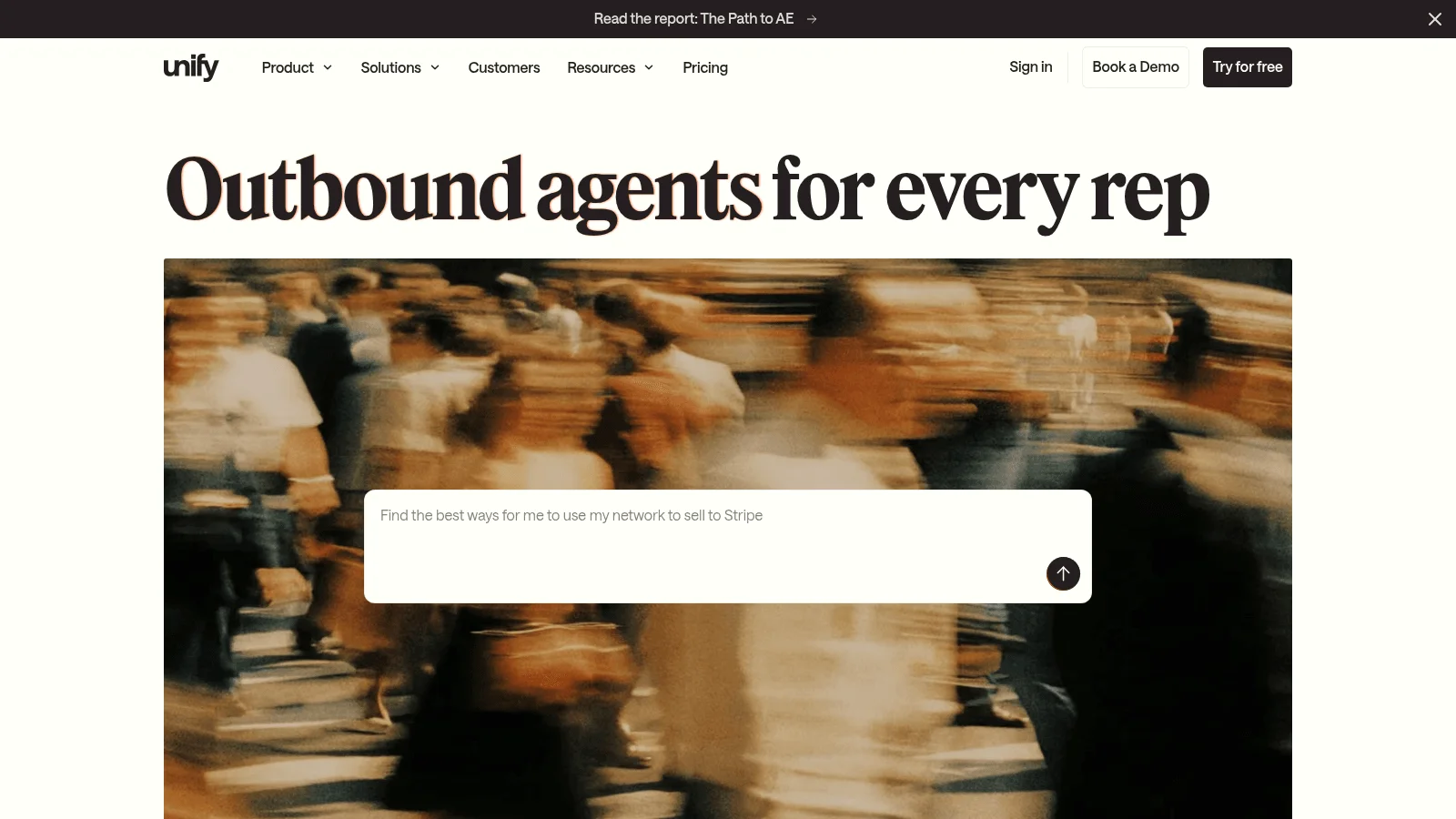
Overview: Unify sells "outbound agents for every rep." Its pricing page lists 1.1B+ people and 65M+ companies across 40+ data sources, agentic chat for building lists, AI copywriting and multichannel sequences in one workspace.
Key features:
- Agentic chat that turns a plain request into a prospect list.
- Signals such as new hires, open roles and tech stack to time outreach.
- A hard credit cap that pauses actions instead of charging more.
Pricing: Free covers up to 3 seats with limited credits. Base is $20 per seat a month with 800 credits per seat, Pro is $60 with 2,400, both billed monthly, and Business is custom on annual billing.
Pros: Free plan, low per-seat entry, model costs folded into credits
Cons: Open API and webhooks only on Business, AI copywriting starts at Base, phone enrichment averages 4 credits and can reach 20
Why buyers shortlist it: The credit cap means an agent workflow can't run up a surprise bill.
Final verdict: Unify fits small teams that want each rep to run AI outbound without a long contract.
5. Common Room
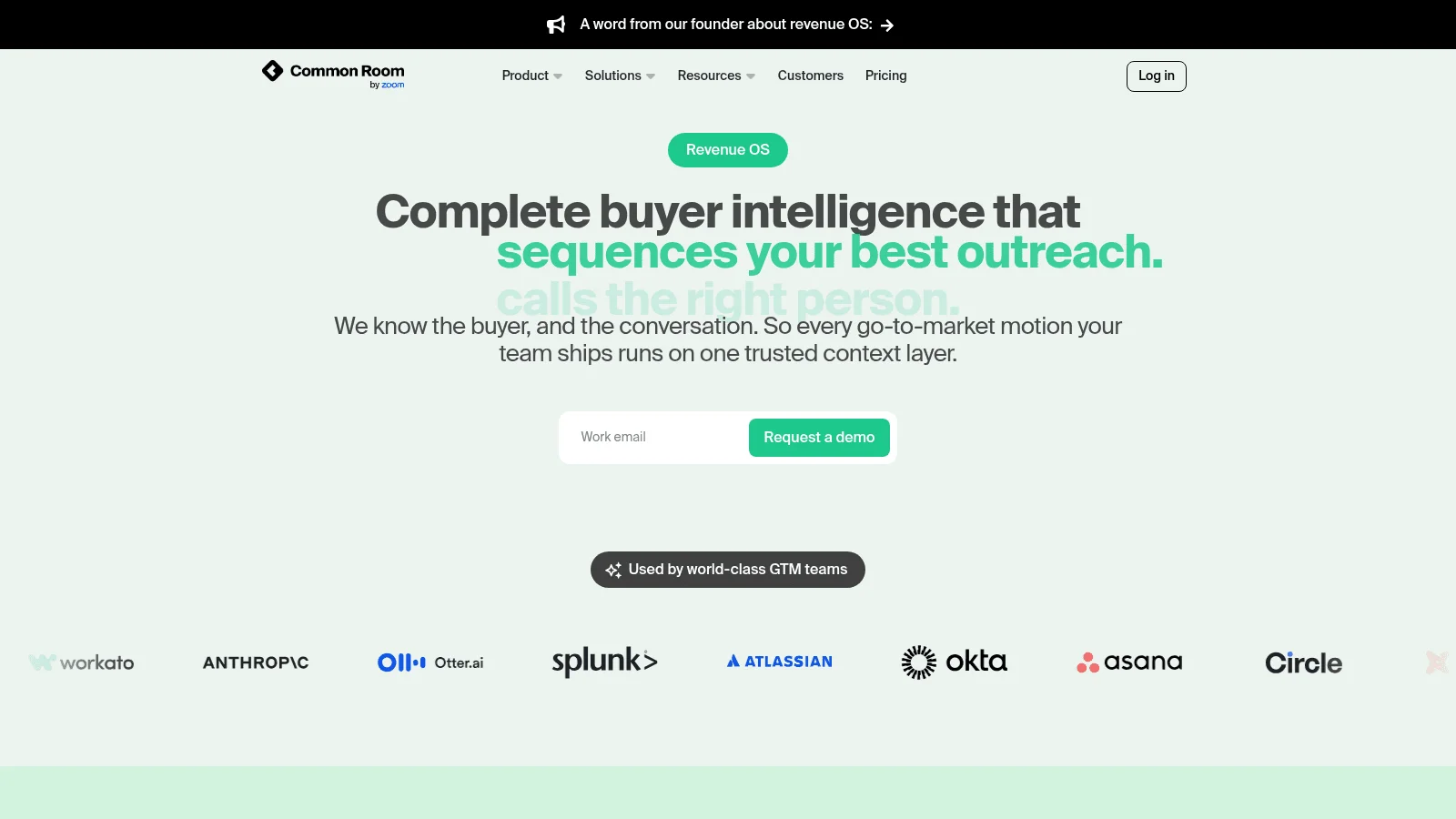
Overview: Common Room, now owned by Zoom, pulls buyer signals from your CRM, product, marketing and engagement tools into one view, then puts AI agents on top. RoomieAI handles account research and Prospector finds contacts in a 400M+ contact directory.
Key features:
- First- and third-party signal tracking that shows who's interested.
- RoomieAI research credits for account briefs.
- An MCP server on all plans, so assistants can query buyer intelligence.
Pricing: Essential is $2,500 a month billed annually, with 5 seats, up to 100,000 contacts, 5,000 RoomieAI research credits and 2,500 Prospector credits. Advanced and Enterprise are custom.
Pros: Strong signal coverage, agents inside Slack and the CRM, MCP on every plan
Cons: High annual entry, only one priced tier, no free plan
What it is genuinely good at: It tells an agent why to reach out now as well as who to contact.
Final verdict: Common Room suits teams with plenty of product and community signals that want AI to act on them.
6. Amplemarket
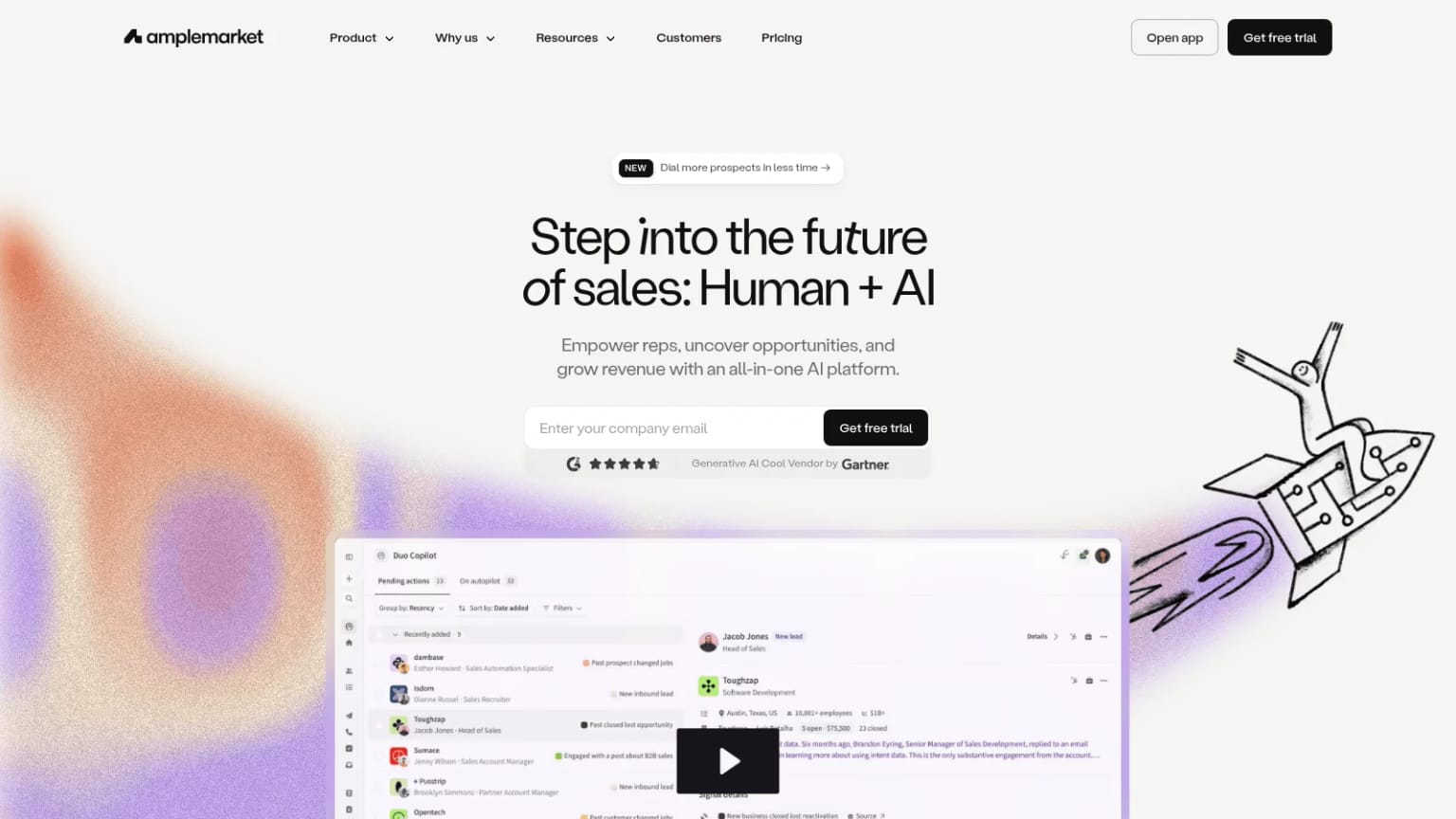
Overview: Amplemarket is an all-in-one outbound platform built around Duo, its AI copilot. Its plans bundle a B2B database, AI intent signals, AI-written emails, multichannel sequences and a dialer.
Key features:
- Duo Copilot, which surfaces leads and drafts outreach for reps to approve.
- Email and phone credits per user per year, plus alerts when a followed contact moves to a new role, on every plan.
- MCP on every plan, for prospecting and research from Claude or ChatGPT.
Pricing: Startup is $600 a month on an annual term, with 2 users and 27,000 contacts. Growth (4 users) and Elite (10 users) are custom, and every plan includes a free trial.
Pros: Data, signals and sending in one contract, AI copilot built into the workflow, free trial on all plans
Cons: Annual term from the first plan, only 600 phone credits per user a year on Startup, Duo Voice only from Growth
Its real strength: Teams replacing a database, a sequencer and a dialer can cut that to one vendor.
Final verdict: Amplemarket fits a mid-size sales team ready for an annual commitment to a single AI-assisted platform.
7. Reply.io (Jason AI SDR)
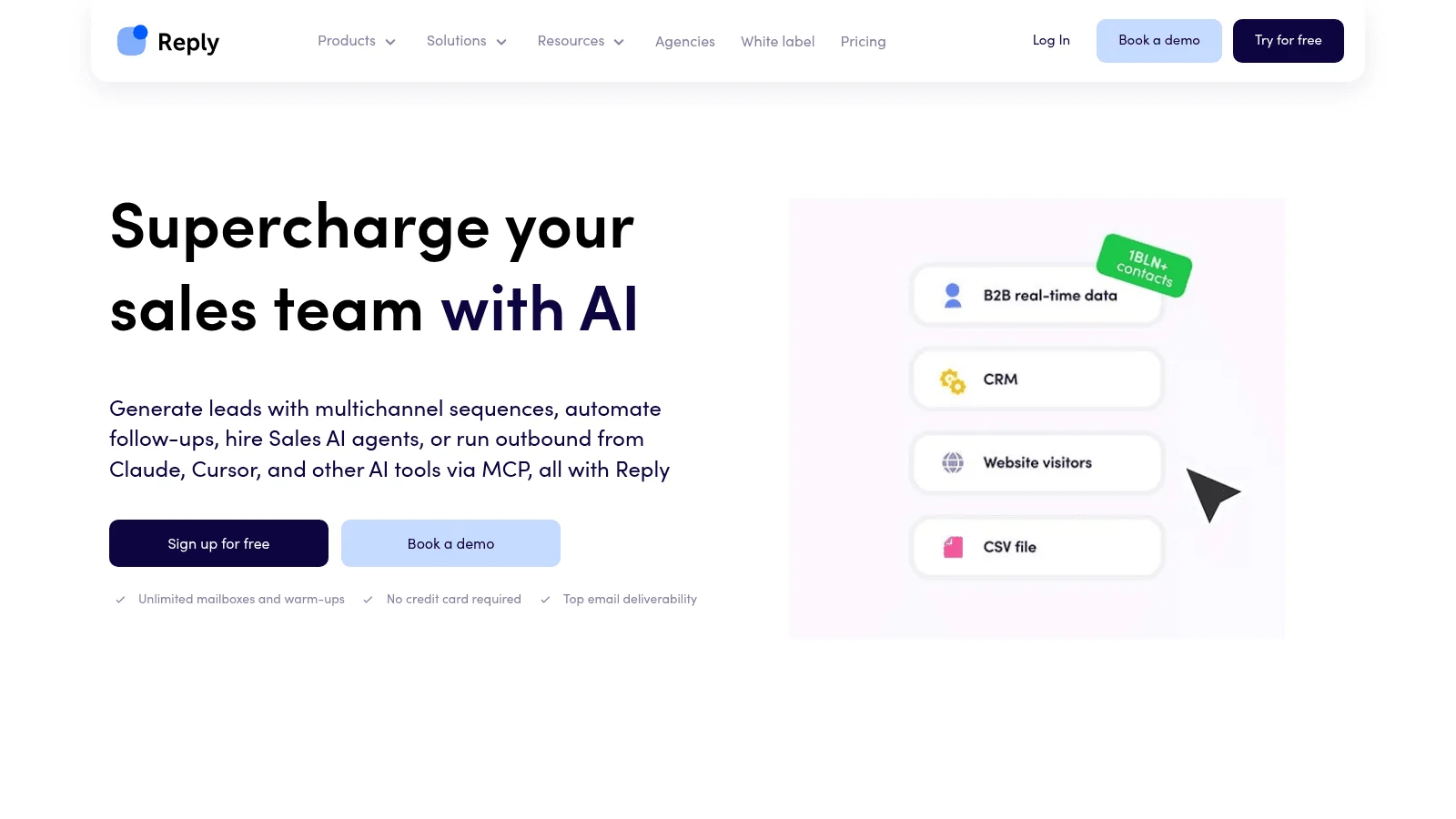
Overview: Reply.io is a sequencing platform, and Jason is its AI SDR. Jason builds an ideal customer profile from your offer, finds prospects through AI web search and a database of 1+ billion contacts, writes across email, LinkedIn and calls in 50+ languages, and handles replies.
Key features:
- Prompt-based targeting: describe your ideal buyer and Jason finds matches.
- A choice of AI model (Claude, Gemini, Mistral or OpenAI).
- Playbooks and a knowledge base that steer what Jason says and how it handles objections.
Pricing: The Jason AI SDR Starter plan is $500 a month billed annually or $800 monthly, for 1,000 contacts. Reply.io offers a 14-day platform trial (the page doesn't say whether it covers Jason) and no free plan.
Pros: Full sequencer underneath the agent, model choice, yearly price published
Cons: Priced by contacts, so volume raises the bill; monthly billing costs 60% more; no free plan
Why it made this list: Jason runs inside a mature sending platform, so deliverability tools come with the agent.
Final verdict: Reply.io suits teams that want an AI SDR plus the option to run human-written sequences in the same tool.
8. AiSDR
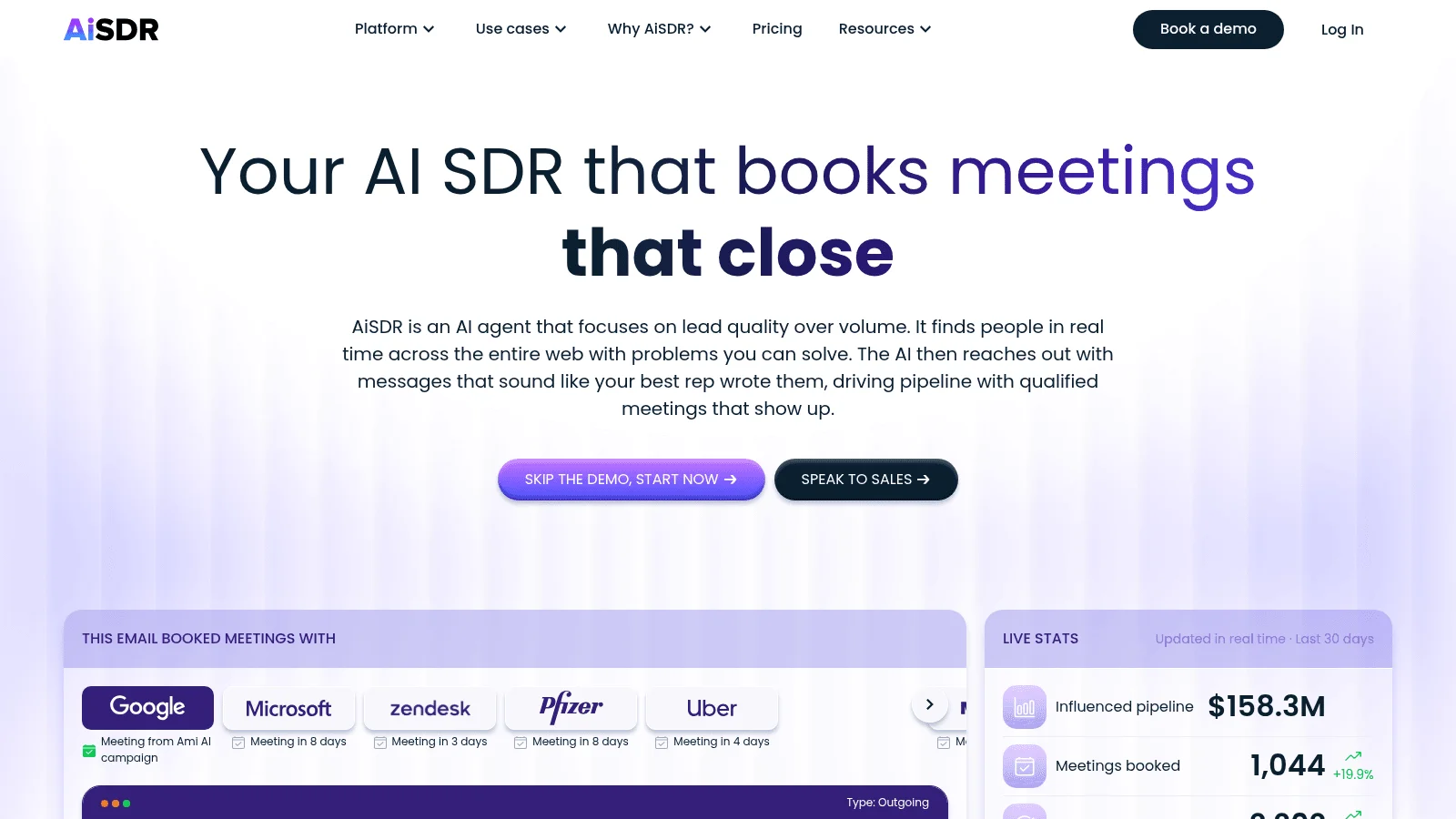
Overview: AiSDR is an AI SDR that researches leads, writes emails and LinkedIn actions, and replies on autopilot or in co-pilot mode. Its pricing page lists a native database of 300M+ leads and a "live AI lead search" from a plain description of your ideal customer profile (ICP).
Key features:
- Research of the top 3 most relevant data points for each lead before writing.
- Ami, an AI GTM agent that sets up your campaign with you in chat.
- Mailbox setup, warmup and bounce checks included.
Pricing: Solo is $250 a month billed monthly or $2,400 a year, for 200 AI-researched contacts a month, 1 user and 3 mailboxes. Explore is $900 a month (800 contacts) and Scale $2,500 (2,500 contacts), both on quarterly contracts.
Pros: Free setup with no card, month-to-month entry plan, published contact allowances
Cons: 200 contacts a month on Solo, quarterly contracts from Explore, Salesforce sync only on Scale
What sets it apart: You can sign up with no card or sales call and build a campaign before paying to launch.
Final verdict: AiSDR is the cheapest way here to run an autonomous AI SDR month to month.
9. Artisan
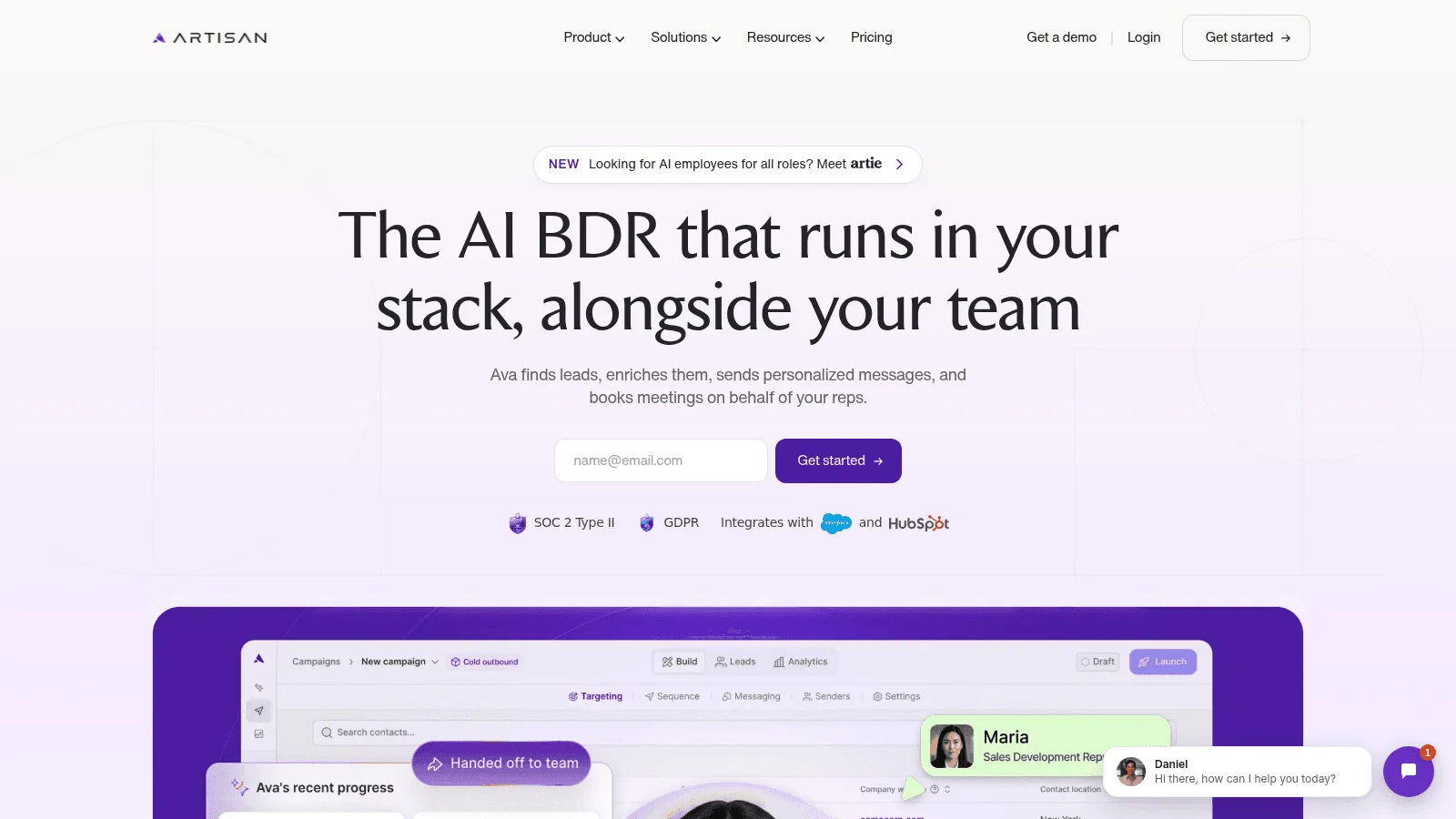
Overview: Artisan sells Ava, an AI BDR (business development rep, another name for an SDR) that finds leads, enriches them, sends personalized messages and books meetings for your reps. Every plan includes 250M+ B2B contacts, autonomous replies and Salesforce and HubSpot sync.
Key features:
- Every campaign type, from cold outbound to re-engaging churned contacts.
- An AI dialer add-on, with a brief before each call and a summary after.
- CSM support and onboarding on every plan.
Pricing: Artisan publishes no prices. Team covers about 2,500 leads contacted a month and Scale about 6,000, each scoped with sales.
Pros: Managed rollout, data included, published volume per plan
Cons: No public price, no self-serve start, dialer priced separately per seat
Where it beats the alternatives: You get people as well as software, which helps a team that has never run outbound.
Final verdict: Artisan suits teams that want an AI BDR set up for them rather than built themselves.
10. 11x
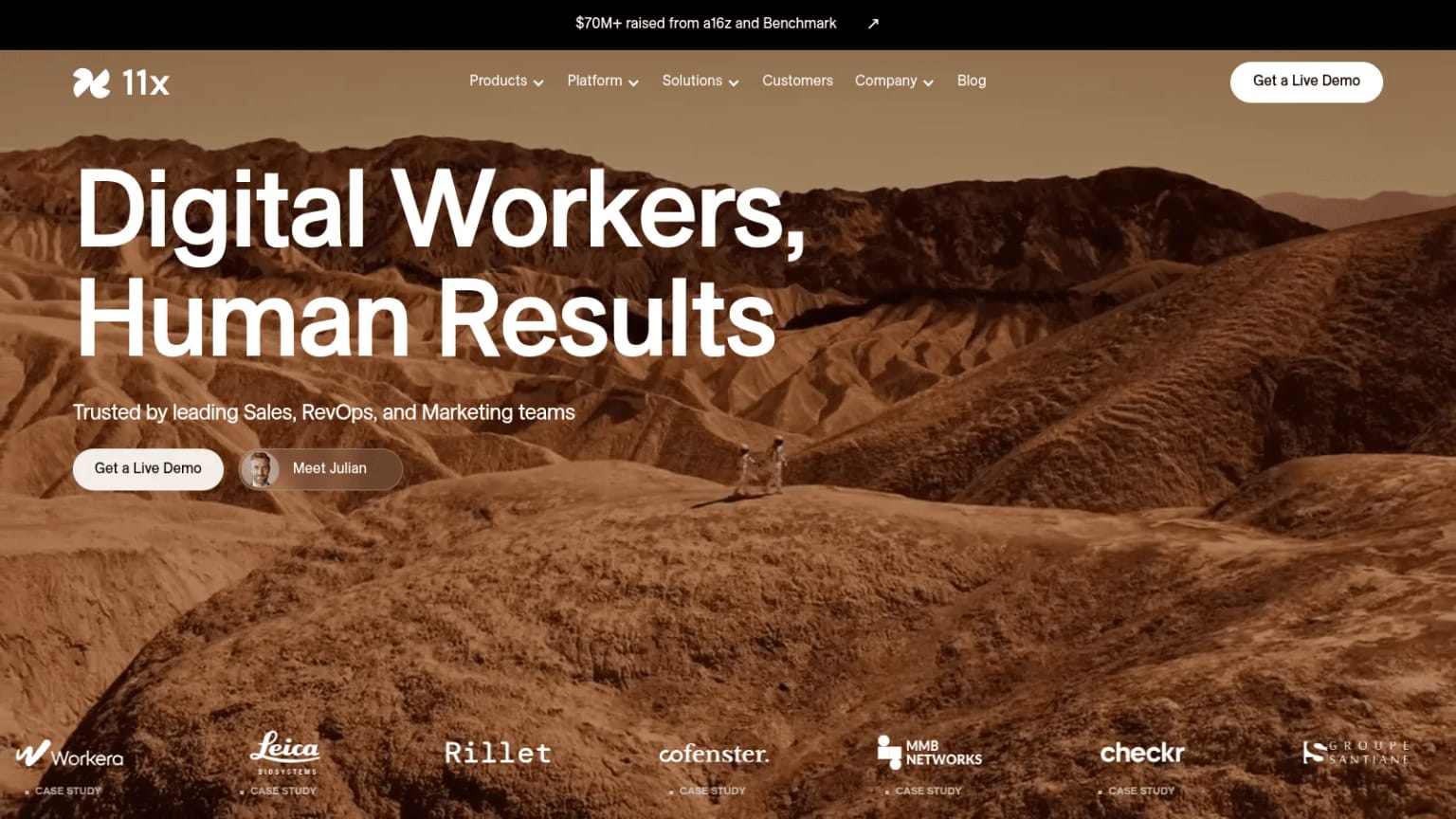
Overview: 11x sells "digital workers": Alice, an AI SDR for outbound, and Julian, an AI phone agent for inbound calls and speed to lead. Its company and lead database is built into the platform, with no separate data contract.
Key features:
- Alice for research, multichannel sequences and replies.
- Julian for answering and qualifying inbound calls.
- Records checked at the point of outreach, per its database page.
Pricing: 11x publishes no pricing; you start with a live demo.
Pros: Outbound and inbound agents in one platform, data included, enterprise focus
Cons: No public price, demo before any trial, a heavier rollout than self-serve tools
Why teams pick it: It covers phone and inbound work that most AI SDRs leave to humans.
Final verdict: 11x fits larger teams that want AI on both outbound email and inbound calls.
Which Layer Do You Need?
The fastest way to narrow this list is to decide how much of the job you want the AI to own, because most AI tools for sales prospecting fit one clear row below.
| Your situation | Start with | Shortlist |
|---|---|---|
| You're building an AI agent or product that needs people data | Data layer | Reverse Contact |
| RevOps wants custom AI research columns and waterfalls | Research and workflow | Clay |
| A small team wants data, AI and sending in one cheap login | Research and workflow | Apollo.io, Unify |
| You already have strong product or community signals | Research and workflow | Common Room |
| A mid-size team wants to replace three outbound tools with one | Research and workflow | Amplemarket |
| You want an AI to run outbound with a human checking replies | Autonomous AI SDR | AiSDR, Reply.io |
| A larger team wants a managed AI BDR or phone agent | Autonomous AI SDR | Artisan, 11x |
Most AI SDRs in this list ship their own database, but whichever database sits underneath decides what the agent writes. If you build your own agent or product, that layer is the piece you choose yourself, and it's where providers of data for AI products fit.
What AI Prospecting Tools Cost
Among the AI prospecting automation tools here, published entry prices run from $20 a seat a month (Unify Base, billed monthly) to $2,500 a month (Common Room Essential, billed annually), and two vendors publish no price at all. Compare the billing unit, not the headline.
Seat pricing (Apollo.io, Unify) grows with headcount. Contact pricing (Reply.io's Jason, AiSDR) grows with volume: AiSDR's Solo buys 200 researched contacts a month and Jason Starter covers 1,000 active contacts, so per contact that's $1.00 against $0.50 on yearly billing, or $1.25 against $0.80 on monthly billing.
Credit pricing (Clay, Reverse Contact) grows with calls. Clay doesn't bill an enrichment that returns nothing. With us, nothing is charged when a cached or live lookup, a standard filter search, an enrichment, or an email or phone hunt comes back empty; only an agentic search request still costs 1 credit when it returns no one.
Watch the billing toggle too. Reply.io's Jason costs 60% more on monthly billing, AiSDR's Solo is $250 monthly against an effective $200 on a yearly plan, and Clay's Launch is $167 annually against $185 monthly. Contact databases split prices the same way: among common Seamless.AI alternatives, Lusha's Starter is $37.45 a month billed yearly against $49.90 monthly, so ask for both prices before you sign.
Data quality changes the real cost more than list price. An email to the wrong person burns a contact, a domain's reputation and a rep's time, so price a tool only after seeing its match rate on your own records.
How to Test an AI Prospecting Tool Before You Buy
Every demo looks its best on the vendor's chosen examples. Your own list shows how it handles the people you sell to, so run every shortlisted tool through the same test:
- Pick 50 people at accounts you know well, including 10 who changed jobs in the last year.
- Give each tool the same one-sentence description of your ideal buyer and the same account list.
- Count correct and current people, wrong people and blanks separately for every tool.
- Read 20 drafted emails per tool and mark each claim about the prospect you can't verify.
- Note what each tool does when it can't tell two people apart: skips, asks or guesses.
- If phone numbers matter, check how many come back and what each costs, since a phone number from an email is often the priciest lookup in the stack.
- Send only a small first batch after a human approves it, then track bounces and replies.
Wrong people are the number that matters most. A blank costs you a wasted lookup at most, while a confident wrong match costs a sent email to a stranger, which is why we'd rather show you candidates than pick one.
Teams that build agents add one more check. A founder of an AI-agent automation platform warned us to "always be mindful of your return results," meaning an agent shouldn't get a whole JSON file dumped on it. An agent reading a lean, predictable record makes fewer mistakes than one reading a wall of fields, so look at what each tool actually hands the model.
Put the Data Layer First
The best AI tools for sales prospecting still depend on the record they start from. Decide which layer you need, shortlist two or three AI prospect research tools or AI SDRs from the table, and run the 50-person test above before you commit to an annual contract.
If you're building an agent, or your AI SDR keeps writing to the wrong people, get a free API key and test Reverse Contact on accounts you know well, using free trial credits with no card.
FAQ
What are AI prospecting tools?
AI prospecting tools use AI to find, research and contact potential buyers. Some, like Clay and Apollo.io, help reps build lists and drafts; AI SDRs like AiSDR, Artisan and 11x run outbound on their own. Data providers like Reverse Contact supply the person and company records those agents read.
Can AI prospecting automation tools replace SDRs?
They can take over research, first drafts and follow-ups, but even the vendors pitch them as working beside reps: Artisan's homepage calls Ava an AI BDR that runs "alongside your team." Use an AI SDR to cover accounts nobody had time for, and keep reps on conversations where judgment matters.
What's the difference between AI SDRs and AI prospect research tools?
A research tool, such as Clay's Claygent or Common Room's RoomieAI, gathers facts and drafts outreach for a person to approve. An AI SDR, such as Reply.io's Jason or 11x's Alice, also sends the messages, handles replies and books meetings, either on its own or with a person approving each step.
How much do AI prospecting tools cost?
The cheapest paid tier here is Unify Base at $20 per seat, billed monthly, and the priciest published entry tier is Common Room Essential at $2,500 a month on annual billing. Clay, Apollo.io and Unify also have free plans. AI SDRs start at $250 a month on monthly billing (AiSDR Solo), and Artisan and 11x quote every plan.
What are the best AI tools for sales prospecting on a small budget?
Apollo.io and Unify both have free plans and low per-seat paid tiers, and Clay's free plan includes Claygent. If you're building your own agent, pay-as-you-go data credits let you test match rates before any contract.
The data layer behind your GTM engine
Access fresh people and company data through one API and power every enrichment, prospecting, and automation workflow.
- Profiles
- 1B+
- Refreshes / month
- 200M
- Response time (P95)
- 500ms