
11 Best Data Enrichment Tools in 2026, by What They Fill In
Julien K.Published Updated
Key takeaways:
- Enrichment tools split by what they can actually return. Apollo, Lusha and LeadMagic are people-first; Explorium is the one built around company attributes; everything else returns both, at prices that range from $49 a month to a quote.
- Nine of the eleven publish a price you can read without a sales call; only ZoomInfo and Cognism quote every paid tier, and ZoomInfo does publish a permanent free plan. Four of the nine, ourselves included, publish every self-serve rung and quote only the top one.
- Three state a refresh cadence you could hold them to: Cognism refreshes 95% of Director-level contacts every 30 days, People Data Labs rebuilds company records monthly, and Lusha publishes a refresh rate field by field. The other eight publish a capability, a deferral to whoever answers, or nothing at all.
- Credits are not comparable. One credit buys a whole company record at People Data Labs, a contact data point at Lusha, and a record costs ten to twenty at Coresignal. Price the job, never the credit.
Data enrichment tools are the least glamorous purchase in a go-to-market stack and the one everything else leans on. A form captures an email, a scoring model needs an industry and a headcount, a sequencer needs a current title, and none of those exist until something fills them in.
The eleven data enrichment tools below do that filling in different ways and at wildly different units of sale. Some sell a database you query, some sell a waterfall across other people's databases, and some sell raw records by the million.
Vendors label themselves inconsistently too. The same product is marketed as data enrichment software, as a data enrichment platform, as one of several data enrichment vendors, or as a data enrichment solution, and none of those words tells you which shape you are buying.
Reverse Contact is ours and goes first for that reason rather than because this list is a ranking. Every price here was read on the vendor's own pricing page during October 2026, and where a vendor publishes nothing we say so instead of guessing. A narrower comparison of pure B2B contact databases covers the contact-only end of the same market, where the b2b data enrichment tools overlap heavily with plain contact providers.
What Enrichment Actually Fixes
Records do not go wrong all at once. They rot a field at a time, and the two causes behave differently.
People move. A title goes stale, then a work email bounces, then the company itself is wrong. Companies also stop existing, which is the half most buyers forget to price in. UK Office for National Statistics figures put 309,000 business deaths in 2023, a death rate of 10.8% against its own count of active businesses.
That rate is not uniform, which matters more than the average. Transport and storage ran a 21.6% death rate in the same year, double some other sectors. If you sell into a high-churn industry, a database refreshed annually is wrong about a fifth of your accounts before you start.
There is a second reason to keep records current, and it is an obligation rather than a preference. Article 5 of the GDPR requires personal data to be accurate and up to date, and says every reasonable step must be taken to erase or rectify inaccurate data without delay. Holding a four-year-old contact record you have never rechecked is hard to square with that.
So enrichment is better understood as maintenance than as a purchase, which is why CRM data enrichment tends to become a standing job rather than a one-off project. The question is not which tool holds the most records but which you can afford to run every quarter.
How to Compare Enrichment Tools
Most comparisons of data enrichment services line up coverage totals, which is the least informative number available. Worse, the figures that get compared are rarely measuring the same thing, so two data enrichment services with identical headline totals can behave nothing alike. Here is what to ask instead, and what the answers usually look like.
| Question | Why it decides the purchase | What a good answer looks like |
|---|---|---|
| What does one credit buy? | The unit varies by a factor of twenty across this list | "One company record", not "one credit" |
| Is a miss charged? | On a 60% hit rate this changes real cost by two thirds | A stated rule, published, either way |
| What does your refresh date mean? | A whole-record rebuild and a field change are different claims | A cadence with a named population |
| What share of records carry an email? | A profile without contact details cannot be actioned | A published fill rate, not a total |
| Can I put the data in my product? | Most standard plans license internal use only | A named tier and a written license |
Two of those are worth expanding, because they are where buyers lose money quietly.
The unit. Every data enrichment platform here sells a credit, and a credit means something different at each one: one buys a full company record from People Data Labs, a single contact field from Lusha, and ten to twenty for an employee record at Coresignal. Comparing per-credit prices across vendors is meaningless until you convert each to a price per thing you actually wanted.
The license. Apollo's own terms restrict its plans to internal business use, and most of this list is similar. If the enriched data will be visible to your customers, that is a different contract everywhere, including with us. Teams running this against their own records rather than a product usually land on CRM enrichment instead.
The 11 Best Data Enrichment Tools
The table below is the buying view: what each tool fills in, what it costs to start, and the rule most likely to catch you out.
| Tool | Fills in | Pricing (from) | Published figure | The rule to know |
|---|---|---|---|---|
| Reverse Contact | People and company identity | Credit packs from $100 | 800M+ profiles, 70M+ companies | A live fetch that misses costs 2 credits |
| Clay | Whatever its providers return | $167/mo billed annually | 200+ providers | HTTP API needs the Growth tier |
| ZoomInfo | Contacts, companies, intent | Quote only | 500M+ contacts, 100M+ companies | One credit per export, API calls included |
| Apollo.io | Contacts plus outreach | $49/seat/mo billed annually | 84% email match rate | Credits expire every billing cycle |
| Cognism | European mobiles and firmographics | Quote only | 90% of Director+ in EU and US | Sold in packages of five seats |
| People Data Labs | Raw person and company records | $98/mo or $940/yr | 26.7% of records carry an email | The free tier obfuscates contact data |
| Lusha | Contact fields, one at a time | $37.45/mo billed yearly | 515M+ contacts, 29M+ companies | Annual credits are forfeited at term end |
| Coresignal | Employees, companies, job postings | $49/mo for 2,500 credits | 907M+ employee records | A record costs 10 to 20 credits |
| Explorium | Company attributes at volume | $29.99 for 500 credits | Coverage differs on its own pages | Prepaid packs, nothing renews |
| Dropcontact | European records, CRM-native | €24/mo billed yearly | None published | Carry-over starts at the second tier |
| LeadMagic | Contacts, success-billed | $83/mo billed yearly | 400M+ people, 25M+ companies | Team access adds $49 a seat |
Position one is ours because we built it, which is worth stating plainly. From there the list runs from the broadest platforms toward the specialists, which is a rough proxy for how much of your workflow each expects to own. Anyone arriving here after Clearbit's withdrawal will find the same names ranked differently among Clearbit alternatives, where freshness rather than breadth is the axis.
1. Reverse Contact
Best for: Enrichment that runs inside a product rather than a dashboard.
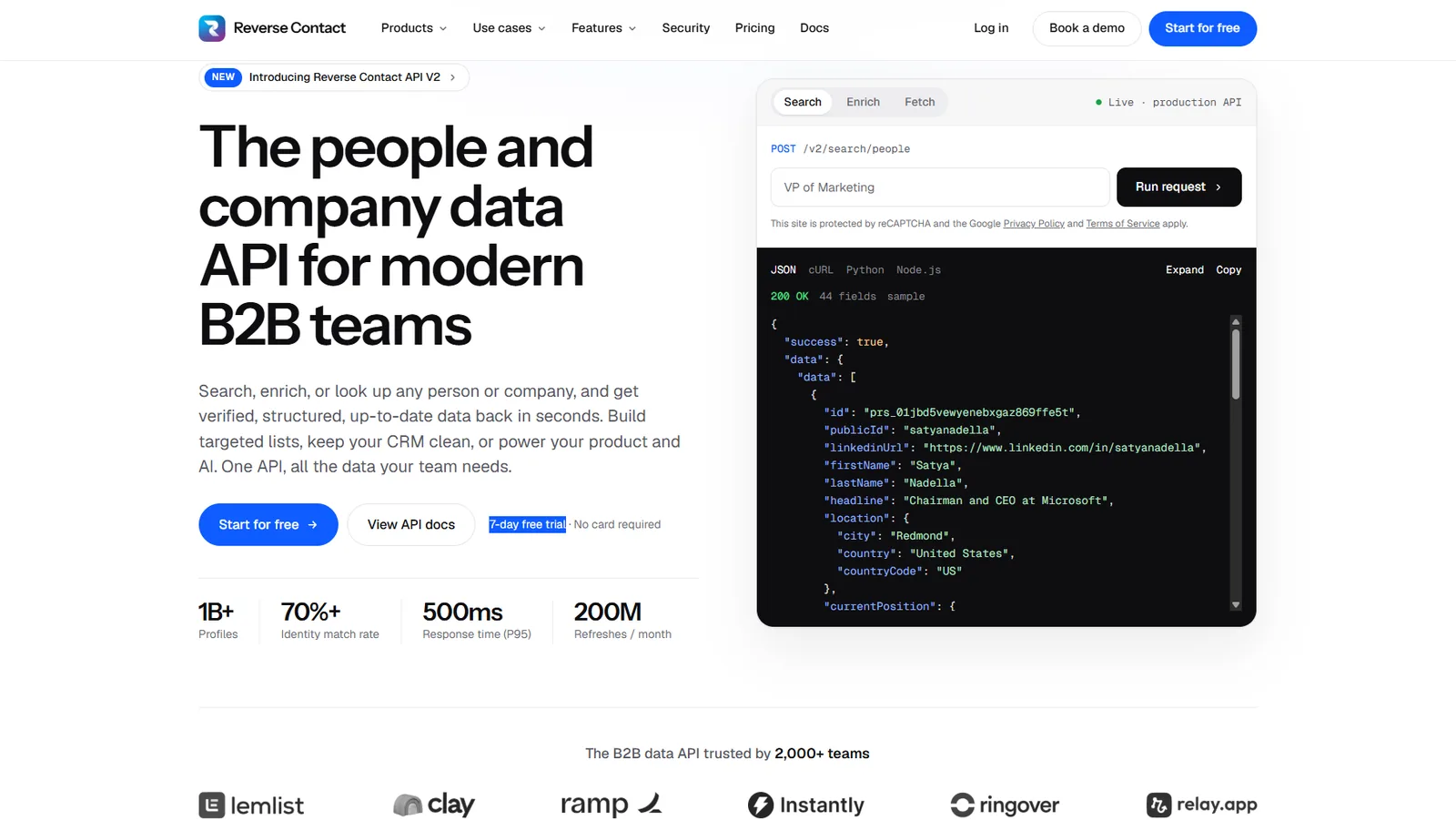
Overview: Reverse Contact resolves one identity at a time and hands it back as JSON. Nothing in it is built for a person to look at, because the thing reading the answer is your code.
Two entry points. Hand it an identifier and one identity resolves; hand it a filter set and you get the people or companies matching it. Either way what comes back is a full record rather than a single field, which is the difference between enrichment and a lookup.
The published coverage is 800M+ profiles and 70M+ companies, at a stated 70%+ identity match rate. Ours are self-reported like everyone else's here, and the caveat above applies to them equally, so we also publish how often each field is filled. In the October 2026 snapshot, function and seniority were filled on 90% of quality profiles (at least one position, one follower and a page still online), and industry on 87% of active companies.
Zuora came to us with a problem this list is built around. The same customer appeared as three different companies across its CRM, its billing system and its product data, so the work started with resolving company and people identity before any enrichment was useful at all, moving toward one trusted customer profile rather than a version per system.
Key features:
- A free match count before any credits are spent, so you can size a segment first.
- A free
/checkcall returning a record's last full refresh date, which decides cached against live. - A business email costs 3 credits and a phone lookup 20, neither charged unless the field comes back.
- Ambiguous identities come back with their alternative candidates rather than a silent guess.
- The same record structure arrives whether you call REST, take a webhook, upload a CSV or connect over MCP.
Pricing: A $100 pack is the way in, with no subscription behind it and a three-month life on each purchase. From there three monthly tiers switch the meter off in stages, $249 covering record lookups, $449 adding search and $699 adding enrichment from an email or a name, while contact calls and live re-fetches stay metered on all of them. Every tier licenses internal use; a Platform agreement, priced on application, covers data a customer will see.
Pros: Nothing on the invoice tracks headcount, the whole self-serve ladder is readable without a call, failed contact lookups are not billed, and both coverage and record age can be checked before a credit moves
Cons: There is nothing to log into, so this fills records rather than replacing a tool anyone opens; phones are the expensive field at 20 credits beside an email's 3; an empty live fetch is billed 2; and the Americas and Europe are far better covered than Asia-Pacific
How to start using it:
- Sign up for trial credits, which need no card.
- Count your segment first. It is free, and a thin count ends the evaluation early.
- Run 200 records you can grade, and record both how many filled and how many filled correctly.
- Work out credits per correct record. That number, not the pack price, is what you are paying.
- If a customer will ever see the output, settle Platform with us before building.
Why it's a good data enrichment tool: It fills fields for software rather than for someone reading a screen, which is the right shape when nobody opens the result. Our company enrichment API carries the firmographic half of the same record.
Final verdict: The right fit where enrichment runs inside software at volume. A rep has nothing to open here, and that is the point rather than a gap.
2. Clay
Best for: Running a waterfall across providers you already pay for.
Overview: Clay does not own a database. It orchestrates calls to other people's, trying them in order until one answers, which is the usual fix when the real problem was depending on a single source.
Key features:
- Its homepage now states 200+ providers behind the waterfall.
- Nothing is charged when an enrichment returns empty.
- Bringing your own provider key costs one action and no data credits.
Pricing: Free gives 100 data credits and 500 actions a month. Launch is $167 a month billed annually, Growth $446, and Enterprise is quoted. Seats are unlimited on every tier, and data credits start around five cents each.
Pros: Unlimited seats, empty enrichments unbilled, a genuine free tier, the broadest provider coverage here
Cons: The HTTP API and webhooks start at Growth and the full Clay API is Enterprise-only, so the cheapest tiers cannot be automated from outside, and your costs still depend on the providers underneath
Why buyers shortlist it: It removes dependence on any single provider, which is the specific failure that sent most people looking.
Final verdict: The strongest answer when coverage gaps were the problem. An expensive way to buy one provider's data.
3. ZoomInfo
Best for: Enterprise breadth with intent attached.
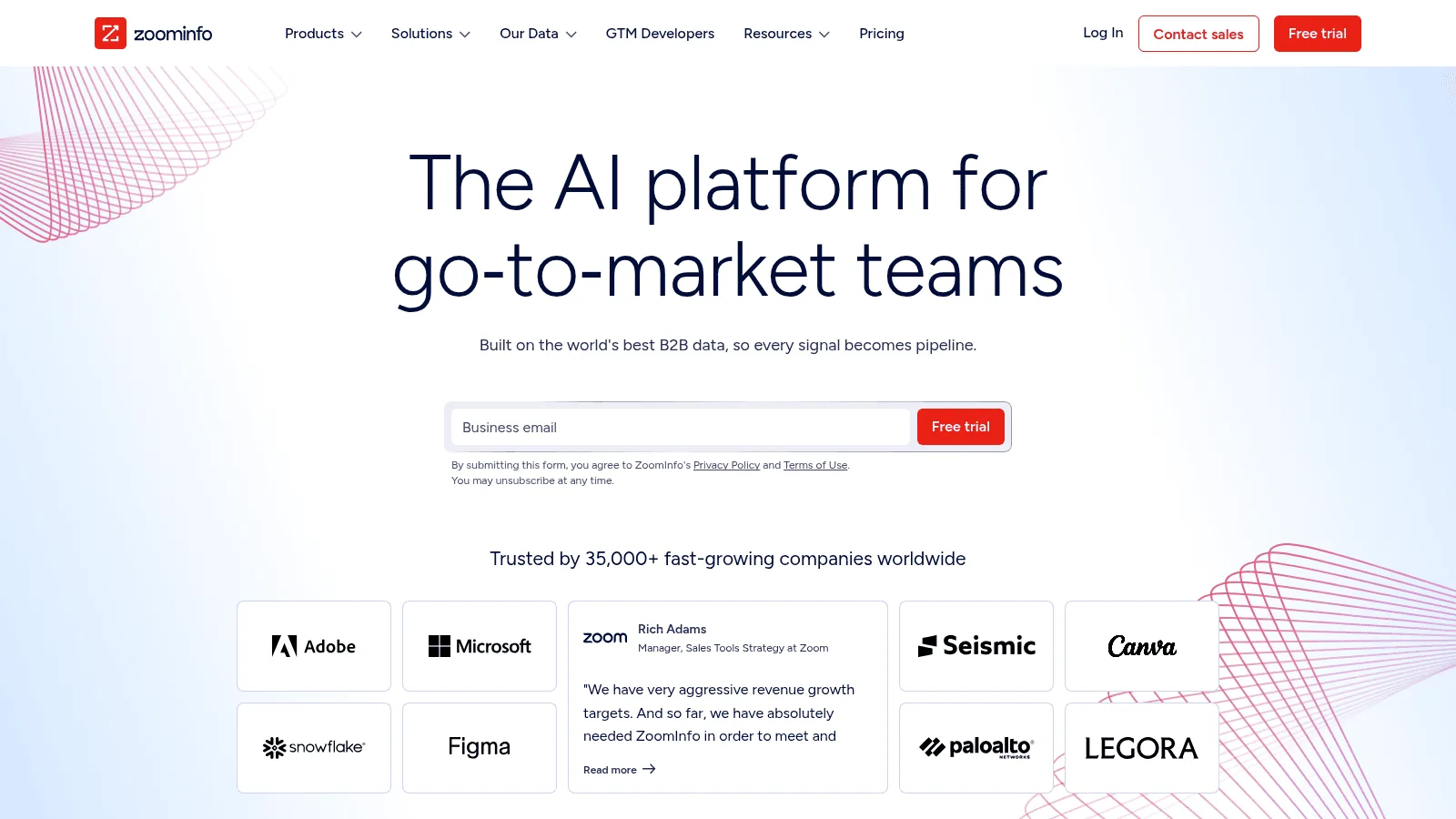
Overview: Enrichment is one feature of a much larger platform at ZoomInfo, sitting beside intent data, visitor identification and conversation intelligence rather than standing on its own.
Key features:
- Fills contacts, firmographics and intent in one pass, from a base it states as 500M+ contacts and 100M+ companies.
- Accuracy is given only as "up to 95%", with no sample behind it.
- Exports cost a credit each, and automated calls draw on the same pool as manual ones.
Pricing: Nothing published. Tiers are priced on a combination of features, licenses and expected credit usage, settled in a call.
Pros: More company fields filled than anything else here, buying signals included in the same subscription, and a permanent free tier to start on
Cons: Not one paid tier carries a public price, and since an automated call spends the same credit a manual export does, scripting your enrichment drains the allowance much faster than working by hand
Why buyers shortlist it: If the brief is to fill as many fields as possible and budget is not the binding constraint, nothing else comes close.
Final verdict: Where large companies end up. Too opaque and too costly below that.
4. Apollo.io
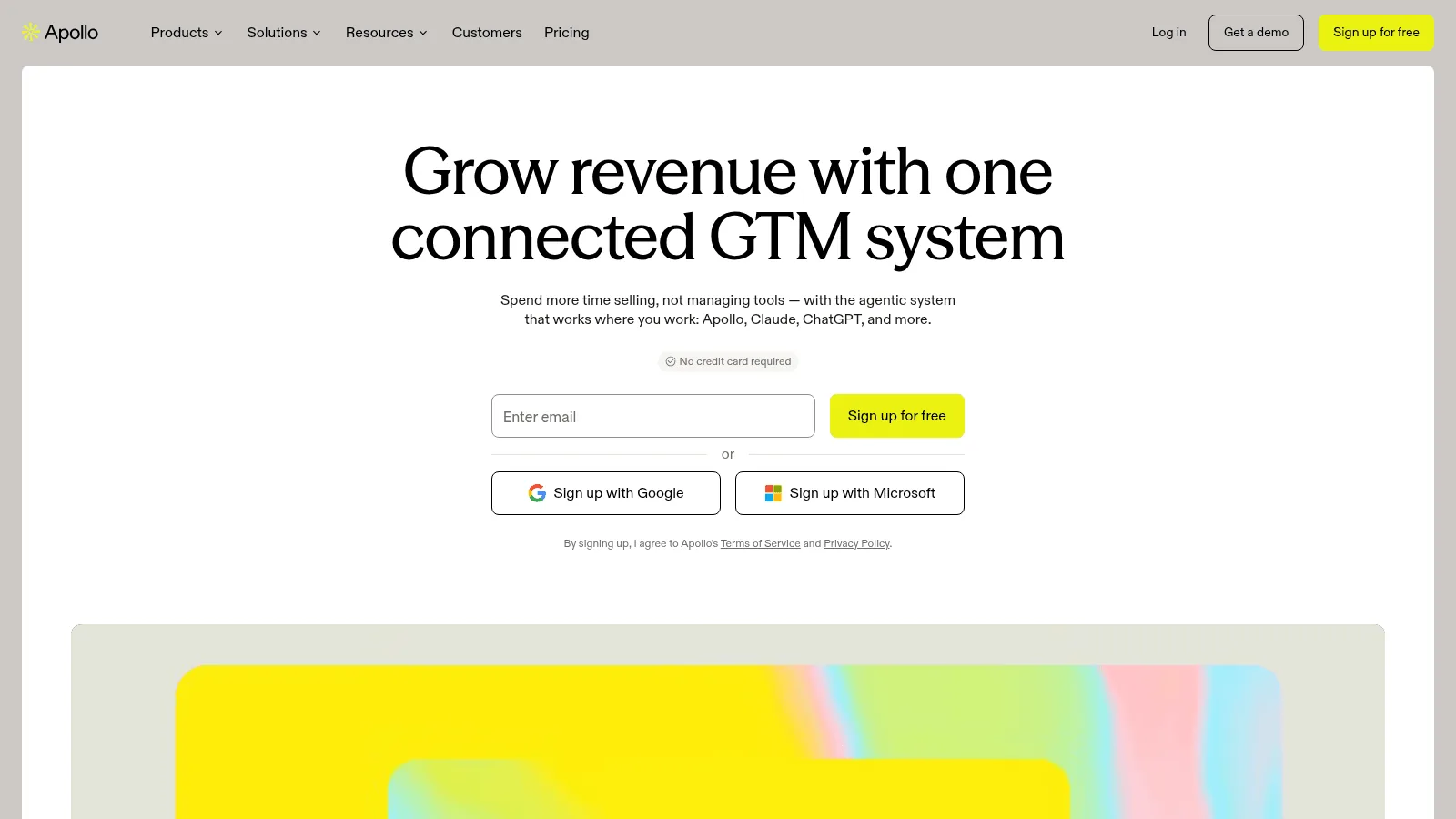
Best for: Enrichment bought alongside the outreach that uses it.
Overview: Apollo fills contact fields and then gives you somewhere to use them, bundling a 240M-record database with sequencing, dialing and a light CRM in one subscription.
Key features:
- Fills contact fields cheaply, at one credit for an email and eight for a phone number.
- Company records number 30M+, drawn from the same pool of seat-granted credits.
- Anything that bounces inside a month puts the credit back.
Pricing: Seats carry it. Basic runs $49 a month on annual terms, Professional $79, Organization $119 with three seats minimum and no monthly option, and a free account draws 900 credits per seat each year. An 84% email match rate sits on its help pages.
Pros: A free allowance you can actually test with, every self-serve tier priced in public, sending included, and a match rate named as a match rate alongside its accuracy claim
Cons: Nothing unused survives the billing cycle, add-ons included; the allowance follows how many people you employ rather than how many records you need; and the terms confine it to internal use
Why buyers shortlist it: Nobody else publishes a lower price for filling the fields and sending the email from one place.
Final verdict: Hard to beat for a team that sells. Check the license terms first if you build on it.
5. Cognism
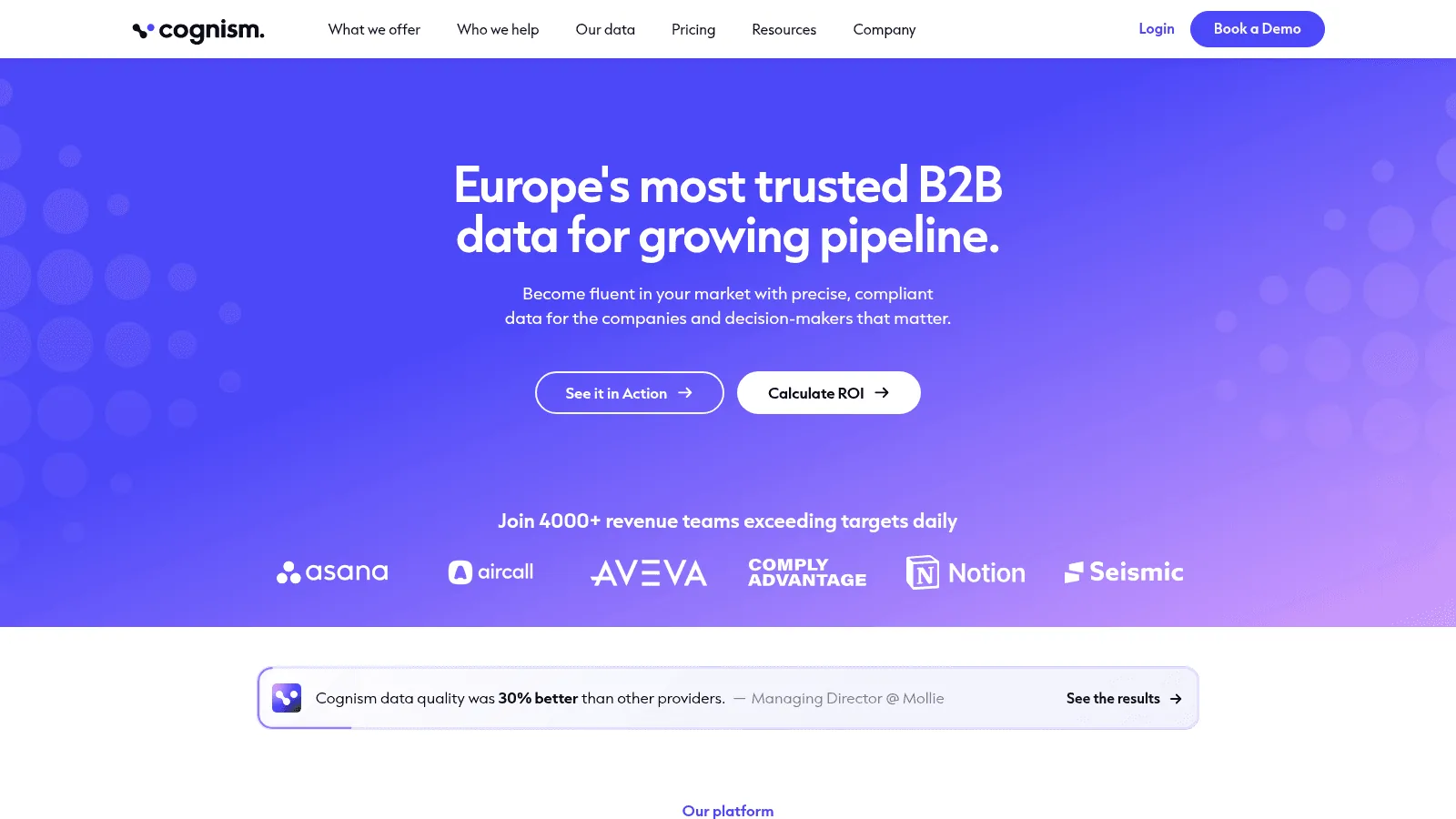
Best for: Dialable European mobiles with screening built in.
Overview: Cognism fills fewer fields than most here and fills the hard one better, concentrating on dialable European mobiles with Do-Not-Call screening across 16 lists included as standard.
Key features:
- Fills mobile numbers and firmographics for senior contacts, claiming 90% coverage of Director level and above in Europe and the US.
- Commits to rebuilding 95% of those contacts on a 30-day cycle, which is the firmest freshness promise here.
- A contact costs one credit wherever it is revealed, in the app or over the API.
Pricing: Unpublished, and packaged around five included seats on both tiers. Emails and mobiles come with either package; stepping up buys mobile filtering, verification you can trigger per record, and intent signals.
Pros: The only vendor here that names the population behind its refresh cadence, genuine depth on European mobiles, compliance screening included, and API access from the first tier
Cons: Nothing about the price is public, the smallest package presumes a five-person team, and CRM enrichment carries its own price on top of whichever package you buy
Why buyers shortlist it: Nothing else here fills a European mobile field as reliably.
Final verdict: Correct for European calling. Impossible to price without entering a sales process.
6. People Data Labs
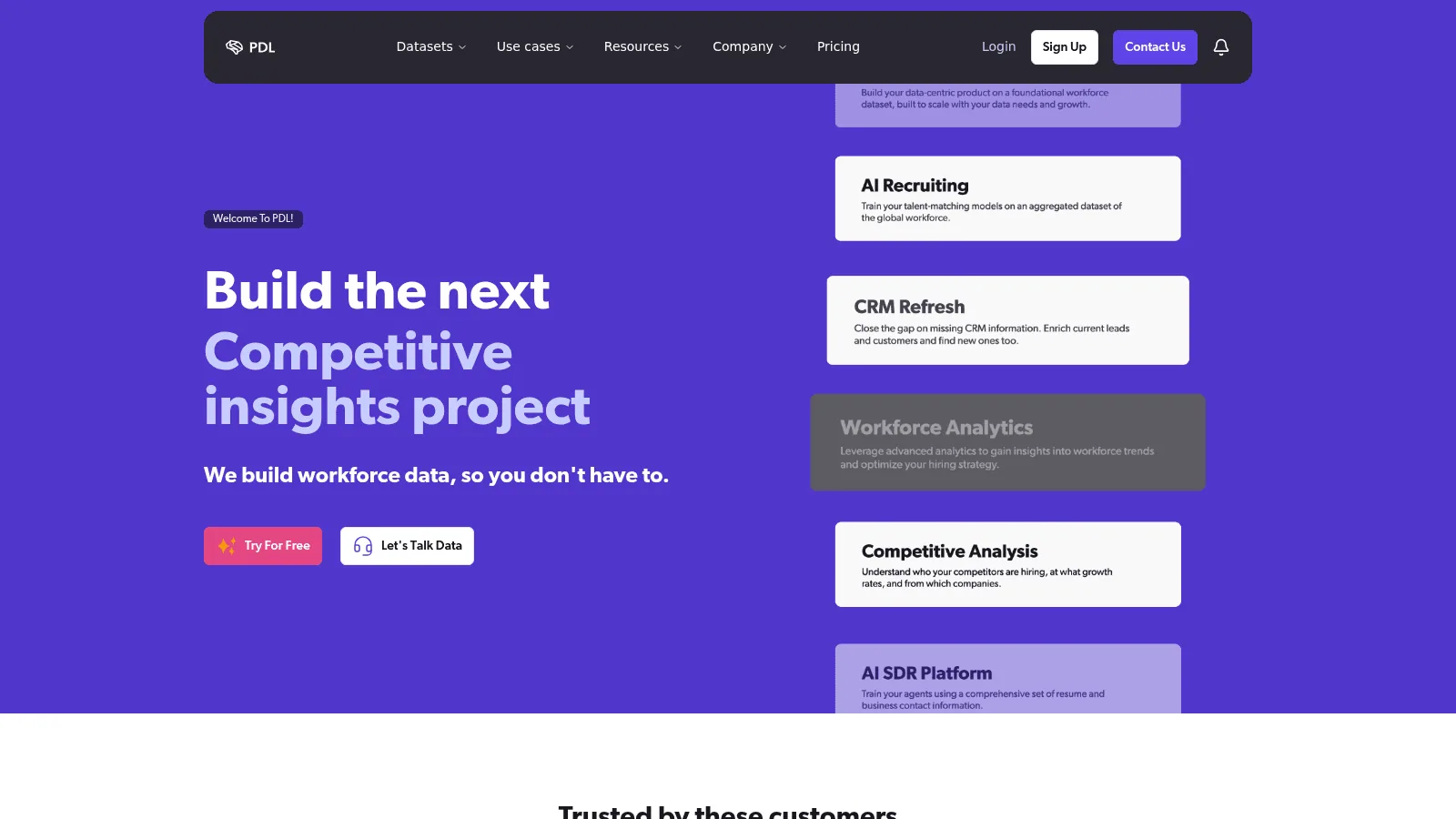
Best for: Bulk records priced per record, with the fill rates printed.
Overview: People Data Labs hands over records rather than answers, sold as developer infrastructure, and it is unusually candid about how much of each record is actually populated.
Key features:
- Fills raw person and company records rather than selected fields, and publishes what share of them are actually populated: 26.7% carry an email and 20.2% a mobile out of roughly 2.47 billion.
- Its 70M+ company records are rebuilt on a monthly cycle.
- Person and company are sold as two separate APIs, a credit to a record on each.
Pricing: Both APIs run free at 100 credits a month, with contact fields obfuscated on the free tier. Paid, the person API is $98 monthly or $940 for a year from 350 credits, and the company API $100 or $960 from 1,000 records. Bulk licensing sits on Enterprise terms.
Pros: States what proportion of records carry each field instead of quoting a headline total, rebuilds company data monthly, offers a free tier against the production API, and licenses in bulk
Cons: The contact fields most buyers want to judge are masked on the free plan, and nothing here resembles an application
Why buyers shortlist it: Knowing in advance what share of records will come back populated removes most of the guesswork.
Final verdict: Well suited to engineers. Of no use to anyone waiting for a screen.
7. Lusha
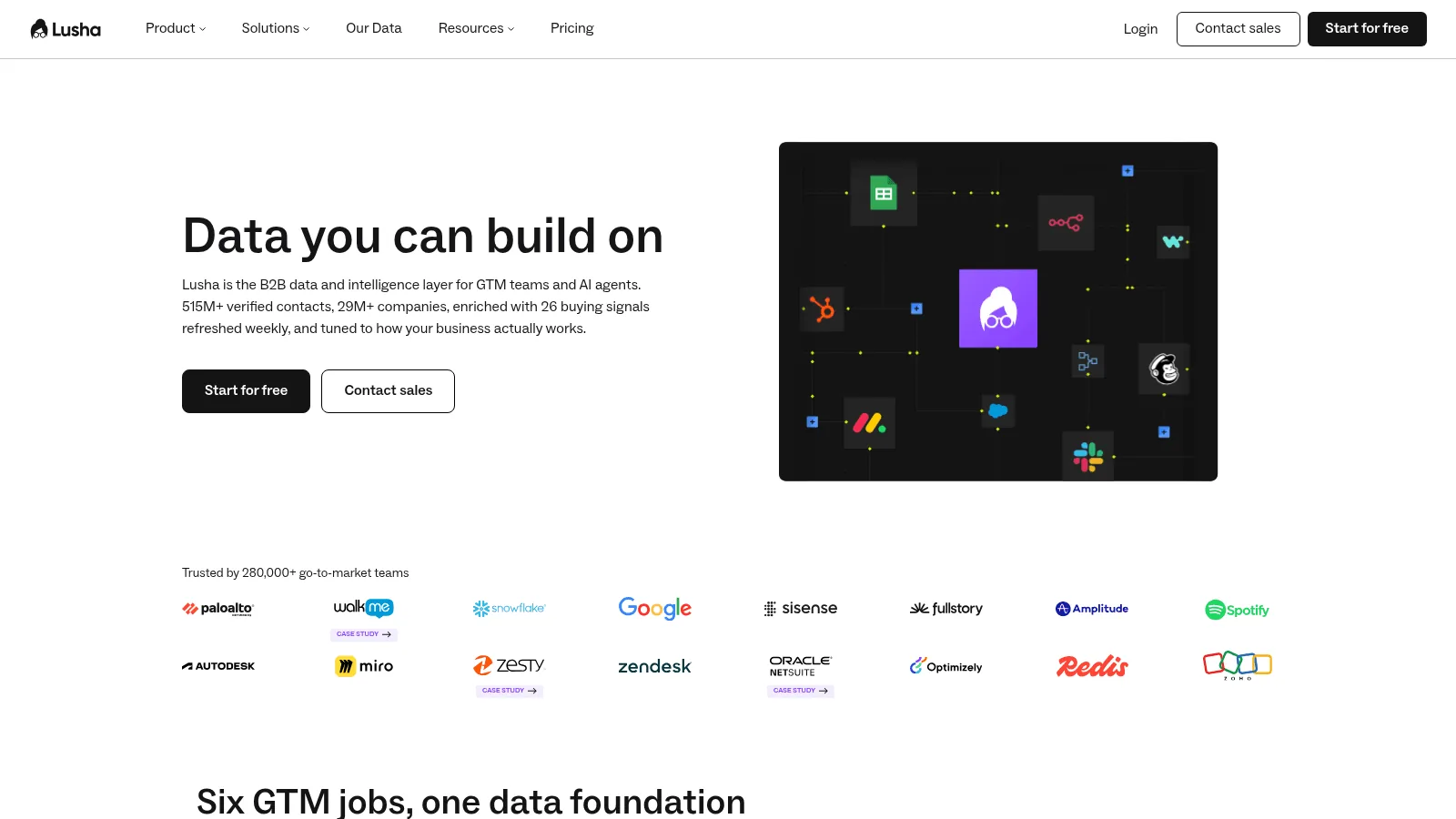
Best for: Transparency about how old the data is.
Overview: Lusha sells fields individually and is alone here in telling you, field by field, how recently each one was refreshed.
Key features:
- Fills one field at a time and charges that way, an email for a credit and a phone for five.
- Publishes how often each of 103 fields is refreshed, which no other entry here attempts at field level.
- Behind it sit 515M+ contacts and 29M+ companies, 165M+ of those emails verified.
Pricing: Seats come bundled rather than added: one on Starter at $37.45 yearly or $49.90 month to month, two on Pro at $52.45 or $69.90, five on Premium at $299.95 or $399.90. A free account carries 40 credits a month.
Pros: Field-level freshness reporting no other entry attempts, a usable free allowance, seats folded into the plan price, and MCP on every tier with the API from Pro up
Cons: Its own documentation says a yearly allowance is lost at term end, and every API request costs at least one credit whether or not a field comes back, a rule you only feel once calls are automated
Why buyers shortlist it: You can find out how old a field is before you buy, which is rare enough to decide the purchase.
Final verdict: Good where a person is clicking. Check what happens to unused credits before signing annually.
8. Coresignal
Best for: Volume, plus hiring signals at a scale nothing else here matches.
Overview: Coresignal sells hiring activity at dataset scale, 486M+ job postings against LeadMagic's 46M+, alongside employee and company records, through an API built for platforms rather than people.
Key features:
- Fills employment history and hiring activity as well as the usual firmographics, across 907M+ employee records, 70M+ companies and 482M+ job postings.
- A job posting costs a single credit while a person or company record costs ten to twenty, so the unit shifts within one vendor.
- Delivery spans REST, webhooks, an MCP server and agentic search.
Pricing: Volume alone sets it. After a seven-day trial on 2,000 credits, $49 buys 2,500 credits a month, $199 buys 12,000, $499 buys 35,000, and four tiers above that reach $5,000. A yearly commitment takes 10% off and releases the credits upfront.
Pros: Every API rung priced in public rather than behind a form, job-posting data at a scale no rival here matches, and a trial that runs against the real endpoints
Cons: Unused credits mostly disappear, and because one record costs ten to twenty of them, its per-credit price cannot be set beside a one-credit vendor without converting first
Why buyers shortlist it: Knowing who a company is hiring is a field the contact databases simply do not carry.
Final verdict: Built for products at volume. Useless to an individual seller.
9. Explorium
Best for: Company attributes bought outright, with nothing renewing.
Overview: Explorium sells prepaid credit packages rather than a subscription, which makes it the only entry here that sells nothing but prepaid packages.
Key features:
- Credits stay valid for twelve months, matched here only by Coresignal's annual plans.
- An enrichment costs between one and five credits depending on what you ask for.
- An AgentSource API and an MCP server, with resell rights available at the top tier.
Pricing: A free trial carries 100 credits for 90 days. Lite is $29.99 for 500 credits, Starter $149.99 for 5,000, Growth $749.99 for 30,000 and Scale $7,499.99 for 500,000, which works out from six cents down to a cent and a half each. Enterprise is quoted.
Pros: Nothing renews by default and nothing expires at month end, a twelve-month credit life, a published per-credit rate at every self-serve tier, resale rights available
Cons: Credits are non-refundable, the service stops when they run out unless you switch on the optional auto-refill, which can top up repeatedly without a cap, and its data page and homepage prose give two different coverage figures
Why buyers shortlist it: A year of validity bought outright suits lumpy, project-shaped work better than a subscription.
Final verdict: The right shape for occasional bulk work. Awkward as a steady pipeline.
10. Dropcontact
Best for: European records cleaned inside the CRM.
Overview: Dropcontact is French, and it tidies records as much as it fills them, correcting what is already in the row before adding what is missing. Of everything here it sits closest to the CRM itself.
Key features:
- Billing follows results, and a credit spent on an email it could not find comes back.
- Pipedrive and HubSpot connect natively; Salesforce and Zoho are described as coming.
- The entry plan already includes API and MCP access.
Pricing: Read it carefully, because the page loads with the volume selector at 4,000 credits rather than at the bottom. The real floor is Starter: 500 credits for €29 monthly, or €24 on yearly billing, with Growth at €35 or €29. No free plan exists, only 50 credits behind the trial button.
Pros: Data and support kept in Europe, nothing billed for a field it fails to fill, CRM connections that need no middleware, and the lowest starting price here
Cons: Three things a buyer would assume are standard, carry-over, company fields and change detection, all begin one tier up at Growth; and the pricing page opens at a mid-range volume that overstates the real entry price threefold
Why buyers shortlist it: When both the records and the regulator sit in Europe, the shortlist tends to be short.
Final verdict: Excellent at keeping a European CRM clean. Little reason to pick it for US-only data.
11. LeadMagic
Best for: One billing rule across every type of call.
Overview: LeadMagic has no interface worth describing and one billing rule that holds across every endpoint: a field that comes back is charged, a field that does not is free.
Key features:
- Prices each field separately and cheaply: a quarter credit to validate, one to find an email, five for a mobile, three to check a job change.
- Draws on 400M+ people, 25M+ companies and 46M+ job postings.
- REST, MCP, a command line and CSV upload all ship with every plan.
Pricing: 5,000 credits cost $99 monthly or $83 on a year's commitment, 20,000 cost $249 or $208, and 50,000 cost $499 or $416. Unused credits bank to twice the allowance on monthly billing and vanish entirely on annual.
Pros: One predictable rule on every endpoint, all four delivery methods available at any tier, validation priced in fractions of a credit, and job changes checkable on demand
Cons: Nothing is free, not even a handful of trial credits, so evaluating it has a price; and once you reach the $499 tier each additional person in the workspace costs $49 a month
Why buyers shortlist it: Costing a workflow in advance is arithmetic rather than guesswork.
Final verdict: Suits engineers who want one rule. Frustrating for anyone who evaluates before buying.
Enriching on a Schedule
Buying a tool is the easy half. Deciding what it may overwrite, and how often it runs, is where most implementations stall.
Decide what enrichment may overwrite
Your CRM already holds values for many of the fields an enrichment call returns, and some were typed by a person who knew something the provider does not. A rep who corrected a title last week is more reliable than a monthly rebuild.
Most teams settle on a three-way rule, and it is worth writing down before the first sync rather than after the first complaint. Fill a field when it is empty, every time. Leave a field alone when a person edited it. Overwrite only when the current value came from a previous enrichment run and the new one is more recent.
Tier the cadence instead of refreshing everything
Refreshing 5% of a database every month comes to 60% of it over a year, against 100% for an annual rebuild, and it keeps the records you actually touch current rather than all of them equally.
Tier it: accounts your team works might refresh monthly, while the long tail waits until you ask for it. Leave that long tail on a quarterly cycle instead and you are refreshing the whole database four times a year, which costs more than the rebuild you were trying to avoid.
Buyers tend to call this CRM hygiene, and one growth lead at a Series A software company described it in exactly those words as the main reason to buy enrichment at all. The label is useful because it sets the right expectation: hygiene is something you keep doing, not a project you finish.
Enrich at capture when software acts on the answer
Some records cannot wait for a schedule. A signup form asks for an email and a name, and enrichment turns those into a company, a size and a role while the user is still on the page, which is what lets routing happen before anyone looks.
The pressure to enrich at the moment of capture is increasing. One product lead at a CRM vendor put it plainly: with little context attached to a lead, their scoring model performed poorly, so better enrichment became the thing that had to happen before the AI feature could work at all.
Any system that reasons about a lead, whether it scores, routes or drafts, is only as good as the context it was handed, which is the argument running through lead scoring generally.
Choosing Between Them
The best data enrichment tool is the one that fills the fields you are actually missing, not the one with the most records, and the best data enrichment tool for a product team is rarely the one a sales team would pick. Start there, because data enrichment companies compete on very different ground depending on what they hold.
If the gap is company firmographics, Explorium fills them cheapest and Dropcontact does it inside your CRM. If the gap is contact details, the email enrichment tools in this list separate quickly: Apollo.io and Lusha publish the clearest per-credit rates, Cognism owns European mobiles, and LeadMagic bills only on success.
If the gap is coverage rather than any single field, Clay's waterfall is the honest answer, because it queries several data enrichment vendors in sequence rather than betting on one.
If software is doing the work and nobody is logging in, the shape changes. People Data Labs sells raw records at a flat rate, Coresignal adds hiring signals, and we focus on resolving one identity correctly and surfacing the alternative candidates when a match is ambiguous.
Whichever applies, test before you commit. Take a free API key, run a free count on your own segment, and push 200 real records through before anyone signs an annual contract.
FAQs
What is the best free data enrichment tool?
Among free data enrichment software Apollo.io's allowance is the most useful in practice: 900 credits a seat each year, and sending is included. ZoomInfo Lite is free permanently, Clay gives 100 data credits and 500 actions a month, Lusha 40 credits, and People Data Labs 100 credits with the contact fields obfuscated. We give trial credits with no card rather than a free plan, which we would rather state plainly than dress up as a tier.
How much do data enrichment platforms cost?
Published entry prices across these data enrichment platforms run from Dropcontact at €24 a month and Explorium at $29.99 for a credit pack, through Lusha at $37.45 and Apollo.io at $49 a seat, up to Clay at $167. ZoomInfo and Cognism publish nothing at any paid tier. Compare them on cost per usable record rather than on the headline, because the unit behind each price is different.
How often should you re-enrich your records?
Tier it rather than picking one interval. Records your team actively works justify a monthly refresh, while the long tail is better refreshed on demand than on a schedule, because a quarterly cycle on the whole database costs more over a year than one rebuild.
Business churn gives you the floor: with roughly one in nine UK businesses closing in a year, and more than one in five in some sectors, an annual rebuild leaves a meaningful share of your accounts wrong for months.
What is the difference between data enrichment and data cleansing?
Enrichment adds information a record is missing, which is what every data enrichment solution on this page sells, whether that is a company size or the email enrichment tools half of the job. Cleansing fixes or removes what is already there and wrong, including duplicates. Most teams need both, and the order matters: deduplicating before you enrich stops you paying twice for the same company under three spellings.
Can you stack multiple data enrichment companies?
Yes, and plenty of teams run two or three data enrichment companies side by side, because no single source gets every record right. Running two providers and keeping the better answer per field is the waterfall approach Clay is built around, and our own data enrichment API is often used as one step inside someone else's. The cost only makes sense once you have measured how much each provider adds that the other missed.
The data layer behind your GTM engine
Access fresh people and company data through one API and power every enrichment, prospecting, and automation workflow.
- Profiles
- 800M+
- Refreshes / month
- 200M
- Response time (P95)
- 500ms