
17 Best Sales Prospecting Tools for B2B Teams in 2026
Julien K.Published
Key takeaways:
- A prospecting workflow has five jobs: find people, enrich records, verify contact details, spot buying signals and send. The 17 tools below are grouped by the job they do best.
- One paid tool per job starts at about $355 a month, mostly on annual billing, but $167 of that is Clay, which most teams add later. Without it, the floor is nearer $190.
- Eight of the 17 publish a free plan, ZoomInfo's Lite plan among them, while Cognism and 6sense publish no price at all.
- Reverse Contact sits at the find step as an API: you describe a buyer in one sentence or start from one great customer, and you pair it with a separate tool for sending.
Ask a sales team what slows prospecting down and you rarely hear "we need another tool." You hear about copying lists from one app to the next, emails that bounce and reps who research accounts by hand. The right sales prospecting tools fix one of those jobs each, and the hard part is buying no more of them than your workflow needs.
Tool overload has a measurable cost. A Gartner survey of 1,026 B2B sellers found 50% feel overwhelmed by the amount of technology they need, and overwhelmed sellers were 45% less likely to hit quota.
One SDR on Reddit listed a separate tool for leads, enrichment, research and sequencing, then summed it up: "By the time everything is connected, you're managing the stack almost as much as the actual outreach." That's one person's experience, and it matches the Gartner finding.
This guide sorts the best sales prospecting software into 17 picks by the job each one does, with every price read on the vendor's own pricing page in October 2026. Reverse Contact is our product and sits first, at the find step.
How a Sales Prospecting Stack Fits Together
Every outbound motion runs the same five jobs in the same order, whether one tool does all of them or five tools split the work. Mapping your current tools, sales research tools included, to these jobs is the fastest way to spot a gap or a double payment.
- Find the companies and people who match your ideal customer, then build a list.
- Enrich each record by filling in missing fields, such as job title, headcount and industry.
- Get a working email or phone for each person, and check it before you use it.
- Spot which accounts are likely to buy right now, from website visits, job changes or research activity.
- Send the email or multichannel sequence and track the replies.
The first job matters most, because every later step inherits its mistakes. Prospecting is only one part of your wider set of lead generation tools, but a bad list here wastes credits at every step after it.
How We Chose These Sales Prospecting Platforms
We started from the sales prospecting platforms buyers actually compare at each job, then kept the ones with a clear role in the workflow. We read every vendor's own pricing and product pages on October 7, 2026. We didn't run our own accuracy tests, so any coverage or accuracy figure below is the vendor's claim and is labeled that way.
Each tool had to clear these checks:
- It does at least one of the five jobs well enough to own it.
- Its pricing is published, or the page says plainly that it's quote only.
- It states what you pay for, whether that's seats, credits, contacts or a custom quote.
- It can pass its results to the next tool through an API, an export or a built-in integration, or through MCP, the connector AI assistants use to call a tool.
- It is still sold as a standalone product in 2026.
That last check removed Clearbit, which HubSpot absorbed; paid HubSpot users now get contact and company enrichment instead.
The 17 Best Sales Prospecting Tools Compared
The table shows each pick of the best sales prospecting software by main job, its biggest drawback, whether it has a free plan and the lowest published paid price.
| Tool | Best for | Key features | Main limitation | Pricing (from) | Free plan? |
|---|---|---|---|---|---|
| Reverse Contact | Building lists inside your own tools | Agentic search, lookalike search, 30+ criteria | API, not a point-and-click rep app | Credit packs from $100; $449/month (Plus, unlimited search); Go from $249 | No |
| Lusha | One rep needing phones | Email and phone reveals, MCP | Strict API rate limits below Pro | $37.45/month billed yearly | Yes, 40 credits/month |
| Apollo.io | Small teams wanting one tool | Database, sequences, dialer | Unused credits expire each cycle | $49/seat/month billed annually | Yes, 900 credits/year |
| UpLead | Predictable cost per lead | One credit per contact | Single user below Professional | $74/month billed annually | No |
| ZoomInfo | Enterprise teams with procurement | Contact and company data, Copilot tiers | No public price for paid tiers | Quote only (paid tiers) | Yes, ZoomInfo Lite |
| Cognism | Phone-led selling in Europe and the US | Do-Not-Call screening, API and MCP | Packaged around 5 seats | Quote only | No |
| Clay | Combining many data providers | Waterfall enrichment, 150+ providers | HTTP API needs Growth | $167/month billed annually | Yes, 100 data credits/month |
| Hunter.io | Turning names into emails | Email finder, verifier, free API | Email only | $34/month billed yearly | Yes, 50 credits/month |
| Prospeo | A low-cost second finder | Emails and mobiles, add-on credits | Priced per user | $37/user/month billed yearly | Yes, 100 credits/month |
| ZeroBounce | Checking lists before sending | Validation, free unknowns | No prospect database | $39 one-time for 2,000 validations | Yes, 100 validations/month |
| Findymail | Low-bounce email lists | Bounce guarantee, rollover | Mobile finder not in the EU | $41/month billed yearly | No |
| RB2B | Website visitor identification | Company and US person-level ID | Person-level ID is US only | $79/month | Yes, 150 company matches |
| Common Room | Intent and job-change signals | Bombora topics, job changes, MCP | One priced tier, no free plan | $2,500/month billed annually | No |
| 6sense | Account-based teams | Predictive scoring, intent, visitor ID | Demo needed to see a price | Quote only | No |
| Instantly | Cold email across many mailboxes | Unlimited sending accounts, warm-up | Lead data costs extra | $37.60/month billed yearly | No |
| Reply.io | Multichannel sequences | Email and multichannel plans, API | Multichannel billed per user | $49/month billed annually | No |
| Lemlist | Sending plus a light data add-on | Sequences, lead data add-on, MCP | Contact data costs extra | $55/month billed yearly | No |
The numbers follow the workflow, not a ranking. Reverse Contact leads its group since it's our own product. After it, each group runs from the lowest published paid price to the highest, with quote-only tools last.
For a fast answer, Apollo.io suits a small team that wants one tool, Cognism suits phone-heavy selling in Europe, Hunter.io covers emails only, Reverse Contact builds lists inside your own software and Instantly spreads sending across many mailboxes.
Find and Build Lists
The six list builders below answer the first question in any campaign: who should we contact? They differ most in how you search and whether you buy seats or API calls.
1. Reverse Contact
Best for: Building prospect lists inside your own tools
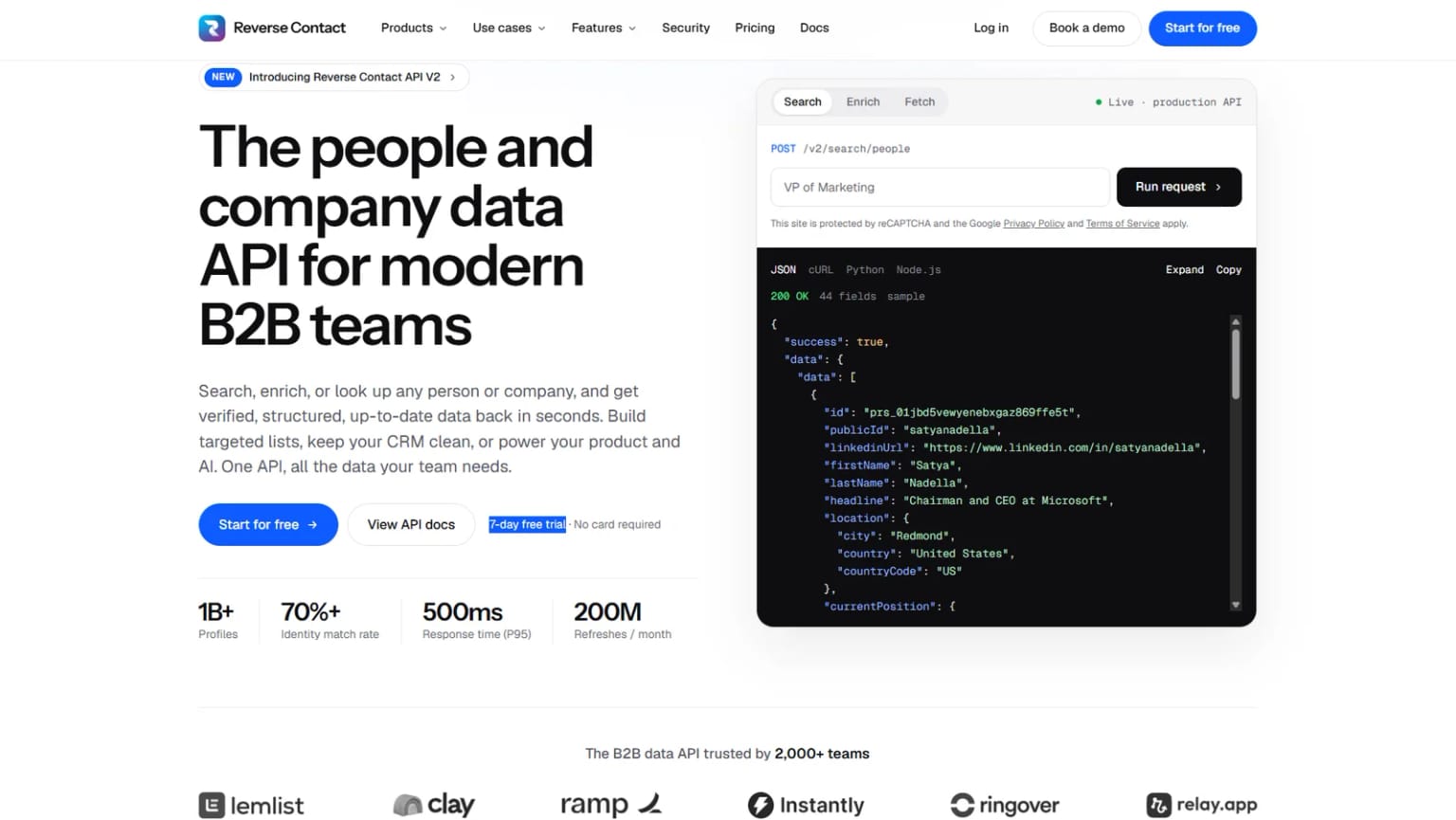
Overview: Reverse Contact sells people and company data through an API. An API is a way for your software to ask for data and get it back in a fixed format, so your CRM, an internal app or an AI agent can pull prospects without anyone exporting a spreadsheet.
For prospecting, the useful part is search. With our agentic search, you describe who you need in one sentence, such as "heads of finance at logistics companies with 200 to 1,000 staff in Texas," and get matching profiles back. If you'd rather start from an example, lookalike search takes one profile of a great customer and returns people like them, and standard search filters on 30+ criteria.
The same search powers products, too. collectif.work, a recruiting marketplace, runs its recruiter search on our API: one request can return up to 100 matching profiles, and it sends us 500,000 to 800,000 requests a month.
Whatever you search for, we'd rather return nothing than a profile that fails our checks, and an empty standard search, cached lookup or contact lookup costs nothing. An agentic search page that finds no one still costs 1 credit. Once the list is built, pair us with a sending tool from the last group in this list, since we don't send email or run sequences.
Key features:
- Agentic search turns a one-sentence brief into a list, and a prompt we can't turn into a search costs nothing
- 30+ search criteria, including role, seniority, department, headcount and industry
- The date each profile was last fully refreshed, so you can see how fresh a title is
- Business emails at 3 credits per email found and direct phones at 20 credits whenever a lookup returns a number
- Delivery by REST API, webhooks (results pushed to your system when they're ready), CSV upload and an MCP server
Pricing: Go is $249 per month, Plus $449 and Max $699, all billed monthly with no annual commitment, and credit packs start at $100. Plus is the prospecting plan: it makes people and company search unlimited, with agentic and lookalike search included within fair use. Every plan still bills credits for real-time re-fetches of a profile, emails and phones, and unlimited plans cover your own team's use, so embedding or reselling the data needs a Platform contract, priced on a call with sales.
Pros: Plain-English list building, lookalike lists from one customer, empty standard searches and contact lookups are free, unlimited search on Plus within fair use
Cons: Built as an API rather than a point-and-click rep app, no free plan beyond free trial credits
How to start using it:
- Open an account to get free trial credits (no card needed).
- Write one sentence that describes your ideal buyer and run it through agentic search.
- Pick your best current customer and run a lookalike search from that profile.
- Find emails for the people you'll contact, and add phones (20 credits whenever one is found) only for top accounts.
- Push the finished list to your CRM or sending tool by CSV, webhook or API.
Why it's a good sales prospecting tool: It handles the find step in plain English and hands every later step a record with its refresh date attached, so stale titles get dropped early.
Final verdict: Choose Reverse Contact if someone on your team can connect an API and you want lists built from a description or from a lookalike, then sent with the tool you already use. Reps who want a browser tab to click through will be happier with Lusha, covered next, or Apollo.io.
2. Lusha
Best for: One rep needing phones
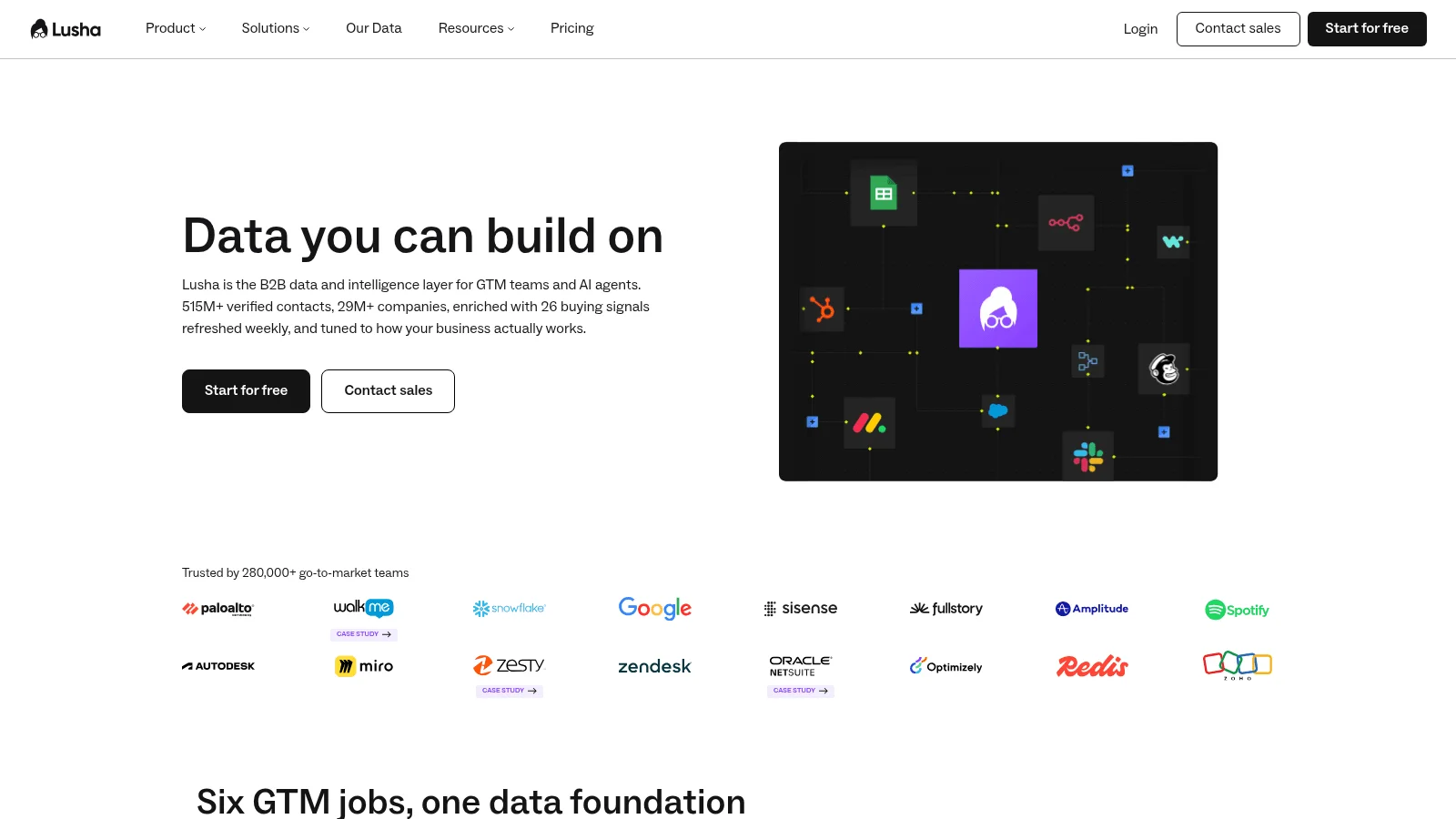
Overview: Lusha is a contact database priced per account, with seats included in each plan. It publishes 515M+ contacts across 238 countries and territories, plus 98% email and 86% phone accuracy, all self-reported.
Key features:
- Email reveals at 1 credit and phone reveals at 5
- MCP access on every tier, Free included
- Credit rollover of up to 2x on Pro and Premium
Pricing: The free plan gives 40 credits a month with no card. Starter costs $37.45 per month billed yearly or $49.90 monthly for one seat, and the API runs under strict rate limits until Pro ($52.45 per month billed yearly).
Pros: Free plan with no card, phones at 5 credits, low entry price
Cons: Strict API rate limits below Pro, Starter covers one seat, rollover only from Pro up
What it does best: Lusha gets a single rep from a target account to a direct phone number at a low monthly price.
Final verdict: Pick Lusha for a single rep who needs phones and emails without a contract.
3. Apollo.io
Best for: Small teams wanting one tool
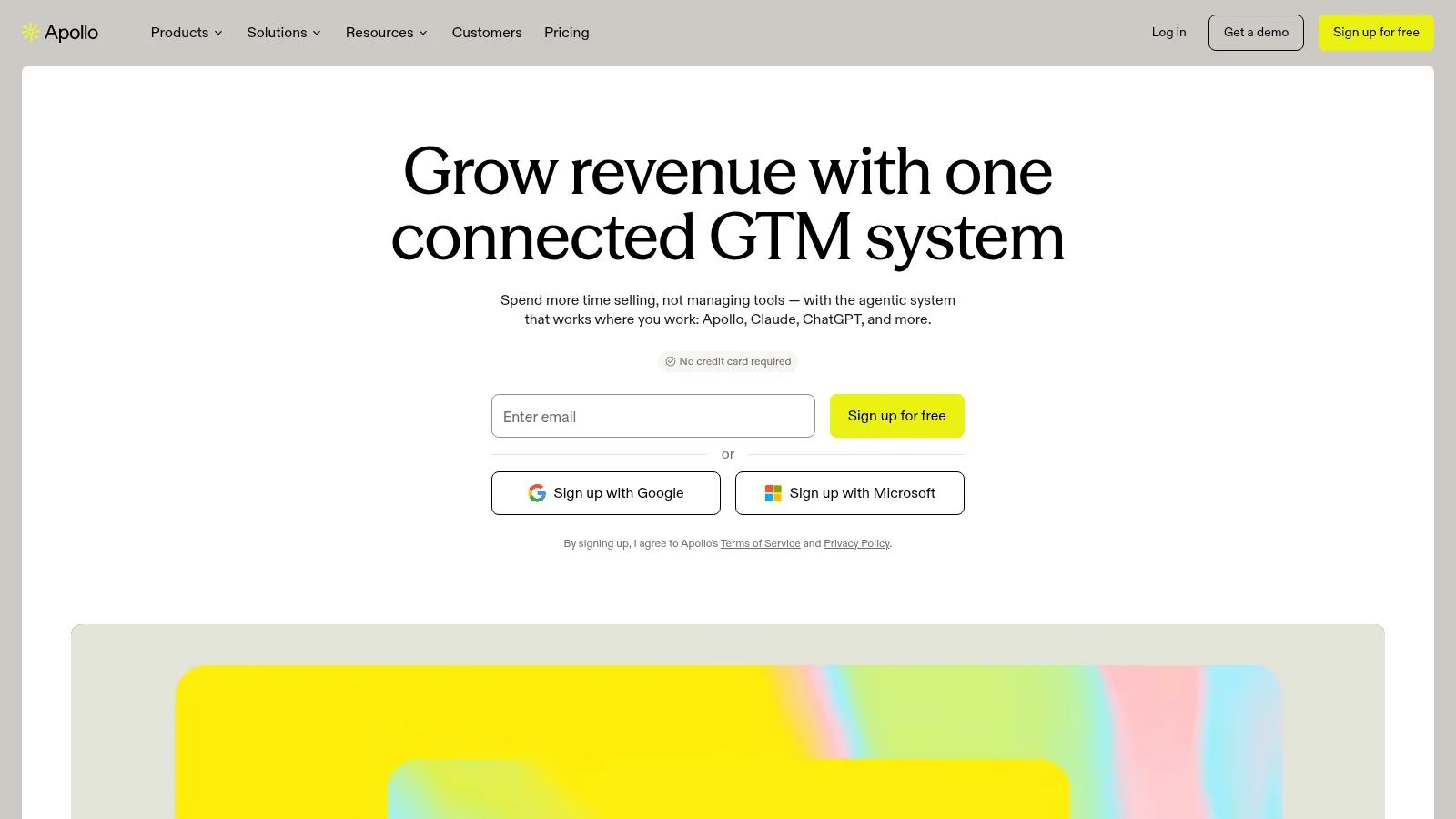
Overview: Apollo.io puts a contact database, email sequences, a dialer and a light CRM in one account. It publishes 240M+ contacts and 30M+ companies.
Key features:
- Database search with reveals at 1 credit per email and 8 per phone
- Built-in sequences and dialer, so the list never leaves the app
- API access listed on Free, API enrichment on paid plans and other APIs on custom plans
Pricing: The free plan's 900 yearly credits per seat arrive in monthly installments. Basic starts at $49 per seat per month billed annually, and every seat must sit on the same plan.
Pros: Real free plan, finding and sending in one place, low entry price per seat
Cons: Unused credits expire each billing cycle, Organization needs 3 seats minimum, the remaining APIs sit on custom plans
Why it's a good sales prospecting tool: It covers finding, enriching and sending in one login, which is the quickest cure for stack sprawl.
Final verdict: Start with Apollo.io if you have fewer than five reps and no ops person, then add specialists only where its data falls short in your market.
4. UpLead
Best for: Predictable cost per lead
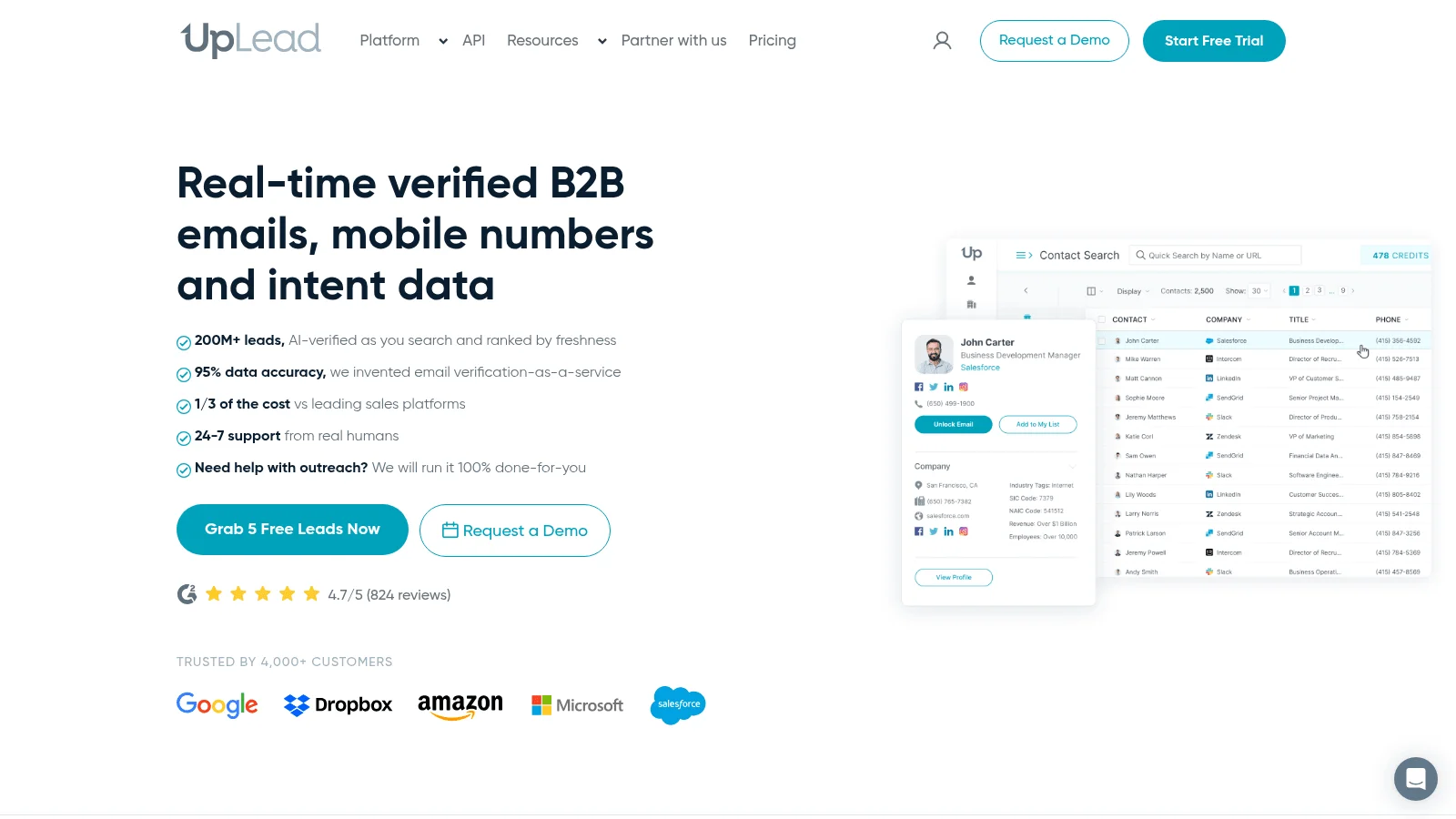
Overview: UpLead sells contacts on a simple rule: one credit buys one contact, email and mobile together. Its homepage claims 200M+ leads and 95% accuracy. Essentials and Plus give you one user, and extra seats come only with Professional, which is annual and custom priced.
Key features:
- One credit per contact covers both email and mobile
- Extra credits at $0.60 on Essentials and $0.50 on Plus
- Full API access on the Professional plan
Pricing: Essentials runs $74 a month billed annually for 2,040 credits a year, or $99 monthly for 170 credits.
Pros: Email and mobile in one credit, easy cost forecasting, 7-day trial with 5 credits
Cons: Single user below Professional, full API only on annual Professional, no free plan
Why it's on the list: You get the mobile number with the email at no extra charge, where most tools here bill phones separately.
Final verdict: UpLead suits a solo seller who wants to know exactly what each lead costs.
5. ZoomInfo
Best for: Enterprise teams with procurement
Overview: ZoomInfo sells contact and company data with sales workflows on top, packaged as Professional, Copilot Advanced and Copilot Enterprise. It publishes 500M+ contacts and 100M+ companies, and a ZoomInfo blog post claims up to 95% accuracy for its verified first-party data.
Key features:
- One credit per export, whether from the app, the browser extension or the API
- Copilot tiers that add AI-assisted workflows to the data
- Sales workflows built on top of the data, so reps work inside one platform
Pricing: You can start on ZoomInfo Lite, which stays free and asks for no card. Paid tiers are quote only, priced on features, number of licenses and credit usage.
Pros: Large published database, data and workflow under one contract, a free Lite tier that doesn't expire
Cons: No public price for paid tiers, multi-year terms are common, heavy for a team of three
Where it fits in the workflow: ZoomInfo covers find and enrich for teams that would rather sign one large contract than manage five small ones.
Final verdict: Shortlist ZoomInfo when legal and procurement are already involved, and skip the paid tiers if you can't wait for a quote and a contract.
6. Cognism
Best for: Phone-led selling in Europe and the US
Overview: Cognism sells B2B contact data built around reaching decision-makers by phone. Its own figures: a 30-day refresh for 95% of contacts at Director level and above, and 90% coverage of that tier in Europe and the US.
Key features:
- Screening against 16 Do-Not-Call lists before you dial
- One credit per revealed contact, shared across the app, Enrich and the API
- MCP and API access from the Standard plan
Pricing: Cognism shows no figures: Standard and Pro are quote only, each with 5 seats. Mobile numbers come on either plan, and Pro layers on intent data, a filter for premium mobiles and mobile checks on request.
Pros: Do-Not-Call screening built in, a simple one-credit-per-contact rule, API and MCP on the entry plan
Cons: No public price, sold in 5-seat packages, intent data reserved for Pro
Who gets the most from it: Sales floors cold-calling European and US decision-makers, because list screening is part of the product.
Final verdict: Choose Cognism if phones drive your pipeline and you have at least five reps to fill the seats.
Enrich Records From Several Sources
Enrichment fills the gaps a list leaves, such as a missing title or headcount. Most list builders above enrich records too: Reverse Contact, Apollo.io, ZoomInfo and Cognism all do. Many teams also start with one of the dedicated data enrichment tools, then add Clay once a single provider misses too many records.
7. Clay
Best for: Combining many data providers
Overview: Clay is a spreadsheet-style workspace that runs enrichment across 150+ data providers plus AI research steps. It doesn't own a database. It runs a waterfall: it asks one provider, then the next if the first comes back empty.
Key features:
- Waterfall enrichment across 150+ providers, with no charge when a lookup returns nothing
- Bring your own provider keys for 1 action and no data credits
- Connections to your own code and systems (HTTP API and webhooks) from the Growth plan
Pricing: Clay's free tier covers 500 actions and 100 data credits monthly, minus phone enrichment. Launch costs $167 per month billed annually, or $185 when paid monthly, split into $60 of actions and $125 of data credits. Growth, which adds CRM auto-sync and the HTTP API, is $446 per month billed annually.
Pros: Unlimited seats, no charge for empty lookups, works with data subscriptions you already pay for
Cons: Two meters to track (actions and data credits), no phone enrichment on Free, CRM sync and HTTP API need Growth
When to add it: Add Clay once you pay for three or more data providers and someone owns the workflow full time.
Final verdict: Clay is the orchestration layer for teams with a builder on staff, and a heavy first purchase for a two-person team.
Find and Verify Contact Details
The four contact tools below turn a name and a company into a working email or phone, or check the ones you already have. The real choice is what you need back: emails only (Hunter.io), emails and mobiles at a low price (Prospeo), a check on addresses you already hold (ZeroBounce) or emails backed by a bounce guarantee (Findymail). Recruiters weighing SignalHire alternatives face the same split between email-only finders and tools that return mobiles.
8. Hunter.io
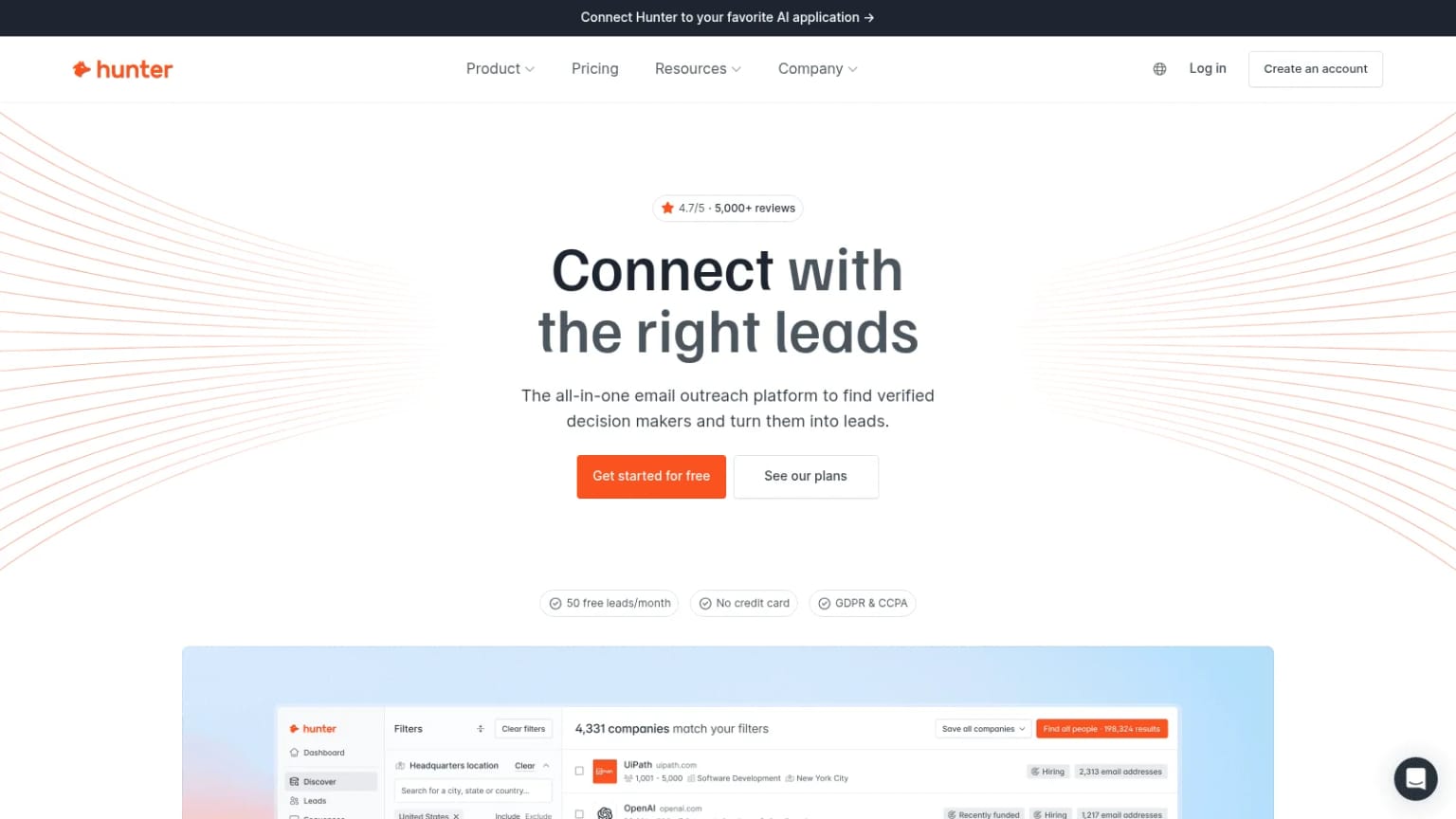
Best for: Turning names into emails
Overview: Hunter.io finds and verifies business emails from a name and a company domain. It publishes no accuracy or match rate. Instead, each email carries a confidence score you can filter on before sending.
Key features:
- One credit per email found, with no charge when nothing turns up
- Verification at 0.5 credit per address
- API and MCP on every plan, Free included
Pricing: Hunter's free tier comes with 50 monthly credits. Starter is $34 per month on yearly billing ($408, with all 24,000 credits upfront) or $49 month to month for 2,000 credits a month, shared by unlimited users.
Pros: Free plan with API access, unlimited users share credits, a confidence score on every email
Cons: Email only, unused credits reset each month on monthly billing, no published match rate
What it does best: Hunter.io turns a list of names and domains into checked emails with almost no setup.
Final verdict: Use Hunter.io for the email step when your list already lives somewhere else.
9. Prospeo
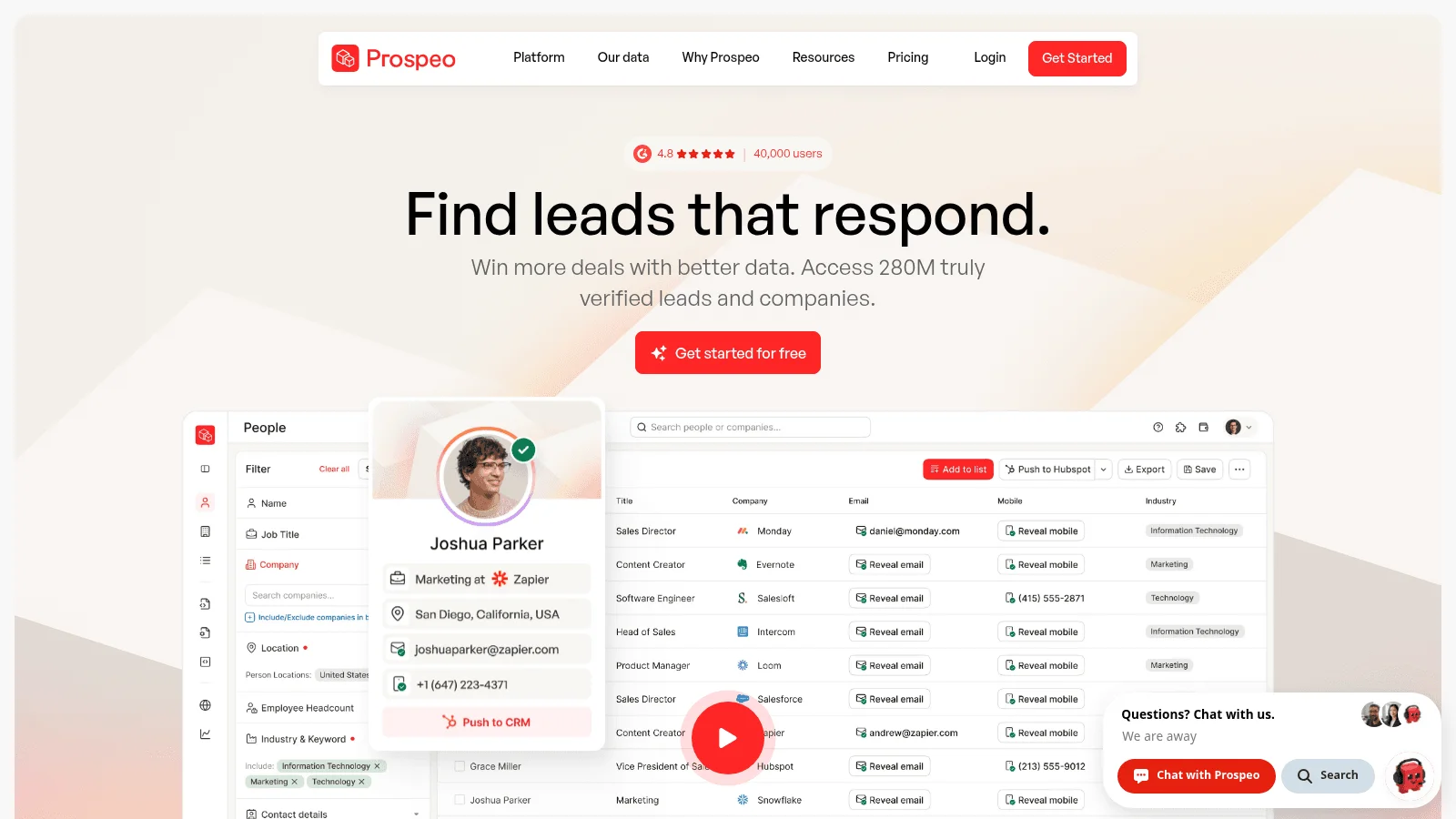
Best for: A low-cost second finder
Overview: Prospeo finds verified emails and mobile numbers, priced per user. It publishes 280M verified leads and companies on its homepage (300M+ on its data page) and a 98% accuracy rate across all fields, all its own figures.
Key features:
- 1 credit per verified email and 10 per mobile
- API from the Starter plan
- Add-on credits from $10 per 1,000
Pricing: Free gives 100 credits a month with MCP but without API access. Starter is priced per user at $37 a month paid yearly, or $49 paid monthly, with 2,000 credits each month.
Pros: A usable free tier, cheap add-on credits, emails and mobiles in one tool
Cons: Priced per user, credits don't roll over, no API on Free
When to add it: Add Prospeo as a second finder in a waterfall when your main tool misses too many emails.
Final verdict: Prospeo is a sensible backup finder at a low entry price, and its Free plan makes it easy to test.
10. ZeroBounce
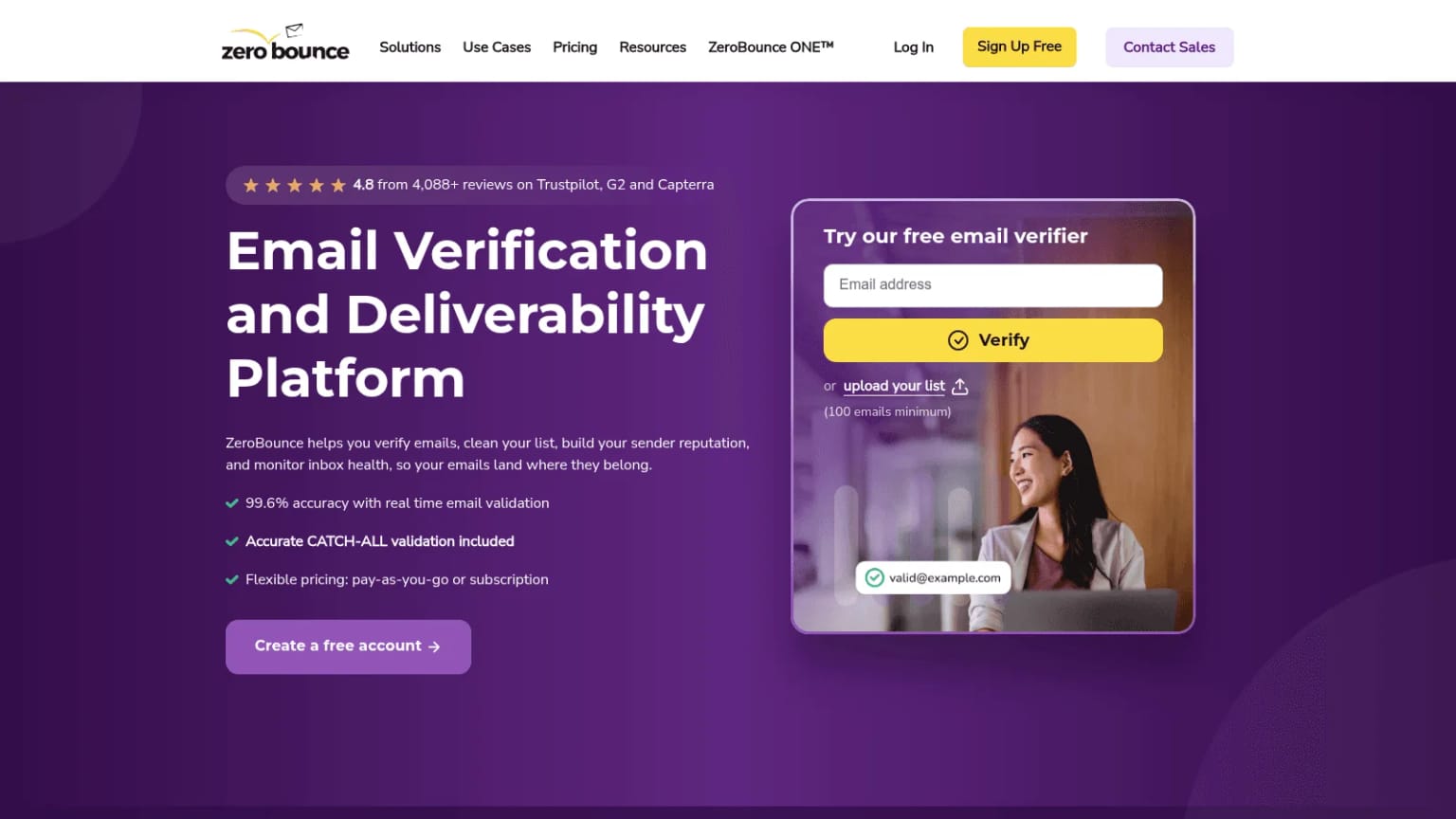
Best for: Checking lists before sending
Overview: ZeroBounce is an email verifier, not a contact database. You give it addresses you already have and it tells you which are safe to send to, and it guarantees 99.6% validation accuracy (its own claim).
Key features:
- One credit per validation, with unknown results free
- API on every account, free ones included
- An email finder at 20 credits per successful query
Pricing: The free plan gives 100 validations a month if you sign up with a business domain. A one-time pay-as-you-go purchase starts at $39 for 2,000 validations.
Pros: Free monthly validations, no charge for unknowns, a pay-as-you-go option
Cons: No prospect database, finder queries cost 20 times a validation, the free plan needs a business email
Where it fits in the workflow: ZeroBounce is the last check between a finished list and your sending tool.
Final verdict: Run ZeroBounce on any list that has sat in a spreadsheet for a few weeks before it goes into a sequence.
11. Findymail
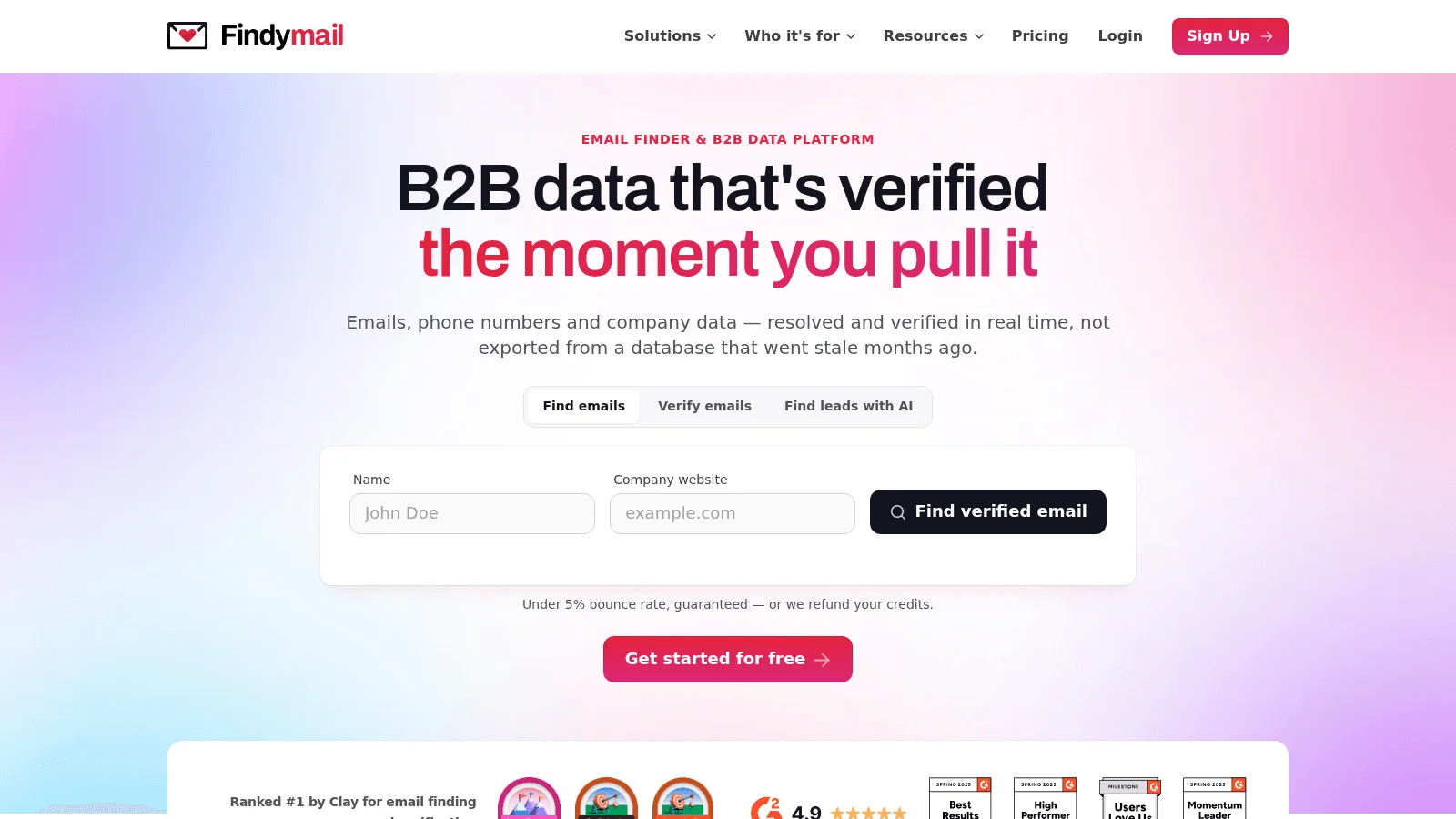
Best for: Low-bounce email lists
Overview: Findymail finds and verifies emails and, outside the EU, mobile numbers. It backs the data with a guarantee: if your bounce rate tops 5%, it refunds the credits.
Key features:
- 1 credit per email and 10 per phone, charged only when found
- Credits roll over up to twice the plan amount
- API on every plan, priced per account rather than per seat
Pricing: Basic is $41 per month billed yearly or $49 monthly for 1,000 credits.
Pros: Bounce guarantee with a credit refund, no per-seat fees, credit rollover
Cons: Mobile finder unavailable in the EU, a free trial of only 10 credits, phones cost 10 times an email
Why it's on the list: The under-5% bounce guarantee puts a number on email risk before a campaign starts.
Final verdict: Choose Findymail if your sending domain can't afford a bad week of bounces.
Spot Buying Signals
Signal tools tell you which accounts to contact this week rather than this quarter. Many use intent data, meaning signs that a company is researching your category, such as reading articles about it. A signal only pays off if it changes your lead scoring and reaches a rep fast.
Buyers we talk to send trigger data straight to the salesperson, because it expires. An executive at a sales-trigger data company put it simply: if a company is "going to open up an office in six months, you need to call them" now.
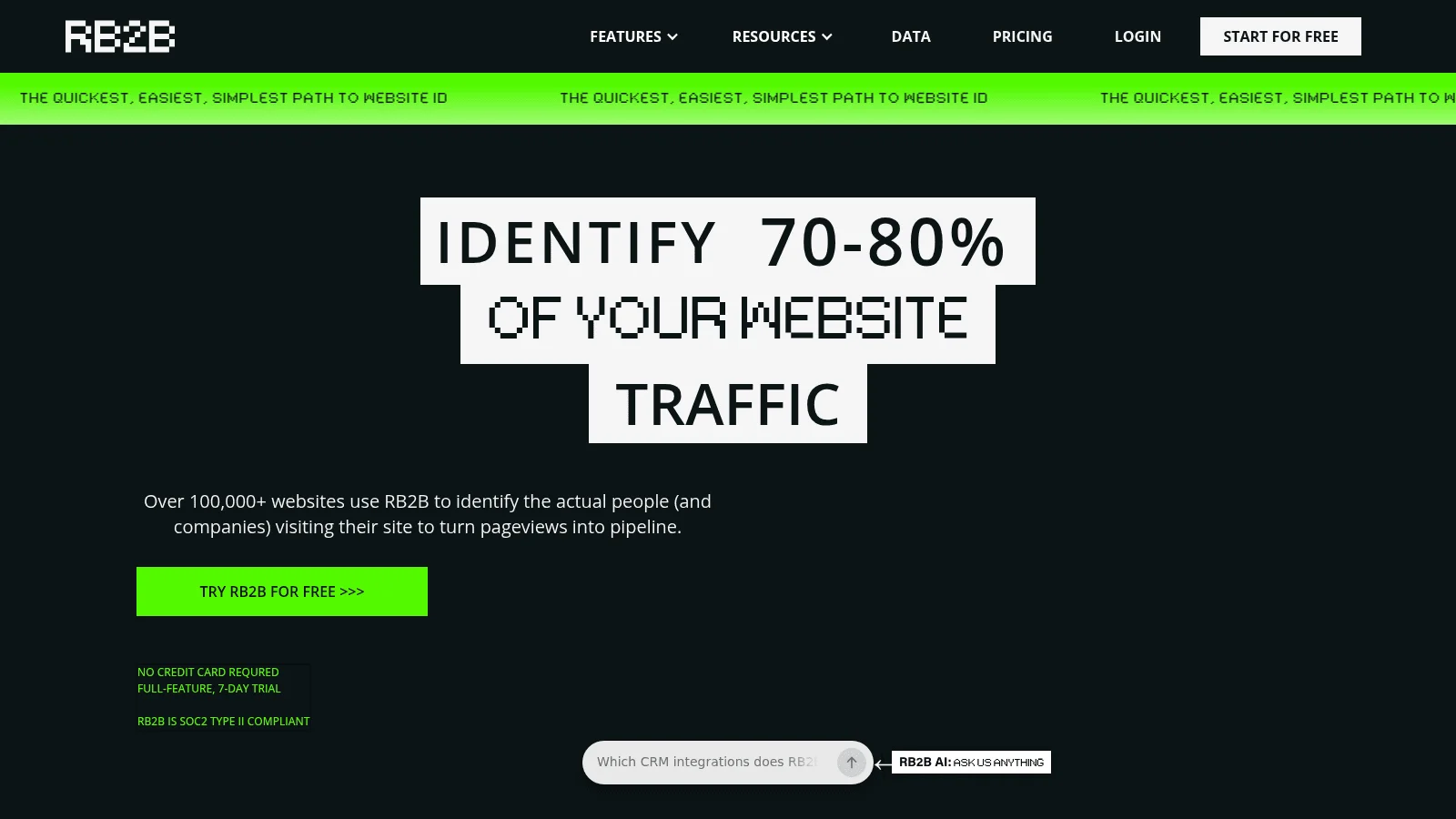
12. RB2B
Best for: Website visitor identification
Overview: RB2B identifies who visits your website. The free plan names companies, and paid plans name individual US visitors, with stated person-level coverage of 15-20% on Starter and Pro.
Key features:
- Company-level visitor identification on the free plan
- Person-level identification in the US on paid plans
- Business emails and full integrations from Pro
Pricing: Free covers 150 company-level resolutions a month, Starter costs $79 per month for 300, and Pro starts at $149 per month with emails and integrations. Every plan is billed monthly.
Pros: A free company-level plan, month-to-month billing, a clear trigger for warm outreach
Cons: Person-level ID is US only, Starter sends visitors to Slack or Teams but has no emails, most visitors stay unnamed at the stated coverage
What it does best: RB2B turns website traffic into a short daily list of accounts already looking at you.
Final verdict: Try the RB2B free plan before you pay for any intent product.
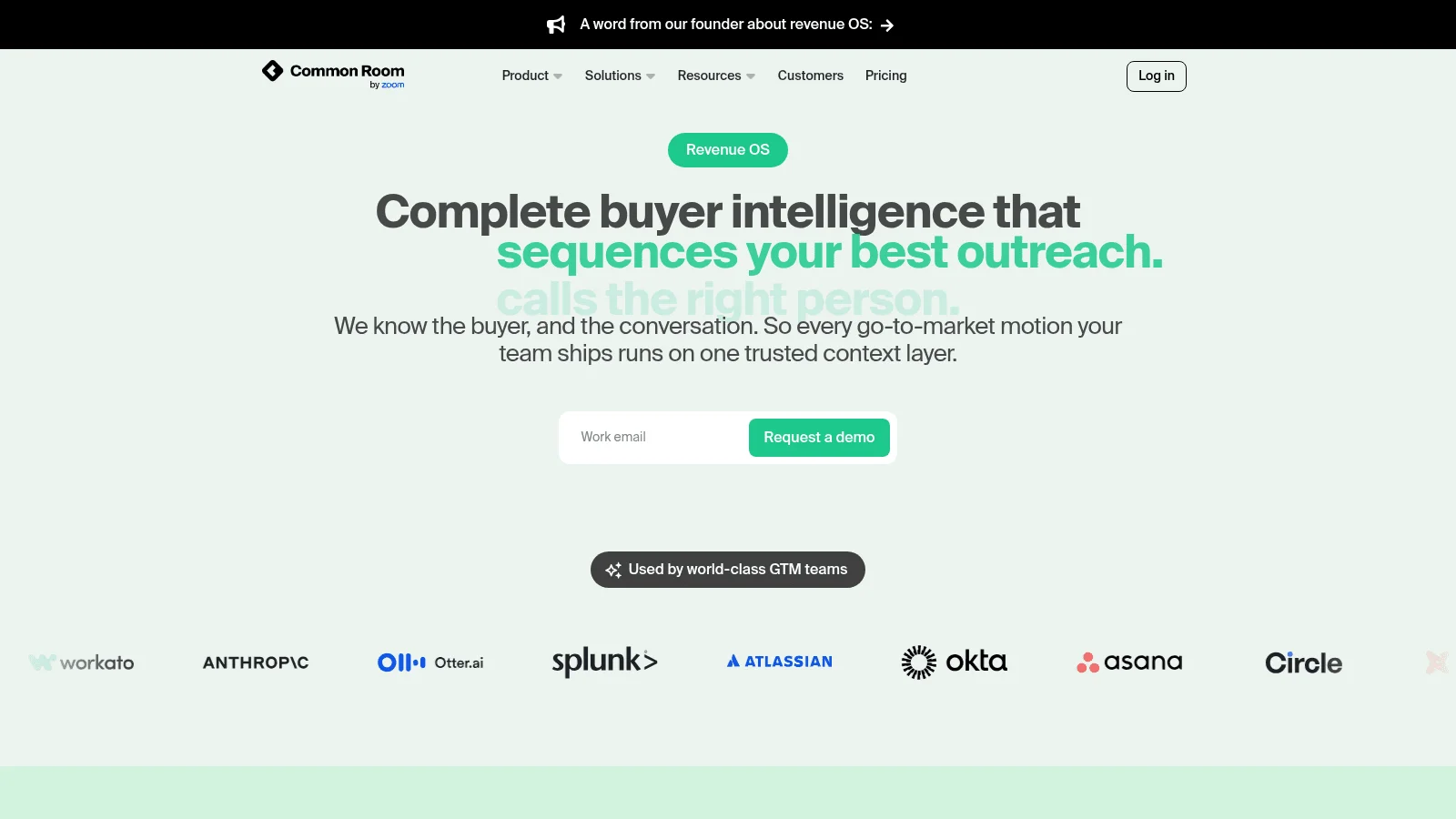
13. Common Room
Best for: Intent and job-change signals
Overview: Common Room, now owned by Zoom, gathers buying signals in one place: intent topics from Bombora (a third-party intent data company), job-change tracking and AI account research.
Key features:
- Six Bombora intent topics on Essential, showing which accounts research your category
- Job-change tracking to catch past champions at their new companies
- An MCP server on all plans
Pricing: The Essential tier runs $2,500 a month on an annual contract and covers five seats and a 100,000-contact ceiling. The two higher tiers have no listed price.
Pros: Intent and job changes in one view, research credits included, MCP on every plan
Cons: A $2,500 monthly entry on annual billing, one priced tier, no free plan
Who gets the most from it: Teams with several reps working named accounts, where signal volume justifies the price.
Final verdict: Common Room fits when your team is short on timing, not on contacts.
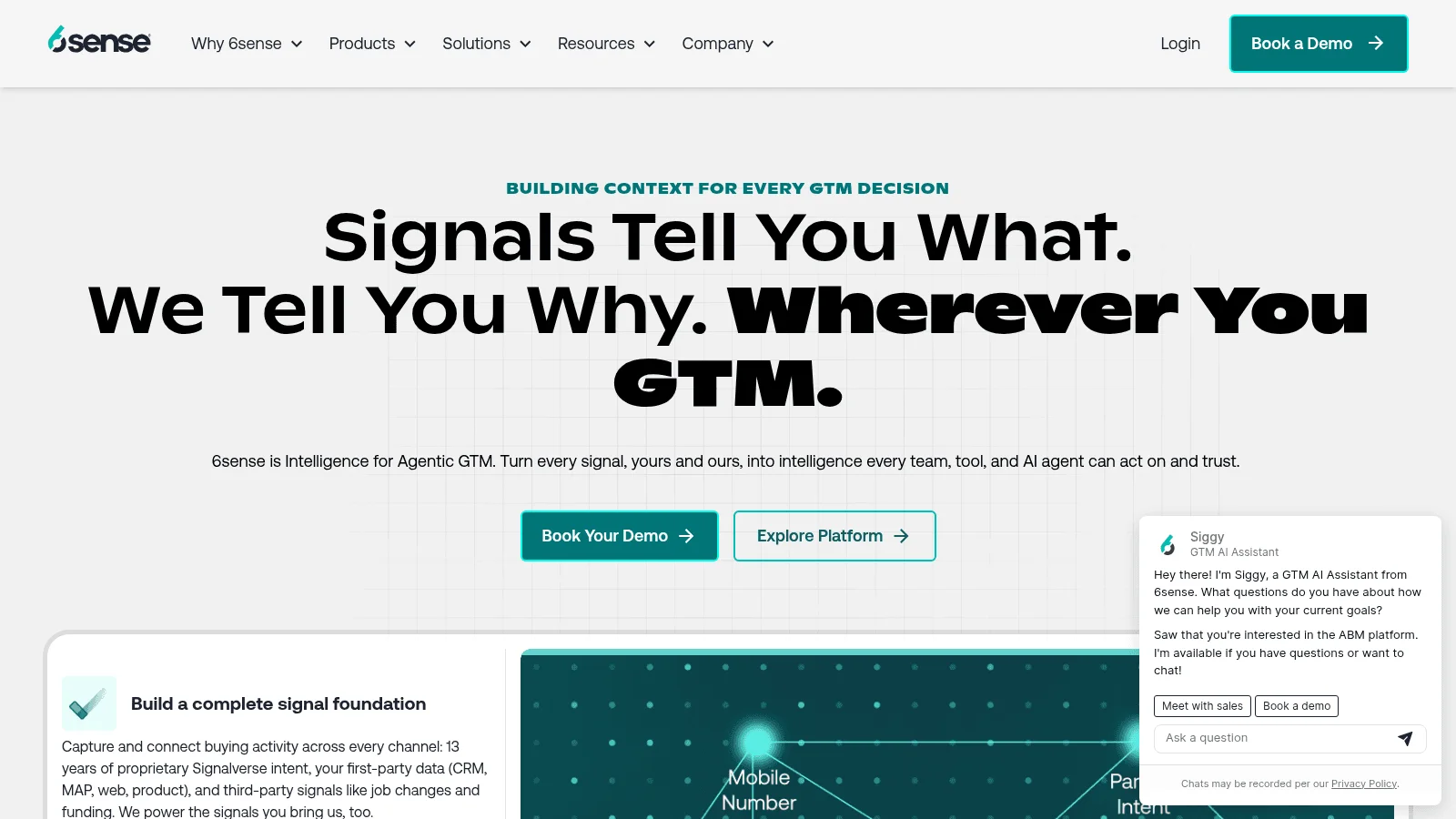
14. 6sense
Best for: Account-based teams
Overview: 6sense combines predictive account scoring, third-party intent data and website visitor identification for larger revenue teams. Emails, phones and enriched records inside the platform are paid for with data credits.
Key features:
- Predictive scoring that ranks accounts by likelihood to buy
- Third-party intent signals alongside your own website traffic
- A Data APIs product for pulling records into your own systems
Pricing: 6sense is quote only, with three Sales Intelligence bundles behind a "Book a Demo" button.
Pros: Scoring, intent and visitor ID in one platform, data APIs available, one priority list for sales and marketing
Cons: No public price, a demo before any number, more platform than a small team uses
When to add it: Add 6sense when sales and marketing run account-based plays together and need one shared priority list.
Final verdict: 6sense is an enterprise signals platform, so smaller teams should start with RB2B's free plan.
Engage and Sequence
The last job is sending, and it's where mistakes become legal problems. The FTC's CAN-SPAM compliance guide says each separate email in violation can cost up to $53,088, so honor opt-outs and use an accurate sender identity in every tool below.
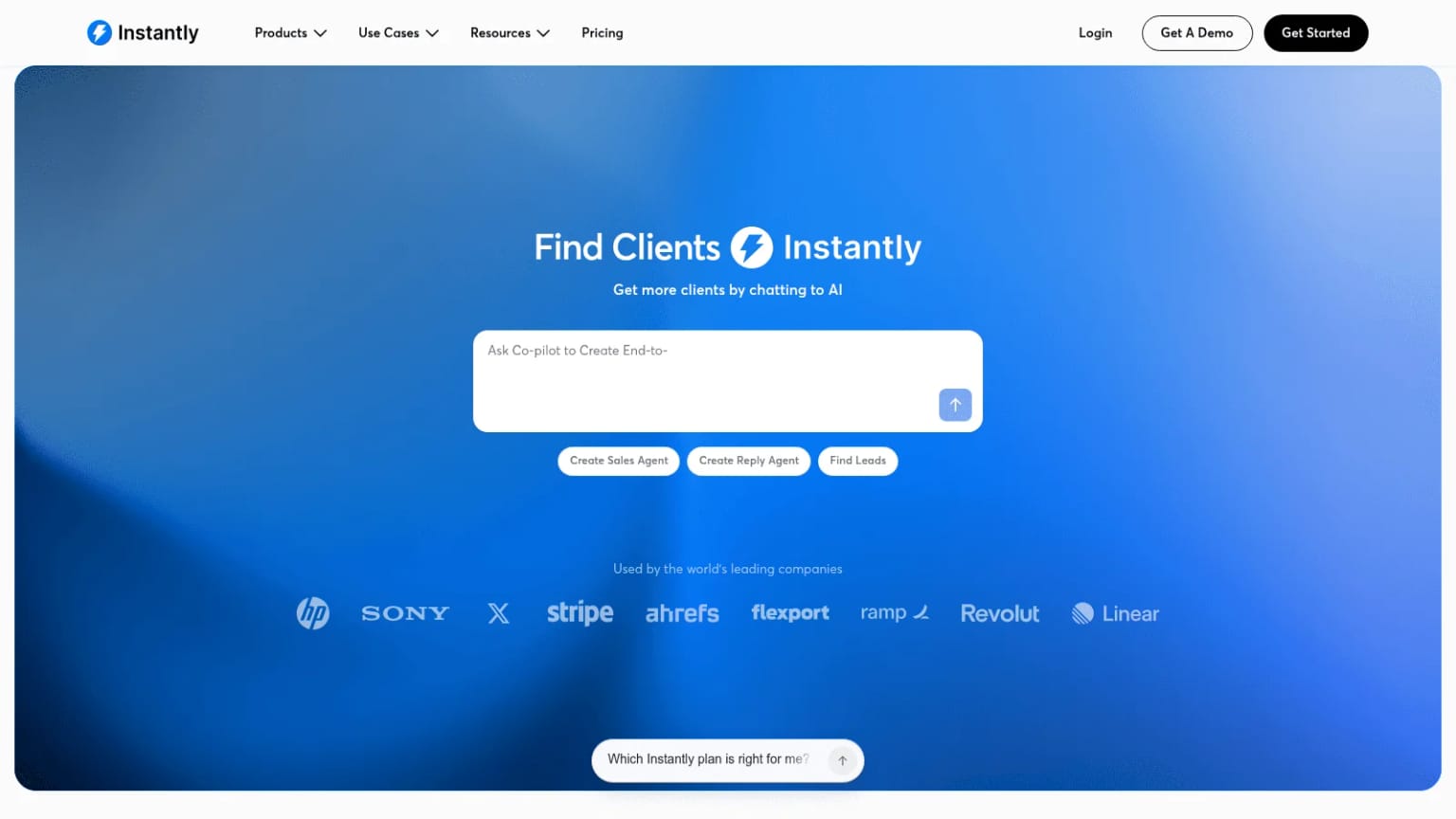
15. Instantly
Best for: Cold email across many mailboxes
Overview: Instantly is made for cold email spread across many mailboxes, with unlimited sending accounts and warm-up, which slowly raises a new mailbox's volume so inbox providers trust it. Lead data costs extra.
Key features:
- Unlimited email accounts and warm-up on every Outreach plan
- 5,000 emails a month on Growth
- API on Growth per its help center, with webhooks from Hypergrowth
Pricing: Growth costs $37.60 per month billed yearly or $47 monthly for 1,000 uploaded contacts. Lead data needs a Credits plan at that same price, or a bundle from $85 a month billed yearly.
Pros: Unlimited sending accounts, warm-up included, low entry price
Cons: Lead data costs extra, Growth caps uploads at 1,000 contacts, no free plan on the pricing page
When to add it: Add Instantly when you need to spread sending across more than one or two mailboxes.
Final verdict: Instantly is a sending engine for teams whose list is already sorted.
16. Reply.io
Best for: Multichannel sequences
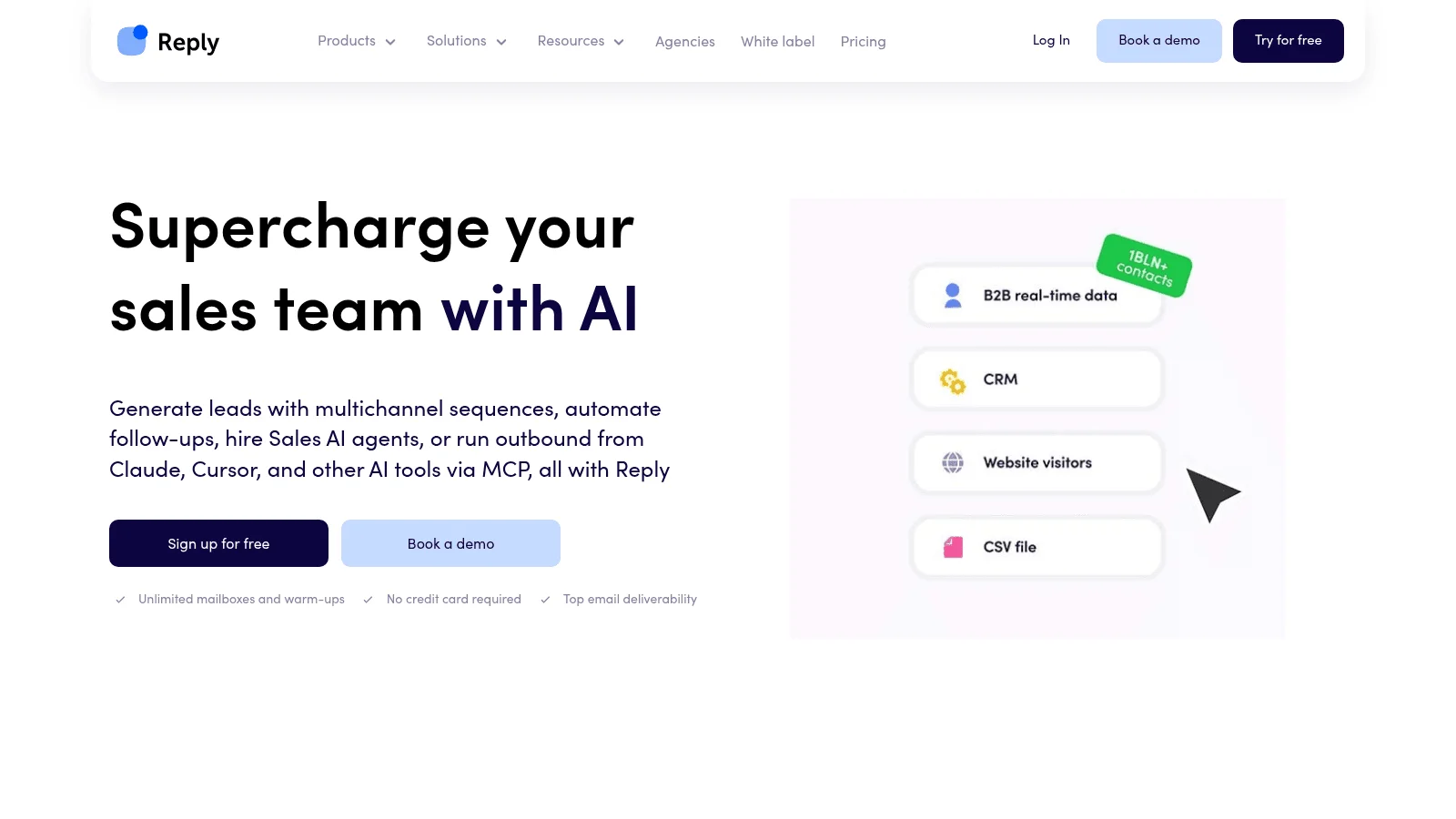
Overview: Reply.io runs outreach sequences across email and other channels and offers an AI SDR, an AI agent that handles a sales rep's outreach, called Jason. Plans also include 50 live data credits a month, so a little prospect lookup comes with sending.
Key features:
- Email sequences priced by active contacts rather than by seat
- Multichannel sequences on a per-user plan
- API included
Pricing: The Email Volume plan is $49 a month on annual billing, or $59 month to month, for 1,000 active contacts. Multichannel is $89 per user per month billed annually ($99 monthly).
Pros: Contact-based pricing for email, a multichannel option, some data credits included
Cons: No free plan (a 14-day trial instead), multichannel billed per user, the AI SDR tier starts at $500 a month
Why it's on the list: Reply.io covers the send step with both email-only and multichannel plans.
Final verdict: Look at Reply.io if your team wants every outreach channel run from one place.
17. Lemlist
Best for: Sending plus a light data add-on
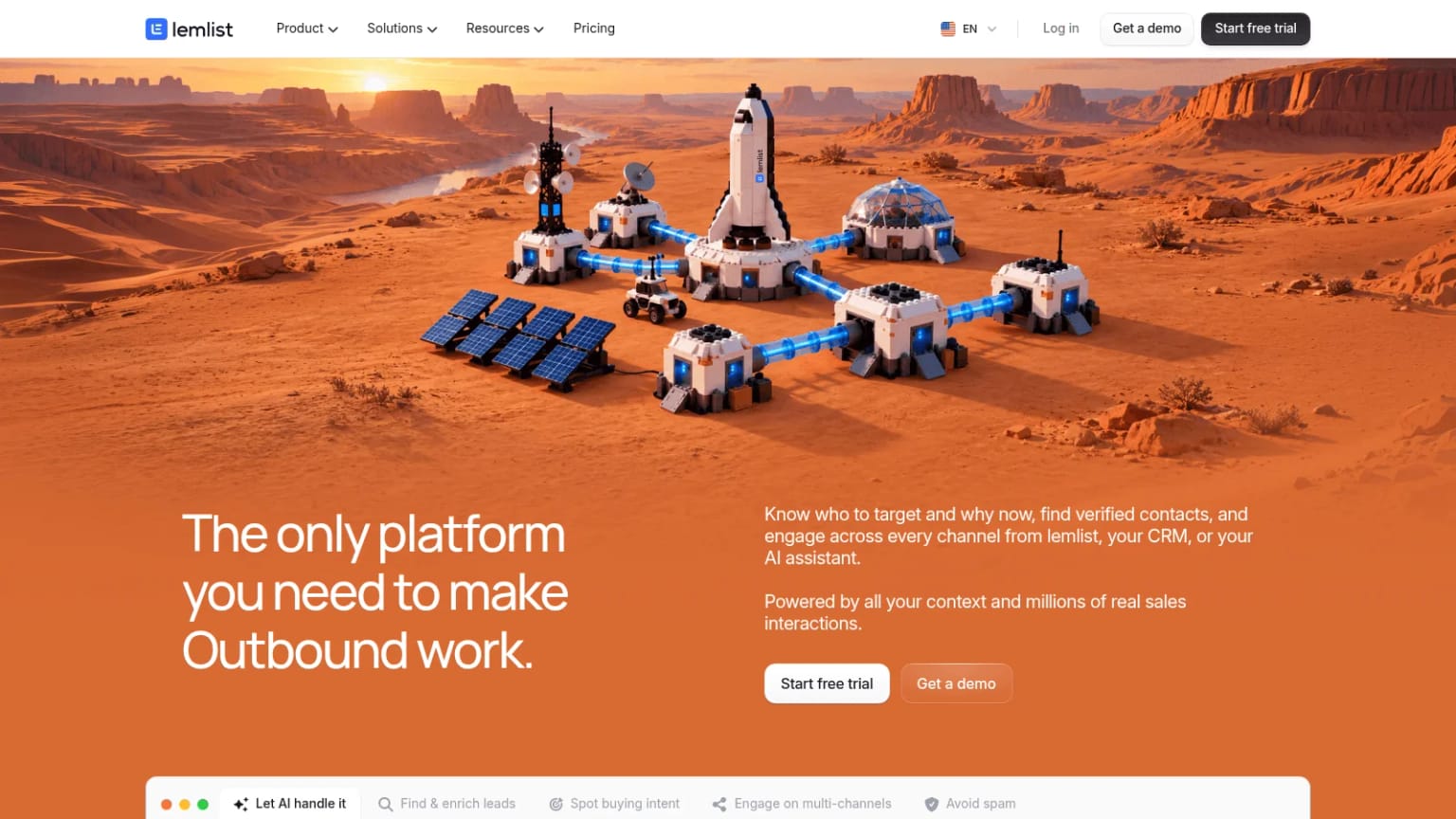
Overview: Lemlist, part of the lempire group, runs personalized outreach sequences and sells contact data as an add-on. Its lead data charges only for successful results.
Key features:
- An Email plan with 50,000 emails a month and unlimited users
- A lead data add-on where 2,000 credits buy 400 emails or 100 phones
- API, a command-line tool and MCP on all plans
Pricing: The Email plan costs $55 per month billed yearly or $69 monthly. The lead data add-on starts at $16 per month billed yearly ($20 monthly).
Pros: Unlimited users on Email, pay-for-results data, a 14-day trial with no card
Cons: Contact data is an extra fee, calls and other channels need Multichannel at $87 per user billed yearly, phones cost 20 credits each
Who gets the most from it: Lean outbound teams that want sending and a modest contact finder on one bill.
Final verdict: Lemlist fits a lean team that wants personalized sequences and its contact data from the same vendor.
Free Sales Prospecting Tools Worth Starting With
You can test most of the workflow without paying anything. These are the free plans published on the vendors' own sites:
- Lusha: 40 monthly credits, no card needed.
- Apollo.io: 900 credits per seat a year, paid out monthly.
- ZoomInfo: the Lite tier, free with no end date.
- Clay: 100 data credits and 500 actions a month.
- Hunter.io: 50 monthly credits, API included.
- Prospeo: 100 monthly credits, MCP but no API.
- ZeroBounce: 100 monthly validations for business-domain signups.
- RB2B: 150 company-level visitor matches a month.
None of the three dedicated sending tools here publishes a free plan, so budget at least one paid subscription for the send step. Reverse Contact has no free plan either: signup comes with free trial credits and needs no card, so you can run an agentic search on your own buyer description before you pick a plan.
What a Full Stack Costs at the Floor
The cheapest published paid plan in each group shows the floor price of a stack that buys one tool per job. Quote-only tools are left out because there's no number to add.
| Job | Tools in this list | Lowest published paid plan | Free plan in the group |
|---|---|---|---|
| Find and build lists | Reverse Contact, Lusha, Apollo.io, UpLead, ZoomInfo, Cognism | Lusha Starter, $37.45/month billed yearly | Lusha, Apollo.io, ZoomInfo |
| Enrich from several sources | Clay | Clay Launch, $167/month billed annually | Clay |
| Find and verify contacts | Hunter.io, Prospeo, ZeroBounce, Findymail | Hunter.io Starter, $34/month billed yearly | Hunter.io, Prospeo, ZeroBounce |
| Spot buying signals | RB2B, Common Room, 6sense | RB2B Starter, $79/month billed monthly | RB2B |
| Engage and sequence | Instantly, Reply.io, Lemlist | Instantly Growth, $37.60/month billed yearly | None |
Add those five floors together and you reach about $355 a month on mostly annual billing (about $410 if you pay month to month), and that's before extra seats, phone credits or Instantly's lead credits. Clay alone is $167 of it, so a team that skips orchestration starts nearer $190.
How to Build a Lean Prospecting Stack by Team Size
Most teams need three or four sales prospecting tools, not all 17, and the right number depends less on budget than on who maintains the stack. A rep who also runs it will feel every extra login.
Solo Founder or One Rep
Start with one all-in-one tool for finding and sending, such as Apollo.io, and one verifier, such as ZeroBounce's free plan. Before buying a second data tool, tighten your filters. One consultant on Reddit found a broad "Growth" title filter pulled in real estate agents and healthcare clinics, and replies pointed to technology, headcount and funding filters rather than a new stack. That's one user's experience, and the fix costs nothing to try.
Team of Two to Ten Reps
Split the stack into data and sending. Use one list tool, one contact finder and one sequencer, and add a signal tool such as RB2B only once reps follow up on signals the same day. Phones are where costs climb, so reserve them for top accounts and fill gaps with a phone number lookup from an email you already have.
Ops-Led Teams and Product Builders
If you have an ops person or an engineer, treat data as a layer you build on, and pick B2B prospecting tools with an API or MCP connector. Sales research tools at this level sit underneath your CRM and AI agents, and the rep only sees the finished list.
Buyers we talk to keep circling one theme here. Giving reps more seats rarely fixes a fuzzy target market, because salespeople want a finished list delivered to them, not a database to build it from. An operator at an outbound agency told us what they need most: "Can we find everyone in a certain department or with a certain job title keyword at a company? That's like the main use case."
This is where an API like Reverse Contact or an orchestrator like Clay pays off, because one person builds the list once for the whole team. An API does add a tool to the stack, so it pays off only when someone owns the connection.
Start With the Job That Breaks First
Whichever lead prospecting tools you end up with, pick the job where your current workflow loses the most time, buy one tool for it and measure it for a month before adding another. If you can't tell which job breaks first, start at the find step, because a bad list costs credits at every later stage.
If your team can work with an API, describe your next buyer in one sentence and see what comes back. You can get a free API key with free trial credits and no card.
FAQ
What are sales prospecting tools?
Sales prospecting tools help you find, research and contact potential buyers. Most cover one of five jobs: building lists, enriching records, verifying contact details, spotting buying signals or sending outreach. As sales prospecting tools for lead generation, they handle the outbound half, where you reach out first rather than waiting for inbound leads.
Are free sales prospecting tools worth using?
Yes, for testing and for very small teams. Hunter.io's 50 credits a month, Prospeo's 100 credits and ZeroBounce's 100 validations are enough to check a tool's results on your own market before you pay. Free plans run out quickly at real volume, and Reply.io, Instantly and Lemlist don't publish one.
What's the difference between sales prospecting tools and sales prospecting services?
Tools give you the data and the software, and your team does the work. Sales prospecting services are agencies or contractors who build the list and often run the outreach for you. A service makes sense when you lack the time to run lead prospecting tools yourself, and a tool makes sense when you want to own the process.
Which outbound prospecting tools send email?
In this list, Instantly, Reply.io and Lemlist are built for sending, and Apollo.io includes sequences alongside its database. Reverse Contact doesn't send email or run sequences, so you'd pair it with one of these outbound prospecting tools.
How does lookalike search help B2B prospecting?
Lookalike search starts from one profile of a customer you'd like more of and returns profiles similar to it. It works best when the seed is a typical customer, not an outlier, since the results copy whatever the seed looks like. Our people lookalike API costs 1 credit per profile on pay-as-you-go credits. Among B2B prospecting tools, it's a fast way to build a first list when you can't yet describe your ideal buyer in filters.
The data layer behind your GTM engine
Access fresh people and company data through one API and power every enrichment, prospecting, and automation workflow.
- Profiles
- 1B+
- Refreshes / month
- 200M
- Response time (P95)
- 500ms