
11 People Data Labs Alternatives for People and Company Data (2026)
Julien K.Published
Key takeaways:
- People Data Labs hides emails, phones and addresses on its free tier, starts Pro at $98 a month for 350 person credits, and keeps bulk license feeds on Enterprise, which is where the case for switching starts.
- Pick the delivery model before the vendor. Only Coresignal publishes a dataset price. Crustdata sells flat files through sales, and we run CSV bulk enrichment on every plan and CSV export of your searches, but don't sell an off-the-shelf dataset. Nine of the 11 publish an MCP server for AI agents.
- Charging only on a match is common: PDL, Coresignal, LeadMagic, FullEnrich, Datagma and Crustdata (on enrich and identify) say so. We do the same: an empty lookup, enrichment, standard search or contact lookup is free, and only an agentic search page that finds no one costs 1 credit.
- Run the same 200 records through two or three trials, then compare filled fields, nulls and last-updated dates before you sign anything.
People Data Labs (PDL) is a developer-first source of person and company records. You call its API or license the whole dataset, and PDL says it covers 1.5B+ unique individuals and 70M+ companies. Its docs are strong and it delivers into Snowflake and Databricks.
So why do teams shop for People Data Labs alternatives? The free tier hides contact data, the full dataset is commonly refreshed monthly, and bulk feeds need an Enterprise contract. That sends some teams toward a live data enrichment API and others toward a different dataset vendor.
This guide compares 11 options for developers and data teams who buy B2B data through an API or as bulk files. Three of them (Apollo.io, Lusha and Cognism) fit teams whose PDL use was really reps looking people up. Reverse Contact is our own product, listed first, so read its entry with that in mind. Prices come from each vendor's own pages, read in October 2026.
Why Teams Look for People Data Labs Alternatives
PDL does a lot right, so the reasons to leave are specific.
The Free Tier Hides the Fields You Want
PDL's free person plan gives you 100 credits a month, but "emails, phone, & address data is obfuscated." You can test the schema, not the contact fields. Pro starts at $98 a month (or $940 a year) for 350 person credits, which works out to about 28 cents a record. Company data is priced apart: Pro is $100 a month for 1,000 company records.
A Monthly Refresh Is Slow for Some Products
PDL says its full dataset is "commonly" refreshed monthly. For a quarterly analysis, monthly is plenty. For a product that shows a person's current title, it can be a month behind.
The Bureau of Labor Statistics found that Americans born between 1957 and 1964 held an average of 12.9 jobs from ages 18 to 58. Each move changes a title, a company and an email in somebody's database, and over a large table a month's worth of moves adds up.
One builder put it bluntly in a thread on Reddit: PDL's monthly batch refresh broke the real-time part of their product. That's one user's experience, but it matches the cycle PDL describes in its own docs.
Bulk Access Is an Enterprise Conversation
PDL's data license feeds, which ship the whole dataset to you as files, are Enterprise-only and sold on annual contracts. If you want a warehouse copy without opening an Enterprise negotiation, you need a vendor that publishes a dataset price.
When PDL Is Still the Right Call
Stay put if you need a very large person dataset in Snowflake or Databricks and a monthly cycle is fine. PDL's scale, docs and warehouse delivery are hard to replace for that job. Many teams use PDL for enrichment, sending a partial record in and getting a fuller one back, and the alternatives below compete on that same workflow.
11 People Data Labs Alternatives Compared
The first table sums up each of the People Data Labs alternatives on one line, with the lowest published price and how it delivers data.
We put Reverse Contact at #1 because we make it. The others run from the closest like-for-like swaps (people and company data by API and files) to the most specialized: an agent API, contact-only APIs, a company-only API, then seat-based sales tools. Need files in a warehouse? Start with Coresignal and Crustdata.
| Tool | Best for | Key features | Main limitation | Pricing (from) | Delivery |
|---|---|---|---|---|---|
| Reverse Contact | Live lookups with a freshness check | Cache or live per request, free /check, no answer rather than an unchecked one | Highest entry price here; in-product use needs Platform | Credit packs from $100; $249/month Go (profile lookups by URL or ID); Max at $699 adds enrichment | API, webhooks, CSV, MCP, CLI |
| Coresignal | Datasets plus a matching API | Published dataset pricing, jobs data | 10-20 credits per employee or company record | $49/month billed monthly (2,500 credits) | API, files, MCP |
| Crustdata | API and flat files from one vendor | Free sandbox key, people and company search | No dollar prices on its site | Credit packs, priced per endpoint | API, files, MCP |
| Explorium | Prepaid credits for agent builders | AgentSource API, no auto-renew | Stops at zero unless Auto-Refill is on | $29.99 pack (500 credits) | API, MCP |
| LeadMagic | Pay-on-success contact enrichment | Every delivery method on every plan | No free plan or free credits | $83/month billed annually ($99 monthly) | API, MCP, CLI, CSV |
| FullEnrich | Email and mobile lookups on demand | Pay only when found, unlimited users | No bulk dataset license | $26/month billed annually ($29 monthly) | API, MCP |
| Datagma | Month-to-month email and EU phones | Free plan with API, no charge on a miss | A mobile number costs 30 credits | Free; $39/month billed annually ($49 monthly) | API, file uploads |
| The Companies API | Company records at volume | 1 credit per company, five SDKs | No people data | $79/month billed annually ($95 monthly) | API |
| Apollo.io | Prospecting and data in one seat | Free tier, sequences, API enrichment | Credits expire each billing cycle | Free; $49/seat/month billed annually | API, MCP |
| Lusha | Sales teams adding contacts with an agent | Coverage table with a date, free plan | Strict API rate limits below Pro | Free; $37.45/month billed yearly ($49.90 monthly) | API, MCP |
| Cognism | Director-level contacts in Europe and the US | 30-day refresh claim, DNC screening | Quote only, packaged around 5 seats | Quote only | API and MCP from Standard |
The second table adds bulk files, freshness and miss charges, with PDL as the baseline. Where a vendor's pages are silent, we wrote "not published."
| Vendor | Bulk files | Refresh stated | Free tier or trial | Charged on a miss? |
|---|---|---|---|---|
| People Data Labs | Enterprise license feeds | Commonly monthly, some fields more often | 100 credits/month, contact data hidden | No (charged per match) |
| Reverse Contact | CSV enrichment on every plan and CSV export of your searches; no off-the-shelf dataset | Cache 30 or 90 days by tier; live on request | Trial credits, no card | No on cached or live lookups, enrichment, standard search and contact lookups; an agentic search page that finds no one costs 1 credit |
| Coresignal | Datasets from $1,000 | API "real time"; datasets daily, weekly or monthly | 7-day trial, 2,000 credits | No (only on a successful match) |
| Crustdata | CSV or JSON flat files | Flat files monthly | Free sandbox key | No on enrich and identify, per its docs |
| Explorium | Not published | Not published | 100 credits for 90 days | Not published |
| LeadMagic | Not published | Not published | None | No on lookups |
| FullEnrich | Not published | Not published | 50 credits, no card | No |
| Datagma | No dataset (enriches uploaded files) | Not published | 100 credits/month | No |
| The Companies API | Not published | "Continuously refreshed" | 500 credits, no card | Not published |
| Apollo.io | Not published | Not published | 900 credits/seat/year | Not published |
| Lusha | Not published | Signals weekly; coverage totals dated Sept. 30, 2026 | 40 credits/month | Not published |
| Cognism | Not published | 95% of Director+ every 30 days | Not published | Not published |
The last column matters for cost, because a per-record price tells the full story only when misses are free. Most API vendors here, PDL included, charge only on a match, so ask the sales-led ones directly.
Freshness claims also cover different things: Cognism's 30-day figure covers Director-level contacts, PDL's monthly cycle covers the full dataset, and our dates are per record. The same timestamp sits on our company records, so you can check a field like headcount before paying to refresh it.
1. Reverse Contact
Best for: Live lookups with a freshness check
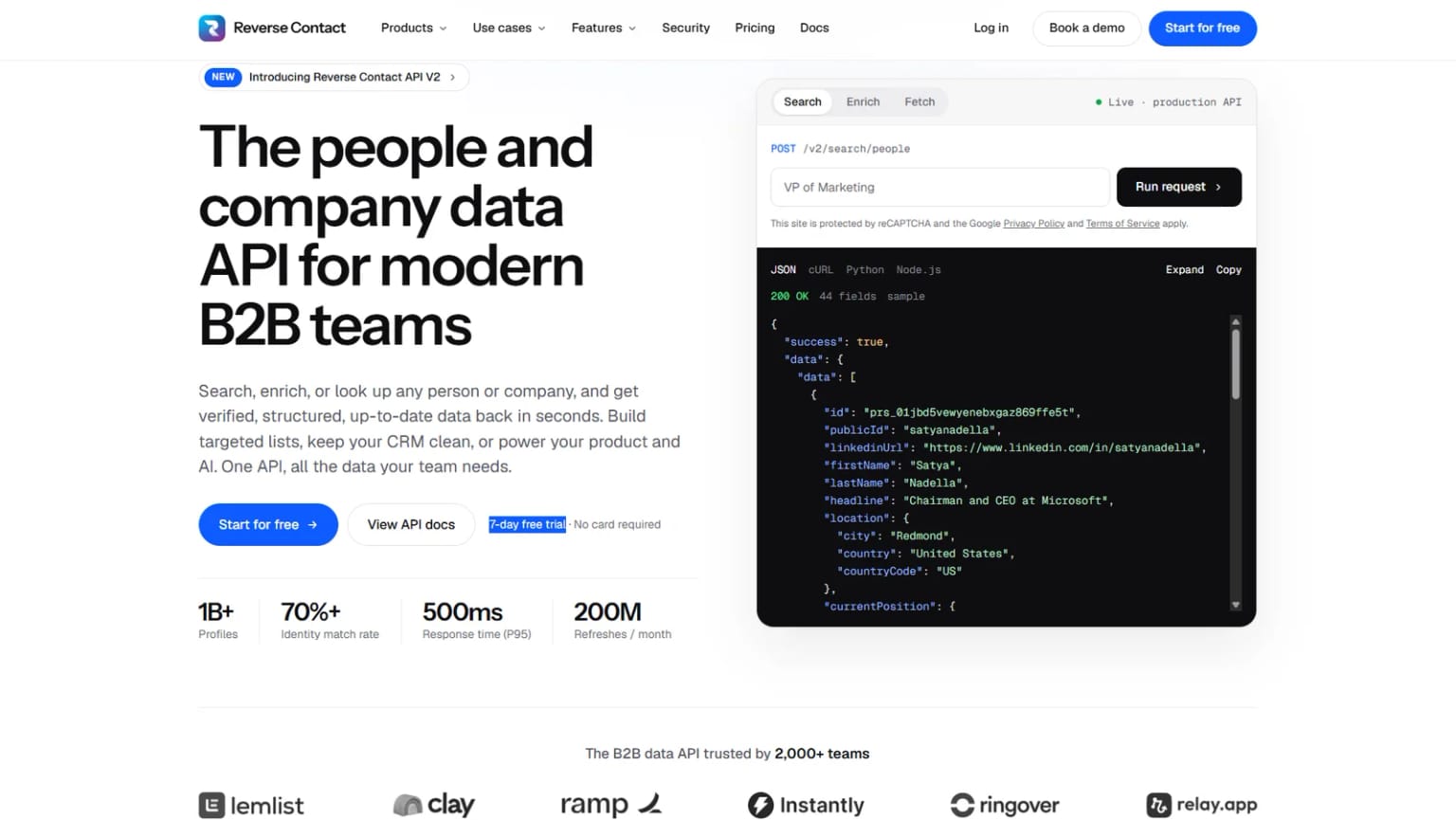
Overview: Reverse Contact serves people and company records through an API. Send an email address, a person's name with a domain, or a company, and you get one structured record stamped with its last full refresh. Enrichment like this can read our stored copy or resolve the record live, per request.
For records you've already identified, you choose per request. A call can read from our cache (a stored copy we already hold), which we publish at about 500ms P95, meaning 95% of calls answer within half a second. Or it can ask for a live copy, which runs as a background job (often tens of seconds, sometimes several minutes) and arrives by webhook (pushed to your server when ready).
Our cache isn't automatically fresher than PDL's monthly build, though: the busiest profiles turn over on a 30-day cycle and other active ones on a 90-day cycle, so some cached records are older than a month. The difference is that every record shows its date, checking it is free, and you pay for a live copy only where it matters.
Whichever route you take, we'd rather send back nothing than a record that fails our checks, and an ambiguous match can come back as a short list of possible people rather than our pick. A cached or live lookup, an enrichment, a standard search, or an email or phone lookup that finds nothing costs nothing; an agentic search page that finds no one costs 1 credit.
Instantly, the cold email platform, shows our enrichment at scale. Imported leads that arrive incomplete go into a queue that calls our API, 2 to 4 million enrichment requests a month, before its AI writes the email. When we can't identify someone, the campaign still launches with lighter personalization.
Key features:
- A free
/checkcall, sent with a record's ID, tells you how old it is and whether it exists. - We report 200M profile refreshes a month across the cache.
- The same schema whether you call the REST API, receive webhooks, upload a CSV or connect our MCP server at
https://api.reversecontact.com/mcp. - Pay only when found: 3 credits per email found, 20 per lookup that finds a phone number.
Pricing: All plans are billed monthly, with no annual commitment. Go costs $249 per month and makes lookups by profile URL or ID unlimited, free /check calls included. Plus, at $449, adds unlimited search, with agentic and lookalike search within fair use. Max, at $699, also makes enrichment unlimited when you start from an email, a name or a domain, the PDL-style workflow. On every plan, live re-fetches (2 credits), emails (3) and phones (20) use credits.
Go, Plus and Max license the data to your own team only. Showing it to your customers inside a product, or reselling it, needs a Platform contract, priced on a call with sales.
Pros: no answer rather than an unchecked one, a free freshness check, MCP and CLI on every plan (pay-as-you-go included), published plan prices
Cons: the highest published entry price here (credit packs from $100, plans from $249 per month), enrichment from an email or a name is unlimited only on Max, in-product use needs Platform, a lookup that finds a phone costs 20 credits
How to start using it:
- Create an account for trial credits (no card asked for).
- Pick 200 records your team knows well.
- Enrich them, and run the free
/checkto see each one's age. - Request a live copy for anything past your cutoff, then compare empty answers and filled fields with your current vendor.
- If customers will see the data in your product, book a demo to size Platform.
Why it's a good People Data Labs alternative: You decide per record whether the cached copy is fresh enough, instead of taking whatever PDL's last monthly build produced.
Final verdict: Pick Reverse Contact when freshness decides whether your product works. If a full dataset in your warehouse is the main job, PDL's license feeds or Coresignal's published dataset prices are the more direct route.
2. Coresignal
Best for: Datasets plus a matching API
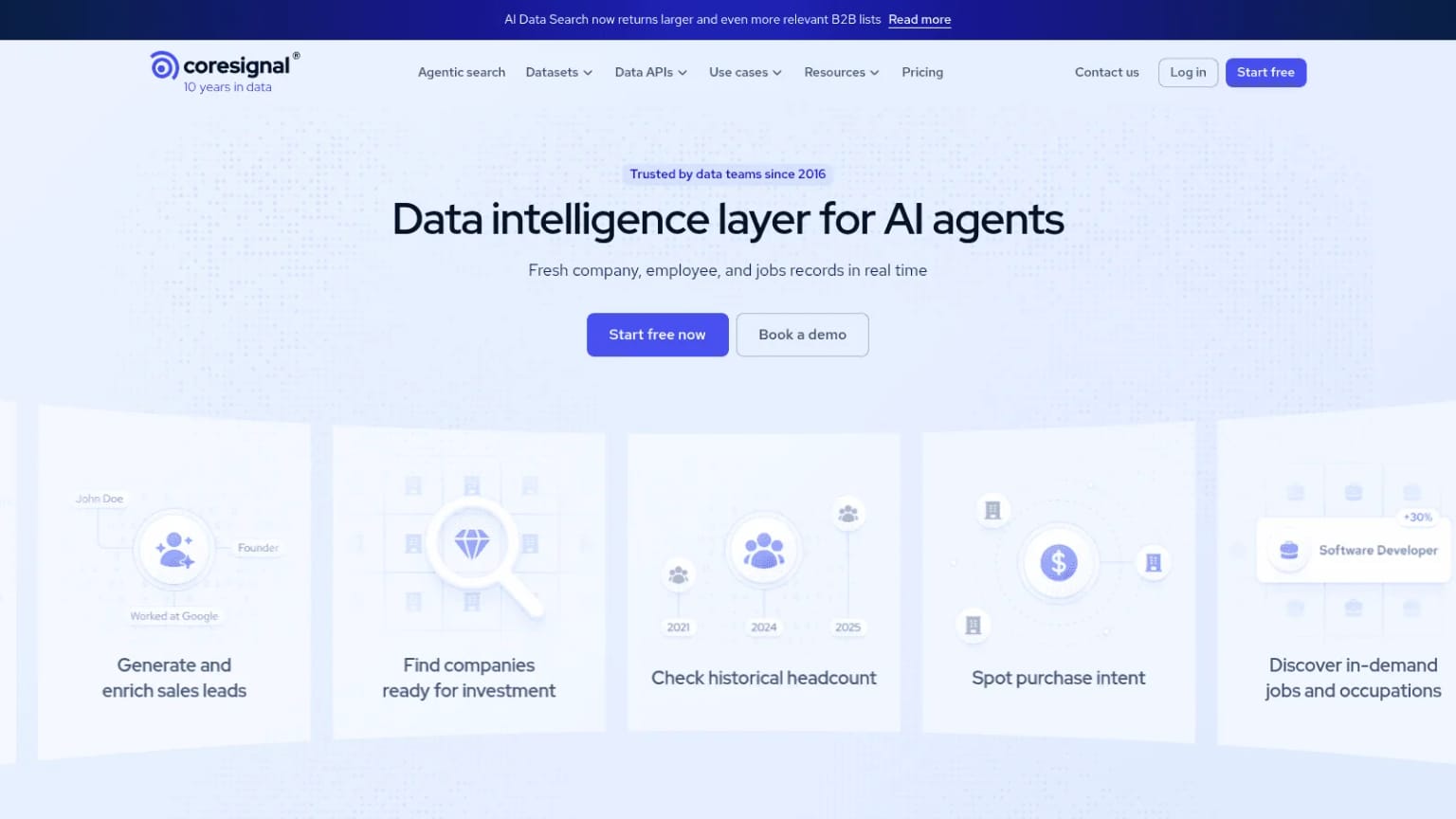
Overview: Coresignal sells people, company and job data two ways, through a credit-based API and as downloadable datasets. It publishes 70M+ company records, 907M+ employee records and 482M+ job postings.
Key features:
- JSON or CSV datasets, with historical data for a warehouse backfill.
- REST endpoints for companies, employees, jobs and agentic search, plus webhooks.
Pricing: The API starts with Mini at $49 a month for 2,500 credits. Datasets start from $1,000, paid monthly on a yearly contract.
Pros: a public dataset price, API and files from one vendor, job postings at 1 credit
Cons: 10-20 credits per employee or company record, credits generally don't roll over, a steep dataset entry price for small teams
Where it beats PDL: You can buy a dataset at a published starting price instead of opening an Enterprise negotiation.
Final verdict: Coresignal is the closest like-for-like swap if you want a warehouse copy and an API together.
3. Crustdata
Best for: API and flat files from one vendor
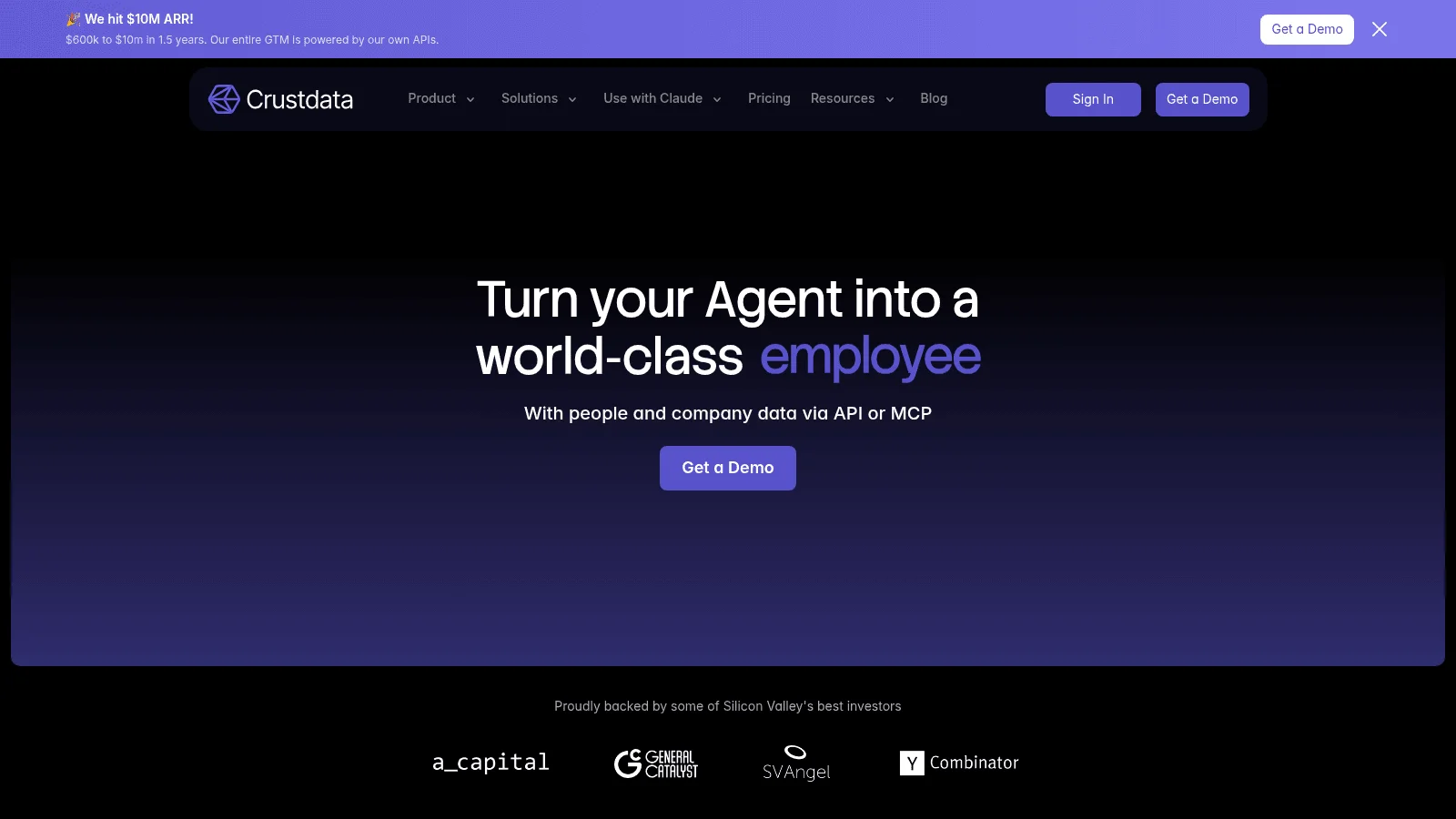
Overview: Crustdata offers enrichment and search APIs for people and companies. It publishes "1B people" and 60M companies.
Key features:
- REST enrichment and search for people and companies.
- CSV or JSON flat files that Crustdata says are fully refreshed monthly.
Pricing: Its site shows no dollar prices, but its docs publish credit costs per endpoint and self-serve credit purchases, with credits valid 12 months. A free sandbox key lets developers try the API first.
Pros: a free sandbox key, API and files under one contract, an MCP server
Cons: no dollar prices on its site, coverage figures vary on its own homepage, flat files on the same monthly cycle as PDL
Why builders pick it: An engineer can wire up a prototype on the sandbox key before anyone books a call.
Final verdict: Shortlist Crustdata for API and file delivery from one vendor, if you can get dollar costs from sales.
4. Explorium
Best for: Prepaid credits for agent builders
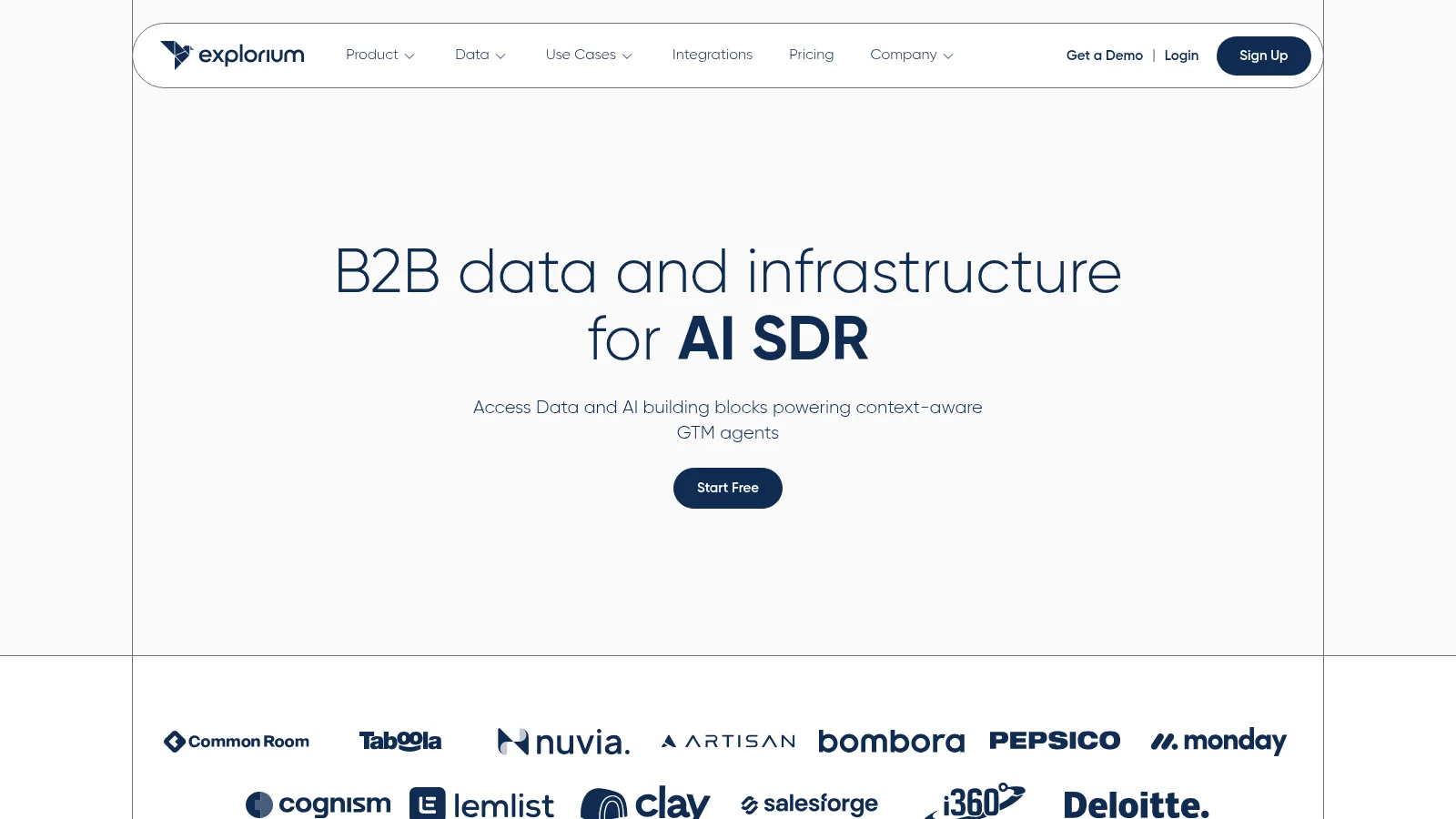
Overview: Explorium sells prepaid credit packs, not subscriptions, for its AgentSource API and MCP server. Credits last 12 months and don't auto-renew, so the service stops when they run out unless you turn on the optional Auto-Refill.
Key features:
- The AgentSource API for people and company lookups.
Pricing: Lite is $29.99 for 500 credits (6 cents each), and Starter is $149.99 for 5,000. The custom Enterprise tier adds resell rights.
Pros: a low entry pack, credits valid for 12 months, resell rights on Enterprise
Cons: non-refundable credits, service stops at zero
Who should switch to it: Agent prototypers who want a hard spending ceiling, since by default a prepaid pack can't run up a bill, though an optional Auto-Refill exists.
Final verdict: Explorium is a cheap way to test agent access before you commit to anyone's subscription.
5. LeadMagic
Best for: Pay-on-success contact enrichment
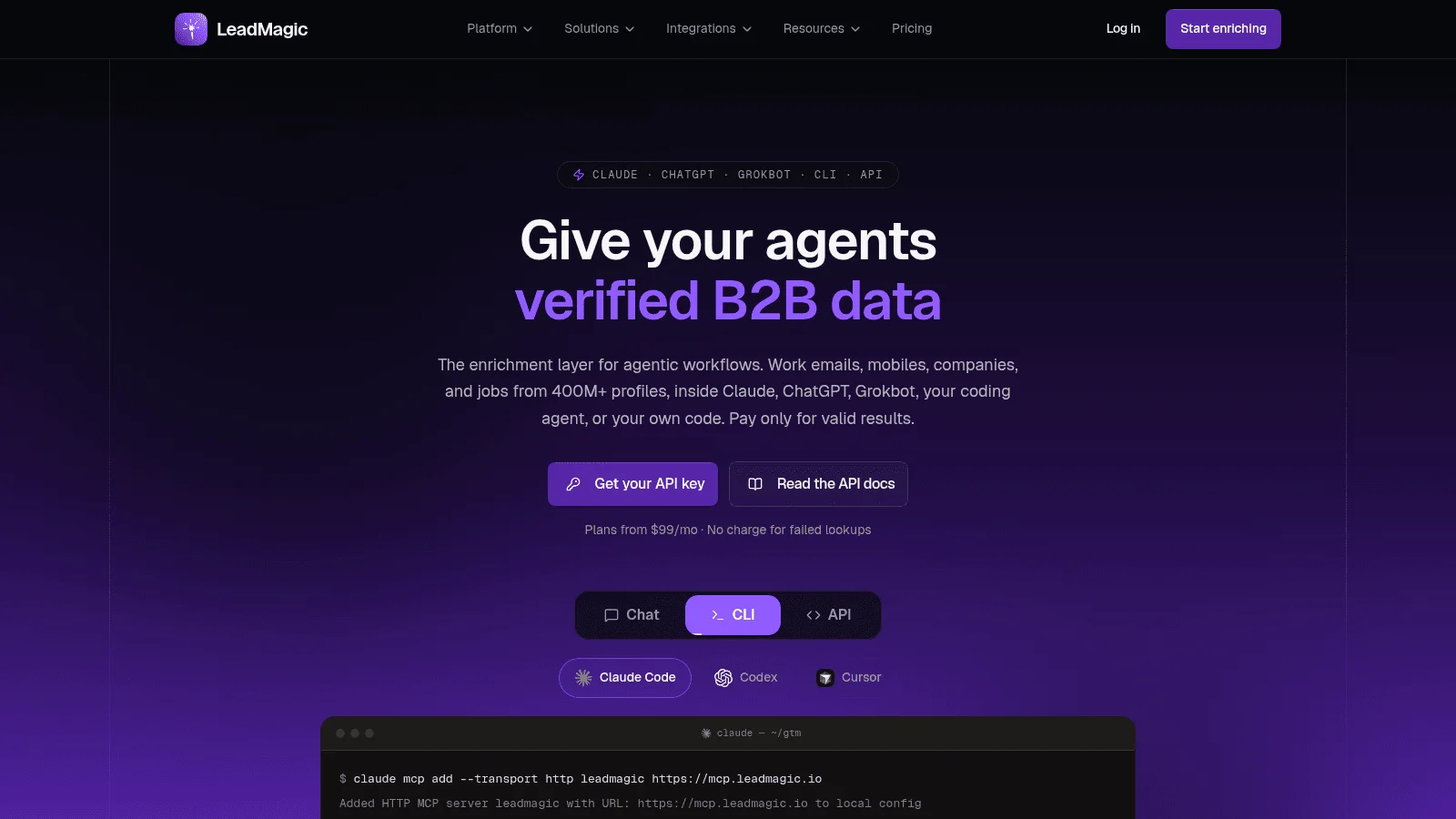
Overview: LeadMagic is an enrichment API that bills lookups only on success, with REST, a hosted MCP server, a CLI and CSV uploads on every plan. It publishes 400M+ people profiles, 25M+ companies and 46M+ open job postings.
Key features:
- Email finder at 1 credit and mobile finder at 5, charged on success.
- A job change detector at 3 credits.
Pricing: Essential runs $83 a month on annual billing ($99 month to month) for 5,000 credits.
Pros: lookups charged only on success, every delivery method on every plan, a job change detector
Cons: no free plan or free credits, annual credits don't roll over, no bulk dataset published
What it fixes: The job change detector targets the decay a monthly dataset struggles with.
Final verdict: LeadMagic fits teams that refresh contacts on a schedule and want misses to cost nothing.
6. FullEnrich
Best for: Email and mobile lookups on demand
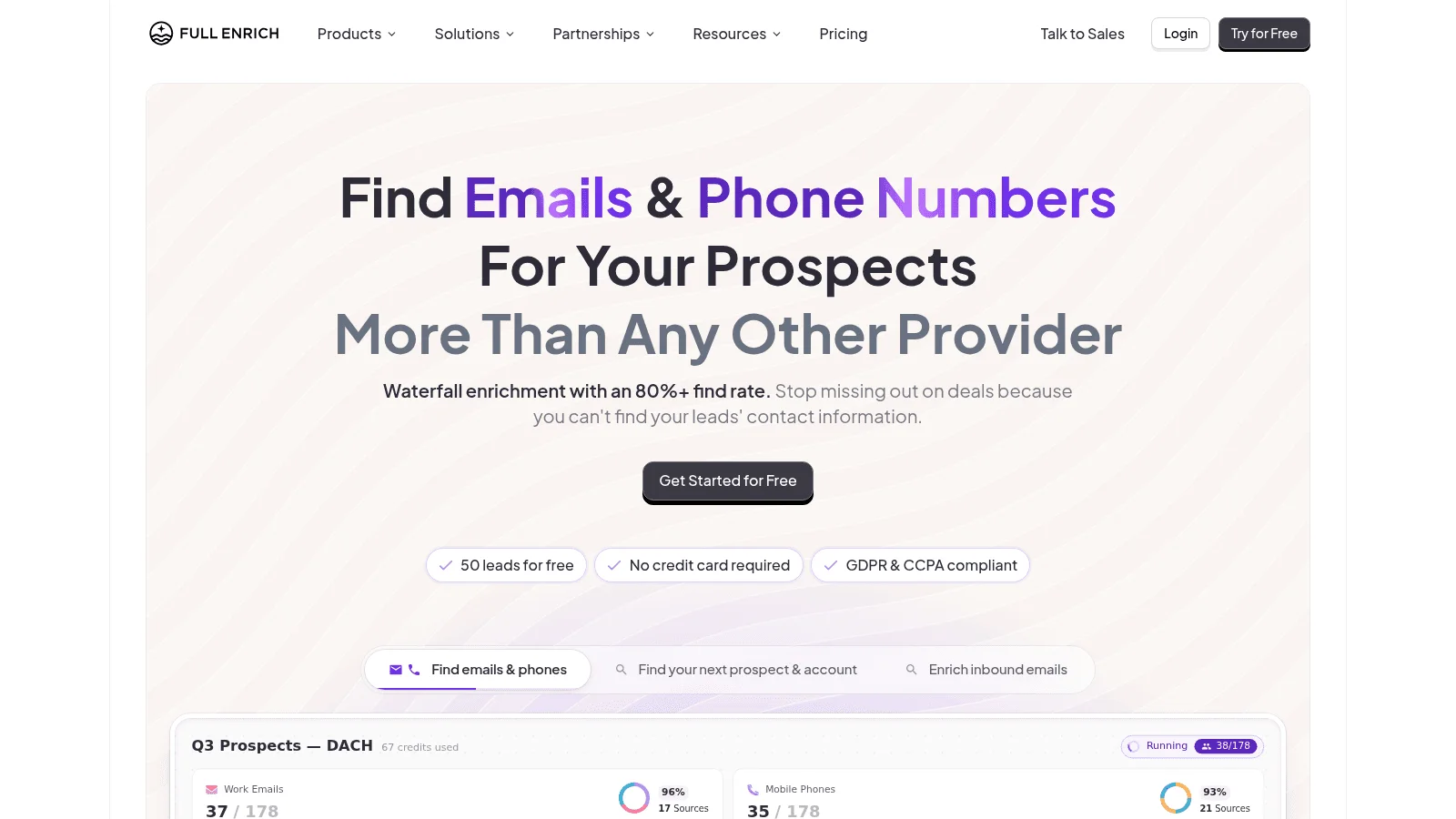
Overview: FullEnrich finds work emails and mobile numbers for records you already hold, and returns profile and company data alongside. It publishes an 80%+ find rate, bills only for data it finds, and includes the API and an MCP server on every tier, the trial too.
Key features:
- Work emails at 1 credit and mobiles at 10.
- People and company search on every tier.
Pricing: You pay $29 a month for 500 credits or $55 for 1,000 billed monthly, or $26 and $49 billed annually. The trial gives 50 credits with no card.
Pros: pay only for data found, unlimited users
Cons: contact-first, with no bulk dataset license, no bounce guarantee
Its edge over PDL's free tier: The trial returns real emails and mobiles through the API, which is exactly what PDL's free tier hides.
Final verdict: FullEnrich suits teams adding emails and mobiles to records they already have.
7. Datagma
Best for: Month-to-month email and EU phones
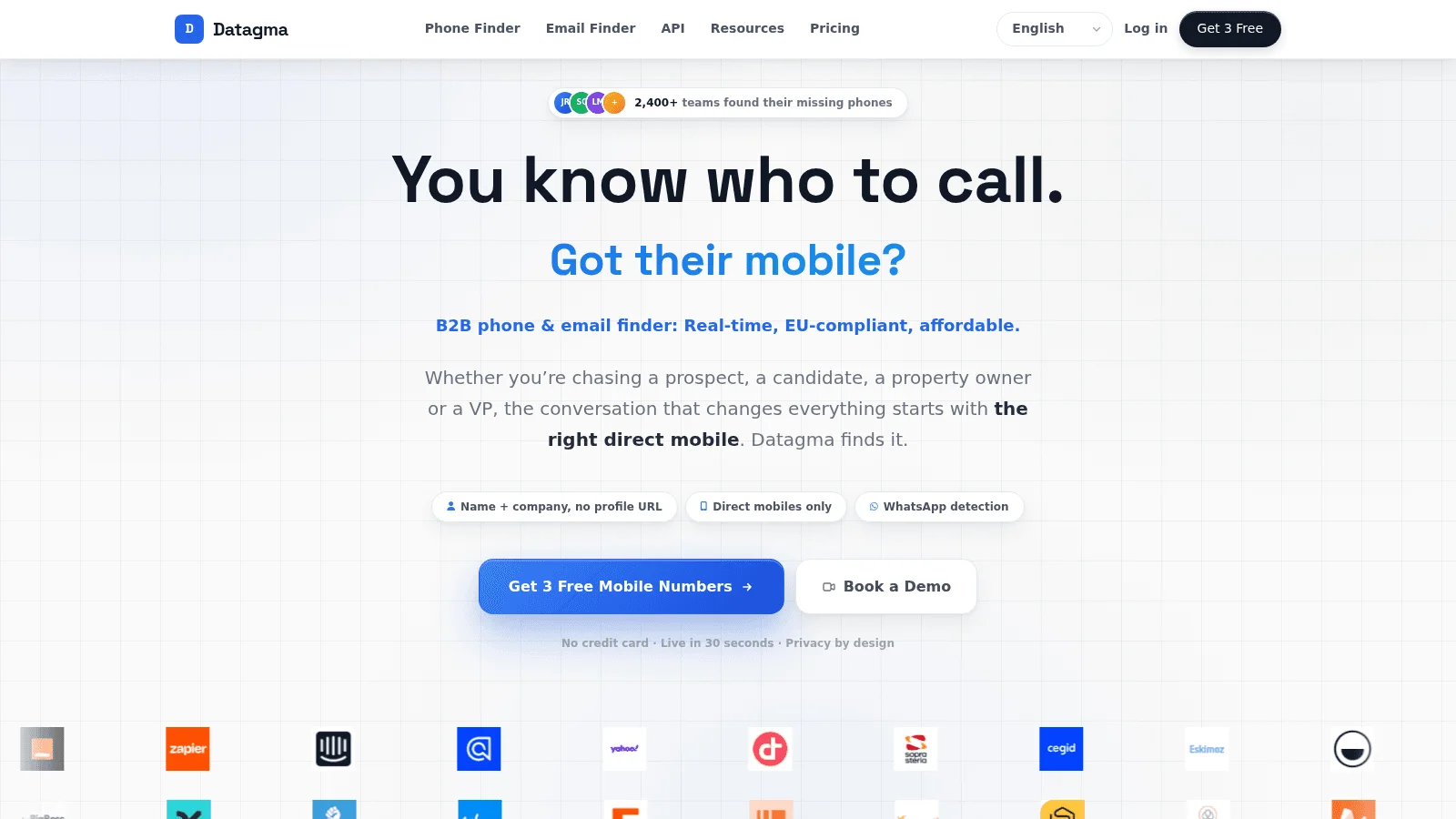
Overview: Datagma is an email and phone enrichment API. It publishes "up to 93% email accuracy" but no database size, and every plan, the free one included, comes with the REST API.
Key features:
- No match means no credit spent.
- Paid-plan credits roll over for up to 12 months.
- Enriches uploaded files of up to 50,000 rows.
Pricing: The free plan gives 100 credits a month, enough for 100 emails or 3 phones. Paid plans start with Regular at $39 a month annually or $49 monthly, for 3,000 credits.
Pros: a free plan with API access, no charge on a miss, 12-month rollover
Cons: 30 credits per mobile number, no database size published, no bulk dataset delivery or first-party MCP server
Its strongest case: European phones without a contract, and a quiet month doesn't waste the budget.
Final verdict: Datagma is a low-commitment pick for emails and phones, not for full person records.
8. The Companies API
Best for: Company records at volume
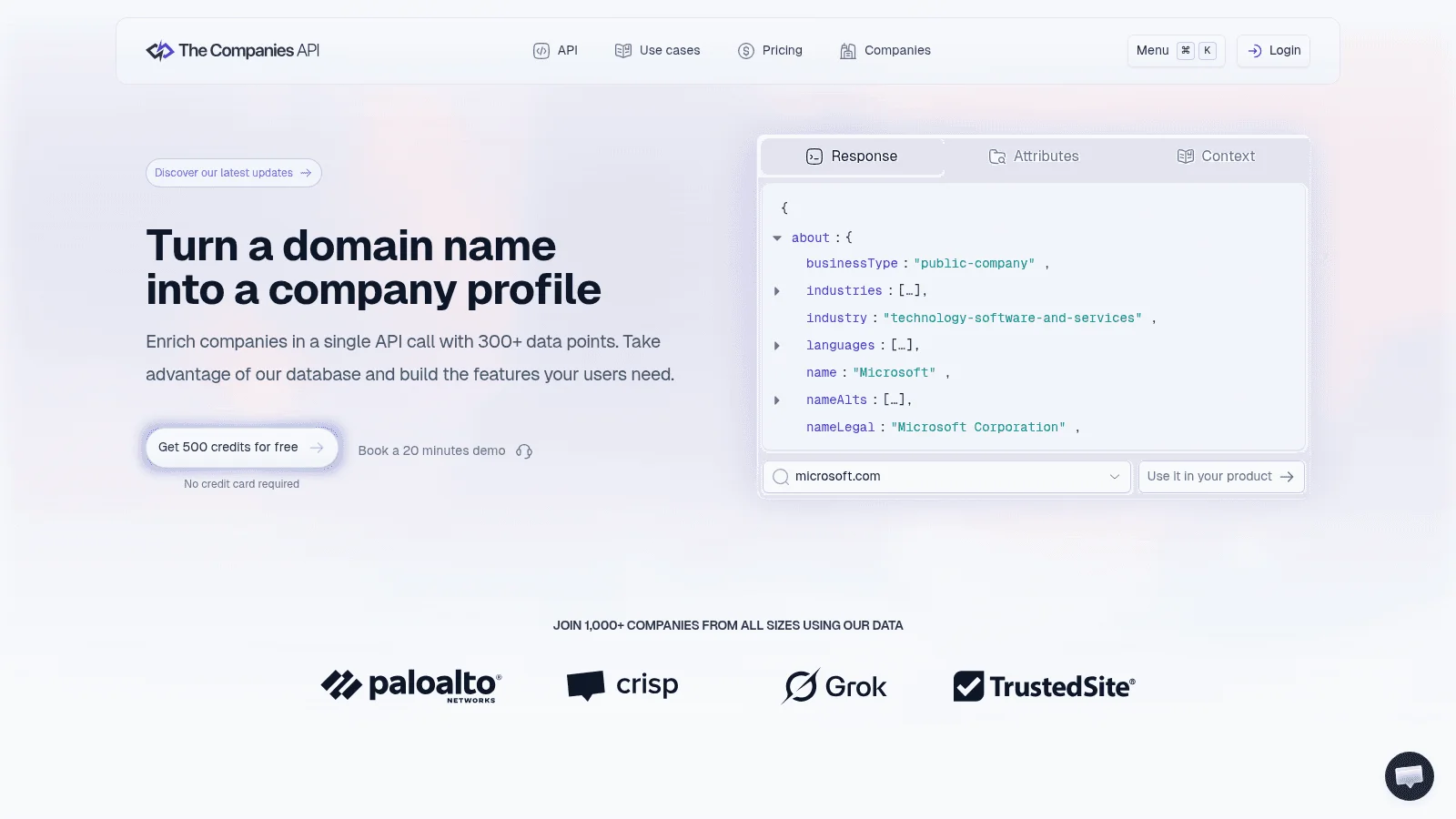
Overview: The Companies API covers companies only. It publishes 50M+ companies and 100+ to 300+ data points per record (its homepage gives both), continuously refreshed, and it's API only.
Key features:
- One credit per company record.
- SDKs (ready-made code libraries) in JavaScript, Python, PHP, Go and Ruby.
- 500 free credits, no card required.
Pricing: For 50,000 credits, Startup costs $79 a month annually or $95 monthly.
Pros: low cost per company record, five SDKs, free credits with no card
Cons: no people data, no bulk files published, no MCP server published
The math against PDL: $95 a month buys 50,000 company lookups here, while PDL's company Pro plan gives 1,000 records for $100.
Final verdict: Use The Companies API for PDL's company side and pair it with a people source.
9. Apollo.io
Best for: Prospecting and data in one seat
Overview: Apollo.io is an all-in-one sales platform, with sequences, a dialer and a CRM alongside API enrichment. Its site lists 240M+ contacts and 30M+ companies.
Key features:
- A free tier worth 900 credits a seat each year.
- API access on Free, API enrichment on paid plans, other APIs on custom plans.
- An MCP server for agents.
Pricing: On annual billing, Basic is $49 a month per seat and carries 30,000 credits per seat for the year.
Pros: a real free tier, sales tools in the same seat, a low entry price
Cons: per-seat pricing, credits (add-ons included) expire each billing cycle, some APIs only on custom plans
When it wins: One bill covers the data and the sales tool.
Final verdict: Choose Apollo.io when people, not pipelines, are the main consumers of the data.
10. Lusha
Best for: Sales teams adding contacts with an agent
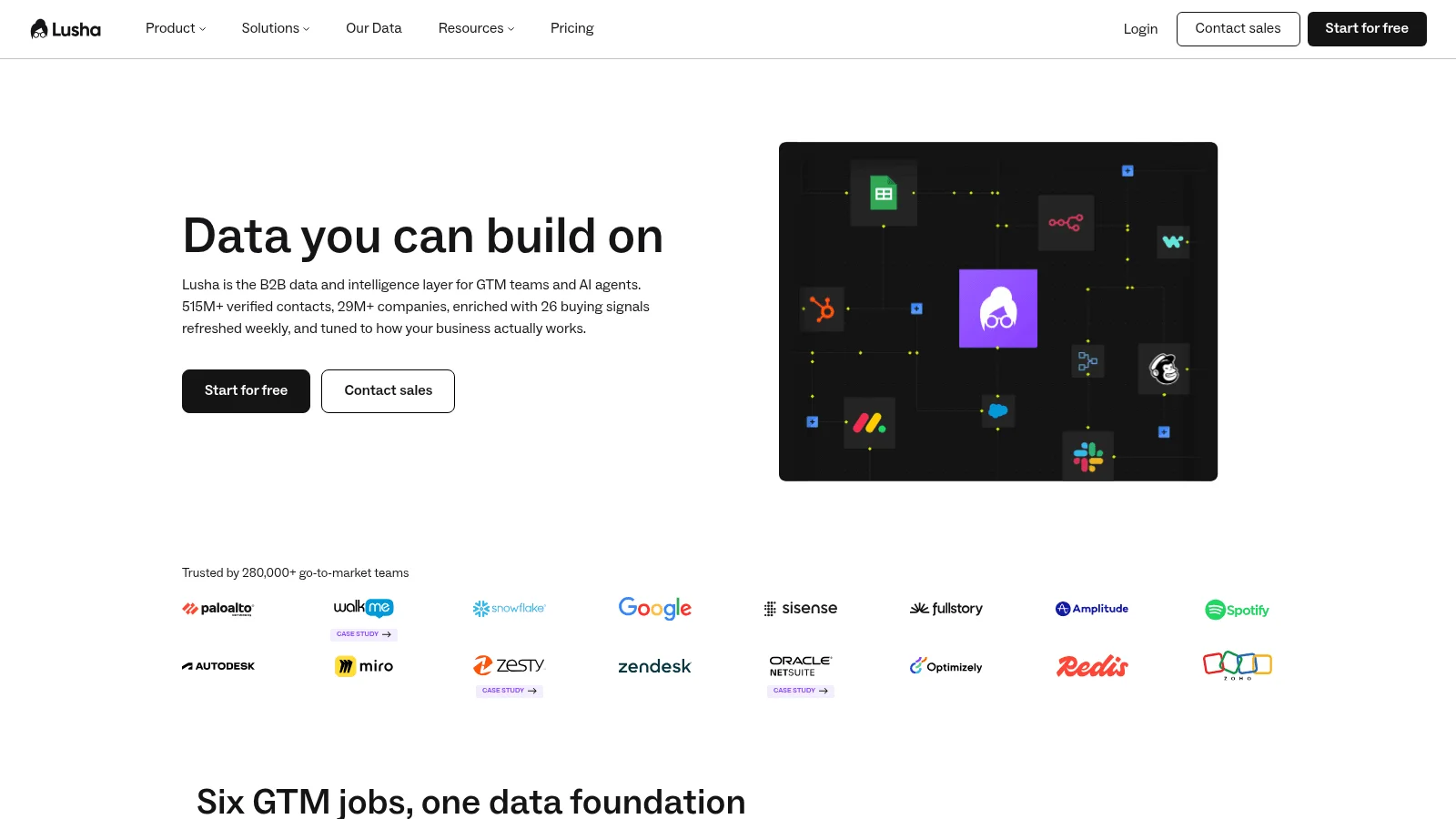
Overview: Lusha is a contact data platform built for sales teams first. Its data page lists 515M+ contacts and 29M+ companies in a table dated "September 30, 2026."
Key features:
- An MCP server on every tier, free included.
- An API on all tiers, throttled hard on Free and Starter.
Pricing: After a free plan of 40 credits a month, Starter costs $37.45 a month billed yearly or $49.90 monthly. Pro, where the strict rate limits lift, is $52.45 yearly or $69.90 monthly.
Pros: a dated coverage table, MCP on every tier, a free plan
Cons: strict API rate limits below Pro, rollover only on Pro and Premium, bundles sized for reps rather than pipelines
Who it suits: Sales-led teams that want an agent pulling contacts on day one.
Final verdict: Lusha works when the data feeds reps and agents, less so a high-volume pipeline.
11. Cognism
Best for: Director-level contacts in Europe and the US
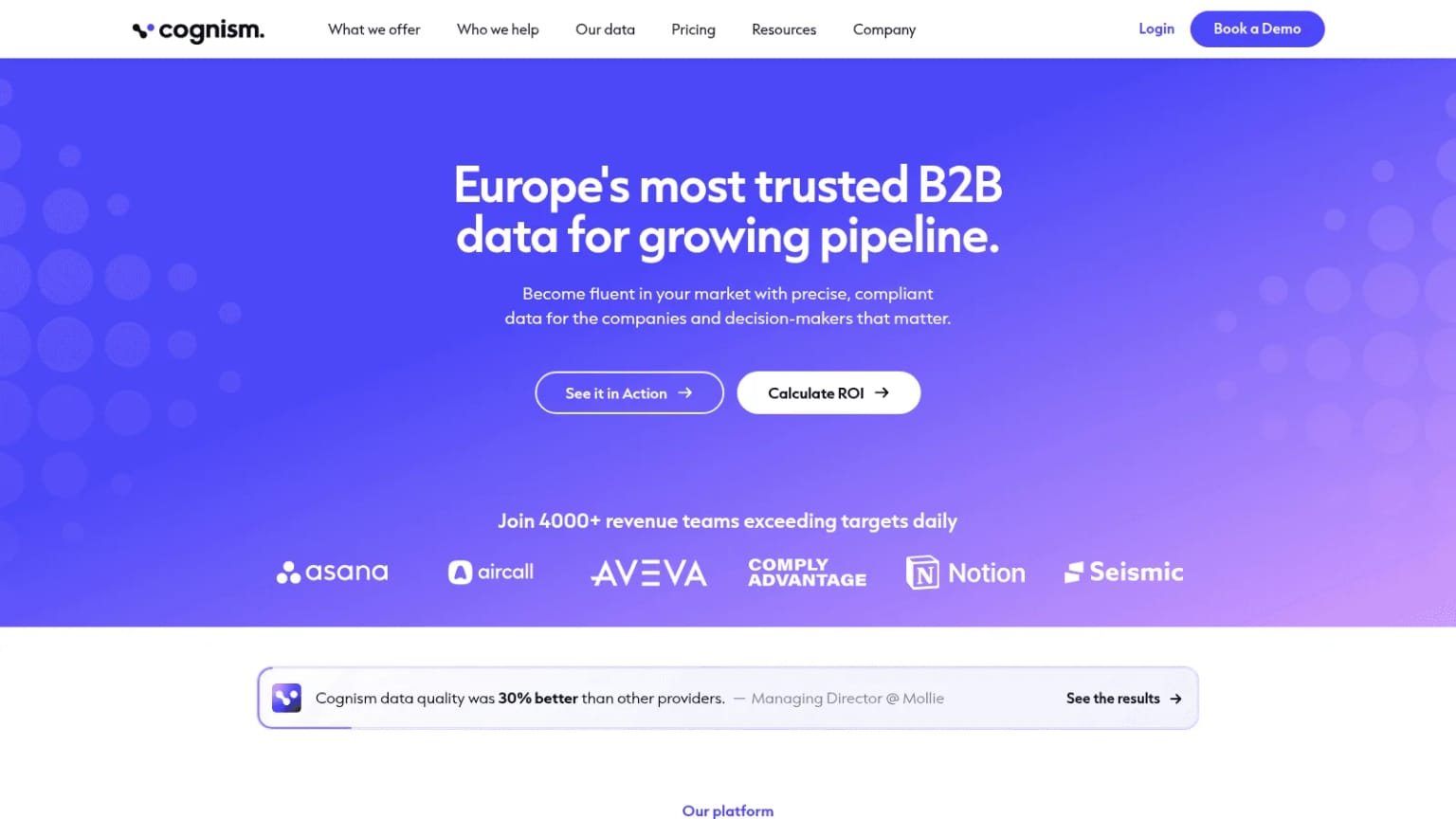
Overview: Cognism offers two quote-only packages of contact data, Standard and Pro. It says 95% of its Director-and-above contacts are refreshed every 30 days, claims 90% coverage of that group in Europe and the US and screens Do-Not-Call lists.
Key features:
- One credit pool across the platform, Enrich and the API.
- API and MCP access from Standard.
- Emails and mobiles in both packages; Pro adds on-demand mobile verification and intent data.
Pricing: Neither package has a published price, and both include five seats. One credit reveals one contact.
Pros: a published 30-day refresh target, API and MCP from Standard, Do-Not-Call screening
Cons: quote only, packaged around five seats, mobile verification and intent data only on Pro
When it fits: European outbound teams that care most about senior contacts.
Final verdict: Cognism suits a sales org buying seats more than a developer team buying records by the million.
API, Bulk Dataset or Both?
Every option above sells some mix of a live API, called per record, and a bulk dataset, meaning the whole file delivered for you to host and query. That choice matters more than the vendor.
The Dump Is the Easy Part
A founding engineer at an early-stage AI sales-tool startup told us that getting a bulk dump and storing it is easy. Making it useful, by indexing and querying it, is the hard part.
Without a data engineer, an API gives you the same records with no warehouse to maintain.
The Hybrid Many Product Teams Land On
Product teams with engineers tend to mix both. They seed their own database with a bulk dataset, refresh it on a schedule, and make a live API call only when one record has to be current.
For that hybrid to work, every record needs a last-refreshed date. The founder of a relationship-mapping platform described the ideal to us: "we get this data with all the last refresh date, right? And then we would update the ones that are old." To place your own team:
- If you run analytics across millions of records at once, you need a dataset.
- If your product shows people a current title or employer, add live lookups on top.
- If you resell or embed the data, read the license terms before the price, because self-serve plans often exclude it (ours do).
When we rebuilt our API as V2 in March 2026, we kept a refresh date on every record, which makes us the live half of that hybrid rather than the dataset half. Most teams can start with an API and add files from a dataset vendor once someone can run a warehouse.
What AI Agents Need From a Data API
MCP (Model Context Protocol) is a standard way for an AI agent to call outside tools, and nine of the 11 alternatives publish an MCP server. Agents raise the stakes on data quality: a Gartner survey of 1,203 data management leaders found 63% of organizations lack, or are unsure they have, the right data practices for AI. Data you buy is part of that data.
A technical lead at an early-stage AI SDR startup told us a complicated API can take five retries before the agent gets usable results. Builders who run many MCP servers also generate them from a vendor's OpenAPI spec (a machine-readable description of the API), so ask for a current, downloadable one.
What People Data Labs Alternatives Cost
Sticker prices for People Data Labs alternatives are hard to compare, because a "credit" means something different at each vendor. The table puts each entry plan next to what it actually buys.
| Plan | Price | What it buys | Unit cost note |
|---|---|---|---|
| PDL Person Pro | $98/month ($940/year) | 350 person credits | About $0.28 per record |
| PDL Company Pro | $100/month ($960/year) | 1,000 company records | $0.10 per record |
| Reverse Contact Go | $249 per month | Unlimited profile lookups by URL or ID for your own team (search from Plus at $449, enrichment from Max at $699) | Live re-fetches 2 credits, emails 3, phones 20 |
| Coresignal Mini | $49/month | 2,500 credits | 10-20 credits per record, so 125-250 records |
| Explorium Lite | $29.99 one-time pack | 500 credits | $0.06 per credit, 1-5 credits per enrichment |
| LeadMagic Essential | $83/month billed annually ($99 monthly) | 5,000 credits | Email 1 credit, mobile 5, on success |
| FullEnrich entry plan | $26/month billed annually ($29 monthly) | 500 credits | Email 1 credit, mobile 10 |
| Datagma Regular | $39/month billed annually ($49 monthly) | 3,000 credits | Email 1 credit, mobile 30 |
| The Companies API Startup | $79/month billed annually ($95 monthly) | 50,000 credits | 1 credit per company |
| Apollo.io Basic | $49/seat/month billed annually | 30,000 credits per seat per year | Email 1 credit, phone 8 |
| Lusha Starter | $37.45/month billed yearly ($49.90 monthly) | 4,800 credits a year | Email 1 credit, phone 5 |
Crustdata publishes credit costs but no dollar prices, and Cognism publishes neither, so both are left out. In every plan above that prices both, a phone costs at least five times an email, from 5 credits at LeadMagic and Lusha to 30 at Datagma, so price phone volume on its own line.
Because a credit buys something different at each vendor, these rows can't be added up into a like-for-like monthly total for your volume. The 200-record test below gives you a real cost per filled record instead.
How to Test a People Data API Before You Commit
Homepage coverage numbers can't tell you how People Data Labs alternatives handle your records. A one-week test can.
Run the Same Records Through Each Trial
A reply in the Reddit thread on B2B data APIs cited earlier offers the cleanest method: run the same 200 contacts through two or three trials and diff the output. Use records you can check, like current customers and people who just changed jobs.
For company records, also pick 20 firms and research each company by hand first, so you have an answer key for headcount and headquarters city. Then run the test in four steps:
- Export the same 200 records with an ID column, so every vendor's output joins back cleanly.
- Run them through each trial on the same day.
- Mark every field as filled and correct, filled and wrong, or empty.
- Note the credits each vendor spent, including on rows it returned nothing for.
Wrong answers matter more than empty ones, because a filled-but-wrong title ends up in your product.
Read the Freshness Timestamps
Ask each vendor for a last-updated date per record, not per dataset. If a vendor can't show one, you can't refresh selectively, so you'll end up re-buying records that hadn't changed.
Which Alternative to Shortlist First
For a warehouse copy, shortlist Coresignal or Crustdata. If you only need company fields, The Companies API's entry plan works out under a fifth of a cent per company. For emails and phones on records you already hold, test LeadMagic, FullEnrich and Datagma, which charge nothing on a miss.
If you're prototyping an agent, Explorium's prepaid packs cap your spend by default. If reps are the main users, Apollo.io, Lusha and Cognism fit better than any API here.
If your users see a person's current title or employer, you need live lookups with a per-record date. That's the case we built Reverse Contact for: check a record's age for free, then read the cache or refresh live.
For your own team's use, you can try it on your records on a self-serve plan.
If customers will see our data inside your product, which needs Platform, book a demo.
FAQ
What is the best People Data Labs alternative?
When each record's age matters more than dataset size, that's the job we built Reverse Contact for. For datasets, look at Coresignal or Crustdata, and for company-only records, The Companies API.
Who are the main People Data Labs competitors?
The closest People Data Labs competitors for developers are Coresignal, Crustdata and Explorium, which sell API access and, for the first two, bulk files. Contact-focused tools such as LeadMagic, FullEnrich, Datagma, Lusha and Cognism compete mainly on emails and phones. Apollo.io competes when the data mostly feeds sales reps.
Is there a free People Data Labs alternative?
Datagma is the closest free swap for an API user: its free plan gives 100 credits a month with REST API access. The Companies API gives 500 free credits for company records, and FullEnrich's trial shows actual emails and mobiles via its API. Apollo.io's free plan lists API access, with API enrichment on paid plans.
Paid HubSpot users already get contact and company enrichment, since HubSpot absorbed Clearbit.
Does People Data Labs sell bulk data?
Yes, through data license feeds on its Enterprise plan, which uses annual contracts. For files without an Enterprise deal, Coresignal lists datasets from $1,000 on a yearly contract. Crustdata sells CSV or JSON flat files through sales.
How often is People Data Labs data refreshed?
PDL describes a mostly monthly cycle for the full dataset, with faster updates on some fields and daily job postings. Our cache runs on 30- and 90-day cycles by demand, and you can request a live refresh on any record after a free /check call shows its date.
The data layer behind your GTM engine
Access fresh people and company data through one API and power every enrichment, prospecting, and automation workflow.
- Profiles
- 1B+
- Refreshes / month
- 200M
- Response time (P95)
- 500ms