
12 ZoomInfo Competitors and Alternatives, Compared (2026)
Julien K.Published
Key takeaways:
- Small sales teams: start with Apollo.io, Lusha or LeadIQ. Software making the requests: Reverse Contact or People Data Labs. Phone-heavy calling into Europe: Cognism.
- Nine of the 12 ZoomInfo competitors below publish an entry price. Cognism, Seamless.AI and SalesIntel are quote-only for every paid plan, the same model as ZoomInfo's paid tiers.
- Published paid entry prices run from LeadIQ's $15 a month (billed annually) to Clay's $167 a month (billed annually), and ours are a $100 credit pack or $249 a month for a plan, so check what each price buys before you pick the cheapest swap.
- ZoomInfo is still the better buy when you'd use its intent data (signals that a company is researching a purchase), visitor identification, account-based marketing (ABM) and conversation intelligence together under one contract.
ZoomInfo is the default name in B2B contact data, and it holds that spot with a platform few rivals try to match. The friction is usually the contract. If you're comparing ZoomInfo competitors, you probably care less about whether another database has your buyers in it and more about what you'd be signing.
Instead of repeating rumors about ZoomInfo's prices, we read what ZoomInfo tells its own shareholders about how it sells. Then we held 12 ZoomInfo competitors up against those terms: what each one publishes, how it bills, and where you can start without a sales call.
We make Reverse Contact, a people and company data API, and it sits first in this list, so read that entry knowing who wrote it. We also cover who should stay with ZoomInfo, because some teams should.
Why Teams Look for ZoomInfo Alternatives
ZoomInfo doesn't publish prices for its paid tiers. Its pricing page lists three sales tiers (Professional, Copilot Advanced and Copilot Enterprise) and says the price depends on features, the number of licenses and credit usage. ZoomInfo also runs a free plan, ZoomInfo Lite, that's permanent and needs no card.
The terms are clearer than the prices, because ZoomInfo states them in its annual report. Subscriptions generally run one to three years and are non-cancelable. ZoomInfo typically bills in advance, annually, semi-annually or quarterly. About 53% of its customer contracts, measured by annualized value, are multi-year agreements.
What that costs a small team is harder to pin down. One user on Reddit said their three-person team was quoted about $20,000 a year. That's one person's report, not a price list. In the same thread, a manufacturing user said ZoomInfo works well for their segment.
Bigger teams hit the same wall at a larger size. Buyers we talk to say enterprise data licenses in the $100,000–$200,000 a year range keep them out entirely, even though they want enrichment (filling in missing fields like title, email and company size) running all year for sales and marketing.
Contact data also ages fast. The Bureau of Labor Statistics counted 5.1 million job separations in August 2026 alone, meaning people who quit, were laid off or left a job some other way that month.
Each of those people is a title, an email or a phone number that may now be wrong in your CRM, whichever B2B contact database it came from. A long contract commits you to one vendor's refresh rate before you've measured it. So when you shop for tools like ZoomInfo, ask how long you're committing before you ask how big the database is.
The 12 Best ZoomInfo Competitors Compared
The table puts each tool's lowest published price next to the one limit most likely to matter if you're leaving ZoomInfo. "Quote only" means the vendor publishes no figure, which is how ZoomInfo sells its paid tiers, and MCP is a connector AI agents use to call outside tools.
| Tool | Best for | Key features | Main limitation | Pricing (from) | Start without a sales call? |
|---|---|---|---|---|---|
| Reverse Contact | Teams building data into products | No answer rather than an unchecked one, stored or fresh data per call, MCP server | An API, not a point-and-click prospecting app | Credit packs from $100; plans from $249/month | Yes: published price |
| LeadIQ | Cheapest paid entry for a small team | Up to 5 users on Pro, API on every tier | Limited database search below Enterprise | Free; $15/month billed annually | Yes: free plan |
| RocketReach | Occasional lookups by a few named people | Refund when nothing is verified | Per-seat pricing, export caps | Free 5 lookups; $33/month billed annually | Yes: free plan |
| Lusha | Reps who need numbers fast | Free tier, MCP on every plan | Strict API rate limits below Pro | Free; $37.45/month billed yearly | Yes: free plan |
| Apollo.io | Small teams wanting data plus outreach | Free tier, sequences, dialer | Credits expire each billing cycle | Free; $49/seat/month billed annually | Yes: free plan |
| People Data Labs | Developers building their own dataset | API on every plan, monthly refresh | Free tier hides contact data | Free; $98/month | Yes: free plan |
| Clay | Combining many data providers | 150+ providers, pay nothing on empty results | Its own API is Enterprise-only | Free; $167/month billed annually | Yes: free plan |
| Lead411 | Email plus direct dial in one export | Exports roll over, intent on annual | API starts at Ignite | $49/month | Yes: published price |
| UpLead | Solo buyers wanting monthly billing | 1 credit covers email and mobile | Single-user below Professional | $74/month billed annually | Yes: published price |
| Seamless.AI | Testing a big email database before a sales call | Credit back on invalid emails, API and MCP | Paid plans quote only | Free up to 50 credits; paid quote only | Yes: free plan |
| Cognism | Teams calling into Europe and the US | Director+ refresh every 30 days, Do-Not-Call screening | No published price | Quote only | No: quote only |
| SalesIntel | Big teams wanting unlimited exports | Unlimited users and export credits | No API on the pricing page | Quote only | No: quote only |
We put Reverse Contact at the top because we make it. After that, tools are grouped by how far you get before talking to sales: free plan and printed price, then printed price with only a trial, then quote only. Within the first two groups, cheaper entry prices come first.
What Each ZoomInfo Competitor Asks You to Commit To
This table shows what each of the ZoomInfo competitors asks of you before you've seen a single record, with ZoomInfo in the last row for reference.
| Tool | Published entry price | Monthly billing available? | Free tier or trial | Quote only? |
|---|---|---|---|---|
| Reverse Contact | $100 credit pack; plans from $249 per month (Go) | Yes: plans billed monthly, no annual commitment; credits also sold pay-as-you-go | Free trial credits, no card required | Platform only (priced on a call); plans and packs published |
| LeadIQ | $15/month billed annually | Yes ($20) | Free plan; 30-day trial | Enterprise only |
| RocketReach | $33/month billed annually | Yes ($69) | 5 free lookups | Team plans from $6,000/year |
| Lusha | $37.45/month billed yearly | Yes ($49.90) | Free plan, 40 credits a month | Scale tier only |
| Apollo.io | $49/seat/month billed annually | Yes ($65) | Free plan; 14-day trial | Custom plans only |
| People Data Labs | $98/month | Yes ($98) | Free plan, contact data hidden | Enterprise only |
| Clay | $167/month billed annually | Yes ($60 + $125) | Free plan; 14-day trial | Enterprise only |
| Lead411 | $49/month | Yes | 7-day trial, 50 exports | Blaze only |
| UpLead | $74/month billed annually | Yes ($99) | 7-day trial, 5 credits | Professional only |
| Seamless.AI | None | Not published | Free up to 50 credits | Yes, all paid plans |
| Cognism | None | Not published | None published | Yes |
| SalesIntel | None | Not published | None published | Yes |
| ZoomInfo | None for paid tiers | Billed in advance, annually, semi-annually or quarterly | ZoomInfo Lite, a permanent free plan | Paid tiers, on 1–3 year terms |
Our own published plans show a monthly price, billed monthly. Other rows come from each vendor's pricing page, and ZoomInfo's from its annual report and homepage.
1. Reverse Contact
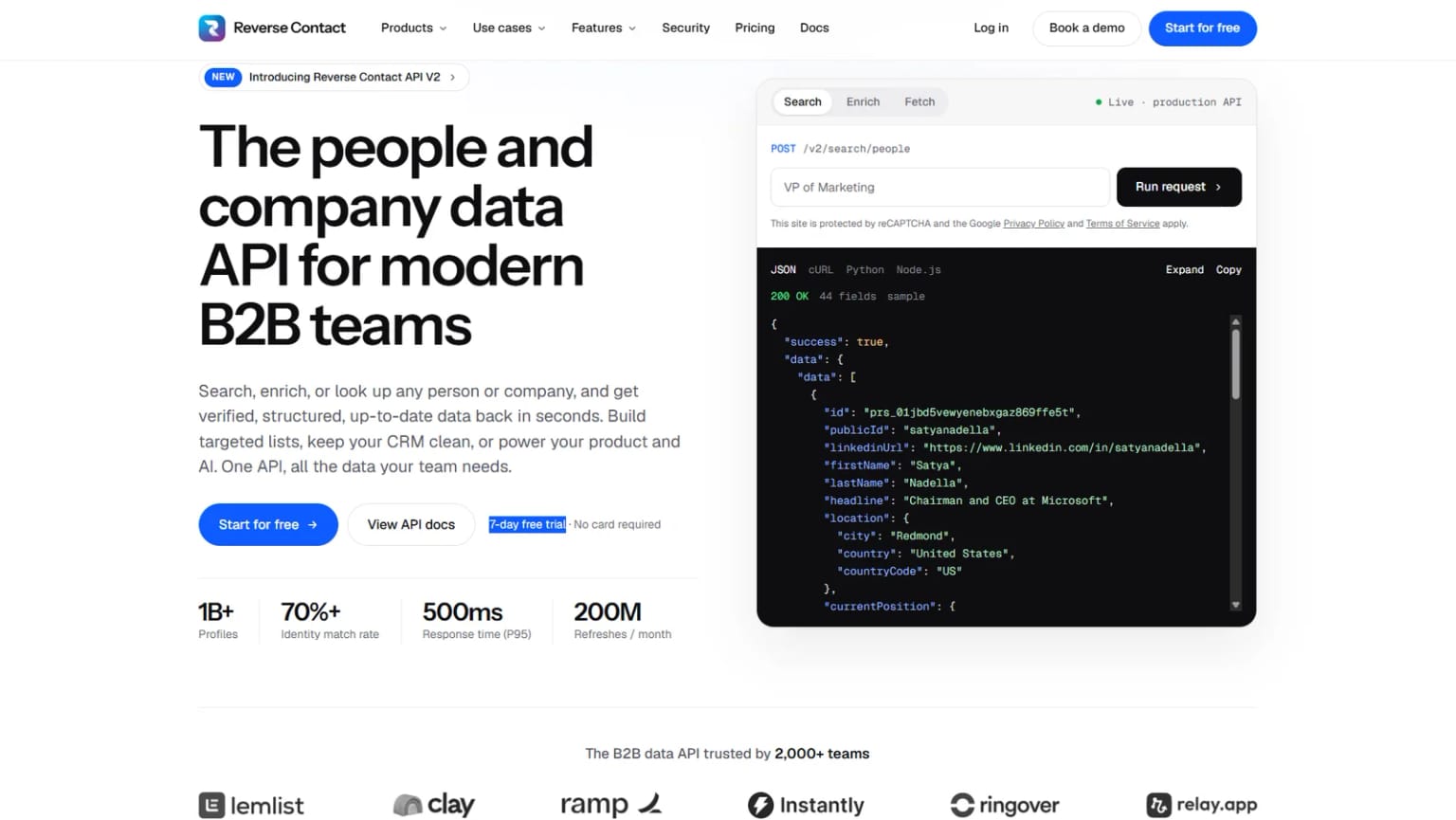
Best for: Product and data teams needing an API.
Overview: Reverse Contact is built for teams whose software, not a rep, makes the requests. You send an email, a name plus a domain, a company name or a set of search filters, and we return a structured B2B profile in one consistent JSON shape (JSON is the plain-text format most software reads).
More than 2,000 teams use it, and Datadog is a good example. When someone signs up or asks for a demo, Datadog enriches them through our API with company size, industry, role and seniority. It then scores that fit alongside product usage to decide who gets a salesperson and who stays self-serve.
Key features:
- No answer rather than an unchecked one: data that fails our checks isn't returned, and when a match is ambiguous we can return the candidate profiles instead of one picked for you. Standard searches, cached lookups and email or phone lookups that come back empty are free.
- Every record shows when the whole profile was last refreshed.
- Stored copy or fresh lookup per request: a free
/checkcall returns that date before you pay for a fresh re-fetch, which runs as a background job (often tens of seconds, sometimes several minutes) and arrives by webhook. - Emails cost 3 credits each and phone lookups 20, charged only when something is found.
- One schema across the REST API, webhooks, CSV enrichment and an MCP server.
Pricing: Go costs $249 a month, with unlimited profile lookups by URL or ID and free /check calls. Plus is $449 per month and adds unlimited people and company search, with agentic and lookalike search under fair use. Max is $699 per month and also lifts the limit on enriching from an email, a name or a domain.
Real-time re-fetches, emails and phones use credits on every plan, and plans cover your own team's use; reselling or building the data into something you sell takes a Platform contract, priced on a call with sales.
Pros: Public monthly prices, no annual commitment, no charge when a standard search or contact lookup finds nothing, free freshness checks, one data format everywhere
Cons: No free plan (free trial credits only), no interface for reps and no email sending, resale needs a Platform contract
How to start using it:
- Create an account and claim free trial credits, no card required.
- Pick a few dozen CRM records, including some you know are out of date.
- Run them through the enrichment endpoint and note which come back empty and which come back with more than one candidate.
- Compare the titles, employers and refresh dates against what your current data says.
- Pick Go, Plus or Max by the endpoints you'd call most.
Why it's a good ZoomInfo competitor: ZoomInfo prices by license for sales teams; we price for the software your team builds, publish the prices and return nothing when data fails our checks.
Final verdict: Pick us if your team builds sales products, data pipelines or AI agents. If your reps need a point-and-click prospecting app with sequences, Apollo.io will suit them better, because we don't send email or run sequences.
2. LeadIQ
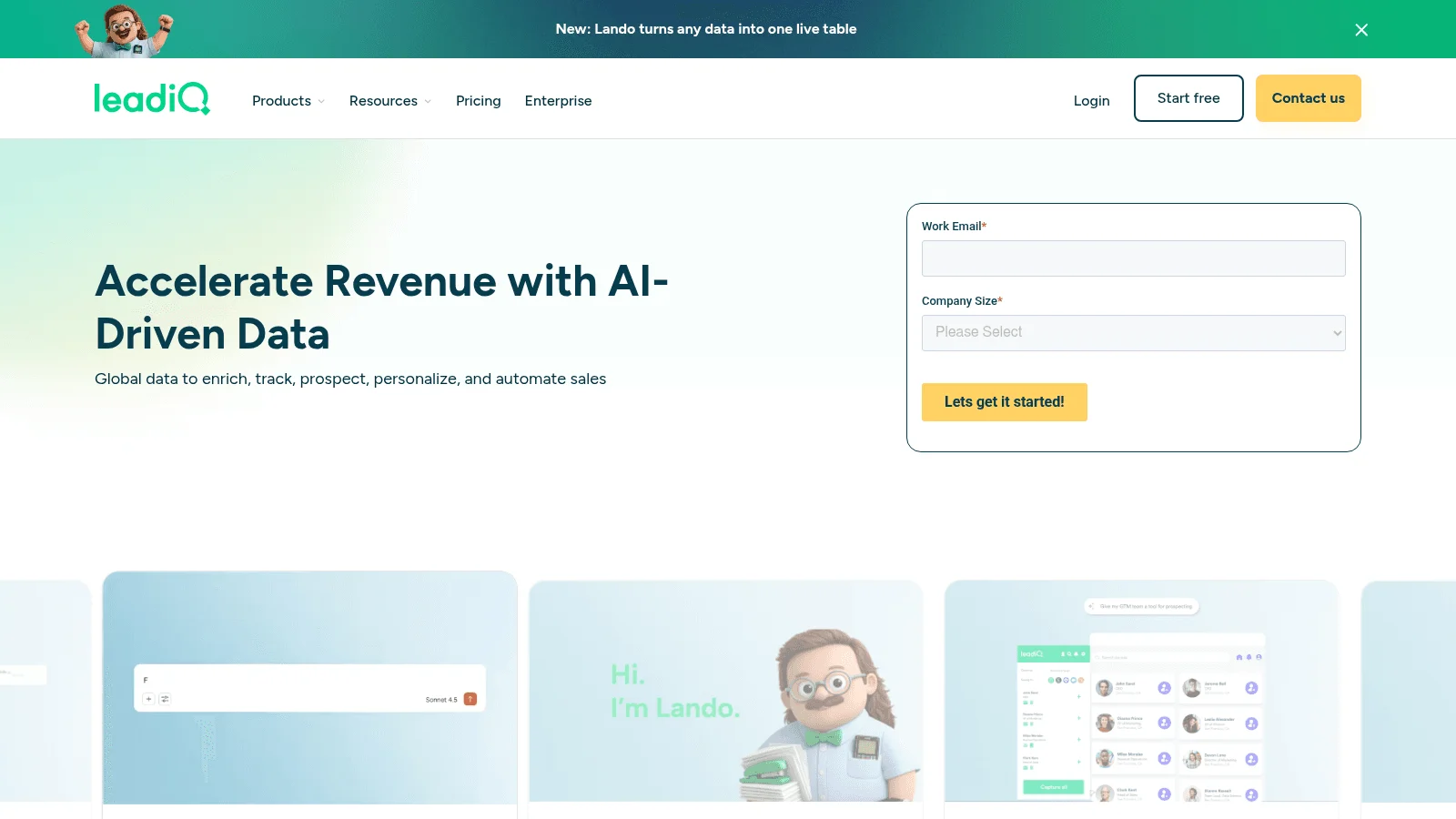
Best for: Cheapest paid entry for a small team.
Overview: LeadIQ prices its Pro plan on a credit slider for up to five users.
Key features:
- A free plan for one user with 50 credits, plus a 30-day free trial on any plan.
- API access on every tier.
- An email costs 1 credit, a phone 10 and both together 11.
Pricing: Pro starts at $15 a month billed annually, or $20 on monthly billing, for 200 credits a month. Enterprise is custom and sold on annual terms only.
Pros: Up to five users on Pro, API from the free plan, a month-long trial
Cons: Database search is limited on Free and Pro, phones cost 10 credits, Enterprise is annual-only
Where it beats ZoomInfo: A team of up to five gets API access from day one and can pay month to month while it decides.
Final verdict: LeadIQ is the cheapest published way to put a small team on paid contact data.
3. RocketReach
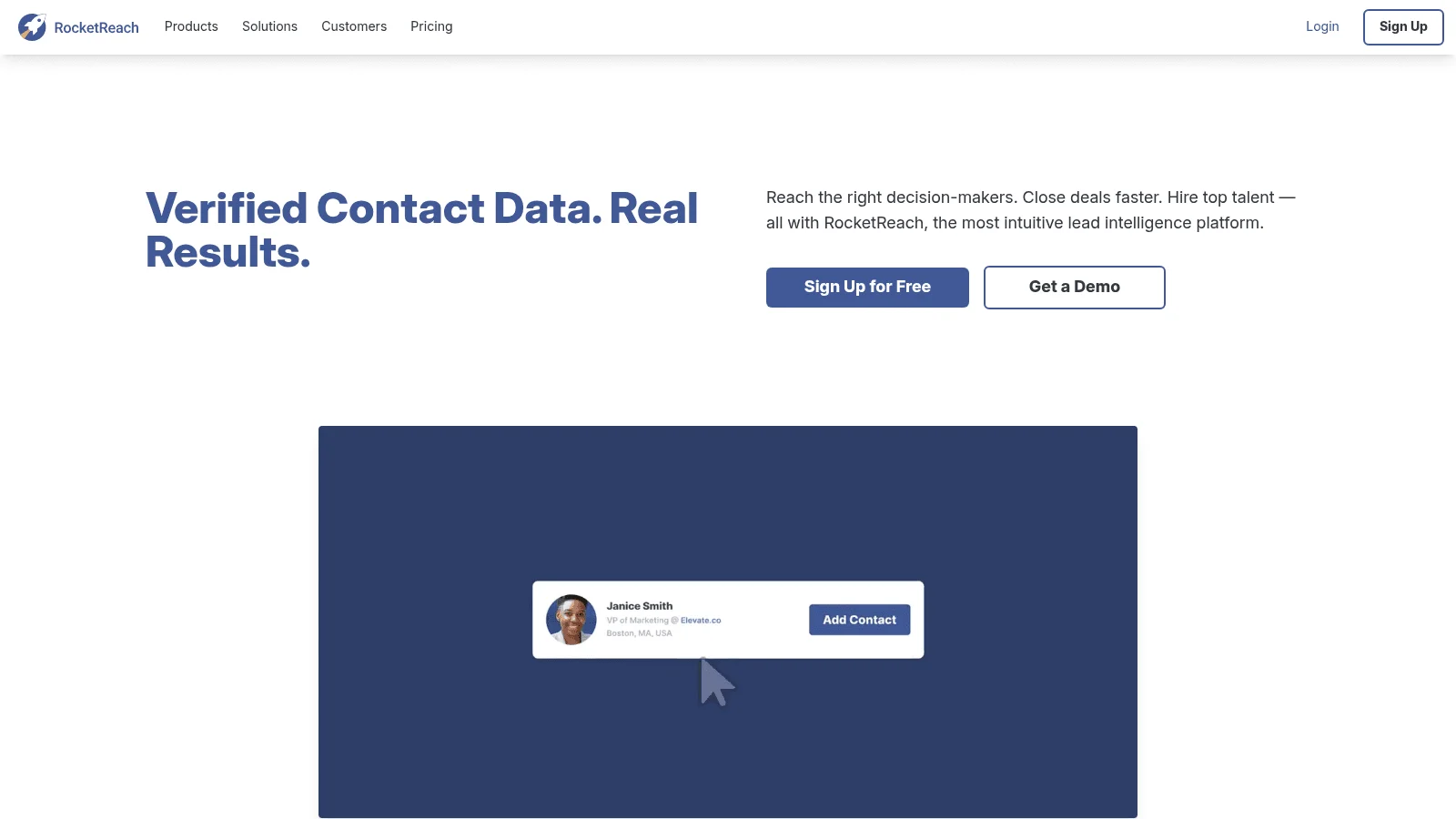
Best for: Occasional lookups by a few named people.
Overview: RocketReach sells per seat. A lookup is used only if RocketReach finds and verifies an email or phone, otherwise it's refunded.
Key features:
- Five free lookups, no card needed.
- MCP and API on every paid tier.
- Monthly plans with 100, 250 or 1,000 lookups.
Pricing: Essentials costs $33 a month billed annually ($399 a year) or $69 monthly, Pro $75 or $119, and Ultimate $142 or $209. Team plans start at $6,000 a year.
Pros: Refund when nothing is verified, monthly billing on every individual plan, API from the lowest paid tier
Cons: Priced per seat, annual "unlimited" lookups still cap exports at 1,200 to 20,000 a year, Essentials has no phones
Why it's a good ZoomInfo competitor: An individual researcher can buy a month, use it, and stop, which ZoomInfo's standard one-to-three-year terms don't offer.
Final verdict: RocketReach suits a researcher or two who look people up now and then.
4. Lusha
Best for: Reps who need numbers fast.
Overview: Lusha sells per account with seats included, and it prints both its yearly and monthly prices. Lusha publishes 515M+ contacts and 29M+ companies in a data table dated September 30, 2026.
Key features:
- 40 free credits a month on its free plan, no card needed.
- Phones cost 5 credits, against 1 for an email.
- MCP on every tier, and API access on every plan, with strict rate limits on Free and Starter.
Pricing: Starter runs $37.45 a month billed yearly or $49.90 on monthly billing, for one seat. Pro is $52.45 yearly or $69.90 monthly with two seats, Premium is $299.95 yearly or $399.90 monthly with five, and Scale is quote only.
Pros: Monthly billing on every paid tier, free plan, unused credits roll over (up to twice the monthly amount) on Pro and Premium
Cons: Strict API rate limits on Free and Starter, no rollover below Pro, phones cost five times an email
Where it beats ZoomInfo: Small sales teams can pay month to month and walk away if it doesn't work, which a non-cancelable contract never allows.
Final verdict: A month-to-month exit is the right test for a first data vendor, and it's the first thing to check on any Lusha alternatives as well.
5. Apollo.io
Best for: Small teams wanting data plus outreach.
Overview: Apollo.io bundles a contact database with sequences, a dialer, a CRM and API enrichment in one account. Apollo publishes 240M+ contacts and 30M+ companies, and its free plan is a working account, not a time-limited trial.
Key features:
- A free plan with 900 credits per seat per year, granted monthly.
- An email costs 1 credit and a phone number costs 8.
- A 30-day bounce credit refund on emails.
Pricing: Basic costs $49 per seat per month billed annually, Professional $79 and Organization $119 with a three-seat minimum. Monthly billing puts Basic at $65 a seat, so paying for the year saves about a quarter.
Pros: Real free tier, outreach built in, 14-day trial on Basic and Professional
Cons: Unused credits expire each billing cycle, including purchased add-ons, every seat must be on the same plan, complete API access means a custom plan
Why it's a good ZoomInfo competitor: You can pull real contacts before paying anything, and the paid price is printed on the page.
Final verdict: Apollo.io is a strong first stop for a small team. If expiring credits bother you, Lusha (rollover on Pro) and Lead411 handle unused credits better, a rule worth checking on any Apollo alternatives too.
6. People Data Labs
Best for: Developers building their own dataset.
Overview: People Data Labs is developer infrastructure, not a prospecting app. It publishes 1.5B+ unique individuals and 70M+ companies, refreshed monthly, and sells person and company data on separate plans.
Key features:
- API access on every plan.
- One credit returns one record.
- Bulk data license feeds on Enterprise.
Pricing: Person data starts at $98 a month on Pro, or $940 a year, from 350 credits a month. Company data Pro is $100 a month or $960 a year, and annual billing saves 20%.
Pros: Free tier for testing, monthly or annual billing, separate person and company plans
Cons: The free tier hides emails, phones and addresses, there's no interface for reps, Enterprise runs on annual contracts
Where it beats ZoomInfo: Engineering teams that bought ZoomInfo mainly for its API can get raw records here at a visible price.
Final verdict: People Data Labs suits builders who want a dataset to own, not a tool for sellers.
7. Clay
Best for: Combining many data providers.
Overview: Clay isn't a database. It connects 150+ data providers, so one record can try several of them in turn before you give up on it.
Key features:
- No charge when an enrichment returns nothing.
- Bring your own provider keys, at 1 action (Clay's unit for each step it runs) and no data credits.
- Unlimited seats on every plan.
Pricing: Launch is $167 a month billed annually, or $60 (actions) plus $125 (data credits) a month billed monthly. Growth is $446 a month billed annually, and annual billing saves 10%.
Pros: Free plan with 100 data credits, a 14-day trial on its self-serve plans, data credits from $0.05 each
Cons: No phone enrichment on Free, CRM auto-sync and calling other APIs from Clay (its HTTP API) need Growth, Clay's own API is Enterprise-only
Why it's a good ZoomInfo competitor: When one provider misses a record, the next one in line gets a try, so no single database has to cover everyone.
Final verdict: Clay fits an ops-minded team that would rather orchestrate providers than trust a single database.
8. Lead411
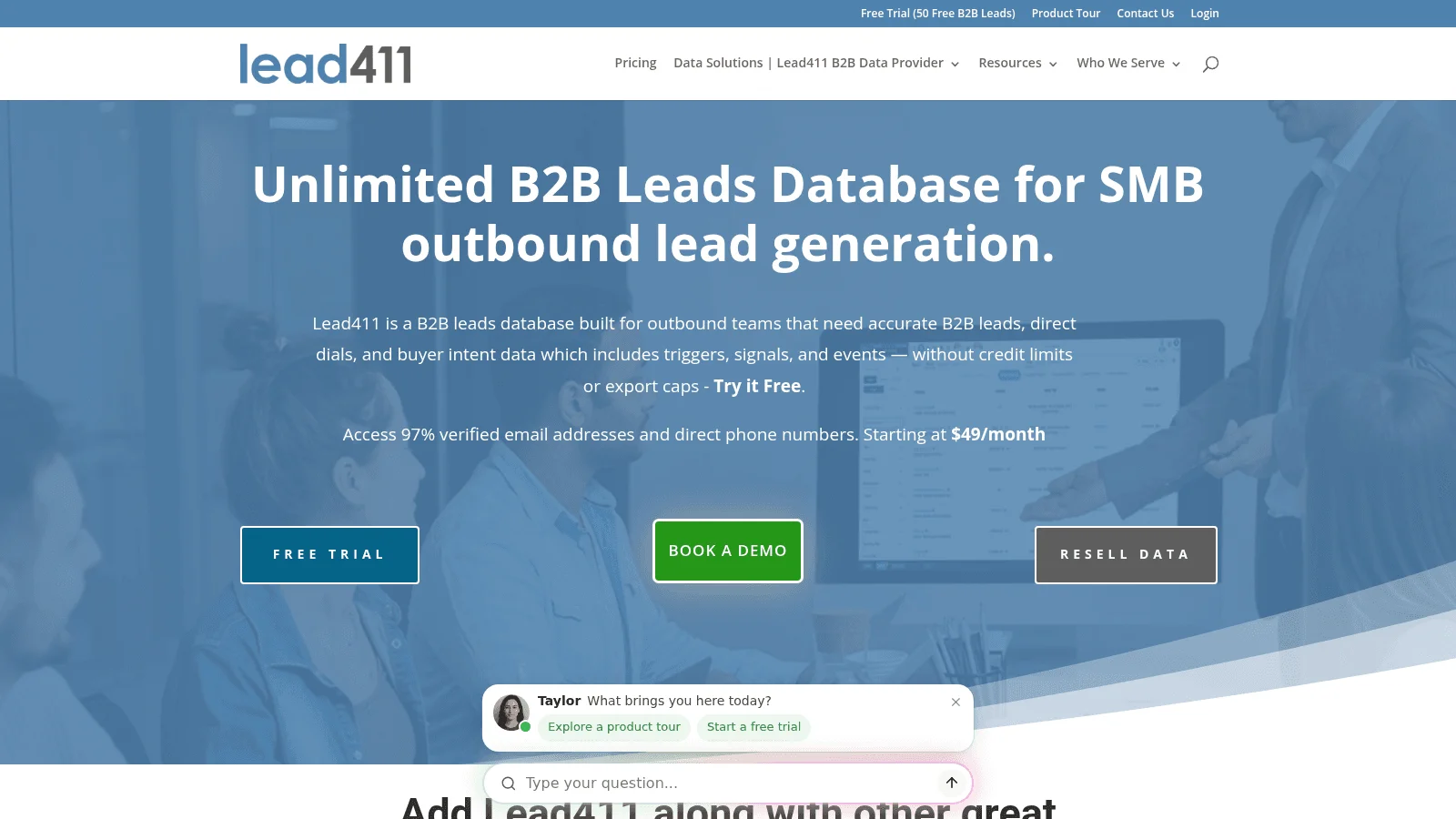
Best for: Email plus direct dial in one export.
Overview: Lead411 counts exports rather than separate email and phone credits, so a contact's email and direct phone come together.
Key features:
- 50 exports to try over 7 days.
- Intent data included on the annual Spark plan.
- API access from the Ignite plan.
Pricing: Spark is $49 a month for 1,000 exports, or $490 a year for 12,000 with intent included. Ignite starts at $150 a month or $1,500 a year, and the unlimited Blaze plan needs a call.
Pros: Rollover on unused exports, email and phone in one export, monthly and yearly options
Cons: No API on Spark, the homepage promises no export caps while Spark caps 1,000 a month, Blaze is quote only
Where it beats ZoomInfo: Intent signals come on a $490 annual plan you can buy from the website.
Final verdict: Lead411 suits phone-first teams that want intent data at a printed annual price.
9. UpLead
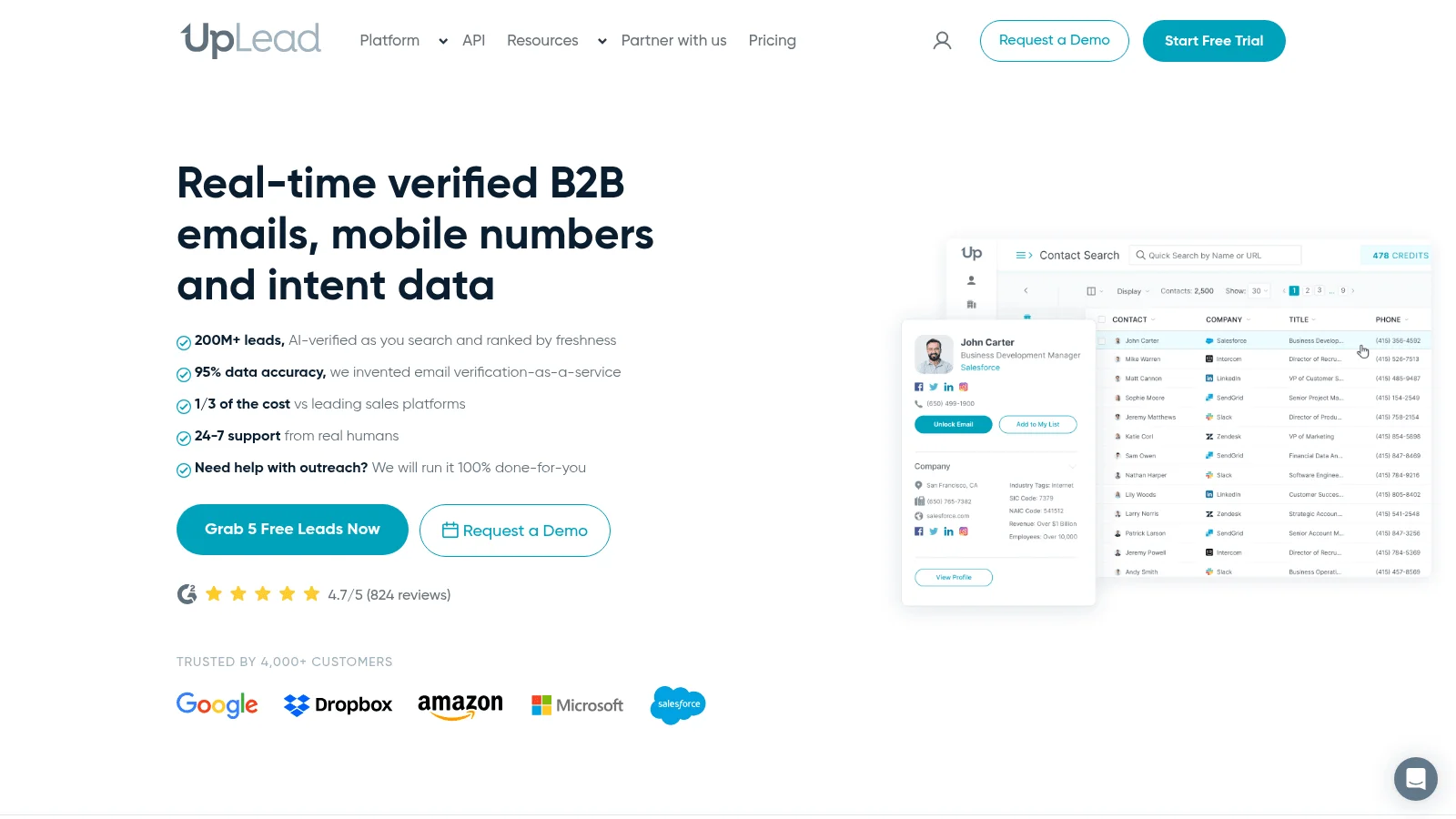
Best for: Solo buyers wanting monthly billing.
Overview: UpLead's Essentials and Plus plans are single-user, and you need Professional (annual, custom price) for more seats. One credit gets you a contact's email and mobile together.
Key features:
- A 7-day trial with 5 credits.
- Extra credits at $0.60 on Essentials or $0.50 on Plus.
- Full API access on the Professional plan.
Pricing: You pay $99 a month on monthly billing for Essentials (170 credits), or $74 a month on an annual plan with 2,040 credits a year. Plus costs $199 monthly or $149 a month annually, and Professional is custom and annual-only.
Pros: Monthly option on the two lower plans, one credit per contact, published overage price
Cons: One user on Essentials and Plus, full API only on annual Professional, a five-credit trial is too small to judge accuracy
Why it's a good ZoomInfo competitor: A one-person team can see the exact cost of each contact before buying.
Final verdict: UpLead fits a solo buyer who wants monthly billing and doesn't need the API.
10. Seamless.AI
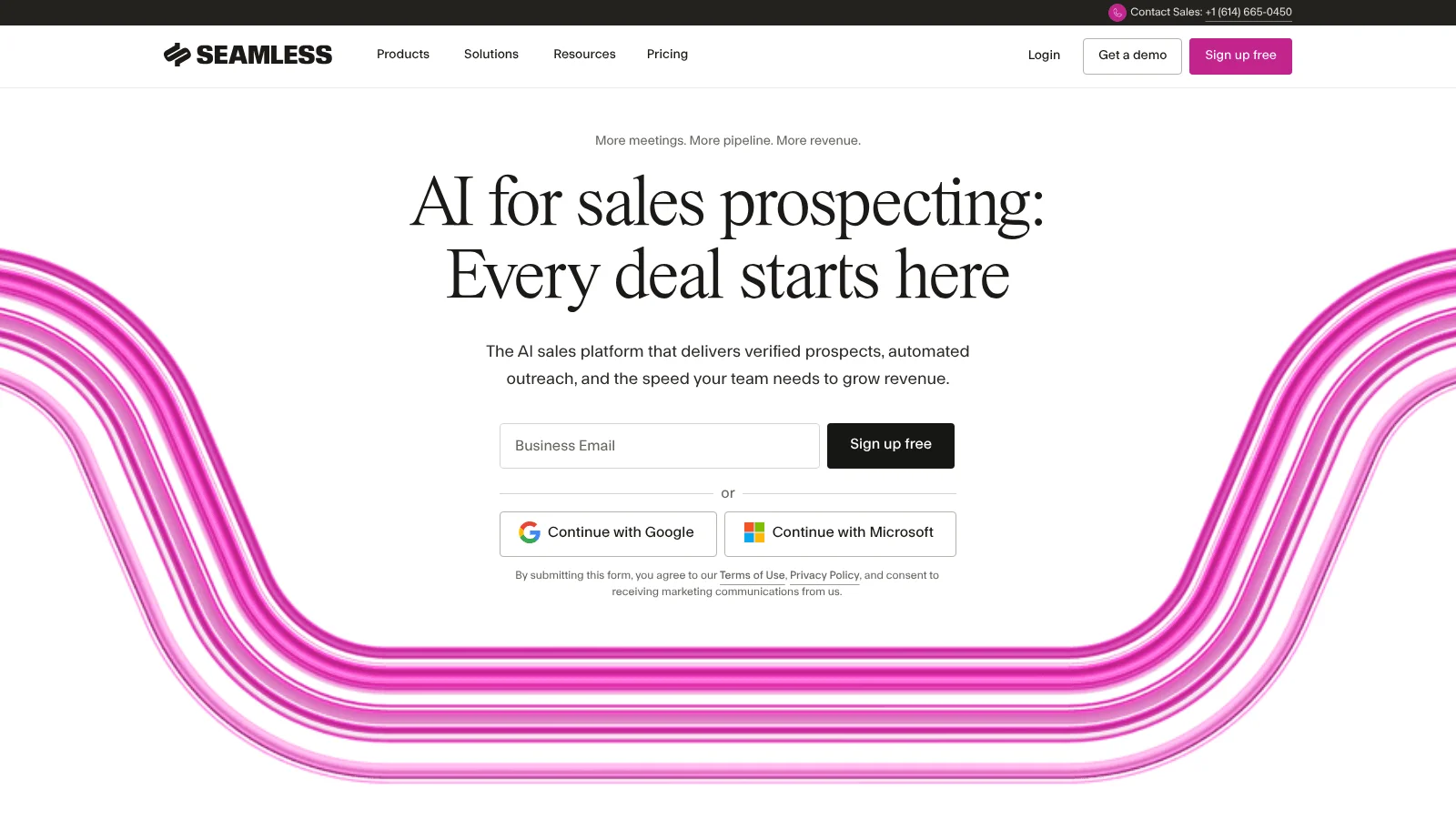
Best for: Testing a big email database before a sales call.
Overview: Seamless.AI lets you start free and then moves you to a demo form for paid plans. Its API page publishes 2.2B+ verified contacts and its homepage 1.6B+ verified business emails and 448M+ phone numbers.
Key features:
- Free for up to 50 credits.
- "Credit Back Protection" refunds a credit when an email turns out to be invalid.
- Separate API and MCP products.
Pricing: Every paid plan is quote only.
Pros: Free start, refunds on invalid emails, API and MCP available
Cons: Paid pricing hidden behind a demo, API tier gating not published
Where it beats ZoomInfo: It covers the same prospecting job and lets you spend 50 free credits before the first sales call.
Final verdict: Seamless.AI suits teams happy to negotiate, while buyers who want a printed price should weigh it against other Seamless.AI alternatives that publish one.
11. Cognism
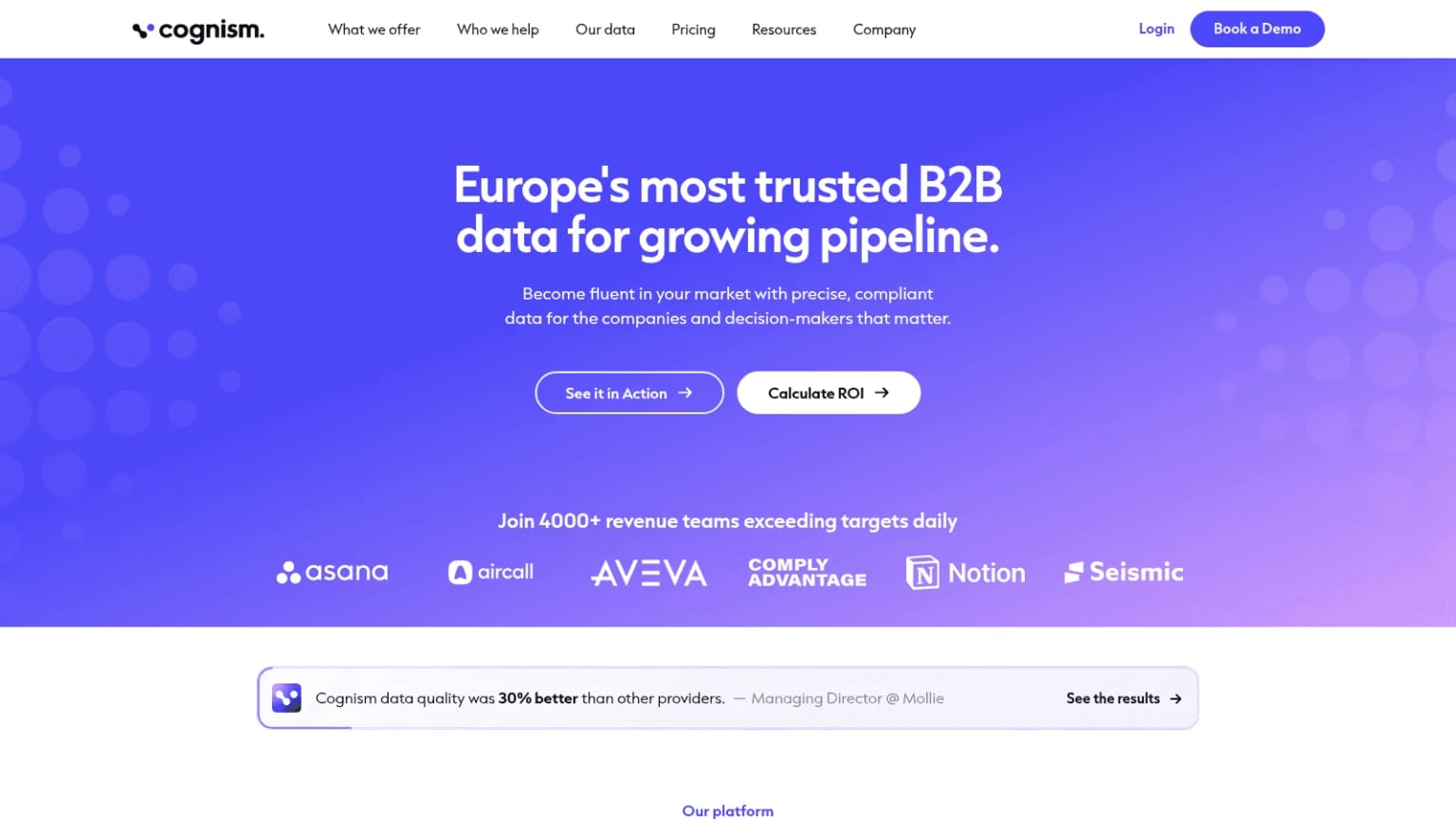
Best for: Teams calling into Europe and the US.
Overview: Cognism sells through a quote, like ZoomInfo. Cognism publishes that 95% of its Director+ contacts (director level and above) are refreshed every 30 days, and it screens numbers against 16 Do-Not-Call lists.
Key features:
- Standard and Pro packages, each with 5 seats included.
- One credit reveals one contact, and the same credits work across the platform, its Enrich product and the API.
- MCP and API access from Standard, and mobiles come with both packages. Pro layers on a premium mobile filter, mobile checks on demand and intent data.
Pricing: Cognism publishes no figures for either package.
Pros: Credits shared across every surface, Do-Not-Call screening, 90% coverage of Director+ contacts in Europe and the US by its own figure
Cons: No published price, sold in 5-seat packages, on-demand mobile checks and intent wait for Pro
Why it's a good ZoomInfo competitor: Cognism chases the same phone-heavy sales teams. Ask for its contract length in writing, since a quote leaves that open.
Final verdict: Choose Cognism when phone coverage in Europe matters more than escaping a sales-led contract.
12. SalesIntel
Best for: Big teams wanting unlimited exports.
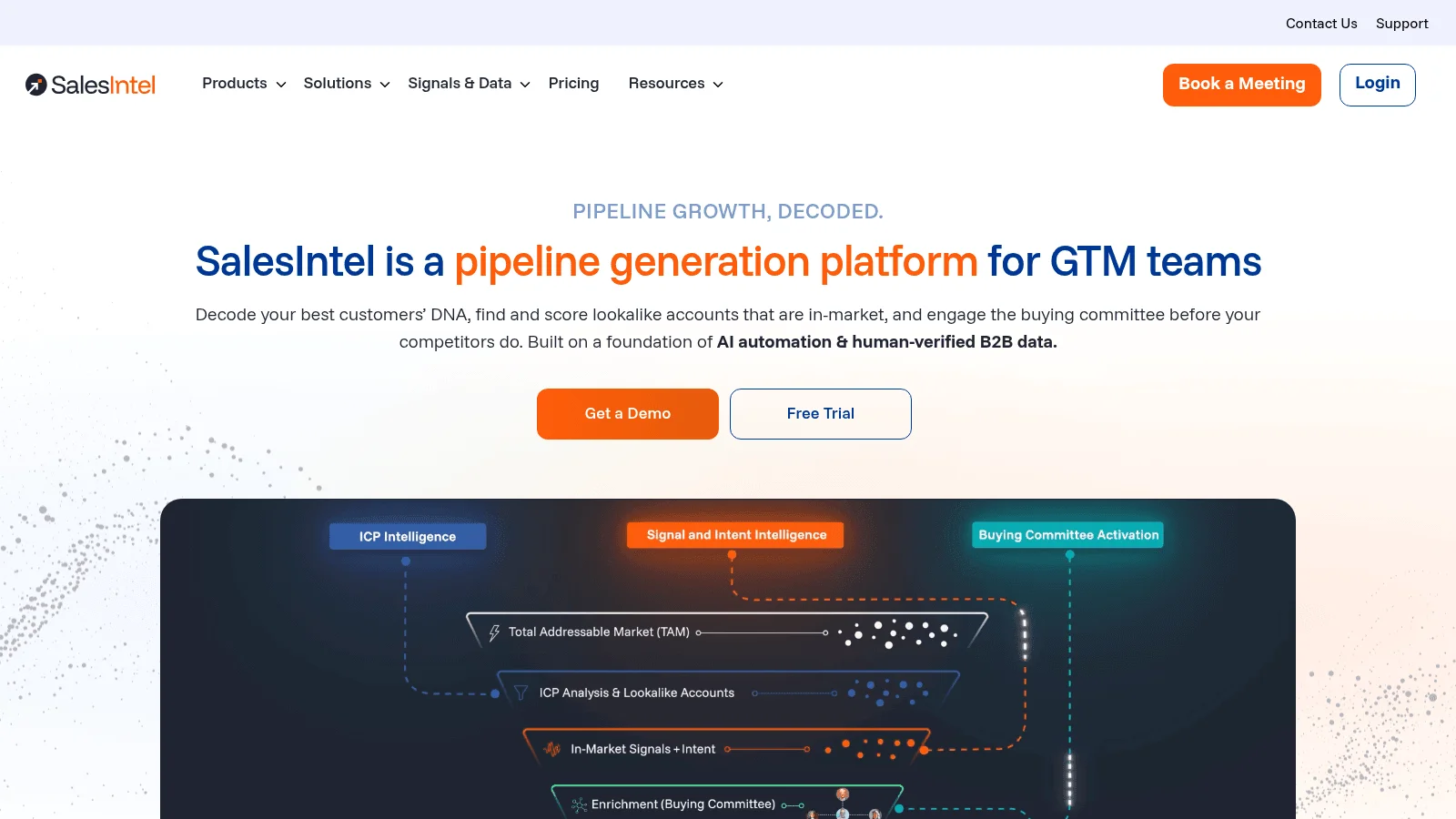
Overview: SalesIntel sells a single package rather than tiers, built around unlimited users and unlimited export and enrichment credits. It publishes 200M+ contacts, 54M+ verified mobiles and re-verification every 90 days.
Key features:
- Research on Demand (contact research you request), with 10 credits per user per month.
- Basic intent included, with advanced intent and VisitorIntel as paid add-ons.
- Integrations with Salesforce, HubSpot, Marketo, Salesloft, Outreach, Dynamics and Zoho, plus CSV.
Pricing: The package is quote only. Advanced intent and visitor identification cost extra on top of it.
Pros: No per-seat counting, unlimited exports, wide CRM coverage
Cons: No published price, no API listed on the pricing page, advanced intent sits behind an add-on
Where it beats ZoomInfo: A large team that hates rationing credits gets unlimited users and exports without metering every download.
Final verdict: SalesIntel makes sense when headcount is high and you'd rather negotiate one flat deal.
When ZoomInfo Is Still the Right Choice
Some teams should stay. ZoomInfo sells one of the broadest platforms in this category: contact and company data, buyer intent, website visitor identification, ABM and conversation intelligence from one vendor. Replacing all of that means buying and connecting several tools.
Scale is the other argument. ZoomInfo publishes 500M+ contacts and 100M+ companies, both its own figures, and its blog claims accuracy of "up to 95%" for contacts checked against first-party data. If your team works a narrow segment where ZoomInfo already performs well, a cheaper database that misses those accounts costs you more than the contract does.
On intent data and ABM specifically, the closer rival among ZoomInfo Technologies competitors is 6sense, an account-based platform built around buyer intent. This list sticks to tools that replace ZoomInfo's contact data. Stay on ZoomInfo if several of these describe you:
- Your reps use intent data or visitor identification every week, not just the contact search.
- You run ABM campaigns that pull from the same vendor's account lists.
- Your conversation intelligence already lives in ZoomInfo and your managers rely on it.
- Your renewal price is locked and still cheaper than three separate tools.
If two or more of those are true, the better move is usually to negotiate the renewal rather than switch. Use the ZoomInfo competitors above as your price anchor in that conversation. And if you're mid-term with more than a year left on a non-cancelable contract, use that time to test alternatives side by side.
What Switching Actually Involves
Most buyers don't want to swap one long contract for another. A partnerships lead at an AI search company told us, "it's gonna be tough for us to make an annual commitment right off the bat. We probably want to be using you guys on a month month basis." Our plans are monthly and can be canceled anytime; ask every other vendor how it bills before you sign.
How to Move Off ZoomInfo Without a Data Gap
Plan around your renewal date. These steps keep your CRM intact while you test.
- Find the notice period in your order form and put the deadline in your calendar with 30 days to spare.
- Export the contacts and accounts you actually worked in the last 12 months, within your export credits.
- Dedupe that export against your CRM so the test sample has no duplicates and you don't pay twice for the same person.
- Run the new tool on a sample of that export for a month, side by side with ZoomInfo.
- Compare bounce rates, connect rates and empty results, then send notice before the deadline.
A business lead at a recruiting-tech company put the risk simply: "everything has an exit cost, right?" Ask any new vendor about exit terms on the first call, while you can still walk away.
How to Choose a ZoomInfo Alternative by Team Size and Use Case
There's no single best ZoomInfo alternative. Among the sites like ZoomInfo above, the right one depends on how many people use it and whether a person or a program makes the request.
Solo Founders and Small Sales Teams
Start free and stay monthly. Of the sites like ZoomInfo here, Apollo.io, Lusha and LeadIQ all have free plans. LeadIQ is the cheapest paid start at $20 a month on monthly billing ($15 billed annually), and Lusha, RocketReach and Apollo.io also let you stop after one bad month.
Mid-Market Sales Teams
Stay pay-as-you-go with most providers and negotiate a subscription only with your top one or two, once volume justifies it, because match rates shift from year to year. Cognism and SalesIntel suit a team ready to negotiate one deal, while Lead411 and Apollo.io's Organization plan publish prices you can budget against.
Product, Data and AI Teams
If software makes the request, skip license-priced tools like ZoomInfo (which also sells API and MCP access) and pick an API with public prices. People Data Labs charges per match, so a lookup that finds no one costs nothing. Our plans make some lookups unlimited, charge credits for emails, phones and real-time re-fetches, and charge nothing when a standard search or contact lookup comes back empty.
Clay works here only on Enterprise, because that's where its own API sits. Its Growth plan lets Clay call other APIs, not your code call Clay.
HubSpot Shops
Check what you already pay for before buying anything. Since HubSpot absorbed Clearbit, paid HubSpot users get contact and company enrichment at no extra cost. Buy a separate tool only for the fields that enrichment leaves empty, which is also the fair test for any of the Clearbit alternatives.
Commit Only After You've Measured Freshness
ZoomInfo's terms suit a team that knows what it needs for the next one to three years. Many teams searching for a ZoomInfo replacement don't, and you only learn how fast a vendor's data ages after you've used it.
Start with the commitment you can live with, then pick the tool. If you need a full sales suite, trial Apollo.io; if you mainly need numbers on a monthly plan, try Lusha. If your product or pipeline makes the calls, Reverse Contact publishes its plans and charges for emails and phones only when it finds them.
You can get a free API key and run your own records through it with free trial credits, no card required.
FAQ
Who are ZoomInfo's main competitors?
The main ZoomInfo Technologies competitors for contact data are Apollo.io, Cognism, Lusha, Seamless.AI, UpLead, SalesIntel, Lead411, LeadIQ and RocketReach. Clay and People Data Labs are ZoomInfo competitors for teams that want data through an API rather than a seat-based app. On intent data and account-based marketing, 6sense is a direct ZoomInfo competitor that this list doesn't cover.
Are any ZoomInfo competitors free to use?
Yes. Apollo.io gives 900 credits per seat per year, Lusha gives 40 credits a month, and LeadIQ gives one user 50 credits. People Data Labs has a free tier but hides contact data on it, and ZoomInfo's own permanent free plan, ZoomInfo Lite, hands out monthly credits. ZoomInfo's annual report says you earn extra if you opt into its contributory network (sharing your own business contacts with it).
How much does ZoomInfo cost?
There's no public figure: apart from the free ZoomInfo Lite plan, ZoomInfo sells every paid tier through a quote. One commenter on Reddit said it ran about $15,000 a year per license "essentially," which is one person's report, not a quote you can rely on. Another user in a different thread reported about $20,000 a year for a three-person team, so quotes clearly vary with team size and add-ons.
Can I cancel a ZoomInfo contract early?
ZoomInfo's annual report describes its subscription contracts as non-cancelable, with terms of one to three years. Check your order form for the notice period, and start a side-by-side test a month or two before that deadline.
What is better than ZoomInfo for a small team?
For a team under five, the best ZoomInfo alternative is usually Apollo.io, Lusha, LeadIQ or RocketReach, all better than ZoomInfo for budgeting, because all four publish prices and have a free plan or free lookups. Pick Apollo.io if you also want sequences, and Lusha, LeadIQ or RocketReach if you mainly need contact data.
The data layer behind your GTM engine
Access fresh people and company data through one API and power every enrichment, prospecting, and automation workflow.
- Profiles
- 1B+
- Refreshes / month
- 200M
- Response time (P95)
- 500ms