
12 Best AI Recruiting Tools in 2026, by Hiring Stage
Julien K.Published
Key takeaways:
- Most AI recruiting tools are strongest at one hiring stage: screening, interviews, notes or the ATS. Two of the 12 were bought: Workday owns Paradox and Zoom owns BrightHire.
- Seven of the 12 publish no price, and Metaview's prices cover AI sourcing, not notes. On November 2, 2026, Workable started at $299 a month billed annually, Ashby at $270 a month on a yearly term, and Manatal at $15 per user a month on yearly plans.
- The five laws we cover put duties on the employer using the tool. The NYS Comptroller's December 2025 audit says New York City's regulator found 1 issue in 32 companies it checked, while the Comptroller found at least 17 potential non-compliances.
- A stale title or a wrong match in the candidate record carries through every later stage. Reverse Contact, our people-data API, is a data layer recruiting products can build that record on, with a free check of each record's last refresh.
A candidate applies, gets screened, books an interview, sits it, gets scored, and ends up as a record in an applicant tracking system (ATS). AI recruiting tools now automate pieces of each step, yet almost none automate all of them, so the useful question is which stage you're buying for.
This list sorts 12 AI tools for recruitment by that stage. Finding candidates and first outreach belong to a separate roundup of AI sourcing tools, and this one starts once a candidate is in your pipeline.
Reverse Contact is ours, so it's first, and it's a different kind of entry: a data API for teams building AI-powered recruitment tools. If you're building a recruiting product rather than buying one, that entry is the one to read closely. Every price below was read on the vendor's own site on November 2, 2026.
What AI Recruiting Tools Actually Automate
The clearest time savings in hiring come from mechanical steps. Parsing a resume, offering interview slots, sending reminders and chasing a missing form all follow rules, and a bot does rules well.
Scoring is harder, because a ranking only helps if someone can explain it. In a Reddit thread on r/RecruitmentAgencies, agency recruiters said the time saved on parsing and scheduling was real, but a score with no visible reason moved the work into spot-checking, since "AI said so" doesn't satisfy a client. It's one anecdotal thread, but it maps onto the stages:
- A chat or text assistant asks knockout questions and books the slot.
- An AI interview by voice, video or text gets scored against a rubric.
- A talent-intelligence model matches people to roles across a large company.
- A notetaker records the human interview and fills in the scorecard.
- The ATS holds the record, now with AI review and summaries built in.
Scheduling and note-taking save time with little judgment involved. Knockout questions, AI interviews, match scores and AI application review all make judgments you'll have to defend.
The stages are also starting to chain. In the AI recruiting platforms we talk to, a search finds candidates, the platform's own weighting scores them, enrichment adds contact details, and an AI voice agent calls to screen. A bounced email or a dead number from the enrichment step stops every step after it.
The ATS is changing too. Some newer systems answer questions from your own candidate records, use a second model to reorder matches, and accept a search typed as a sentence rather than assembled from filters.
Each of those steps reads data about the candidate. Hiring platforms and job boards also show candidates what an employer does and how big it is, the same research on a company they'd otherwise do in a browser tab, so whoever builds one has the employer's record to get right too.
The 12 Best AI Recruiting Tools by Hiring Stage
The table puts each tool at its stage, with what it scores or decides and whether another company has bought it. Prices are in each entry.
| Tool | Hiring stage it covers | What it scores or decides | Acquired by another company? |
|---|---|---|---|
| Reverse Contact | None: data for products that build these stages | Which person a lookup matches; it scores no candidates | No (ours) |
| Paradox | Conversational screening and scheduling | Screening answers, by chat or text | Workday |
| Humanly | Conversational screening and scheduling | Screening answers; structured AI interviews | No |
| HireVue | AI interviews and assessments | Interview results, evidence shown; skills tests | No |
| Sapia.ai | AI interviews and assessments | Chat answers, against competencies | No |
| Eightfold | Enterprise talent intelligence | 0 to 5 star match scores; AI interviews | No |
| Metaview | Interview notes | Applications; AI screening chats | No |
| BrightHire | Interview notes and AI screening | Applications and AI screens, against rubrics | Zoom |
| Greenhouse | ATS with AI built in | Talent Matching; voice AI interview (extra) | No |
| Ashby | ATS with AI built in | Applications, against your criteria | No |
| Workable | ATS with AI built in | Applicants, against the job (credits) | No |
| Manatal | ATS for small teams and agencies | Match scores; AI Interviewer add-on | No |
After our own entry, the other eleven follow the stage list above, from screening to the ATS where every stage writes its result, and within a stage the order isn't a ranking.
1. Reverse Contact
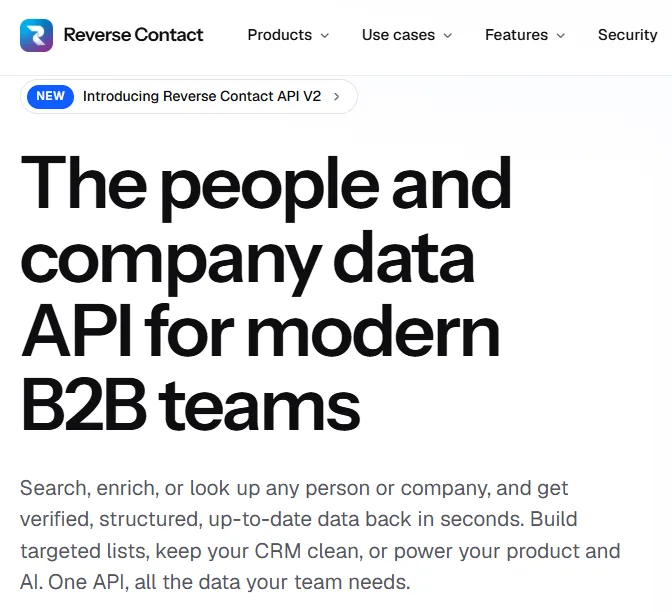
Stage: None directly. It's data for products that build these stages.
Best for: Teams building an AI recruiting platform or job board.
Overview: Reverse Contact is a data API: your code sends a name with a company domain, an email or a company domain, and gets back a person or company record in one consistent JSON shape. We cover 800M+ profiles.
The first use is the employer page: our records on 70M+ companies carry the description, industry, size and headquarters a hiring platform shows candidates.
The second is keeping candidate records current. The first lookup through our person enrichment API returns a person id to store with the record. Later, a free /check on that id returns the last full refresh date, and your code re-fetches only the old records.
A record that fails our checks comes back empty, and an uncertain match comes back with our best match first and the other possible people listed after it. If enriched fields ever feed a score, audit them like any other field your scoring reads: a profile the candidate never supplied shouldn't decide anything alone.
Key features:
- A free last-refresh check per person
id, which needs at least 2 credits in the workspace to run. - Enrichment from an email or a name that answers in the same request; live re-fetches are asynchronous, so you poll for the result (free) or get it at a webhook.
- Bulk enrichment of up to 25,000 people per request or CSV, and exportable Lists.
- REST API, a CLI and an MCP server (the standard AI assistants use to call tools).
Pricing: Showing the data to your customers needs Platform, priced by sales. On own-team plans, Go at $249 a month covers cached lookups by ID, Plus at $449 adds search, and Max at $699 adds enrichment from an email, a name or a domain, with unlimited use capped at 100,000 profiles per workspace a day. Credit packs start at $100 and last three months. Every plan bills live re-fetches (2 credits, even on a miss), business emails (3 credits per email found) and phones (20 credits when a lookup finds one).
Pros: Enrichment from an email or a name answered in the same call, bulk runs of 25,000 people with unmatched rows free, Lists that don't charge for someone already on them and pause at your credit ceiling, a free last-refresh check, the best match plus other likely people on an ambiguous name
Cons: It doesn't screen, interview, schedule or run an ATS, and has no ATS integration of its own; no alerts when a candidate changes jobs
How to start using it:
- Sign up on free trial credits, no card required.
- Enrich a sample of records your product holds, with the permission your customer contracts require.
- Store each person
idand count the right matches. - Later, run
/checkon those IDs and re-fetch the old ones. - Connect through Zapier, Make, n8n or your own code.
Why it's a good AI recruiting tool: Every tool below works from a candidate record that can go stale, though Manatal enriches profiles itself. Reverse Contact gives builders employer records and a way to keep candidate records current.
Final verdict: Right for a team building a recruiting product in code. Wrong for a recruiter who wants a ready-made hiring tool.
2. Paradox
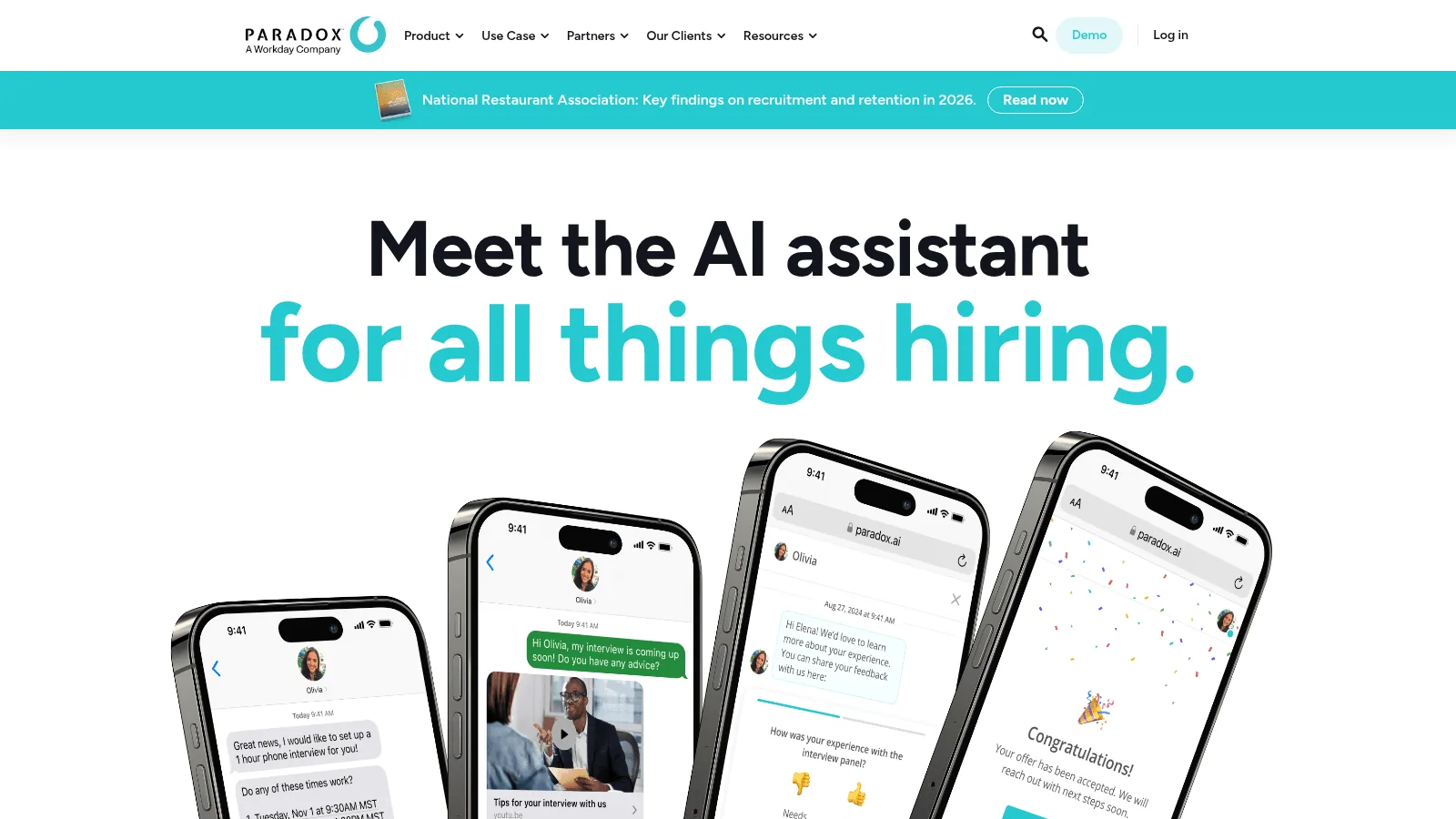
Stage: Conversational screening and scheduling.
Best for: High-volume screening by chat or text.
Overview: Paradox's assistant, Olivia, screens applicants by chat or text, books and runs video interviews, and carries candidates through offers and onboarding. Workday completed its purchase of Paradox on October 1, 2025, and the assistant is now sold through either company.
Key features:
- Screening and booking in one thread, so nobody waits on a recruiter's calendar.
- A Conversational ATS and a Career Site Studio.
- Integrations with Workday and SAP SuccessFactors.
Pricing: Paradox publishes no price, and its pricing address resolves to the homepage. No trial was found.
Pros: Scheduling inside the conversation, coverage through onboarding, links to two major HR suites
Cons: No price or trial, no longer independent, its video interviews may need Illinois consent steps
Where it fits: Volume hiring where candidates apply from a phone and booking the interview is the slowest step.
Final verdict: Strong for volume screening, harder to evaluate without a sales call.
3. Humanly
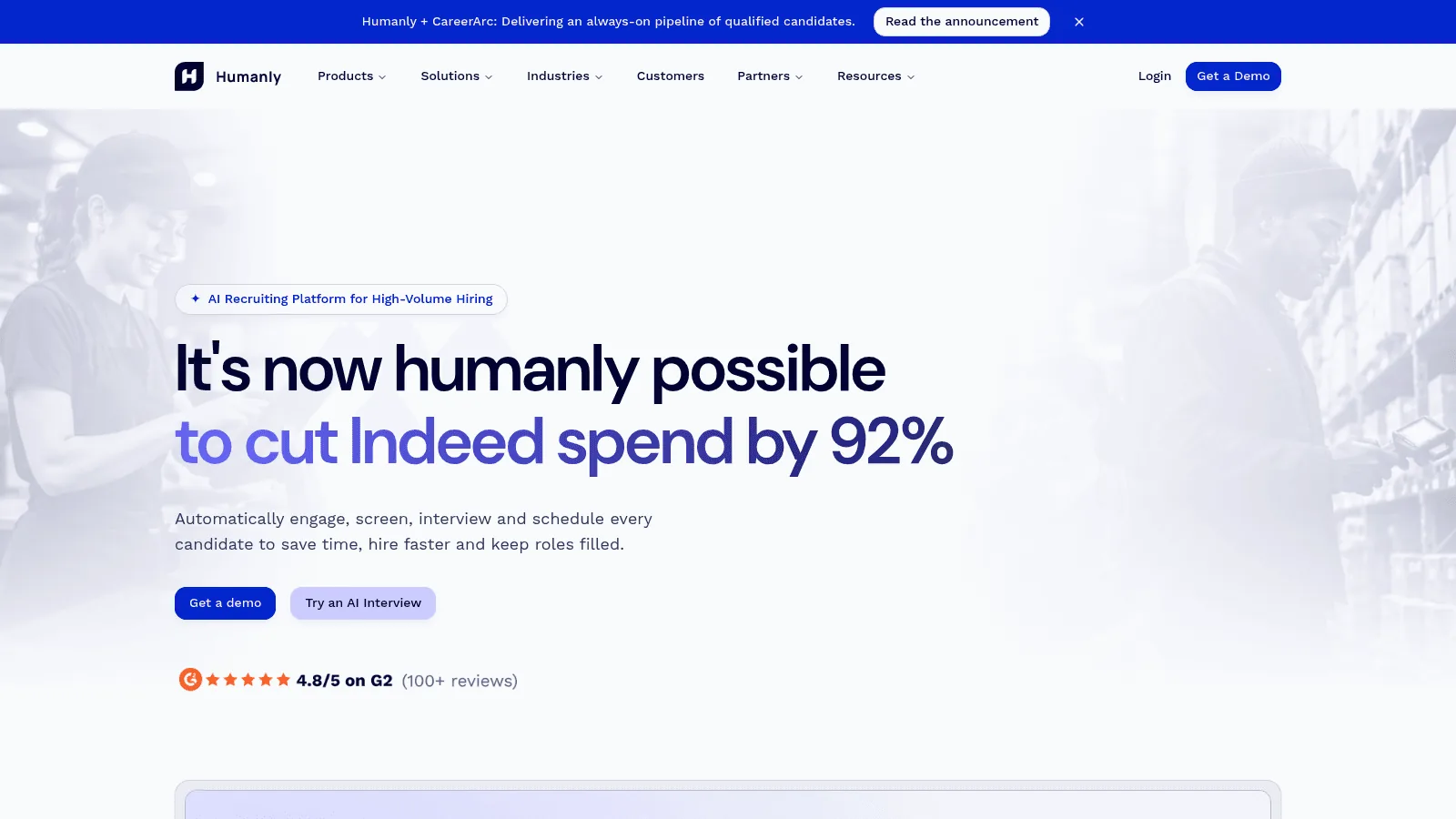
Stage: Conversational screening and scheduling.
Best for: Screening, interviews and notes from one vendor.
Overview: Humanly's AI Recruiter screens and schedules across chat, voice and video, and its AI Interviewer runs structured interviews. It also sells an AI Notetaker, a talent CRM and an ATS, and it has bought other companies, CareerArc among them.
Key features:
- One assistant across chat, voice and video.
- Structured interviews run by its AI Interviewer.
- A notetaker for the interviews people still run.
Pricing: No price is published, and its pricing URL shows a "Page not found" page. A demo is the way in.
Pros: Several stages from one vendor, candidates choose the channel, an ATS if you want one
Cons: No public price or trial, overlaps tools you may already pay for, voice and video screening may need candidate notices
Why it made this list: It's the screening option for a team that wants the interview and the notes from the same place.
Final verdict: Good for cutting your vendor count; check first what your ATS already does.
4. HireVue
Stage: AI interviews and assessments.
Best for: Enterprise interviewing and skills testing.
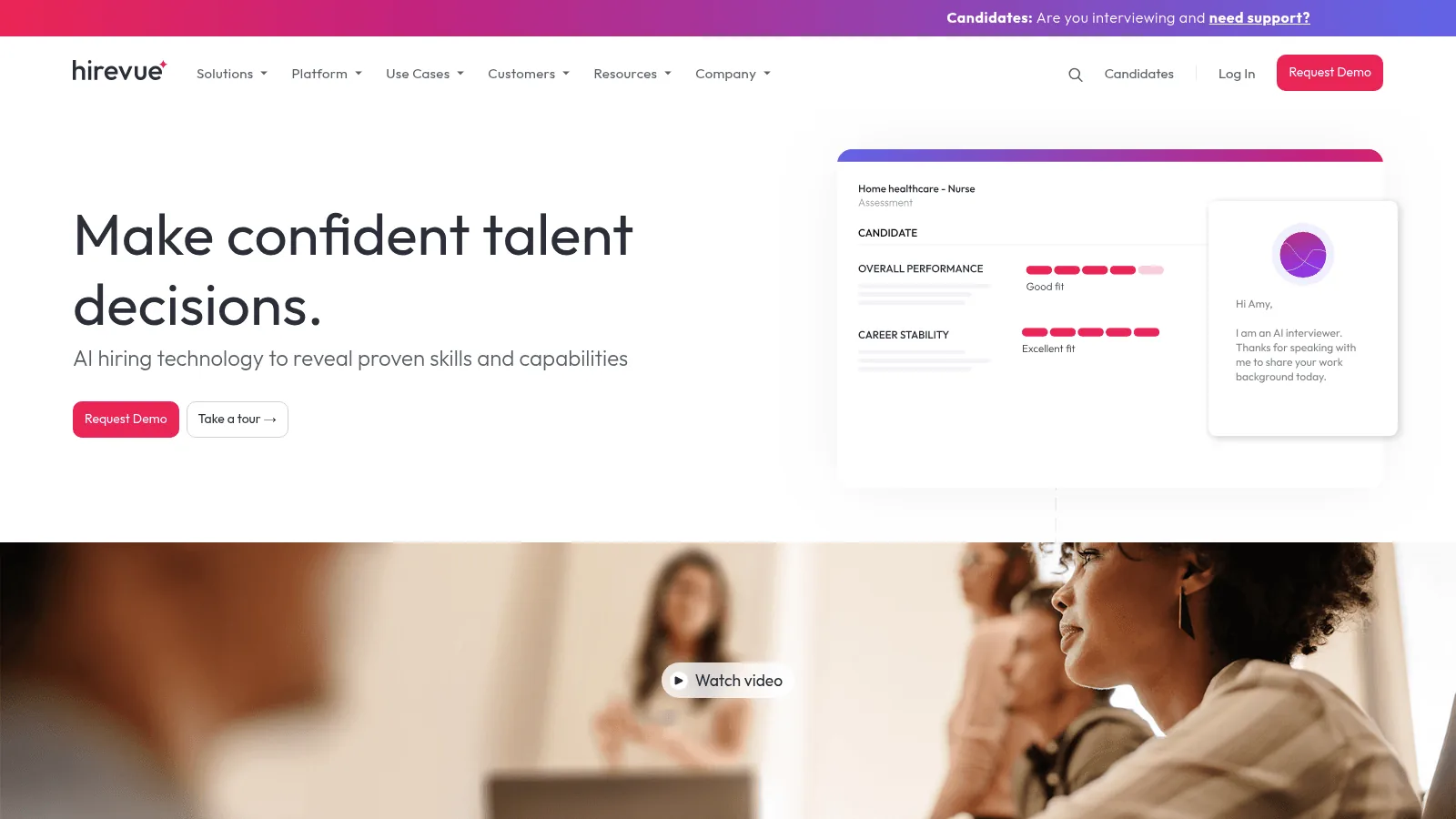
Overview: HireVue's AI Interviewer runs voice-based screening interviews and shows the evidence behind each result, and its assessments test skills. It acquired Hireguide's technology on March 10, 2026.
Key features:
- An Assessment Builder for your own tests.
- Live interviews in HireVue, Zoom, Teams or Webex, with AI summaries and transcripts afterwards.
- Cheating and fraud checks.
Pricing: HireVue publishes no plans or prices, only a demo request. It's free for candidates.
Pros: Evidence shown beside results, assessments and interviews together, fraud checks built in
Cons: Quote only with no trial, AI analysis of recorded video, where used, can bring in Illinois's AI Video Interview Act, heavy for a team hiring a few people a month
Its real strength: Showing the evidence answers the "AI said so" problem before a candidate, client or regulator asks.
Final verdict: A fit for structured interviewing across many roles at enterprise scale.
5. Sapia.ai
Stage: AI interviews and assessments.
Best for: Employers with more than 500 hires a year.
Overview: Sapia.ai interviews candidates by text chat and scores their answers against competencies set in its Job Analysis Studio. It also schedules, and its AI Career Coach offers career guidance.
Key features:
- Chat interviews, so candidates answer in writing rather than on camera.
- Questions built from a job analysis.
- Coaching tips after the chat interview, hired or not.
Pricing: Sapia.ai charges per hire at a tailored rate and publishes no figure. It says the model suits companies hiring more than 500 people a year.
Pros: A chat interview with no video to store, you pay only for hires, feedback for every candidate
Cons: No published rate, built for large intakes, its public bias-audit page is undated and calls the NYC law "forthcoming"
Why it earns a place here: Per-hire pricing ties the bill to outcomes, though ask for its current audit before signing.
Final verdict: A strong fit for large, repeated intakes where a text interview suits the candidates.
6. Eightfold
Stage: Enterprise talent intelligence.
Best for: Large employers matching people across many roles.
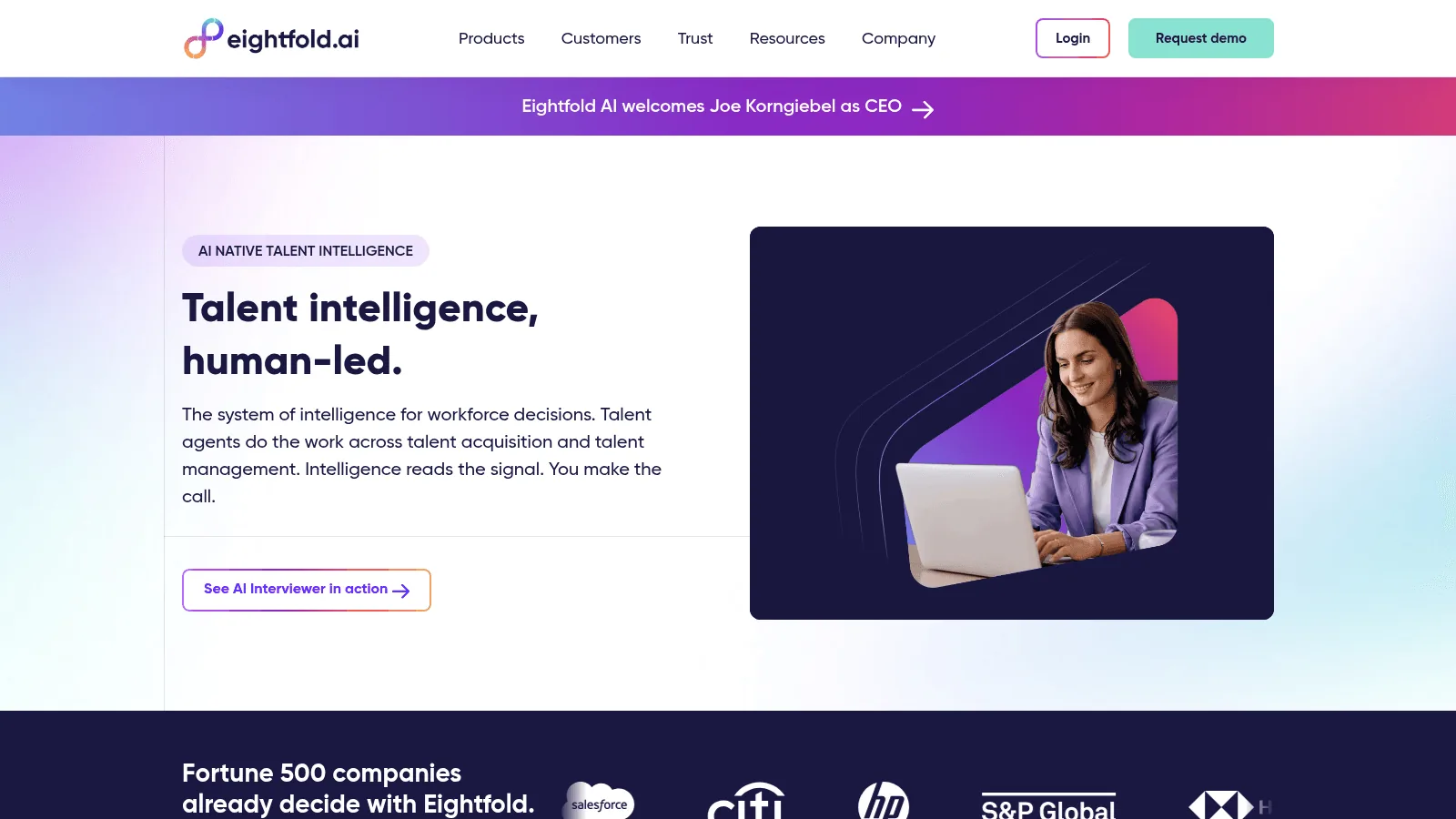
Overview: Eightfold's matching model gives each candidate a 0 to 5 star match score, with an AI Interviewer, an Interview Companion and a Candidate Concierge on top. It also sells talent management modules beyond hiring.
Key features:
- Matching across a large company's open roles.
- AI interviews it describes as "bias-conscious".
- NYC Local Law 144 audit results, prepared by BABL AI, for its matching model and its AI Interviewer.
Pricing: No price is published. Its blog says AI Interviewer pricing scales with company size, interview volume and use case.
Pros: Published 2026 audit results, hiring and talent management together, matching plus interviews
Cons: Quote only, an enterprise-scale rollout, its audit page says some data was synthetic
Why it's among the best AI recruitment tools: Matching and AI interviews come from one vendor, and each has a 2026 audit on Eightfold's own site.
Final verdict: A strong fit for a large employer that needs audit evidence up front, once you've read what each audit covered.
7. Metaview
Stage: Interview notes and intelligence.
Best for: Notes that fill ATS scorecards.
Overview: Metaview records interviews and maps each answer into the ATS scorecard, naming Greenhouse, Ashby, Lever and Workday as supported. It has since added application review and AI screening conversations.
Key features:
- Notes written straight into the scorecard.
- Application review alongside the notes.
- AI screening conversations before the human interview.
Pricing: A Free tier, then Pro at $100 and Max at $300 per user per month, plus a tailored Enterprise tier. Those tiers are framed on its AI sourcing feature, and the page publishes no price for notes.
Pros: A free tier, scorecards filled automatically, support for the major ATS platforms
Cons: No published notes price, paid tiers priced on another feature, no annual terms stated
What it's genuinely good at: The scorecard, which interviewers review and correct instead of writing from scratch.
Final verdict: A strong pick for teams whose scorecards go unsubmitted.
8. BrightHire
Stage: Interview notes and AI screening.
Best for: Rubric-based screens and interview notes.
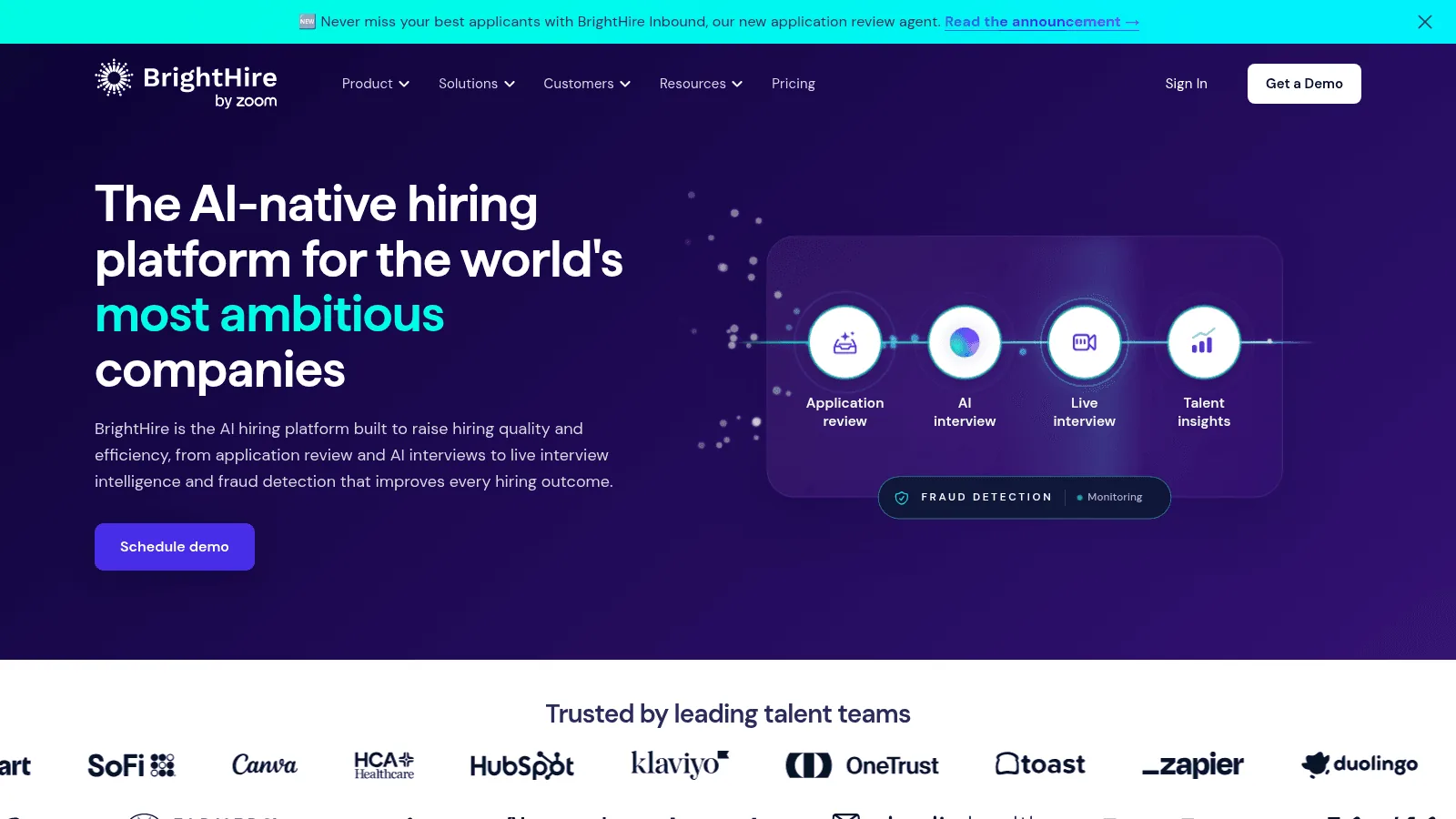
Overview: BrightHire reviews applications against a rubric, runs two-way AI voice or video screens scored against rubrics, and takes notes in human interviews. Zoom announced its purchase on November 13, 2025 and closed it that December, and the BrightHire name stayed.
Key features:
- Application review against a written rubric.
- Two-way AI screens by voice or video.
- Live interview guides and one-click ATS scorecards.
Pricing: Inbound is priced by applicant volume, Screen by interview volume and Interview Intelligence by company size. No figures are published.
Pros: Screen and interview in one product, rubric scoring at application and screen, fraud detection included
Cons: No published price, three meters to forecast, AI video screens can bring in Illinois's video-interview law
What sets it apart: Rubric scoring runs from application review through the AI screen, so early scores trace to criteria you wrote.
Final verdict: Good for teams that want rubric-scored screens and interview notes from one vendor.
9. Greenhouse
Stage: ATS with AI built in.
Best for: Structured hiring at growing companies.
Overview: Greenhouse is an ATS with an AI Notetaker, Talent Matching on every plan and Real Talent fraud checks on Plus and Pro; its voice AI first interview is sold separately. It bought Ezra AI Labs on May 27, 2026.
Key features:
- A two-way voice AI first interview, as an extra.
- Talent matching, plus fraud checks from Plus up.
- AI agents, MCP connectivity and AI report filters.
Pricing: Core, Plus and Pro are all custom priced, and Greenhouse says cost depends on plan, hiring volume and complexity.
Pros: AI inside the system of record, notes tools like Metaview write to it, MCP access for your own assistants
Cons: No published price or trial, a bigger setup than a small-team ATS, voice AI interviews raise audit and notice questions
Where it beats the alternatives: Its AI sits where your hiring data already lives.
Final verdict: A dependable ATS for structured hiring, if a quoted purchase suits you.
10. Ashby
Stage: ATS with AI built in.
Best for: Startups that want an ATS with built-in reporting.
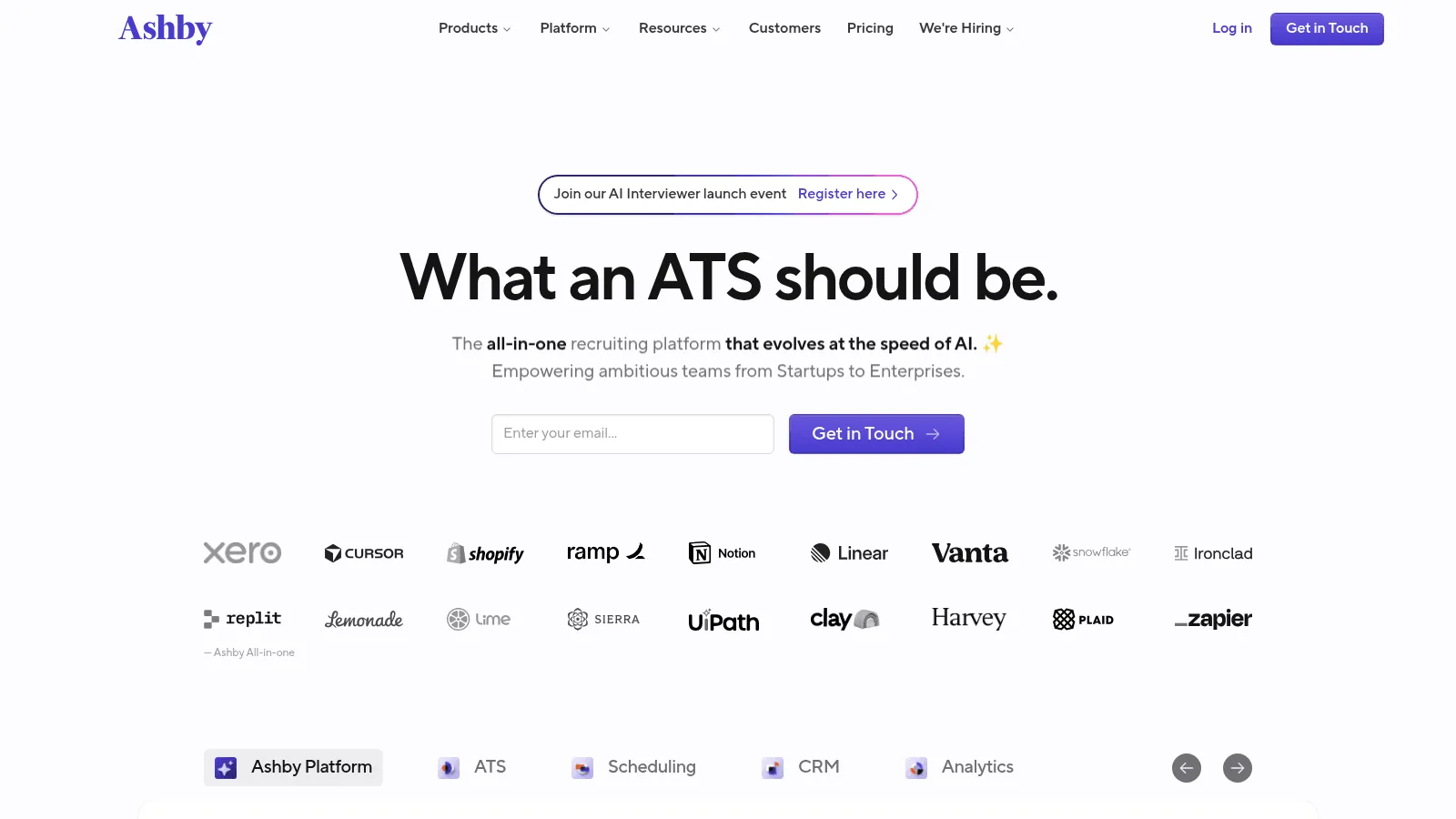
Overview: Ashby reviews applications against your criteria, summarizes interview feedback, offers an AI Candidate Assistant and flags fraud. Its AI Interviewer, announced in May 2026 after it acquired Talent Llama's team in late 2025, is still waitlist only.
Key features:
- AI application review against criteria you set.
- AI summaries of interview feedback.
- An MCP server for your own AI assistant.
Pricing: Foundations covers up to 100 employees; for 1 to 10, it's $270 a month on a yearly term or $300 monthly. Plus and Enterprise aren't published.
Pros: A published price for small companies, AI review built in, dashboards and reports included
Cons: Larger companies get a quote, texting past 1,000 messages a month costs $90 per 1,000
Why it's a good AI recruiting tool: It publishes a real entry price and builds AI review into the system you'd already pay for.
Final verdict: A clear pick for a startup that wants a priced ATS with AI review included.
11. Workable
Stage: ATS with AI built in.
Best for: Small teams that want itemized AI costs.
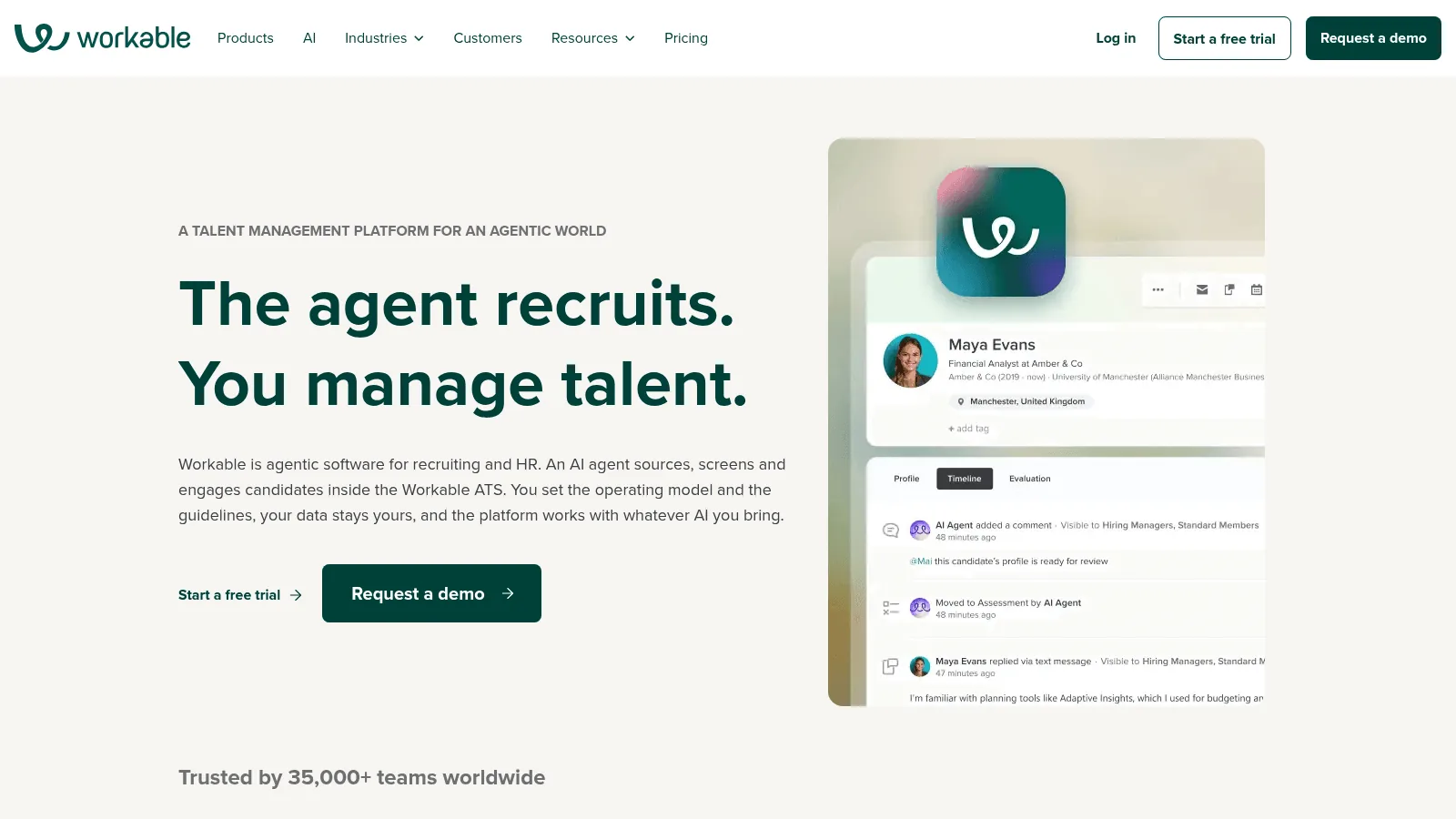
Overview: Workable is an ATS with the Workable Agent on top. The Job Brief Agent is included, while the Sourcing, Screening and Engagement agents spend AI credits: Evaluate costs 1, Source 2 and Chat 10.
Key features:
- A Screening agent that evaluates applicants against the job.
- Standard add-ons, billed annually: texting at $89 a month, video interviews at $109 and assessments at $59.
- 3,000 free AI credits on every paid account.
Pricing: Standard, for 1 to 20 employees, is $299 a month billed annually, or $360 on monthly billing. Premier is $599 a month and Enterprise $719, both annual only, and credit packs start at 5,000 for $600.
Pros: Published prices, a 15-day free trial with no card, AI usage visible in credits
Cons: The Agent isn't in the trial, upper tiers are annual only, credits expire after a year
Why teams pick it: Its AI costs are itemized per action, so you can see what screening one role spent.
Final verdict: A practical ATS for a small team, if you budget for credits.
12. Manatal
Stage: ATS for small teams and agencies.
Best for: Agencies and small in-house teams.
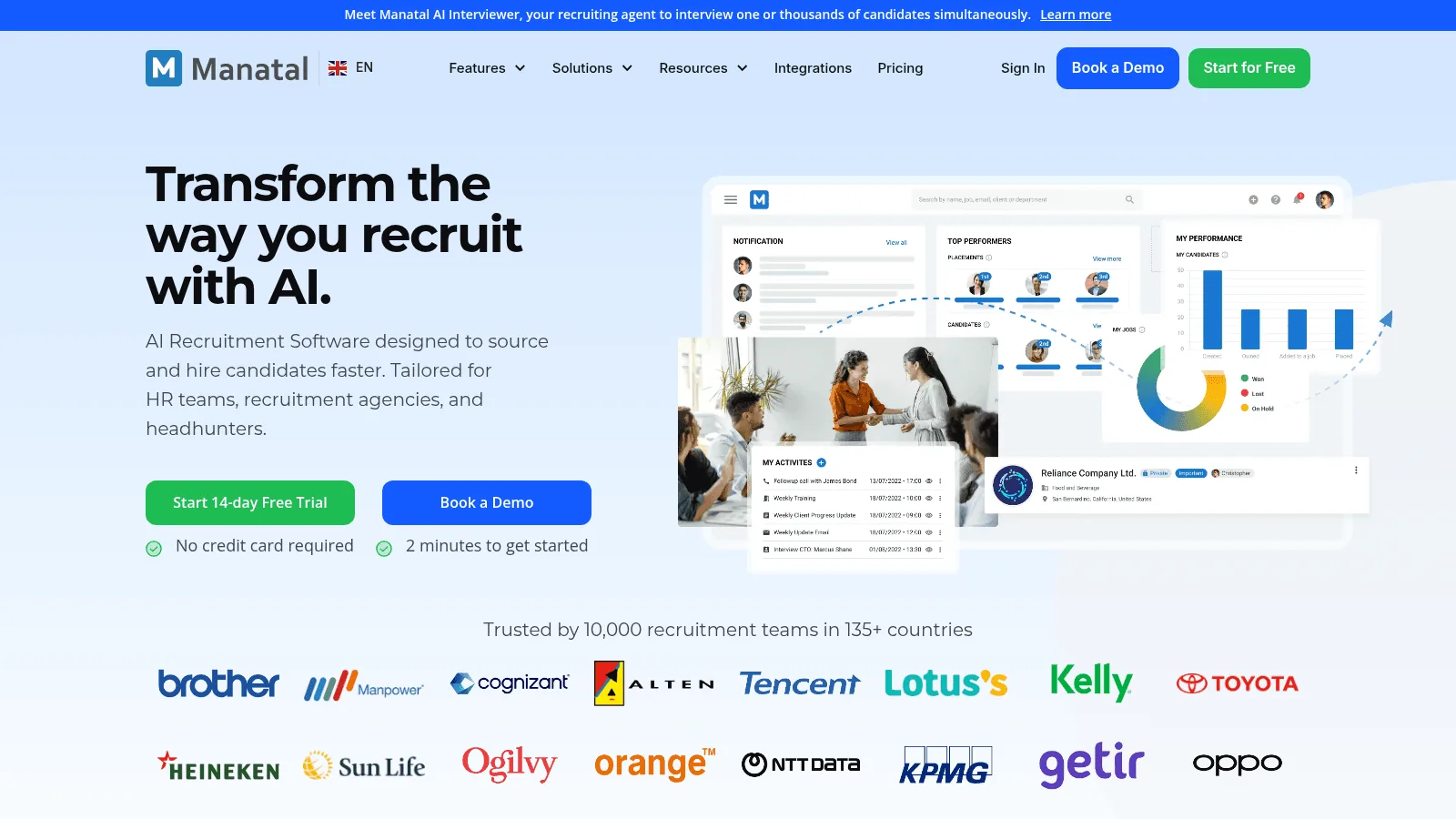
Overview: Manatal is an ATS priced per user, with match-scoring recommendations and its own profile enrichment. Its AI Interviewer is an add-on, on request and priced in credits.
Key features:
- An AI Interviewer add-on that screens before a recruiter's first call.
- Match scores that suggest candidates for each job.
- Connectors for ChatGPT, Claude and Gemini on Enterprise Plus.
Pricing: Professional is $15 per user a month on yearly plans, or $19 on monthly plans. Enterprise is $35 or $39, and Enterprise Plus $55 or $59.
Pros: A $15 per-user entry price, a 14-day free trial with no card, match scoring built in
Cons: The bill grows with every recruiter, the AI Interviewer carries no published price, match scores still need explaining
Who it suits best: An agency or small team that wants AI match scores on a per-head bill it can predict.
Final verdict: An easy start, though the trial covers plan features, not the AI Interviewer add-on.
How We Chose the 12
Each of these AI tools for recruitment had to act on a candidate after they apply: screen, interview, score, take notes or hold the record. AI-powered recruiting tools that mainly find people or send first outreach were left out, along with anything without a readable product page. Our own entry breaks the first rule because it's our product, so that gap leads its Cons.
Bulk employee-data feeds, the kind HR-tech product teams weigh when comparing Coresignal alternatives, stayed off for the same reason: they don't act on a candidate.
Ownership got a column because AI recruiting companies keep changing hands, and a new owner can change pricing and integrations.
What to Look for in AI Recruiting Software
The best AI recruiting software passes four checks that separate saving time from moving the work somewhere else.
A Score You Can Explain
Ask each vendor to show, for a real candidate, which answers moved the score. HireVue shows the evidence behind a result, and BrightHire and Sapia.ai score against rubrics or competencies you can read, which makes the spot-check a quick look rather than a rerun.
ATS Write-Back
Notes only save time if they land in the ATS without anyone copying them. In a Reddit thread on r/recruiting, a recruiter piloting a notes tool with Greenhouse said each question showed up in the scorecard with bulleted answers. Another user switched back to a different notetaker after quality dropped, so treat both as anecdotes and test on your own interviews.
Audit Evidence
Ask for the latest bias audit, its date, auditor and data. Eightfold publishes two 2026 audits by BABL AI, and Greenhouse monthly Talent Matching audits by Warden AI. Ask HireVue, Sapia.ai and the rest for theirs.
The Data Underneath
Every tool here works from the candidate record, and that record decays: recruiters we talk to describe the ATS showing an old title for someone who has moved on. Ask each vendor how its tool keeps records current and where refreshed fields come from, the same two questions behind any CRM data enrichment purchase.
Bias Audits and the Law
The roundups we read skip the law, though New York City's penalties count by the day. The five laws below put duties on the employer using the tool, and the EU and Colorado laws bind the vendor too; the four-fifths rule is a federal test of adverse impact. This is a summary, not legal advice, so check with counsel before you deploy any AI-powered recruitment tools.
| Law | Who it applies to | What it sets out | When it applies |
|---|---|---|---|
| NYC Local Law 144 | Employers and employment agencies | Bias audit within a year before use, a public summary, notice 10 business days ahead | Enforced since July 5, 2023 |
| EU AI Act, Annex III point 4 | Providers and deployers of hiring AI | High-risk duties, and telling workers before use | From December 2, 2027 |
| Illinois HB 3773 | Employers in Illinois | No discriminatory effect, no zip codes as a proxy, notice of AI use | Since January 1, 2026 |
| Illinois AI Video Interview Act | Employers using AI on recorded video interviews | Notice, an explanation, consent, deletion within 30 days on request | Since January 1, 2020 |
| Colorado SB 26-189 | Developers and deployers of automated decision tools | Notice at use, an explanation within 30 days of an adverse outcome | Signed May 14, 2026; duties from January 1, 2027 |
| Four-fifths rule, 29 CFR 1607.4(D) | Title VII employers, as a federal agency test | A group selected at under 80% of the top group's rate generally counts as evidence of adverse impact | In force; being withdrawn in 2026 |
New York City shows how light enforcement has been. The NYS Comptroller's 2025 audit, covering July 2023 to June 2025, found the city's consumer protection department received only 2 complaints about these tools. It checked 32 companies and found 1 issue, while the Comptroller found at least 17 potential non-compliances in the same 32. The Comptroller lists penalties of $500 to $1,500 a day.
In Europe, recruitment and selection systems are high-risk under the AI Act, and Regulation (EU) 2026/1744 moved those duties from August 2, 2026 to December 2, 2027. One rule is live already: since February 2, 2025 the Act has banned inferring emotions at work outside medical or safety reasons, so ask any video interview vendor about it.
In the US, disparate impact is written into Title VII, though a 2025 executive order told agencies to deprioritize enforcing it. Private suits continue: Mobley v. Workday, which alleges Workday's screening tools discriminated, has no merits finding yet, though the court has ruled on motions.
Whatever counsel advises, it helps to have each vendor's latest audit on file, a plan for candidate notices, and a list of the fields your scoring reads.
What AI Recruiting Software Costs
Seven of the 12 tools publish no price. Eightfold, BrightHire and Sapia.ai say what their bill scales with, and the other four share the quote-only row with our Platform plan. The five that publish bill on different bases, and Metaview's figures cover sourcing, not notes, so headline figures don't line up.
| How it's billed | Who bills this way here | What makes the bill grow |
|---|---|---|
| Per user | Manatal, Metaview's paid tiers | Each recruiter or interviewer you add |
| By company size | Ashby, Workable, BrightHire Interview Intelligence | Headcount crossing a bracket |
| By volume | BrightHire Inbound and Screen, Eightfold's AI Interviewer | Applicants or interviews processed |
| Per hire | Sapia.ai | People you hire |
| Per credit | Workable's AI agents, Manatal's AI Interviewer, Reverse Contact's credit packs | Actions run or records returned |
| Flat monthly plan | Reverse Contact's Go, Plus and Max | A higher plan, plus credits for live re-fetches, business emails and phones |
| Quote only | Greenhouse, Paradox, Humanly, HireVue, Reverse Contact's Platform | Plan, hiring volume and complexity at Greenhouse; unpublished at the rest |
A data vendor adds one cost: continuity. When Proxycurl, a people-data API, shut down in July 2025, every product calling it had to rebuild, and teams shortlisting Proxycurl alternatives were pricing a migration. Ask any data vendor, us included, about continuity and how you'd export what you stored.
When Recruiting Automation Pays Off
Automation needs volume to pay back. A co-founder of an AI recruiting startup gave us a rule of thumb: roughly 200 to 500 or more employees and two to six or more recruiters. Smaller companies don't hire often enough to automate.
Below that line, fix the basics first: a clean ATS, a structured process, and contact details that work, which one of the email verification tools checks cheaply. An AI-assisted ATS such as Manatal or Workable then covers most of the rest.
Above it, volume decides which stage to buy first. A team making hundreds of hourly hires a month loses the most hours to screening and scheduling, where Paradox and Humanly aim. Notes tools are the exception: they pay off on interviewer hours, not hire volume, so a team filling a few senior roles a quarter can justify Metaview or BrightHire.
Picking the Stage to Automate First
Most AI recruiting solutions are strongest at one stage, so the best AI recruitment tools for you are the ones aimed at the stage that costs the most hours. If screening and scheduling eat the week, compare Paradox with Humanly. If interviews are the bottleneck, HireVue suits structured enterprise testing and Sapia.ai a large text-based intake, while Eightfold fits an enterprise that needs matching and audit evidence together.
If feedback never gets written, Metaview and BrightHire both fill scorecards. For the ATS itself, Greenhouse suits structured hiring at a growing company, and Ashby, Workable and Manatal suit a small team that wants published prices, though Workable's trial leaves out its Agent and Manatal's leaves out its AI Interviewer.
If you're building an AI recruiting platform rather than buying one, the data your product shows and scores comes first. Start on free trial credits with Reverse Contact and test it on a sample of records your product already holds.
FAQs
What are AI recruiting tools?
AI recruiting tools are software that automates parts of hiring. After a candidate applies, that means chat screening, scheduling, AI interviews, interview notes, and AI inside the ATS. Most AI recruiting solutions cover one or two of those stages well, so many teams pair an ATS with one specialist tool.
What is the best AI recruiting software for a small team?
Start with an ATS that publishes its price. Manatal and Workable both offer a free trial with no card, though Workable's leaves out its Agent and Manatal's AI Interviewer is a paid add-on. Ashby publishes Foundations prices for up to 100 employees. Add a specialist tool once one stage clearly eats the most hours.
Are AI recruiting tools legal to use?
The laws covered here attach duties to their use rather than banning them, apart from the EU's ban on inferring emotions at work. New York City requires a bias audit within a year before use and candidate notice, Illinois requires notice and bans discriminatory effects, and the EU's high-risk hiring rules apply from December 2, 2027.
Do AI recruiting tools replace recruiters?
No. AI-powered recruiting tools take over scheduling, reminders and note-taking, and they draft scores and summaries. A recruiter still has to explain why a candidate ranked where they did, which is why tools that show the evidence behind a score save more time.
Which AI recruiting companies have been acquired recently?
Workday completed its purchase of Paradox on October 1, 2025, and Zoom closed its purchase of BrightHire in December 2025, though both still sell under their own names. Vendors on this list are buying too: HireVue acquired Hireguide's technology in March 2026, Greenhouse bought Ezra AI Labs that May, and Ashby acquired Talent Llama's team late in 2025.
The data layer behind your GTM engine
Access fresh people and company data through one API and power every enrichment, prospecting, and automation workflow.
- Profiles
- 800M+
- Refreshes / month
- 200M
- Response time (P95)
- 500ms