
10 Cognism Alternatives for B2B Contact Data (2026)
Julien K.Published
Key takeaways:
- Cognism's strength is European mobiles. Both Standard and Pro include them, and Pro adds on-demand verification in under 48 hours. Its 98% accuracy figure, for phone-verified European mobiles, is Cognism's own.
- Lusha prints contact counts by country, ZoomInfo contacts and mobiles by continent, SalesIntel one international total, Lead411 a list of 13 countries and Datagma a US and Western Europe match rate. Our docs publish find rates by region, including mobile, and profile counts by region and country; test them on your own records. Apollo.io, LeadIQ, Prospeo and Seamless.AI publish nothing regional.
- By our arithmetic on entry plans, a found phone costs, at best, $0.16 to $0.21 on Apollo.io, $0.19 to $0.25 on Prospeo, $0.39 to $0.49 on Datagma, $0.47 to $0.62 on Lusha and $0.75 to $1.00 on LeadIQ. Ours costs 20 credits when a lookup finds a phone and nothing when it doesn't.
- Read Cognism's General Terms before renewal: auto-renewal unless you give 60 days' notice, a 10% cap on renewal increases, non-refundable fees with two exceptions, written consent to resell the data or share benchmark results, and use of data you already hold after you leave.
Cognism suits a sales team that sells into Europe and lives on the phone, with phone-verified mobiles, five-seat packages and a sales-led quote. That fit breaks when the renewal quote lands, when most of the pipeline is in the US, or when your customers need to see the data inside your product.
Before database size, ask each vendor two things: what it publishes about mobiles by region, so you know what to test against, and what it charges when a number is found. This guide reviews ten Cognism alternatives that way, plus Cognism's own contract terms, which no ranking page we read quotes.
So what are some alternatives to Cognism worth testing? Reverse Contact is ours and sits first: it's an API with no dialer or rep seats, so it fits teams running lookups in code or a product, not reps who dial all day. We checked every price, in USD, against each vendor's website on November 2, 2026.
Why Teams Look Past Cognism
Often the trigger is a renewal quote. In a Reddit thread on r/LeadGeneration, one buyer selling into the US and Europe said the renewal price had them looking around. The most useful reply was a test: pull about 100 contacts from each provider, check them by hand, and test the US and Europe separately.
That pressure isn't unique to Cognism. Gartner analyst Jo Liversidge said SaaS vendors raised prices by 9 to 25 percent in 2025, against 2.8 percent growth in corporate IT budgets, as reported by The Register. Her advice was to start planning two years before a renewal.
Geography is the second reason. Buyers we talk to say a headline count is no use if the records sit outside your market, so a US-focused team weighs Cognism, built around European mobiles, differently from one selling into Europe.
The third reason is packaging. Cognism's pricing page shows no price for Standard or Pro, and its data needs written consent before it goes into a product your customers use. A team building software should ask each of the Cognism competitors here whether it allows that: ZoomInfo's terms forbid it, and our pricing puts it on a Platform contract.
What Cognism Does Well With Mobiles
Cognism says its phone-verified mobiles (its Diamond Data) come from "a routine process" that calls the numbers and confirms the right person picks up. On Pro, you can also ask its team to verify a specific mobile on demand, which it says takes less than 48 hours.
Cognism also screens its numbers against national do-not-call lists, 15 or 16, depending on which of its pages you read. That's a real job: the FTC's Do Not Call Registry Data Book for fiscal 2025 counts 258,515,050 active registrations on the US consumer registry alone.
Cognism's headline figures are self-reported: a "3x connect rate", "98% accuracy on phone-verified European mobile numbers", and 90% coverage of Director+ contacts in Europe and the US. Bombora intent on Pro covers up to 12 topics from a library of more than 11,000.
Its miss rule is published, too. Below its match threshold, Cognism says it "returns no data rather than guessing," and its help center says API Search and Enrich calls use no credits; only redeeming a contact costs one. Its newer developer docs add a search-token allowance and a credit per person returned with contact details, so ask which model your package uses.
What Cognism's General Terms Say About Renewal
Cognism's General Terms and Conditions are online (version October 2026). Your Order Form can change them, so treat these as defaults:
- An order auto-renews for the length of the initial term or one year, whichever is longer, unless either side gives written notice at least 60 days before the term ends (clause 10.1).
- Cognism may raise fees at renewal, but the increase "shall not exceed ten percent" (clause 5.4).
- Payment obligations are "non-cancellable" and fees non-refundable (clause 5.1), except on termination for cause (clause 10.2) or an unremedied material service failure (clause 6.1).
- You can't resell the data or make it available to a third party without Cognism's prior written consent (clause 1.2(j)).
- You can't share benchmark-test results with third parties without written consent (clause 1.2(f)).
- Nothing limits your right "to use other providers in parallel," and data already on your systems stays usable after the contract ends, at your own risk (clauses 10.4 and 10.5).
The 10% cap sits near the bottom of the 9 to 25 percent rises Gartner described, but it's a ceiling, so expect a quote up to it. Put the notice date in your calendar now. Once you've given notice, run the new vendor beside Cognism for the term's last weeks and export the mobiles your team has reached.
The 10 Best Cognism Alternatives
The table compares the ten Cognism alternatives on what a found phone costs and what regional figure each vendor publishes. Cognism also owns Kaspr, so it isn't listed.
| Tool | Built for | What a found phone costs | Regional figure published (self-reported) | Price from (basis) |
|---|---|---|---|---|
| Reverse Contact | Product teams calling an API | 20 credits when a lookup finds a phone | Find rates by region, including mobile, and profile counts by region and country in our docs; test your own records | Credit packs from $100; Go $249 a month for your own team |
| ZoomInfo | Enterprise sales teams | One credit per export; API mobiles are Enterprise-only | By continent (Europe 66M+ contacts, 18.5M+ mobiles); none by country | Platform quote only; developer API credits $0.25 to $0.45 each |
| Lusha | Reps revealing contacts in a browser | 5 credits per phone | Contact counts by country, dated September 30, 2026; no regional mobile counts | $37.45 a month billed yearly, one seat |
| Apollo.io | Reps who want data and sequences | 8 credits per phone, only when found on standard API; waterfall can bill a miss | None published | $49 a seat a month billed annually |
| SalesIntel | Teams wanting human-verified contacts | Unlimited export credits per user | One international total (7.2M+ contacts, 14 countries); mobiles not split by region | Quote only, one package |
| Lead411 | Small outbound teams | Direct phones included in each export | A list of 13 countries, no counts; not Germany, France, Spain or Italy | $49 a month for 1,000 exports |
| LeadIQ | Reps capturing prospects into a CRM | 10 credits per phone | None published | $15 a month billed annually |
| Datagma | Small teams calling European mobiles | 30 credits, only when a mobile is found | A 70 to 80% US and Western Europe match rate; no European count | $39 a month billed yearly |
| Prospeo | Reps buying lookups per user | 10 credits per mobile | None published | $37 a user a month billed yearly |
| Seamless.AI | Teams wanting a large database | Credits per phone not stated; credit-back covers emails only | 448M+ phone numbers in total, no regional split | Quote only; free up to 50 credits |
Reverse Contact heads the table because we make it. The other nine are grouped rather than ranked: platforms first (ZoomInfo, Lusha, Apollo.io, SalesIntel), then contact tools (Lead411 and LeadIQ), per-lookup finders (Datagma and Prospeo), and Seamless.AI, a quote-only database with a free tier.
1. Reverse Contact
Best for: Putting contact data inside products.
Overview: Reverse Contact is an API (an interface your software calls directly) that returns person and company records, sold by credits or a flat monthly plan rather than by seat. Your code sends an email, a full name plus employer domain, or search filters, and receives a structured record. We publish 800M+ profiles and 70M+ companies.
A profile lookup doesn't include a phone. /contact/phone finds one separately, returning mobiles and direct lines rather than switchboards, checked when you ask but not guaranteed.
Instantly shows how enrichment runs inside another product. Its users' leads often arrive as little more than an email and a first name, so Instantly queues them in the background, calls our API for each person's role, work history and company, and hands that context to its own AI writer. When we can't confidently identify someone, Instantly falls back to lighter personalization. The writing and the fallback are Instantly's own.
Key features:
- A free
/checkcall shows when a profile was last fully refreshed, so you choose the stored copy or a live one (your workspace must hold at least 2 credits to use it). - Phone, email and live profile lookups run in the background. The target is under 15 seconds a result, yet allow for tens of minutes and queue them. Stored profiles come back in the same request.
- An empty phone lookup costs nothing and says why: no matching person, or no number for them.
- People search can target a whole region or market, such as EMEA, DACH or the Nordics, in one filter, and counting the matches is free.
- Each API key can carry a daily, monthly or total credit cap, so a test stops at your budget.
- REST calls, webhooks, the command line and an MCP server for AI assistants all draw on the same data, credits and limits.
Pricing: Credit packs start at $100 and stay valid for three months from each purchase. Three plans make whole groups of API calls unlimited, up to 100,000 profiles per workspace a day: Go, $249 a month, on stored lookups of a known profile by its URL or ID; Plus, $449 a month, on search as well; Max, $699 a month, on enrichment from an email, name or domain too.
On packs and plans alike, a lookup that finds a phone costs 20 credits (20 times a stored profile lookup), one that finds a business email 3, and a live refresh 2. Plans carry a monthly commitment, packs none, and cover your own team only: putting our data inside software your customers use, or reselling it, falls under Platform, priced on a call.
Pros: Phones billed only when found, mobiles and direct lines rather than switchboards, regional find rates in our docs to test against, region and market filters with a free count, no seats to buy
Cons: No dialer or seat-based tool for reps, so a team that calls all day still needs one; no intent data or lead scoring, since we supply records rather than signals
How to start using it:
- Start on free trial credits (no card), then buy a pack for the full test.
- Pick 200 contacts you've already called, split by region.
- Run them through our phone number lookup and email finder, logging found, missed and wrong results.
- Work out credits per right-person number in each region.
Why it's a good Cognism alternative: Cognism sells seats and reveals, while we sell credits or a team plan and charge for a phone or email only when found.
Final verdict: Pick it when contact lookups run in your code or your product. If your reps dial Europe all day from a prospecting app, keep Cognism or look at Lusha.
2. ZoomInfo
Best for: Enterprise teams buying one sales platform.
Overview: ZoomInfo sells contacts, company data, intent and scoring inside one licensed platform. Its data page counts contacts and mobiles by continent, Europe at 66M+ contacts and 18.5M+ mobiles.
Key features:
- Streaming Intent, an add-on, flags accounts researching your topics.
- Copilot Advanced adds an Account Fit Score for ranking accounts.
- A pay-as-you-go developer API on gtm.ai sells data credits at $0.25 to $0.45 each, by volume.
Pricing: The sales platform is quote only, priced on licenses and credit usage, with one credit per export. On the developer pricing, mobiles are Enterprise-only.
Pros: Contacts, intent and scoring under one contract, the only regional mobile counts in this list (by continent), a free ZoomInfo Lite plan, a public developer price
Cons: No published platform price, nothing split by country, License Terms that forbid building the data into your own products
Why buyers shortlist it: It's the default enterprise swap, but it's another quote-only contract, so price a few ZoomInfo competitors before you switch.
Final verdict: Broader than Cognism; get mobile figures for your countries in writing before signing.
3. Lusha
Best for: Reps who check coverage country by country.
Overview: Lusha is a self-serve contact platform, and the only rival here whose data page prints contact counts country by country. That page, updated September 30, 2026, lists Europe at 103.1M+ contacts, the UK at 23.3M+ and Germany at 10M+, and says Italian contact data "is not currently available."
Key features:
- A phone costs 5 credits and a verified email 1, both published.
- Intent costs 1 credit per topic per company or contact.
- Seven predictive scoring models rank leads for you.
Pricing: One seat on Starter costs $49.90 monthly, or $37.45 a month on yearly billing. Pro, at $69.90 monthly or $52.45 a month yearly, adds a second seat, webhooks and higher API rate limits. The free plan's 40 monthly credits need no card.
Pros: A per-country contact table to test against, credit costs published per data type, a free plan with no card
Cons: No Italian contacts today, no regional mobile counts, annual credits that don't roll over, a base where Europe is about a fifth of contacts (103.1M+ of 515M+, by Lusha's own count)
Where it fits: An EU-focused team that wants Cognism's region on a self-serve plan. If annual credits that lapse at renewal bother you, compare Lusha alternatives that roll credits over.
Final verdict: The self-serve option with the most European detail on its data page, unless Italy is on your list.
4. Apollo.io
Best for: Reps who want data and sequences together.
Overview: Apollo.io puts contact data, email sequences, intent and lead scoring behind one seat, and says its database holds 240M contacts.
Key features:
- A phone costs 8 credits. Standard API enrichment bills only when a mobile comes back, but waterfall enrichment, which tries several sources in turn, can bill on a miss, typically 8 to 25 credits a phone.
- Intent covers 6 topics on Basic and Professional and 12 on Organization.
- Annual billing grants the whole year's credits upfront.
Pricing: With annual billing, seats run $49 a month on Basic, $79 on Professional and $119 on Organization. Month to month, Basic is $65 and Professional $99, while Organization is annual only and needs three seats.
Pros: Published prices, a free plan with 900 credits a seat a year, AI lead scoring from Basic (capped at 2 scores) and unlimited from Professional
Cons: No regional figure published, credits that don't roll over, a bill that grows with every seat
Why it made this list: It replaces Cognism plus a sequencer for many US-led teams, though per-seat pricing sends some to weigh Apollo alternatives later.
Final verdict: Strong value for US outbound; test its European mobiles before you rely on them.
5. SalesIntel
Best for: Teams wanting human-verified contacts.
Overview: SalesIntel is the closest in kind to Cognism's phone-verified pitch: it says people as well as AI check its records, re-verified every 90 days. It publishes 54M+ verified mobiles with no regional split, plus one international total: over 7.2 million contacts at over 1 million companies in 14 countries.
Key features:
- Research on Demand gives each user 10 requests a month for contacts its team looks up.
- Basic intent is included, and its homepage cites 60,000+ topics from its own PredictiveIntent plus Bombora.
- An ICP fit score helps rank accounts.
Pricing: Quote only. One package covers every user, with no cap on export or enrichment credits per user, and advanced intent and website-visitor data cost extra.
Pros: Human verification on a 90-day cycle, no per-contact credit math, an open offer to run your own sample against its data
Cons: No public price, no API on its pricing page (its homepage lists API and webhooks), no regional breakdown of its mobiles
What it's genuinely good at: Unlike most sales intelligence tools here, it gives each user unlimited export credits, so a phone-heavy team never counts reveals.
Final verdict: Take it up on the sample, and split that sample by region.
6. Lead411
Best for: Small outbound teams wanting published prices.
Overview: Lead411 sells a contact database aimed at SMB outbound, with intent data on its annual entry plan. Its regional figure is a country list rather than counts: its FAQ names 13 countries, including the UK and the Netherlands.
Key features:
- Direct phone numbers come with each export on every tier.
- Unused exports roll over.
- A lead-scoring product sits in its data menu.
Pricing: Spark costs $49 a month with a 1,000-export cap, or $490 paid yearly for 12,000 exports plus intent. Ignite opens at $150 a month, or $1,500 yearly, and is where the API starts.
Pros: Phones without a separate phone credit, intent at a published entry price, a trial with 50 free leads
Cons: Spark caps exports at 1,000 a month even though the homepage says "without credit limits or export caps," no API below Ignite, no coverage counts by country
Why buyers shortlist it: It's a plain way to get phones plus intent at a price you can read before a call.
Final verdict: A budget pick for US-led SMB calling; its FAQ's country list leaves out Germany, France, Spain and Italy.
7. LeadIQ
Best for: Reps capturing prospects into their CRM.
Overview: LeadIQ is a prospecting and capture tool with email and mobile search on every tier, plus a Power Dialer in beta. It describes its data as global but publishes no regional figure.
Key features:
- A phone costs 10 credits, an email 1, or 11 for both.
- API and MCP access come with every tier.
- Any plan can be tried free for 30 days.
Pricing: Pro opens at $15 a month on annual billing, or $20 month to month, for 200 credits a month and up to five users, and the price rises as you slide to more credits. Enterprise is custom and annual only.
Pros: The lowest published paid entry price in this list, a month-long trial, API on every plan
Cons: Only 20 phones a month on the $15 plan, limited database search on Free and Pro, no regional coverage data
Where it fits: A small team that adds a handful of mobiles a week to its CRM.
Final verdict: Cheap to try for a month; do the phone math before you size the plan.
8. Datagma
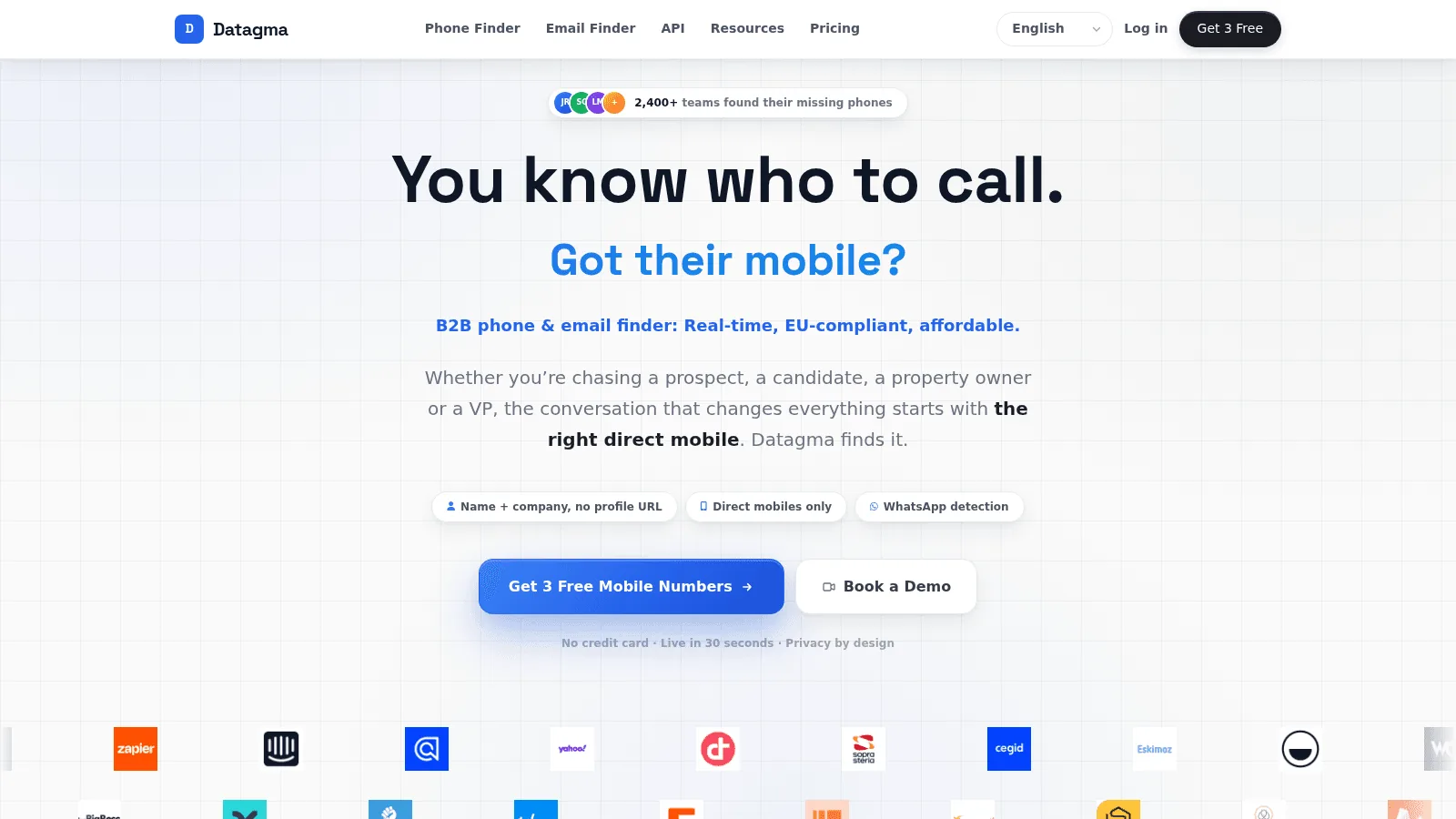
Best for: Small teams calling European mobiles.
Overview: Datagma is a phone and email finder that markets "European mobile coverage others miss," though it publishes no European-only count (its comparison page gives 250M+ verified phone numbers globally and a 70 to 80% match rate for the US and Western Europe). It puts a REST API on every plan.
Key features:
- Empty results cost nothing; you pay when a verified email or phone comes back.
- WhatsApp detection comes on every plan.
- File enrichment handles up to 50,000 rows.
Pricing: Regular is $39 a month billed yearly, or $49 monthly, for 3,000 credits, which buys 3,000 emails or 100 mobiles at 30 credits each. Popular is $79 billed yearly, or $99 monthly, for 7,500 credits and three seats, and the free tier includes 100 credits a month.
Pros: Found-only billing, a month-to-month option, unused credits that roll over for up to 12 months
Cons: Only 100 mobiles a month on Regular, no published regional counts, no MCP server of its own
Why it earns a place here: Its pitch targets the same European mobiles Cognism sells, on month-to-month terms.
Final verdict: Worth a test batch if Europe is your gap and your volumes are small.
9. Prospeo
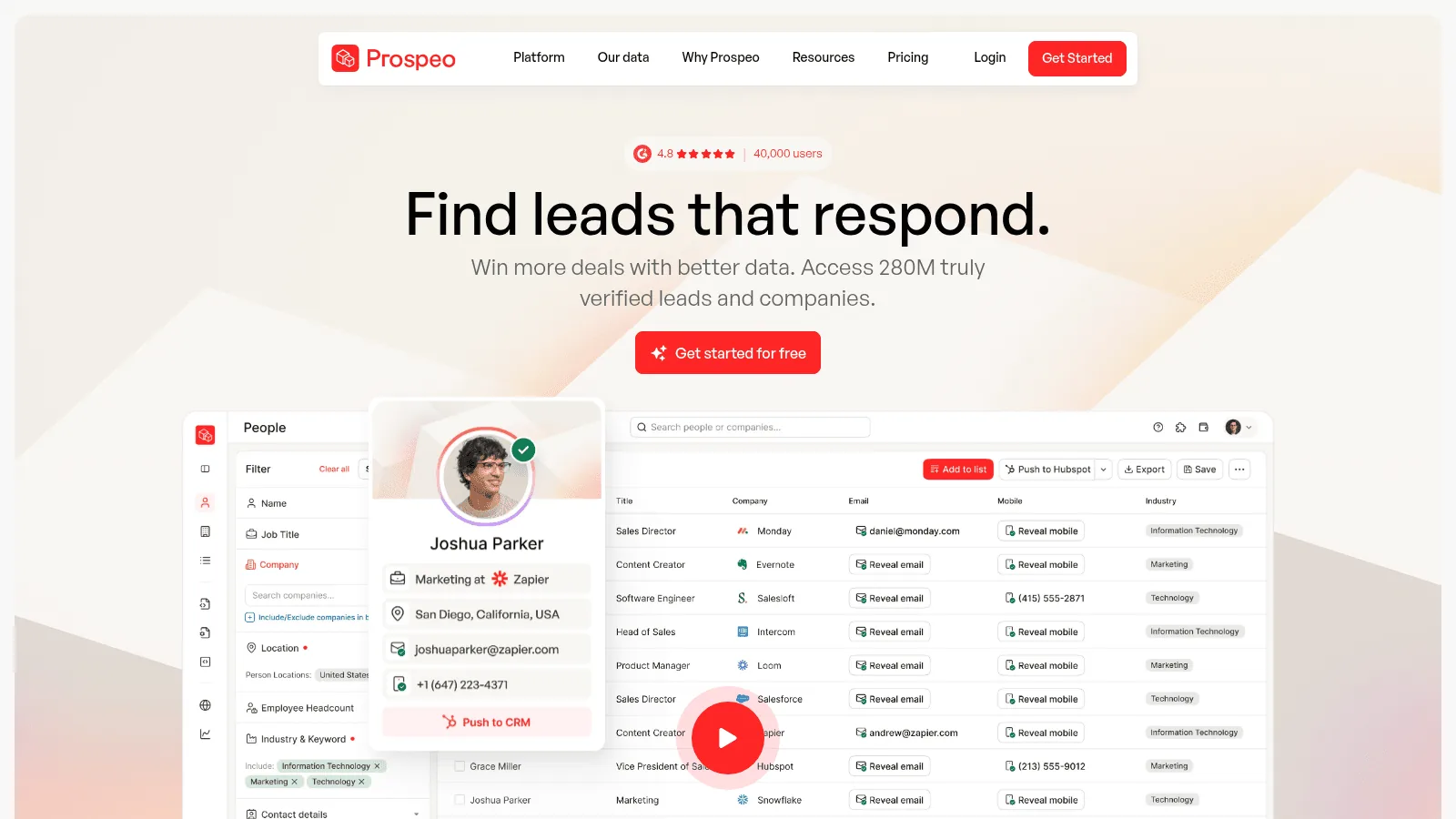
Best for: Reps buying lookups one seat at a time.
Overview: Prospeo sells verified emails and mobiles per user, with its credit math printed in its FAQ: one credit per verified business email and 10 per direct mobile.
Key features:
- CSV and API enrichment start on the Starter plan.
- An MCP server comes even with the free plan.
- Its pricing FAQ says credits roll over or expire at renewal, depending on which version you see, so ask first.
Pricing: Starter costs $49 a user monthly, or $37 a month on yearly billing, for 2,000 credits a month, and Growth $99 monthly, or $74 yearly, for 5,000. The free tier's 100 monthly credits come without API access.
Pros: A published mobile price, an MCP server on the free plan, a low entry price
Cons: Pricing per user, no regional figure, a homepage and data page that give different database sizes
Why buyers shortlist it: Starter's 2,000 credits cover 200 mobiles a month, enough for the 200-contact test below.
Final verdict: A light per-user option with mobile math you can do in your head.
10. Seamless.AI
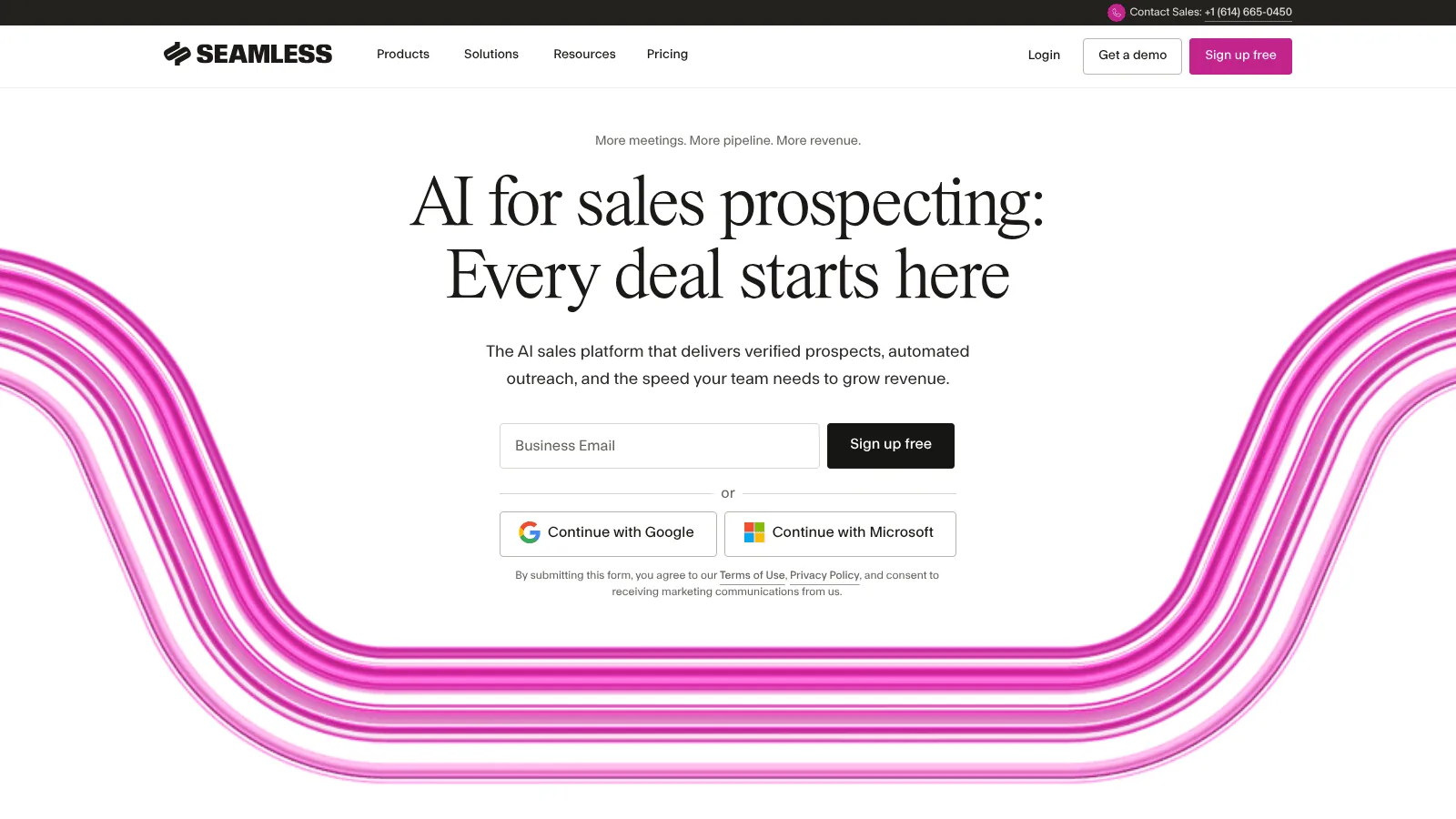
Best for: Teams wanting a large database and a free start.
Overview: Seamless.AI says it holds 1.6B+ verified business emails and 448M+ phone numbers, neither split by region.
Key features:
- 100% Credit Back Protection refunds a credit when a mail server confirms an email is invalid.
- API access comes on every plan, including free, though its API page still describes tiers; it also sells an MCP product.
Pricing: Paid plans are quote only. The annual plan rolls into another 12 months unless you give notice more than 60 days ahead (the Terms disagree on whether exactly 60 counts).
Pros: A free tier, an email credit-back, API on every plan, per its May 2026 release
Cons: No published paid price, a credit-back that covers emails but not phones, Terms that make every sale final
Where it fits: Teams that want volume and will mark the renewal date.
Final verdict: Fine for breadth, but you'd swap one annual auto-renewal for another.
What a Found Phone Costs on Each Alternative
The table turns credit prices into dollars per phone for each vendor whose entry plan shows a price, a credit allowance and a per-phone credit cost. It assumes every credit goes on phones and every lookup finds one, so it's a floor; the arithmetic is ours. Most vendors price a phone, not a mobile, so a direct dial bills like a mobile; step 4 of the test below separates them.
| Vendor and entry plan | Credits per phone | Phones a month on that plan | Cost per phone, billed monthly | Cost per phone, billed yearly |
|---|---|---|---|---|
| Lusha Starter, one seat | 5 | 80 (400 credits) | $0.62 | $0.47 |
| Apollo.io Basic, per seat | 8 | 312 (2,500 credits) | $0.21 | $0.16 |
| LeadIQ Pro, lowest slider step | 10 | 20 | $1.00 | $0.75 |
| Datagma Regular | 30 | 100 | $0.49 | $0.39 |
| Prospeo Starter, per user | 10 | 200 | $0.25 | $0.19 |
On these assumptions, Apollo.io's Basic seat is the cheapest per phone and LeadIQ's lowest step the most expensive, and Datagma's mobiles cost less than Lusha's phones despite the higher credit count. Lead411 bundles direct phones into exports instead: $0.05 an export on Spark monthly and $0.04 yearly, with a phone only when one exists.
Cognism, SalesIntel and Seamless.AI show no paid-plan price on their pricing pages, and ZoomInfo's public developer pricing leaves mobiles to Enterprise, so none of them can take a row. We take no row either, since our credit packs carry no monthly allowance; a phone is simply 20 credits when a lookup finds one.
Datagma and our phone lookup bill nothing on a miss, Apollo.io's standard API adds its 8 phone credits only when a mobile comes back, and Lusha's API bills at least 1 credit a request, even an empty one. Where a vendor bills a miss, the real cost per phone rises with your miss rate; on every row it rises with your wrong-number rate, which is why the test below matters more than this table.
How to Test Mobiles by Region Before You Switch
Buyers moving into a new market often ask vendors for country-by-country counts of people, mobiles and emails. Every published regional figure, ours included, is self-reported, so the fairest test we know sends the same list, spread across your regions, through each vendor:
- Pick 100 European and 100 US contacts your team has already reached by phone.
- Send the identical list to every vendor on your shortlist, including Cognism if you're renewing.
- Sort every number into right person, wrong number or nothing returned.
- Separate direct mobiles from switchboard numbers, because a switchboard won't get you to the person.
- Ask each vendor whether it flags numbers on national do-not-call lists, and for which countries.
- Add 50 target accounts where you have no contact yet, and count how many get at least one callable contact.
- Divide each vendor's spend by its right-person numbers, region by region.
Keep the Cognism side of the results in-house: clause 1.2(f) of its General Terms bars sharing benchmark results with third parties without its written consent.
Step 6 is how some teams we talk to define coverage: one person to call in every company in their market, not a total contact count. Expect little overlap: buyers tell us each provider finds numbers for different people, so your runner-up can cover the winner's misses.
If a data API wins, you build the CRM sync yourself, in code or a workflow tool such as Make, so budget time for field mapping and error handling.
Picking a Cognism Alternative by Job
Teams leaving Cognism tend to want one of four things, each with its own short list.
Cognism Alternatives for Contact Enrichment
To fill missing emails and phones on CRM records, look at lookup tools with published per-contact credit costs: Datagma and Prospeo, or Reverse Contact if the lookups run in code. Cognism sells CRM Enrichment as a separate add-on, so compare against that line on your quote.
Cognism Alternatives for Sales Intelligence
For a platform your reps work in all day, ZoomInfo, Lusha and SalesIntel are the closest swaps, with Apollo.io where sequencing matters too. Ask each for mobile figures in the regions you sell into.
Cognism Alternatives for Buyer Intent Leads
Cognism Pro uses Bombora with up to 12 topics. SalesIntel includes basic intent, Lead411 includes Bombora intent on annual Spark, Apollo.io gives 6 to 12 topics by plan, Lusha charges 1 credit per topic, and ZoomInfo sells Streaming Intent as an add-on.
Cognism Alternatives for Lead Scoring
Apollo.io offers AI lead scoring, unlimited from Professional, Lusha has seven predictive models, SalesIntel an ICP fit score, ZoomInfo an Account Fit Score on Copilot Advanced, and Lead411 a lead-scoring product in its data menu. If you'd rather build lead scoring yourself, a data API such as ours can feed it the role and company fields.
Whatever the job, two or three vendors on a regional test beat ten on a feature grid.
Start the Test Before the Notice Date
Work backward from Cognism's 60-day notice window and run the regional test a month before it, because a split result, strong in Europe and weak in the US, may mean keeping one vendor per region rather than replacing Cognism outright. If one of your Cognism alternatives is an API, test it on your records with the same 200 contacts as everyone else.
FAQs
What are some alternatives to Cognism?
This guide reviews Reverse Contact, ZoomInfo, Lusha, Apollo.io, SalesIntel, Lead411, LeadIQ, Datagma, Prospeo and Seamless.AI. For European calling, start your test with Lusha and ZoomInfo, which publish European figures to test against, and Datagma, which markets European mobiles. For data inside your own product, look at a data API such as Reverse Contact.
Does Cognism charge for a search that finds nothing?
Not in credits. Cognism's help pages say API Search and Enrich requests are free and you pay one credit to redeem a contact, though its developer docs also meter returned search rows. There's no published credit-back for a wrong mobile, and its General Terms call fees non-refundable.
Does Cognism's Standard package include mobile numbers?
Yes. Both Standard and Pro include emails, mobiles, job titles and work history, with five seats each. Pro adds a premium mobile filter, on-demand mobile verification in under 48 hours, and Bombora intent data.
Can you build Cognism data into your own product?
Not by default. Cognism's General Terms (October 2026) license the data for internal business use and bar reselling it or making it available to third parties without Cognism's prior written consent. If the data will reach your customers, raise it before you sign.
Which Cognism competitors publish their prices?
Six of the nine rivals reviewed here publish a self-serve price: Lusha, Apollo.io, Lead411, LeadIQ, Datagma and Prospeo. ZoomInfo's sales platform, SalesIntel and Seamless.AI's paid plans are quote only, though ZoomInfo now publishes per-credit developer pricing.
The data layer behind your GTM engine
Access fresh people and company data through one API and power every enrichment, prospecting, and automation workflow.
- Profiles
- 800M+
- Refreshes / month
- 200M
- Response time (P95)
- 500ms