
11 Best Sales Intelligence Tools in 2026, Data Coverage Compared
Julien K.Published Updated
Key takeaways:
- The 11 vendors here count different things: contacts, profiles, person records, leads or email addresses. People Data Labs alone publishes 2,466,510,427 person records in its docs and 1.5B+ unique individuals in another file.
- Pick by job: Apollo.io or Lusha for a rep app with a free plan, ZoomInfo or Cognism for enterprise packaging, an API such as Reverse Contact or People Data Labs for data inside your product, and Clay for combining sources.
- Only four of the 11 publish a refresh cadence (Reverse Contact, Cognism, SalesIntel and People Data Labs). Ask the other seven how old a record can get before it's checked again.
- Seven of the 11 publish a free plan. Most are too small for a full test, so run a handful of people who've left your company through them and see which tools return the new job.
Every sales intelligence vendor leads with a big number. One says 500 million contacts, another says 1.6 billion emails, and we say a billion profiles. They sound comparable, and they aren't, because each one counts a different thing.
This guide compares 11 sales intelligence tools on the coverage figures each vendor publishes on its own website, and it labels what every number actually counts.
Full disclosure: Reverse Contact is our product, and it sits at number one here. Its limits are listed like everyone else's, and we never claim our count beats a rival's, because the units make that kind of claim meaningless.
What Are Sales Intelligence Tools?
Sales intelligence tools give your team facts about the people and companies you sell to: who works where, in what role, how to reach them, and what the company looks like. Most sales intelligence services deliver that data through a search app, a browser add-on, a CRM sync or an API (an interface your own software calls to get data back).
For this guide, our sales intelligence tools definition is simple: software that finds, fills in and keeps current the contact and company details your reps act on. That overlaps heavily with data enrichment, which fills gaps in records you already hold, while a sales intelligence platform usually adds search to find new ones.
A Gartner survey of 645 B2B buyers found they used an average of seven information sources during a purchase, and 69% said they prefer to check what AI tools tell them with a sales rep. If buyers come to reps to check facts, the rep's own facts have to be current. A rep who calls them by last year's job title loses that conversation early.
People Data, Company Data and Signals
Most tools in this list cover two kinds of record. People records hold a name, title, seniority, work email and phone. Company records hold firmographics: headcount, industry, location, revenue band and tech stack.
Company data is often the first thing you check before you contact anyone, the same research a rep does when trying to find information on a company by hand.
A third layer sits on top in some products: signals such as job changes, hiring or buyer intent (signs that a company is researching a purchase). ZoomInfo lists buyer intent among its products, and SalesIntel includes basic intent data, with advanced intent as an add-on. This guide compares the data layer underneath, not the signal products.
How We Compared Coverage
We read each vendor's own coverage, data and pricing pages on October 7, 2026. We did not test any of these databases against a sample, so every figure below is the vendor's own claim.
For each tool we recorded three things: the headline figure, the unit it counts, and whether the vendor publishes how often records are refreshed. Where sales intelligence companies publish two figures that disagree, we say so rather than picking the larger one.
The 11 Best Sales Intelligence Tools Compared
This table puts each tool's best job, features, limits, price and coverage unit side by side. Prices are the lowest published tier, with the billing basis the vendor states.
| Tool | Best for | Key features | Main limitation | Pricing (from) | Coverage unit |
|---|---|---|---|---|---|
| Reverse Contact | Current data in CRMs, products and agents | Last-updated date on every record, no answer rather than an unchecked one, API, CSV and MCP | No free plan, API rather than a prospecting app | Credit packs from $100; plans from $249/month (Go); email-based enrichment on Max, $699/month | Profiles |
| ZoomInfo | Large teams wanting one enterprise platform | 500M+ contacts, Copilot tiers, credit per export | Paid tiers quote only, non-cancelable terms of one to three years | $0 (Lite), paid quote only | Contacts |
| SalesIntel | Teams wanting unlimited seats | Unlimited users and exports, 90-day re-verification | No API listed on pricing page | Quote only | Contacts |
| Cognism | European and US directors and above | 30-day refresh claim, 16 Do-Not-Call lists screened | No public price, 5 seats per package | Quote only | Not published |
| Apollo.io | Small teams wanting data plus sending | Free tier, sequences, dialer | Credits expire each billing cycle | $0, paid $49/seat/month billed annually | Contacts |
| Lusha | Quick lookups for small teams | Dated coverage table, MCP on every tier | Strict API rate limits below Pro | $0, paid $37.45/month billed yearly | Contacts |
| Seamless.AI | Email volume with credit back on invalid emails | 1.6B+ emails, 2.2B+ contacts, credit refund on invalid emails | Paid plans quote only | $0 (50 credits) | Emails and contacts |
| UpLead | Single users buying contacts by the credit | Email and mobile in one credit | Essentials and Plus are single-user | $74/month billed annually, or $99 monthly | Leads |
| RocketReach | Pay-per-verified lookups | Refund when nothing is verified, API on paid tiers | Essentials is email only | $0 (5 lookups), paid $33/month billed annually | Profiles |
| People Data Labs | Developers building on raw records | Record-level stats, company and person APIs | Free tier hides contact data | $0, paid $98/month | Person records |
| Clay | Combining many data providers | 150+ providers, no charge on empty results | Not a database itself | $0, paid $167/month billed annually | None, not a database |
We put Reverse Contact first because it's our product. After it, the list runs from enterprise platforms (ZoomInfo, SalesIntel, Cognism) to small-team apps (Apollo.io, Lusha, Seamless.AI, UpLead, RocketReach) to developer and orchestration tools (People Data Labs, Clay), so read the "Best for" column before the price.
Data Coverage Compared: What Each Number Counts
Here's every coverage figure the 11 vendors publish on their own pages.
| Tool | Headline figure | What it counts | Companies | Refresh or freshness detail |
|---|---|---|---|---|
| Reverse Contact | 800M+ profiles; separately, 450M highly verified profiles | Profiles | 70M+, ~200 countries | 30 days for high-demand, 90 days for active profiles |
| ZoomInfo | 500M+ | Contacts | 100M+ | Not published |
| SalesIntel | 200M+ contacts; 54M+ verified mobiles | Contacts and mobiles | 40M+ | Re-verified every 90 days |
| Cognism | Not published | Percentages of Director+ contacts | Not published | 95% of Director+ refreshed every 30 days |
| Apollo.io | 240M+ | Contacts | 30M+ | Not published |
| Lusha | 515M+ contacts; 165M+ verified emails | Contacts and emails | 29M+ | No contact cadence published; signals refreshed weekly (table dated September 30, 2026) |
| Seamless.AI | 1.6B+ emails; 448M+ phones; 2.2B+ verified contacts (API page) | Emails, phones and contacts | Not displayed | Not published |
| UpLead | 200M+ | Leads | Not published | Not published |
| RocketReach | 700M | Profiles | 60M | Verified on demand (no cadence) |
| People Data Labs | 2,466,510,427 records; 1.5B+ individuals | Records and unique people | 70M+ | Monthly |
| Clay | Not a database | Providers connected: 150+ (pricing page) or 200+ (site navigation) | Not applicable | Depends on each provider |
Director+ means directors and anyone more senior. Profiles, contacts, records, leads, emails and phones all appear in that middle column, so no ranking by size holds up.
Why the Units Don't Compare
A contact is usually one person at one company with some way to reach them. A profile can be a person without any contact details at all. A record is a row in a dataset, and one person can account for more than one row, which is why People Data Labs can publish about 2.47 billion records and more than 1.5 billion individuals at the same time without either being wrong.
An email count is different again. One person can hold several addresses, and Seamless.AI shows two units side by side: 1.6B+ emails on its homepage, 2.2B+ verified contacts on its API page. Our own two figures make the same point: our 450M highly verified profiles are a subset of the 800M+ profiles our people search covers, so ask any vendor which of its numbers it's quoting.
The Sales Intelligence Tools, Reviewed
Each review covers what the tool does, what it costs, where it falls short and who should pick it.
1. Reverse Contact
Best for: Current data in CRMs, products and agents
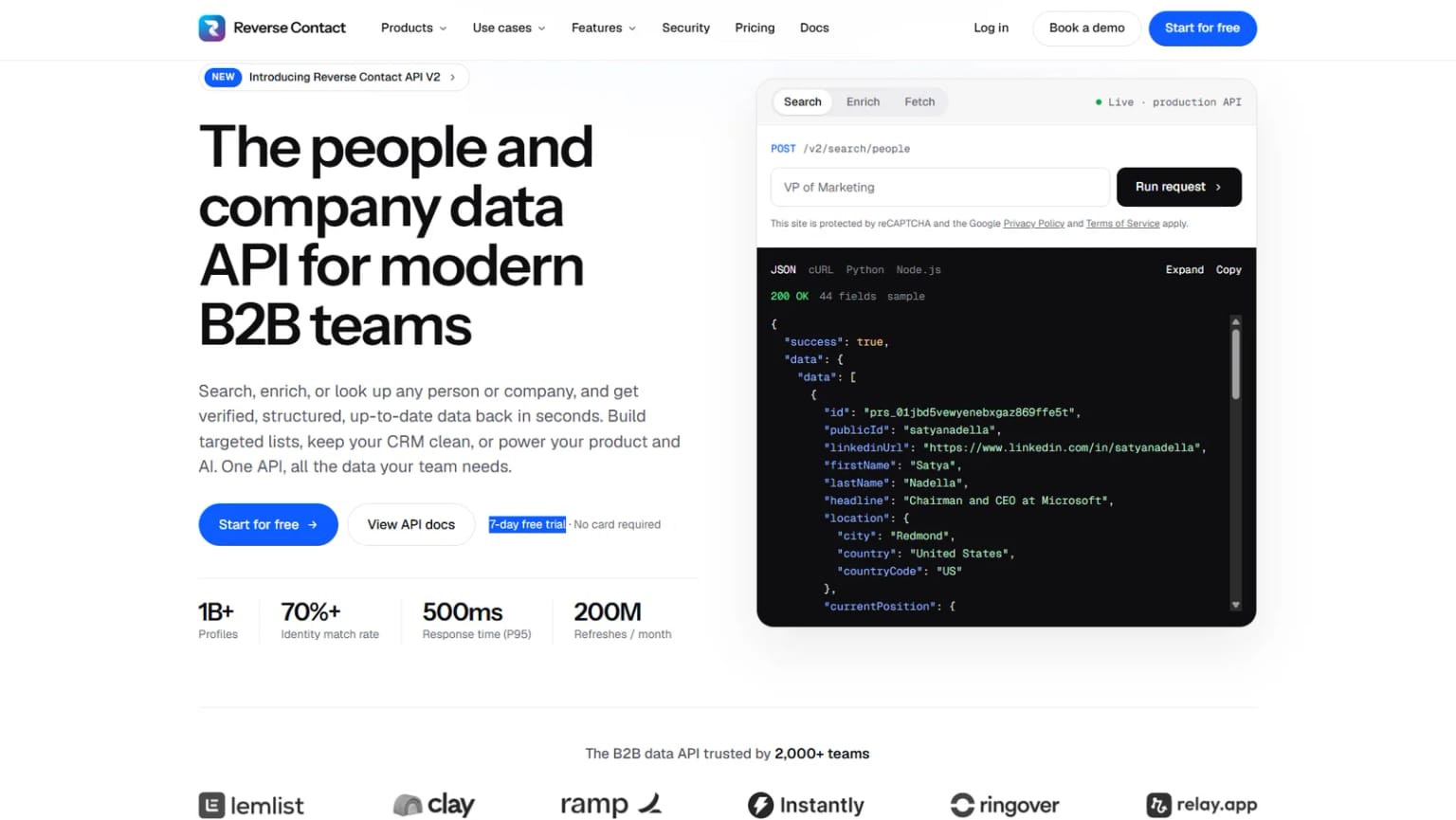
Overview: Pass our API an email, a name with a company domain, or search filters, and each record comes back with the date the whole profile was last refreshed.
Behind those records sit two figures we publish for our people data and keep apart on purpose: 800M+ profiles in total, and 450M highly verified profiles. On the company side, it's 70M+ profiles across about 200 countries.
To keep them current, high-demand profiles refresh every 30 days, active ones every 90 days, and the long tail on request. Our monthly coverage report shows what that adds up to: in the October 2026 snapshot, 62% of quality profiles (at least one position, one follower and a page still online) had been collected again within 30 days, and 94% within 90. We also hold back any record that fails our checks, and if two people could match, we can return the candidates rather than our pick. You aren't billed when a stored or live lookup, an enrichment, a standard search, or a hunt for an email or phone comes back empty; an agentic search page that finds no one costs 1 credit.
Key features:
- A free freshness check that returns a record's last-updated date and whether it exists.
- A choice on each request between our stored copy (fast) and a fresh lookup (a background job, often tens of seconds and sometimes several minutes, delivered by webhook), with the same response format.
- No answer rather than an unchecked one, and candidate profiles when a match is ambiguous.
- An email finder costing 3 credits per address it finds, and a phone finder that spends 20 credits only when a number turns up.
- The same records over REST (standard web requests), webhooks (results sent to your server when ready), CSV files or an MCP server (the protocol AI agents use to reach outside tools).
Pricing: Go costs $249, Plus $449 and Max $699, all billed monthly with no annual commitment. Each plan names what it makes unlimited: Go covers profile lookups by URL or ID (plus free freshness checks), Plus adds people and company search, and Max adds enrichment from any email address, name or domain. Real-time re-fetches, emails and phones are billed in credits on every plan.
Go, Plus and Max are licensed for your own team; putting the data inside software you sell, or reselling it, needs Platform, and its price comes from a sales conversation.
Pros: Refresh date on every record, empty lookups and standard searches are free, published refresh tiers, public list prices
Cons: No free plan (trial credits only), and no point-and-click prospecting app for reps
How to start using it:
- Create an account (trial credits, no card), then generate an API key.
- Pull the job-changer and customer list from the testing section below.
- Run them through CSV enrichment or the API.
- Note the refresh date on each result, and count empty answers and multi-candidate answers separately from clean matches.
- Pick a plan by the kinds of lookups you'll run most, or stay on pay-as-you-go credits.
Why it's a good sales intelligence tool: It tells you how old each record is and declines to answer when the data fails its checks, which is the information a coverage number leaves out.
Final verdict: Reverse Contact fits teams that pipe people and company data into a CRM, a product or an AI agent and need to know how current each record is. Reps who want a search app with a dialer should look further down this list.
2. ZoomInfo
Overview: ZoomInfo is an enterprise sales intelligence platform built for large teams. Its sales packages are named Professional, Copilot Advanced and Copilot Enterprise, and its site claims 500M+ contacts and 100M+ companies. Its blog puts accuracy at up to 95%, measured on first-party data.
Key features:
- Contact and company search in one platform, so large teams work from a single source.
- One credit per export, including exports through its browser extension and API.
- Copilot tiers that layer AI features on the core data.
Pricing: A free tier, ZoomInfo Lite, needs no card and doesn't expire. Paid tiers publish no number; features, license count and credit use set the price. Its annual report says contracts typically run one to three years and can't be canceled.
Pros: Contact and company data in one contract, broad feature set, mature enterprise packaging
Cons: Paid tiers quote only, non-cancelable terms of one to three years, free plan missing from the pricing page
Where it earns its place: A big sales team that wants one vendor gets search, data and AI features in a single contract.
Final verdict: Choose ZoomInfo when breadth in one contract matters more than flexibility, and read the term length before you sign.
3. SalesIntel
Overview: SalesIntel has a single package, with no cap on users, exports or enrichment. Its data page lists 200M+ contacts, 54M+ verified mobile numbers and 40M+ companies, claims 95% accuracy, and promises to re-verify records every 90 days.
Key features:
- A separate Research on Demand allowance of 10 credits per user each month, on top of the unlimited exports.
- Native connections to Salesforce, HubSpot, Marketo, Salesloft, Outreach, Dynamics and Zoho.
- Basic intent data included, with advanced intent and VisitorIntel as add-ons.
Pricing: It's quote only, sold as a single package rather than tiers. Advanced intent and VisitorIntel cost extra.
Pros: Unlimited users and exports, published re-verification cycle, broad CRM integrations
Cons: No public price, no API mentioned on its pricing page, add-ons raise the cost
Why buyers shortlist it: The 90-day re-verification promise gives you a concrete age limit to test against your own records.
Final verdict: SalesIntel suits larger teams that would otherwise ration seats and exports.
4. Cognism
Overview: Cognism is the one vendor here that publishes coverage as percentages instead of a total. Its claim: 95% of Director-and-above contacts get a refresh within 30 days, and it covers 90% of that senior group across Europe and the US.
Key features:
- Screening of phone numbers against 16 Do-Not-Call lists.
- A single credit balance for the app, its Enrich product and the API, at one credit per contact revealed.
- API and MCP access starting on Standard.
Pricing: Cognism quotes its Standard and Pro plans, five seats each, with emails and mobiles in both. Pro layers on intent data, on-demand checks of mobile numbers and a filter for premium mobiles.
Pros: Published refresh cadence, strong European focus, one credit model everywhere
Cons: Prices only by quote, five seats in every package, Pro needed for mobile verification and intent data
What its coverage is good for: Its percentages describe senior contacts in two regions, so a team selling to directors in Europe or the US can test exactly that claim.
Final verdict: Cognism suits teams selling to senior buyers in Europe or the US who care more about freshness than raw size.
5. Apollo.io
Overview: Apollo.io combines a contact database with sequences (automated email follow-ups), a dialer and a light CRM. On its data page it publishes 240M+ contacts and 30M+ companies, plus 98% email accuracy, and a help center page adds an 84% "email match rate" for verified emails without saying what that measures.
Key features:
- A free plan with real credits, so you can test before paying.
- Email at 1 credit and phone at 8 credits per reveal.
- Credits come back if an Apollo-verified email bounces within 30 days.
Pricing: The free plan hands out 900 credits per seat a year in monthly slices. Paid seats start at $49 a month on annual billing (Basic).
Pros: Genuine free tier, data and sending in one account, low paid entry price
Cons: Unused credits expire each billing cycle, several APIs need a custom plan, no mixing plans across seats
Why it's a good sales intelligence tool: A small team can find, enrich and email from one login for $49 a seat per month, billed annually. Its 98% accuracy figure sits beside an undefined 84% match rate, a reminder to ask what each number means.
Final verdict: Apollo.io is the value pick for small teams that want data and outreach together.
6. Lusha
Overview: Lusha publishes a coverage table on its data page dated September 30, 2026: 515M+ contacts, 165M+ verified emails, 29M+ companies, and reach across 238 countries and territories.
Key features:
- Phone reveals at 5 credits and emails at 1.
- An MCP server on every tier, including Free.
- Credit rollover on Pro and Premium.
Pricing: The free plan includes 40 monthly credits. One seat on Starter is $37.45 a month on yearly billing, $49.90 if you pay monthly.
Pros: Dated coverage figures, low entry price, free plan with no card
Cons: Tight API rate limits below Pro, one seat on Starter, rollover only on higher plans
Best reason to shortlist it: Lusha dates its own coverage table, which tells you when the figure was last true.
Final verdict: Lusha is a sensible first test for a small team that needs emails and phones without a contract.
7. Seamless.AI
Overview: Seamless.AI's homepage counts more than 1.6 billion verified business emails and over 448 million phone numbers, and its API page counts 2.2B+ verified contacts. It displays no company total.
Key features:
- Automatic credit refunds on invalid emails under its "100% Credit Back Protection".
- API and MCP products for connecting other tools.
- A free allowance of 50 credits to try the search.
Pricing: Paid plans are quote only, through a demo form.
Pros: Credit back on invalid emails, 1.6B+ published email addresses (addresses, not people), free plan to test
Cons: No public paid pricing, no displayed company total, tier access to API and MCP unpublished
Who it fits: High-volume senders who want invalid addresses refunded.
Final verdict: Seamless.AI makes sense when email volume is the goal.
8. UpLead
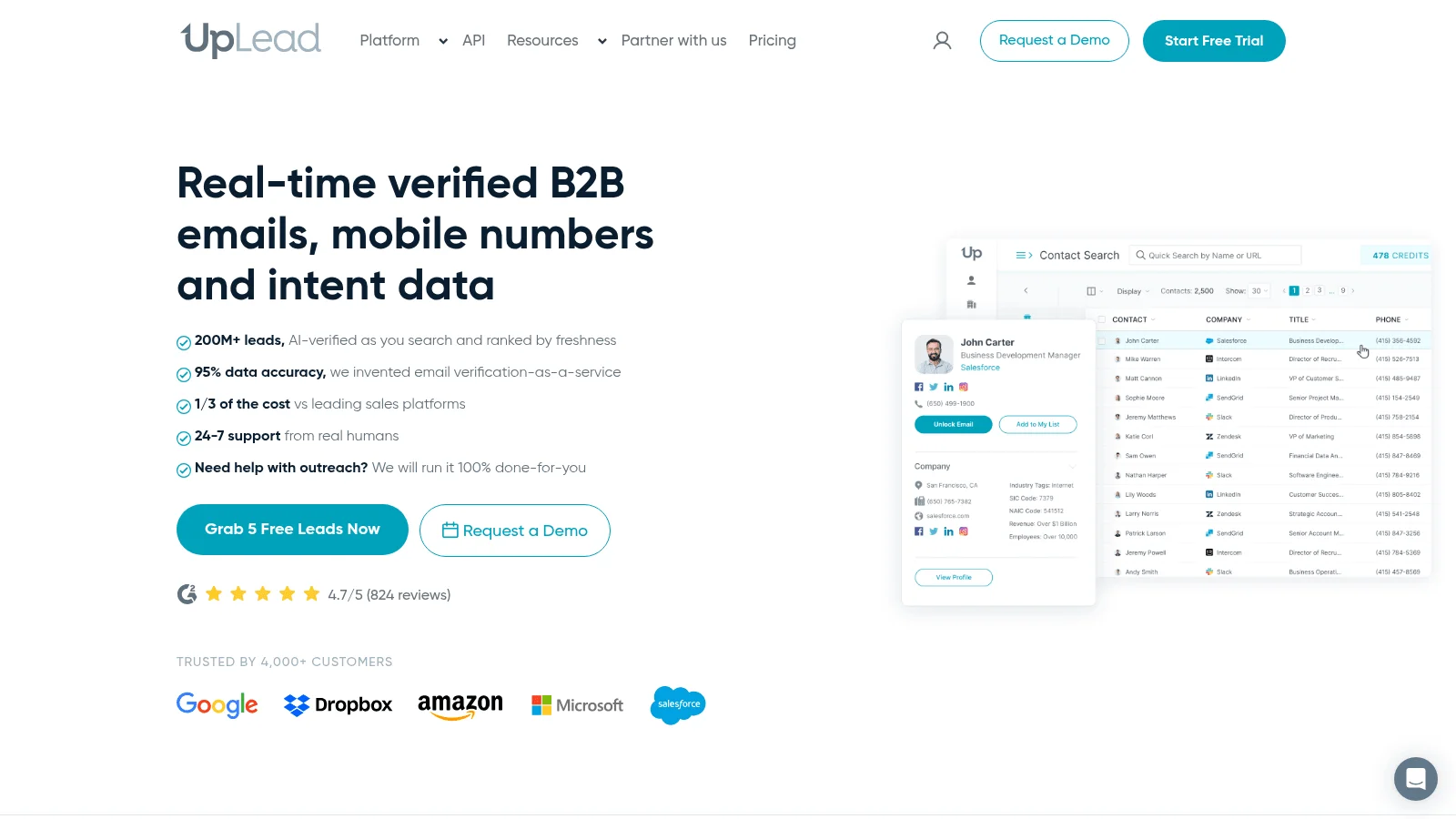
Overview: UpLead sells contacts by the credit, with email and mobile included in one credit. Its homepage claims 200M+ leads and 95% data accuracy.
Key features:
- One credit per contact, email and mobile together.
- Top-up credits priced at 60 cents on Essentials and 50 cents on Plus.
- A 7-day trial with 5 credits.
Pricing: Essentials is $74 a month when paid annually (2,040 credits for the year) or $99 on a monthly plan (170 credits). Full API access sits on the annual-only Professional plan, priced on request.
Pros: Simple credit model, published per-credit top-ups, email and phone in one credit
Cons: Essentials and Plus are single-user (only Professional adds seats), the full API reserved for Professional, a five-credit trial
Why it made this list: It fits a founder or solo seller who wants predictable per-contact costs.
Final verdict: UpLead works for one person buying up to about 170 contacts a month on Essentials.
9. RocketReach
Overview: RocketReach publishes 700M profiles and 60M companies on its homepage.
Key features:
- A refund on any lookup that returns nothing verified.
- MCP and API access on every paid tier.
- Email-only and email-plus-phone plans.
Pricing: The email-only Essentials plan is $399 a year (about $33 a month) or $69 on monthly billing. Phones come with Pro, at $75 a month on annual billing or $119 month to month. Annual plans call lookups unlimited but cap exports each year.
Pros: Pay only for verified results, API on all paid plans, free 5 lookups with no card
Cons: Essentials excludes phones, annual "unlimited" lookups still cap exports, priced per seat
What it is genuinely good at: You pay for verified results, so a poor match rate costs you time rather than money.
Final verdict: RocketReach fits recruiters and sellers who look people up one at a time.
10. People Data Labs
Overview: People Data Labs is developer infrastructure rather than a prospecting app. Its docs list 2,466,510,427 person records, of which 26.7% carry an email and 20.2% a mobile, while another of its files says 1.5B+ unique individuals.
Key features:
- Person and company APIs, with 70M+ companies.
- One credit per record returned.
- Monthly refreshes, with some fields updated more often.
Pricing: The person API is free for 100 credits a month, with emails, phones and addresses hidden. Pro starts at $98 per month for 350 credits, or $940 a year.
Pros: Record-level coverage stats, huge dataset, API on every plan
Cons: Free tier hides contact data, no search app for reps, needs engineering time
The case for it: It publishes how many records carry an email or a mobile, which tells you what share of its pool you can actually contact.
Final verdict: People Data Labs is the pick for engineers building their own data product on a very large base.
11. Clay
Overview: Clay is not a database. It connects to many data providers and runs them in sequence, so the second source fills what the first one missed.
Key features:
- Chained lookups across providers in one table.
- No charge when an enrichment returns nothing.
- Your own provider keys at 1 action, with no data credits used.
Pricing: Clay bills in actions (steps a table runs) and data credits (provider lookups). Free gives 500 actions and 100 data credits a month, without phone enrichment. Paid plans start with Launch at $167 a month on annual billing, and the HTTP API (direct access for your own code) waits for Growth at $446 a month, also billed annually.
Pros: Combines many sources, unlimited seats, no charge on empty results
Cons: No coverage of its own, no phone enrichment on Free, Growth required for CRM sync and the HTTP API
Its real strength: When no single vendor covers your market, Clay lets you stack several and pay per result.
Final verdict: Clay is the right tool when your answer to "which vendor?" is "more than one".
What Coverage Numbers Leave Out
A headline count can't tell you how much of the pool you can use, or how old each field is.
Why a Big Count Says Little About Usable Records
A big number says little about how many records you can use. Ask any vendor how many current, usable records it holds for the accounts you sell to.
Part of a large pool is people who rarely appear online. As a co-founder of a B2B data provider told us, "Usually they're... frontline workers, like restaurant workers, warehouse workers, nurses... but still real at times." Those records are real, and they're rarely the buyers on a B2B list.
Your own records start out worse than you'd think. A study in Business Horizons that reviewed 75 data quality assessments found that 47% of newly created records had at least one critical error. Enrichment that guesses only adds to the pile.
Why Old Data Hurts Even When It's There
A record can be present and still be wrong because it's old. Search filters are where this hides: you filter by revenue or headcount and trust the results, without knowing when those values were set.
A technical lead at an early-stage AI SDR startup told us what they found after filtering by revenue: "it turns out that these revenue values that basically informed the results are, let's say, 5 years old." If your lead scoring weights company size, a five-year-old revenue band scores accounts on a company that no longer exists in that form.
How to Test Coverage on Your Own Records
The only coverage figure that matters is the one you measure on your own accounts. Vendors differ by region, industry and company size, and one user on Reddit who ran the same 500 accounts through four vendors found almost no overlap on some mid-market companies. That's a single anecdote, so treat it as a reason to test, not as data.
The test below uses people you already know about:
- List 20-30 people who left your company in the last year, plus where they went.
- Add 50 current customers whose contacts you've confirmed recently.
- Run the same list through each trial, on the same day.
- Count three outcomes per vendor: correct and current, present but out of date, and missing.
- For the job changers, check whether the tool returns the new employer and title or the old ones.
- Record the last-updated date where the tool shows one, and note where it doesn't.
- Send to a small sample of the emails and track bounces before you buy.
Free tiers won't cover 80 records on most tools. Ask the quote-only vendors (ZoomInfo, Cognism, SalesIntel) for a pilot on your list, and run a subset of 5-10 people on the smallest free tiers.
The job changers are the sharpest test, because you know the right answer and a stale vendor can't fake it. Repeat the check a few months after you buy, because CRM data enrichment is a cadence, not a one-time load.
Step 7 matters even when a tool says "verified": one user on Reddit reported 20-30% bounces on emails a vendor labeled verified. That's one team's experience, but it's cheap to check.
Free Sales Intelligence Tools
Seven of the 11 tools publish a free plan. Here's what each free tier includes:
- Apollo.io grants credits monthly, adding up to 900 per seat a year.
- Lusha includes 40 credits every month, no card needed.
- ZoomInfo Lite is free with no card, listed on its homepage, not its pricing page.
- Seamless.AI lets you use up to 50 credits without paying.
- People Data Labs gives 100 credits a month, with contact data hidden.
- RocketReach gives 5 lookups with no card.
- Clay includes 100 data credits a month on Free, plus 500 actions, but no phone enrichment.
Reverse Contact isn't on that list because we don't offer a free plan; new accounts get trial credits instead. UpLead offers a 7-day trial with 5 credits, and Cognism and SalesIntel show no free plan.
Free sales intelligence tools are good for checking a handful of known people, the same way a reverse email lookup answers one inbound question.
What Sales Intelligence Software Costs
Four of the 11 publish no paid price: ZoomInfo, Cognism and SalesIntel quote paid plans only, and Seamless.AI publishes only its free allowance. Among the rest, the lowest published paid entry runs from $33 per month (RocketReach, billed annually) to $167 per month (Clay, billed annually). Ours is a $100 credit pack, or $249 per month for the Go plan, and they all buy very different things.
Compare pricing models on your own volumes. A seat-based tool at $49 a month is cheap for one rep and expensive for 30, while credit-based pricing grows with the records you pull rather than the reps you hire.
A flat plan with named things unlimited, such as SalesIntel's users and exports or our profile lookups, costs the same at 1,000 of those calls or 100,000.
On terms, Apollo.io credits expire each billing cycle, ZoomInfo locks you in for one to three years, and some tools charge only when they find something while others charge per reveal. The best sales intelligence software for your budget is the one whose billing unit matches how you'll use it.
Pick the Number You Can Check
The vendor with the biggest headline isn't automatically the best sales intelligence software for the accounts you sell to. Pick two or three tools whose unit and refresh cadence fit your use, then run the job-changer test above.
If you need people and company data inside your CRM, your app or an agent workflow, try it on your records using free trial credits; you won't need a card.
FAQ
What are the top sales intelligence tools in 2026?
The top sales intelligence tools in this guide are Reverse Contact, ZoomInfo, SalesIntel, Cognism, Apollo.io, Lusha, Seamless.AI, UpLead, RocketReach, People Data Labs and Clay. They do different jobs: ZoomInfo and Apollo.io are full platforms, People Data Labs and Reverse Contact are APIs, and Clay combines other providers. Pick by the job, then test coverage on your own records.
How often is sales intelligence data refreshed?
It depends on the vendor. Of the 11 here, four publish a cadence: we refresh high-demand profiles every 30 days and active ones every 90, Cognism puts its Director+ refresh cycle at 30 days for 95% of those contacts, SalesIntel re-verifies every 90 days, and People Data Labs refreshes monthly. For the other seven, ask before you sign.
Are database sizes comparable between sales intelligence companies?
Not directly. Vendors count contacts, profiles, records, leads or email addresses, and People Data Labs alone gives a person-record total near 2.5 billion and a unique-individual count of 1.5B+. Compare the unit first, then test on your own accounts.
What is the difference between a sales intelligence solution and a data enrichment tool?
A sales intelligence solution usually adds search, so you can find new people and companies. A data enrichment tool fills in records you already have. Many products do both, and sales intelligence services such as Cognism's sell the data through an app and an API at once.
Are free sales intelligence tools good enough?
They're good enough to test, not to run a team. RocketReach gives 5 lookups, Lusha 40 credits a month, and People Data Labs 100 credits a month with contact details hidden. Use them to run a small version of your job-changer test, then pay for the tool that passed it.
The data layer behind your GTM engine
Access fresh people and company data through one API and power every enrichment, prospecting, and automation workflow.
- Profiles
- 800M+
- Refreshes / month
- 200M
- Response time (P95)
- 500ms