
ZoomInfo vs Apollo (2026): Data, Pricing and Which to Pick
Julien K.Published
Key takeaways:
- Apollo.io prices four plans on apollo.io/pricing, with paid seats from $49 to $119 a month on annual billing, and quotes a Custom plan. ZoomInfo quotes its subscriptions, and Vendr's buyer data puts the median ZoomInfo contract at $33,500 a year.
- Worked from Apollo's published prices, an email costs about 2 cents and a phone number about 16 cents on annual billing, if you spend every credit. Under Apollo's Terms, credits you don't spend in a cycle are gone when it renews.
- ZoomInfo's GTM.AI now sells self-serve credits at $0.25 to $0.45 per record, per gtm.ai/pricing, and any credit, free or purchased, lapses 12 months after it's granted.
- Neither standard license lets you build the data into a product you sell. Apollo's Terms limit use to "your internal business purposes," and ZoomInfo's subscription License Terms §2.3 bar it outright.
Many of the pages ranking for this comparison are written by a third vendor and end by pitching it. This one has a pitch too, kept to one section near the end for readers building contact data into a product.
ZoomInfo and Apollo.io are both sales intelligence tools that sell business contact data with outreach features around it, but they sell it in opposite ways.
ZoomInfo quotes a price after a sales call and usually signs a contract of a year or more. Apollo prints its prices and takes a card, month to month if you want, so a ZoomInfo vs Apollo decision is partly a choice between two ways of buying.
This guide reads both vendors' Terms, works out cost per contact from published prices, and covers ZoomInfo's new pay-as-you-go pricing, which the third-party comparisons we read don't mention. Every vendor quote was read on the vendor's own pages between November 2 and 8, 2026.
ZoomInfo vs Apollo at a Glance
Every cell below comes from the vendor's own pages, Terms or annual report, except the Vendr figure.
| ZoomInfo | Apollo.io | |
|---|---|---|
| How you buy | Quote from sales, or self-serve credits on GTM.AI | Self-serve by card, or talk to sales |
| Published subscription price | None; Vendr's buyer median is $33,500 a year | $49 to $119 per seat per month, billed annually |
| Free option | ZoomInfo Lite, no credit card; a free trial; GTM.AI signup credits | Free plan, 900 credits per seat per year; 14-day trial |
| What a credit buys | Subscription: one export, count set in your order; GTM.AI: one company, contact or intent record | One email; a phone number takes 8 credits |
| Credit expiry | Subscription: set in your Ordering Document; GTM.AI: 12 months after they're granted | End of each billing cycle |
| Typical term | Subscriptions run one to three years, non-cancelable; GTM.AI has no contract | Monthly or annual, renews unless you give 30 days' notice |
| Outreach included | AI email writing and dialing on Professional; outreach workflows from Copilot Advanced | Sequences on every plan, 2 on Free |
| Data inside a product you sell | Subscription License Terms §2.3 bar it; on GTM.AI, confirm which terms apply | Not permitted under standard terms |
Apollo is easier to start and to price, while a ZoomInfo subscription asks for more commitment and publishes less about cost. The rest of this Apollo vs ZoomInfo comparison asks whether that commitment buys anything your team needs.
What Each One Is
Both vendors now call themselves AI platforms for go-to-market teams, which tells you little. Their product pages say more.
ZoomInfo
ZoomInfo was founded in 2007 and trades on Nasdaq under the ticker GTM. It sells Sales, Marketing and Talent packages, and the Sales package comes in three tiers: ZoomInfo Professional, Copilot Advanced and Copilot Enterprise. Each tier adds features, such as intent signals, to the contact database.
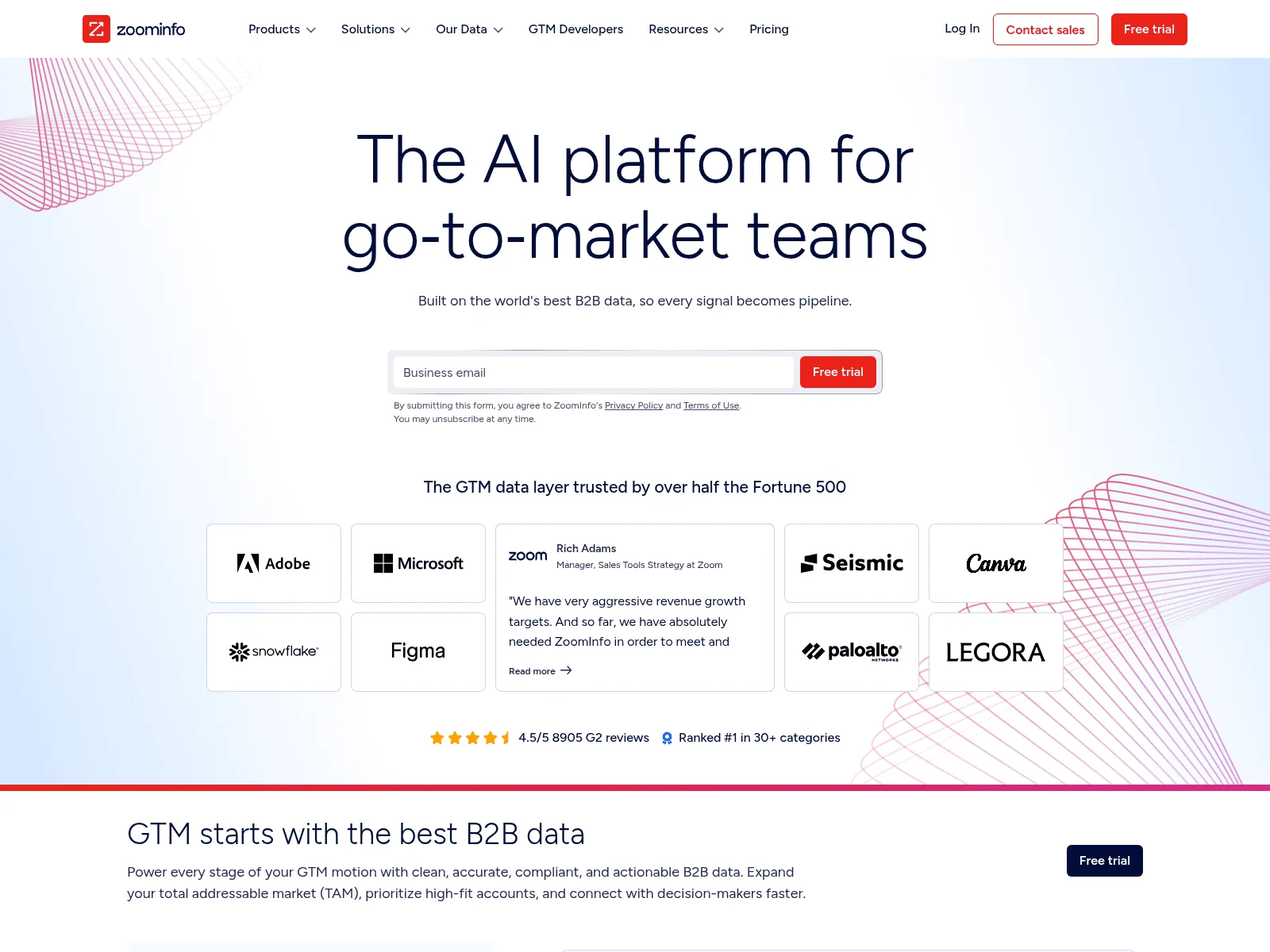
ZoomInfo's homepage, zoominfo.com (November 2026).
A second ZoomInfo product is easy to miss. GTM.AI is its developer offer, with API, command-line and MCP access billed from one credit pool, and it's the ZoomInfo data product with a public price.
Apollo.io
Apollo.io bundles a contact database with tools you'd otherwise buy separately: email sequences, website visitor identification, AI research and, on paid plans, a US dialer that spends 1 credit per 30 seconds. For a small team, that can replace several B2B sales tools with one plan, though parallel and power dialing are a paid add-on.
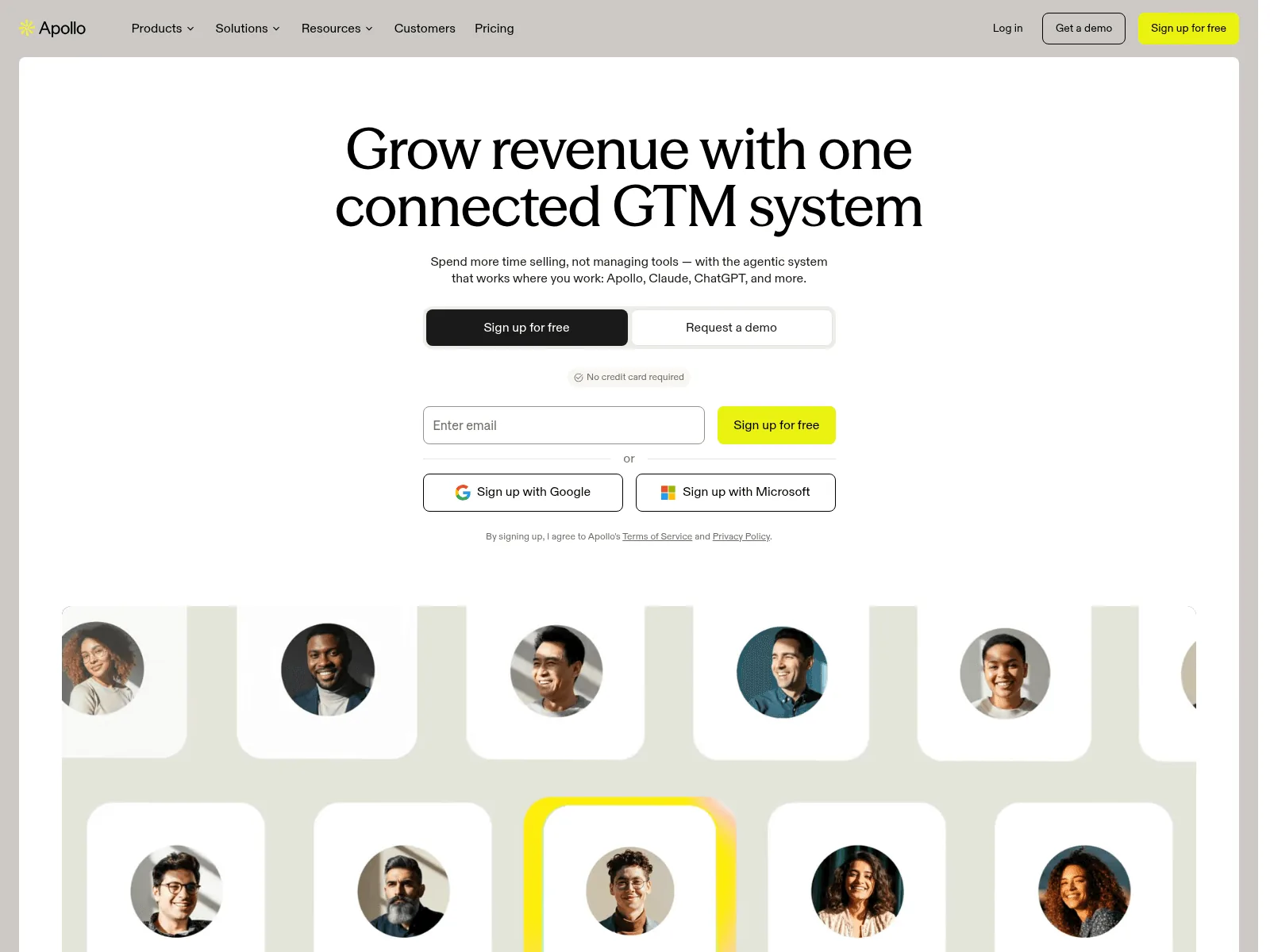
Apollo.io's homepage, apollo.io (November 2026).
Data and Coverage Claims, Read Carefully
Each vendor publishes big numbers that measure something narrower than they seem.
ZoomInfo's homepage claims "500M+ contacts and 100M+ companies." Its data page claims "300M+ Verified Emails" and "135M+ Direct Dial Numbers," while its about page says "200M+ verified business emails" and "135M+ verified phone numbers, 120M+ direct dials." So ZoomInfo's own pages disagree by 100 million emails, and on whether 135 million counts direct dials or all phones.
The same data page lists "contact hit rates" of 96% for business email, 87% for mobile and 72% for direct dial. All three are ZoomInfo's own numbers, not a rate for your list.
Apollo says it holds "240M+ global contacts" and "30M+ global companies." Its accuracy story is harder to follow, because three different percentages get quoted as one:
- The 98% figure is marketing copy on Apollo's B2B data page, which promises "seven-step email verification with 98% accuracy."
- The 91% figure comes from Apollo's help center: "Apollo verified emails have an accuracy rate of 91%," with a 9% bounce rate.
- An 84% "email match rate" for verified emails, which Apollo never defined, sat in another help article until it was rewritten on October 23, 2026, though other sites still quote it.
None of the three is a find rate, the share of your list for which Apollo returns an email at all. The 98% and 91% describe emails already marked verified.
Whichever vendor you pick, the data decays under you. The BLS tenure release for January 2026 put median tenure with a current employer at 4.1 years, with 20.6% of wage and salary workers in their job a year or less. So part of any contact database describes a job someone has just left.
What Happens to the Data You Connect
Both vendors grow their databases partly with data their users contribute, so connecting a CRM or a mailbox can mean sharing what's in it.
Apollo's Terms give it a license to "use Customer Data to grow, enrich, and verify the Contributor Database." Its help center says that covers CRM and CSV uploads, mailbox and calendar connections, and contact edits. On the Free, Basic and Professional plans the data-sharing terms apply "unless otherwise agreed," and Organization customers can discuss options with their account manager.
ZoomInfo runs its contribution through ZoomInfo Lite, whose users contribute data from a connected email account in exchange for extra monthly credits. Its Lite Community Terms say ZoomInfo may use that data "for its own purposes, including supplementing the ZoomInfo database." ZoomInfo's annual report says many paying customers take part as well, and that customers "may elect not to participate."
Both companies appear in CalPrivacy's Data Broker Registry: Apollo under its legal name, Zenleads, Inc., and ZoomInfo as ZoomInfo Technologies, LLC. California's Delete Act requires registered brokers, from August 1, 2026, to check the state's DROP system at least every 45 days and process the deletion requests in it.
So expect California contacts who filed a DROP request to drop out of both tools within about 45 days, though copies already exported to your CRM stay where they are. And before anyone connects a mailbox, ask your counsel whether the opt-out you need exists on your plan.
Apollo vs ZoomInfo Pricing
Apollo prices four plans, with a toggle between annual and monthly billing, and quotes a fifth, Custom. The capture below shows the annual view, where prices are lowest.
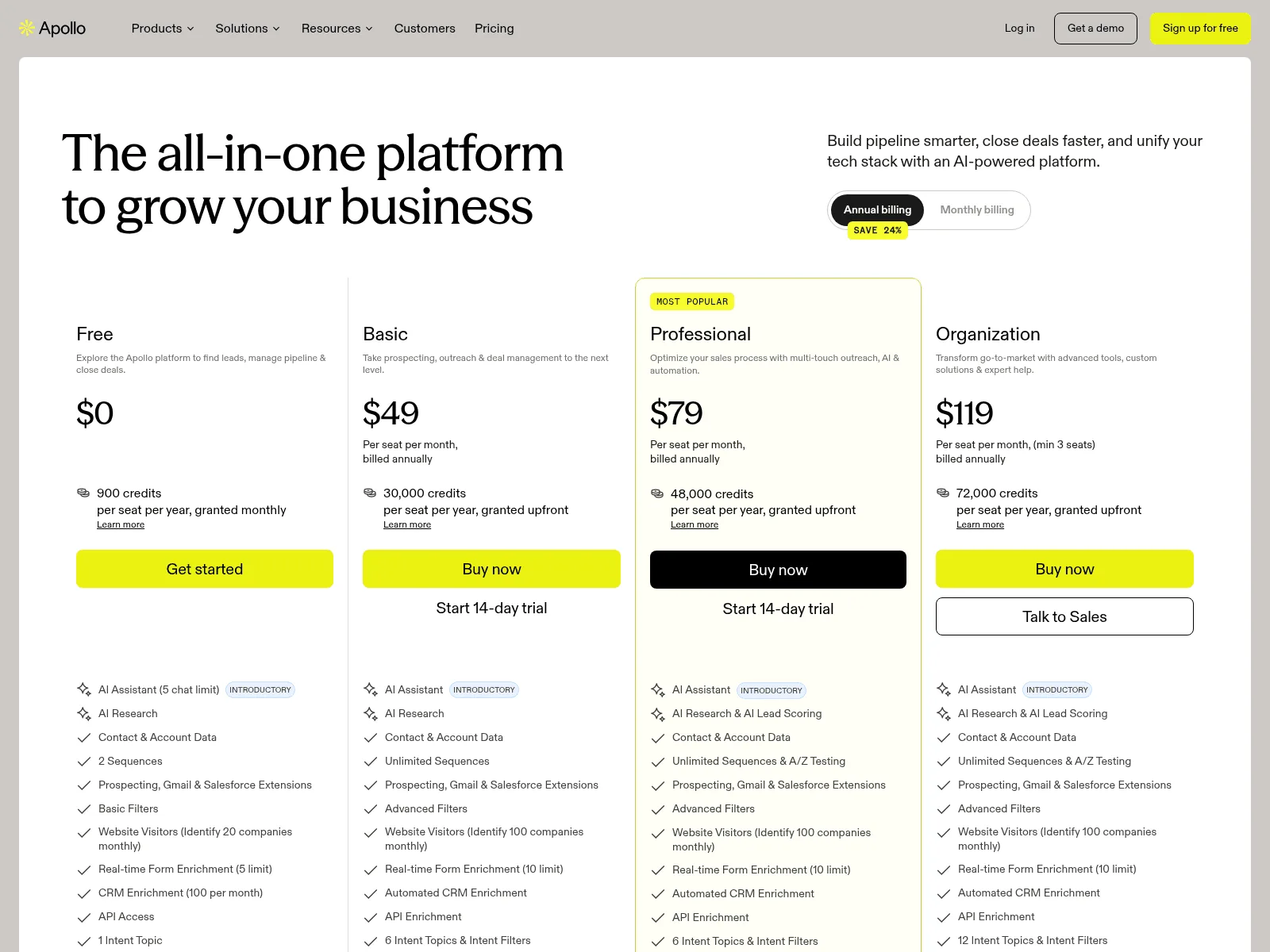
Apollo.io's pricing page, apollo.io (November 2026).
On annual billing a paid seat gets its whole year of credits upfront, and Organization needs at least 3 seats, so its real entry price is $4,284 a year. All seats on one account share a plan, so an occasional user can't get a cheaper seat. Here's the ladder on both billing bases:
| Plan | Per seat per month, billed annually | Per seat per month, billed monthly | Credits per seat per year |
|---|---|---|---|
| Free | $0 | $0 | 900, granted monthly |
| Basic | $49 | $65 | 30,000 |
| Professional | $79 | $99 | 48,000 |
| Organization | $119, minimum 3 seats | Annual only | 72,000 |
The toggle says annual billing saves 24%, which matches Basic; on Professional the saving is 20%. Basic and Professional come with a 14-day trial.
ZoomInfo's pricing page shows no dollar figure anywhere, even in the page source.
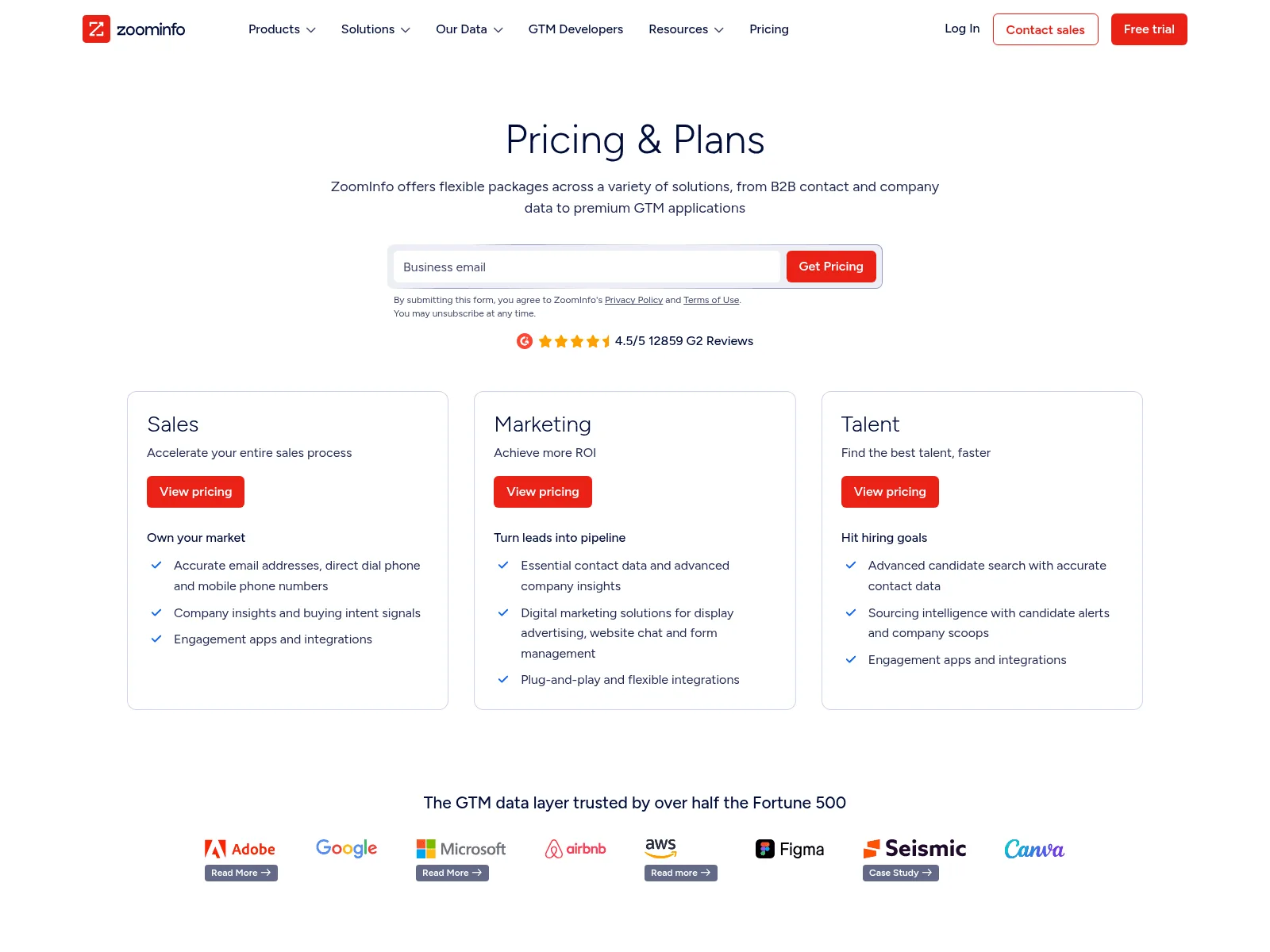
ZoomInfo's pricing page, zoominfo.com (November 2026).
In place of prices sits a "Get Pricing" form. The FAQ says price depends on features, licenses and credit usage, and that "each export costs one credit."
Vendr, a software purchasing platform, fills the gap: it says the median buyer pays $33,500 a year, based on 1,578 purchases, and most deals it tracks fall between $7,247 and $156,032.
ZoomInfo's GTM.AI page is the exception, and it's where Apollo vs ZoomInfo pricing comes closest to comparable. One data credit covers one company, contact or intent record enriched or exported.
On the page's own pricing slider the rate falls from $0.45 per credit on the smallest purchases to $0.25 past roughly 86,000 credits, and it's $0.38 at the 5,000-credit position where the slider rests. Mobile phone data is listed only in Enterprise packages.
Cost per Contact, Worked Out
Cost per contact, ZoomInfo vs Apollo, is a fairer measure than seat price, and Apollo publishes enough to work it out: divide a seat's yearly price by its yearly credits, then multiply by 1 credit for an email or 8 for a phone.
| Plan and billing | What you pay | Credits it buys | Per email | Per phone | Per email at half use |
|---|---|---|---|---|---|
| Apollo Basic, annual | $588 per seat per year | 30,000 | $0.020 | $0.157 | $0.039 |
| Apollo Professional, annual | $948 per seat per year | 48,000 | $0.020 | $0.158 | $0.040 |
| Apollo Organization, annual | $1,428 per seat per year | 72,000 | $0.020 | $0.159 | $0.040 |
| Apollo Basic, monthly | $780 per seat per year | 30,000 | $0.026 | $0.208 | $0.052 |
| Apollo Professional, monthly | $1,188 per seat per year | 48,000 | $0.025 | $0.198 | $0.050 |
| ZoomInfo GTM.AI, list price | $1,900 at the slider's rest | 5,000 records | No email price; $0.38 per record | Mobiles in Enterprise packages only | $0.76 per record |
The per-email and per-phone figures assume you spend every credit you pay for. Unspent Apollo credits lapse when the cycle renews, so the last column shows the email price if half your allowance goes unused, and at quarter use Basic annual reaches about $0.078. Apollo refunds the credit for an Apollo-verified email that bounces if you sent it from inside Apollo within 30 days of getting it.
Set ZoomInfo cost vs Apollo side by side and a GTM.AI credit costs about 19 times Apollo's Basic annual email credit at $0.38, or about 13 times at $0.25, but the units differ. A ZoomInfo credit buys a whole record, which ZoomInfo's docs say stays paid for 12 months, while its pricing FAQ calls that an Enterprise benefit, so its own pages disagree on whether self-serve buyers get it.
A ZoomInfo subscription can't be costed this way, because ZoomInfo publishes no credit count against a price. At GTM.AI's rates, Vendr's $33,500 median would buy about 134,000 record credits, since a spend that size lands in the $0.25 tier. That's arithmetic for scale only.
Contact cost is also one line in a wider budget for lead generation tools, so price the whole stack before you treat 2 cents as a bargain.
Contracts, Renewals and Credits
The Terms decide what happens when your needs change mid-contract.
Apollo's Terms, last updated August 10, 2026, say fees "are based on the credits purchased, not actual usage" and are "non-cancelable and non-refundable." Seats "may not be decreased during a Term," and the contract renews for an equal period unless you give written notice "at least thirty (30) days prior to the end."
Apollo can also change the fee at renewal, and its pricing FAQ adds that downgrades take effect at once with no refund.
ZoomInfo's License Terms, dated May 1, 2025, say in §3.1 the agreement "is not cancellable." The public Terms carry no auto-renewal clause or notice window, so the term, renewal, notice and credit expiry live in the Ordering Document. ZoomInfo's annual report says subscriptions run one to three years, and about 53% of contracts by annualized value are multi-year. Vendr says contracts often include annual price escalators, typically 5 to 10%.
ZoomInfo's Terms also hold a remedy worth knowing. If more than 5% of contacts aren't at the company ZoomInfo lists, it has 30 days to reach 95% accuracy, failing which you get a prorated refund and a right to terminate.
GTM.AI has no contract, and its pricing page says credits expire 12 months after they're granted, whether free or purchased, so size a pack to what you'll use in a year. Whichever vendor you pick, find these in the paperwork:
- The date your notice of non-renewal must arrive, and where it goes
- Whether you can drop seats or credits at renewal, or only add them
- What happens to unused credits, and when
- Whether the data may appear in anything your customers see
If a multi-year, non-cancelable term is a deal-breaker, start with the ZoomInfo competitors that publish a monthly price.
API, MCP and AI Features
Both vendors now sell data to software too, through an API and an MCP server, the protocol that lets AI assistants call outside tools.
On Apollo enrichment vs ZoomInfo, start with the per-person price. Without waterfall enrichment, enriching a person costs 1 to 9 credits: 1 for the email or profile details, plus 8 if a mobile comes back, charged only when data is found. With waterfall on, costs can run higher, and some waterfall vendors bill even on a miss.
Apollo's MCP server at mcp.apollo.io draws on the same credits. Apollo's pages disagree on access: the pricing cards list "API Access" on Free and "API Enrichment" on paid plans, and the docs say most endpoints work on every account, but the FAQ says "API access is available on Custom plans." Confirm your plan's access with Apollo before you build.
GTM.AI gives 1,000 data and 1,000 AI credits at signup with no card, per gtm.ai/pricing, while ZoomInfo's own MCP page says 100 free credits, so check which applies. Apollo's Terms and ZoomInfo's subscription terms cover API enrichment for your own team's workflows, while piping the results into a sales product you sell needs a separate agreement.
On Apollo AI vs ZoomInfo, both list features by plan. Apollo puts AI Research on every plan at 1 credit a run, and AI Lead Scoring on Basic, capped at 2 scores, then uncapped from Professional. ZoomInfo's pricing page lists AI email generation on Professional, AI talking points and buying groups on Copilot Advanced, and AI account summaries on Copilot Enterprise, but keeps the price inside the quote.
For Apollo enrichment vs ZoomInfo through an API, both vendors print a price: credits inside an Apollo plan, or GTM.AI data credits with no seat or contract, and GTM.AI's AI credits cost a flat $0.05 each.
Test Both on Your Own Records First
Every coverage and accuracy figure in this Apollo vs ZoomInfo comparison is the vendor's own, and none predicts your list. The head-to-head tests on page one of Google are often run by vendors selling a competing tool, and their results don't match.
Buyers report that the gap between a trial and real use is where they got hurt. One data lead at a sales-intelligence provider said that after committing volume to a vendor that looked good in evaluation, "when it was live, the match rate was very poor."
Others say data problems tend to surface only once a vendor is wired into production. So test on your own records, then sign the shortest term on offer (Apollo's monthly billing or GTM.AI's no-contract credits), or negotiate an exit tied to production results. Here's a test you can run in both trials at once:
- Pull a few hundred contacts your team has already confirmed by hand, spread across the regions you sell into.
- Strip everything except name and company, then run the same file through both trials.
- Mark each result right, wrong or empty, because a wrong answer costs more than an empty one.
- Run a separate, fresh sample through each tool, email the addresses it returns and count bounces after a week. Bounces can't catch a valid address for the wrong person or a catch-all domain, which is why step 3 matters.
- Agree on a passing score before you look at the numbers, so nobody moves it afterward.
Apollo's 14-day trial carries 75 credits, so shrink the file for both tools or pay for a month of one seat. If you pay, send non-renewal notice on day one, since Apollo renews unless notice arrives 30 days before the term ends. On the ZoomInfo side, use its free trial for the phone test, since GTM.AI's signup credits exclude mobiles and run through an API, CLI or MCP, so they need a developer.
Keep the results internal: once you sign, ZoomInfo's License Terms bar licensees from disclosing benchmark results to third parties without its written consent.
ZoomInfo vs Apollo: Which to Pick
Neither wins outright, so find the row that matches your situation:
| If this describes you | Lean toward | Why |
|---|---|---|
| Team of one to ten, card budget | Apollo | Public prices, monthly option, sequences included |
| You need direct dials and mobiles at scale | Both, tested on phones | Reddit users report weak Apollo phones (anecdotal), and each costs 8 credits, about $0.16 on annual Basic; GTM.AI lists mobiles only in Enterprise packages, so ZoomInfo mobiles mean a quote either way |
| You sell mainly outside the US | Neither until tested | Reddit users report weak coverage in some regions |
| You can't commit to a year or more | Apollo on monthly billing, or ZoomInfo's GTM.AI credits | ZoomInfo subscriptions run one to three years and can't be canceled, and Apollo's annual fees are non-cancelable too; GTM.AI has no contract |
| Developers want API access without a seat | Either, once access is confirmed | GTM.AI is ZoomInfo's no-seat API route; Apollo's own pages disagree on which plans include its API |
| You want a remedy in the contract if the data is wrong | ZoomInfo subscription | ZoomInfo gets 30 days to restore 95% accuracy, then owes a prorated refund and an exit; Apollo only returns credits for bounced verified emails |
| Data goes inside a product you sell | Neither, on standard terms | Apollo's Terms and ZoomInfo's subscription terms bar it |
Region deserves more weight than most ZoomInfo vs Apollo write-ups give it. In one anecdotal Reddit thread, a user on r/sales said these tools were "quite okay for Benelux and Nordics, but absolutely useless for DACH." The same user said cheap emails leave phone quality as the reason to pay more.
Phones came up in a second Reddit thread. On r/salesdevelopment, also anecdotally, one user called Apollo great for emails and weak for phones, and a user in Southeast Asia said only about 1 in 10 saved contacts had a phone number. If Apollo fails a phone test on your records, that's the point to run ZoomInfo and other Apollo alternatives on the same file.
If You're Building Data Into Your Own Product
Everything above assumes your own team is the user. If the data will sit inside software you sell, both standard licenses stop you: Apollo's Terms grant a license "solely for your internal business purposes," and its pricing FAQ rules out reselling Apollo data or using it in external products without a separate agreement.
ZoomInfo's subscription License Terms are blunter, at §2.3: "Licensee shall not incorporate any portion of the Services or Licensed Materials into Licensee's own products or services." Any way around it is a custom order. GTM.AI's footer links only ZoomInfo's website Terms of Use, so if you'd build on GTM.AI, ask which terms cover embedding.
Reverse Contact, an API for people and company records, draws a similar line in its pricing. On our self-serve plans, the price covers your own team's use, and building our data into a product you sell needs a Platform contract, quoted by sales, much like ZoomInfo's custom order or Apollo's separate agreement.
Run this article's tests on us, too, starting with free trial credits, no card required. A pack of pay-as-you-go credits lasts three months from the day you buy it. A lookup that finds a business email costs 3 credits, one that finds a phone costs 20, and one that finds nothing costs nothing.
Our smallest pack is 5,000 credits for $100, about 6 cents an email and 40 cents a phone. A 200,000-credit pack costs $1,800, which brings an email under 3 cents and a phone to about 18 cents. Each figure assumes you spend the pack within its three months, the same full-use basis as Apollo's 2 cents an email on annual billing.
Inside a product, your users meet a bad match before you do. So we would rather return nothing than an answer that fails our checks, and when more than one person could fit, the response ranks the other candidates behind the best match for your product to weigh.
Instantly, the cold email platform, shows the embedded pattern. When a user launches a campaign, Instantly queues the lead records with gaps and looks up each person through the Reverse Contact API, so nobody waits on the lookup. The context feeds Instantly's own AI personalization. When a person can't be identified confidently, Instantly falls back to a simpler email built from the fields it has, and the campaign goes ahead.
Product teams we talk to find that usage changes shape once data sits inside software. AI agent platforms for go-to-market teams embed a people-data API, so usage follows their own customers and can arrive in bursts. Richer data can also push a product's per-seat price past what customers will pay, so the data cost has to fit your pricing.
Bursts are easier to contain when each of our API keys can carry its own daily, monthly or total credit cap, and a call over it is refused before it costs anything. Platform also brings higher rate limits, set in the contract, and our official TypeScript and Python SDKs are on npm and PyPI.
If that's the problem you're solving, book a demo and bring the volumes you expect, and we'll quote a Reverse Contact Platform contract against them.
FAQs
Is Apollo as good as ZoomInfo?
One r/salesdevelopment user rated Apollo's emails well, and an r/sales user called email cheap to find with any of these tools, so price often decides an Apollo.io vs ZoomInfo choice. On phones, users in that r/salesdevelopment thread found Apollo weak (anecdotal), and GTM.AI's self-serve credits exclude mobiles. Apollo publishes no find rate and ZoomInfo's hit rates are self-reported, so test both on your records.
Is ZoomInfo more expensive than Apollo?
For a sales team weighing ZoomInfo cost vs Apollo, usually yes. At Vendr's $33,500 median, 30 Apollo Professional seats cost less: $28,440 a year billed annually. But Vendr's low marker, $7,247, sits below 8 Professional seats at $7,584. Vendr doesn't give seat counts, so get a ZoomInfo quote at your own before you compare. GTM.AI suits buyers wanting no contract or seat, though a record costs more than an Apollo email credit, a different unit.
Do Apollo credits roll over to the next month?
No. Apollo's Terms say credits expire at the end of your billing cycle and don't roll over, and its pricing FAQ says purchased add-on credits expire too. Since fees follow credits bought, not used, any allowance you don't spend raises your real cost per contact.
Does ZoomInfo have a free version?
Yes. ZoomInfo Lite is a permanent free plan with no credit card, and its users can earn extra credits by contributing mailbox data. GTM.AI also gives signup credits with no card, though ZoomInfo's own pages disagree on how many.
Apollo AI vs ZoomInfo: which has more AI built in?
Apollo puts AI Research on every plan, including Free, while ZoomInfo lists AI email generation on Professional and adds more in the Copilot tiers. The difference is price: Apollo's is public, ZoomInfo's comes in a quote, and GTM.AI sells AI credits at a flat $0.05 each. In an Apollo.io vs ZoomInfo trial, run the AI research on accounts you already know well.
The data layer behind your GTM engine
Access fresh people and company data through one API and power every enrichment, prospecting, and automation workflow.
- Profiles
- 800M+
- Refreshes / month
- 200M
- Response time (P95)
- 500ms