
15 Best AI Sourcing Tools for Recruiters in 2026
Julien K.Published
Key takeaways:
- Prices on this list run on six units: seats, flat monthly plans, open roles, contact-data subscriptions, API credits and private quotes. Perfect charges $300 per open position a month, and Noon, Rival Recruit and LinkedIn Recruiter publish no figure.
- Fourteen of the 15 vendors publish a database size, between 350M and 1B+ records, each one the vendor's own claim. They're counted differently and overlap, so test on the roles you fill.
- New York City's DCWP says Local Law 144 doesn't cover a tool used to scan a resume bank or reach out to potential candidates. The European Commission's draft AI Act guidelines treat candidate sourcing as recruitment.
- Finding a candidate and reaching one can be separate purchases. SignalHire and ContactOut sell contact details, and Reverse Contact, which is ours, sells people search, enrichment and contact data as one API.
Finding people by hand is slow: a Boolean string, a long scroll, a spreadsheet of names, then a hunt for an email. A recruiter at an HR outsourcing firm summed it up on a call with us: "It's very manual." AI sourcing tools promise to take that loop off your desk, from the first search to the first message.
The 15 below are grouped by the job they do in that loop. Reverse Contact sits first as the people-data layer, seven tools find and match candidates, four run search inside an ATS or CRM, one is the network incumbent, and two sell contact details.
What AI Sourcing Tools Do and Where They Stop
An AI sourcing tool takes a hiring need and returns people worth contacting. The input is usually the job description. Teams building AI candidate sourcing tools describe the same first step: parse the description into skills, responsibilities and requirements, then filter candidate data against each one.
The search itself has moved into plain language. Instead of a Boolean string, you type "senior backend engineers in Berlin who've worked at a payments company" and the software builds the filters. Product teams tell us that kind of search is only as good as the profiles behind it, so they lean on enrichment to keep records complete and current.
AI sourcing software then ranks the results, scoring how well each profile fits, and that score decides who you see first. Contact details come next, then the first message, which many candidate sourcing tools now hand to an agent that writes and sends it.
Screening applicants and moving them through an ATS come after a reply, and that's a different purchase. Keep the two apart, because a tool that's good at finding people can be thin at judging them, and the legal rules differ.
Teams that build a recruiting product instead of buying one need a people-data layer under every step above, which is where the first entry fits.
The 15 Best AI Sourcing Tools Compared
The table sorts each tool by its job and shows how you start and the cheapest published plan.
| Tool | Job in the workflow | How you start | Price from (basis) |
|---|---|---|---|
| Reverse Contact | People-data layer: search, enrichment, contact data | Free trial credits, no card | Credit packs from $100; plans from $249 a month for your own team |
| Juicebox | Plain-language search and outreach | Free plan | $99 per seat a month, yearly billing |
| SeekOut | Search plus AI outreach campaigns | 14-day free trial (Core) | $149 a month paid annually, 3 seats |
| hireEZ | Agentic search, CRM and outreach | 7-day free trial (solo) | $494 a month, basis not stated |
| Findem | Attribute-based people search | Free starter credits (Studio) | Studio: $2,499 per seat a year, or $249 monthly |
| Pin | Search, outreach and scheduling agent | Free plan | $100 per user a month billed annually |
| Noon | Autonomous search and outreach | Demo only | Quote, one plan |
| HeroHunt.ai | Search and outreach on autopilot | 8-day free trial | $99 a month, monthly billing |
| Perfect | Per-role workflow with its own ATS and CRM | Demo on one live role | $300 per open position a month |
| Gem | Search agent plus recruiting CRM | Demo, or startup offer | Quote by headcount; startup $130 a month billed yearly |
| Loxo | ATS and CRM with search built in | 7-day free trial | $149 per user a month billed annually (Core) |
| Rival Recruit | ATS, or outbound layer over yours | Demo only | Not published |
| LinkedIn Recruiter | Network search plus Hiring Assistant | Negotiated contract | No single standard price |
| SignalHire | Contact finder | Free credits | $39 a month billed annually |
| ContactOut | Contact finder | Free plan | $49 a month, monthly billing |
Reverse Contact leads the table for one reason: it's ours. The rest follow the workflow, from find and match to contact data, rather than a score.
1. Reverse Contact
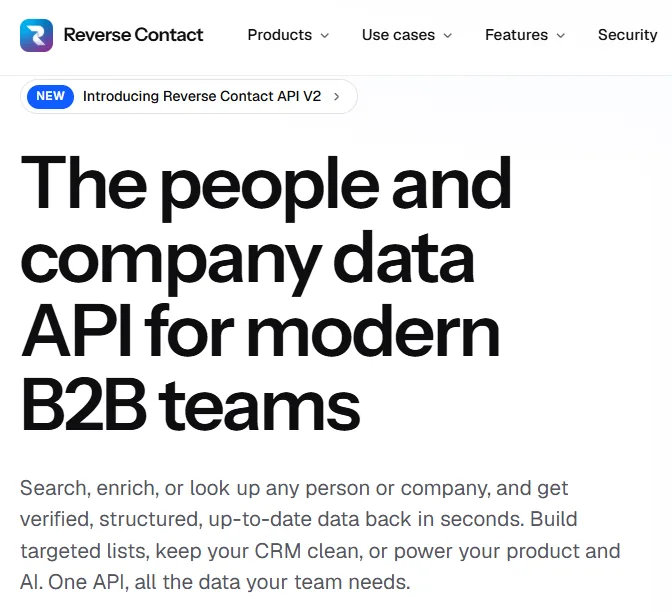
Best for: Recruiting products that need people data underneath.
Overview: Reverse Contact is an API for people and company records. A recruiting product calls it from code, or an in-house team uses a no-code app, to find people, complete their profiles and get contact details.
People search filters 800M+ profiles on 30+ criteria. Agentic search turns one plain sentence into those filters and shows which ones it applied, and lookalike search starts from one strong hire.
Unless your plan makes search unlimited, each profile delivered costs 1 credit, and agentic search adds 1 per request. Contact data waits until you've picked the people you'll call: 3 credits per business email found, and 20 when a lookup finds a phone.
Before an email or phone reaches you, we check it at request time, and anything that fails those checks is withheld. When more than one person could fit, the response lists the candidates so your product makes the call.
Key features:
- People search on 30+ criteria, sized for free before you pay.
- Agentic search from a single sentence.
- Lookalike search from one seed profile, at 1 credit per profile.
- A free check of when a profile was last fully refreshed, before you pay to re-fetch it (the workspace needs at least 2 credits).
- Contact lookups at 3 credits for each business email found, and 20 for a lookup that finds a phone.
- Delivery by REST API, CSV upload, webhooks, MCP or the CLI, plus apps on Clay, Zapier and Make.
Pricing: Pay-as-you-go opens with a $100 credit pack, no subscription, each purchase valid three months. For your own team's use, Go is $249 a month with cached profile fetches unlimited, Plus $449 adds unlimited search, agentic and lookalike included, and Max $699 adds unlimited enrichment. Each workspace tops out at 100,000 plan-covered profiles a day, and emails, phones and live re-fetches cost credits on every plan. A product that shows the data to its own customers needs Platform, which is custom priced.
Pros: A free count that sizes a search first, plain-sentence search that lists the filters it used and flags what it couldn't, lookalike search seeded by one strong hire, search filters for skills, languages and schools, email and phone lookups free when they find nothing
Cons: We don't screen candidates, schedule interviews, send outreach or run an ATS; plain-sentence search reads "Director" as part of the job title, so filter seniority in standard people search
How to start using it:
- Open an account. Free trial credits come with it, and no card is required.
- Run a free count on the segment your users search most.
- Run 200 of your users' real searches through agentic search.
- Divide the credits spent by the profiles you could use.
- Give each API key a daily or monthly credit cap before go-live.
Why it's a good AI sourcing tool: It suits a team building its own search, with people data, enrichment and contact lookups in one API.
Final verdict: Strong for a recruiting product or a technical team. A recruiter who wants outreach and a pipeline in one place should start lower down this list.
2. Juicebox
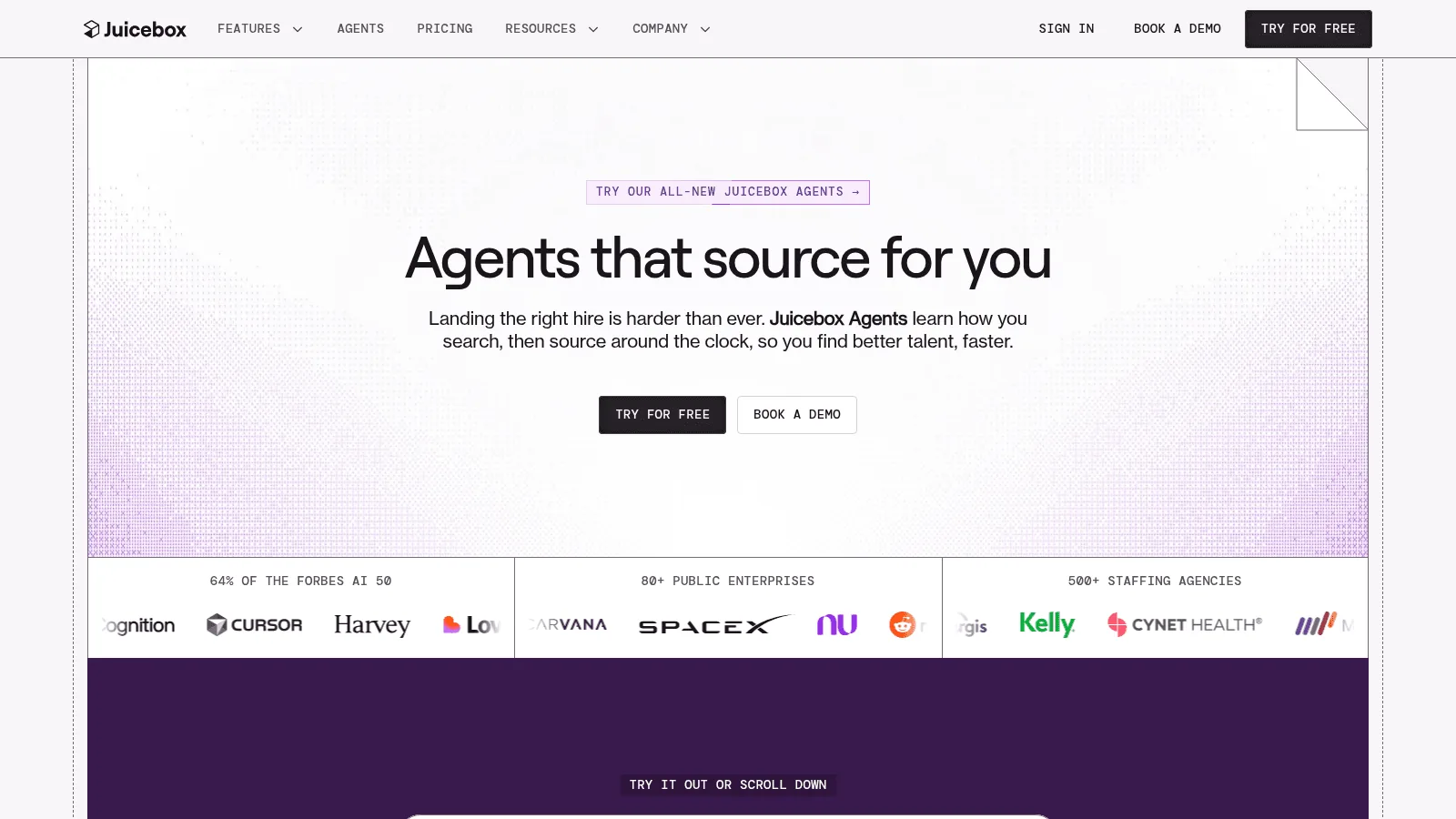
Overview: Juicebox runs plain-language people search with outreach and AI agents on top. On October 6, 2026, it announced it had acquired Fetcher's assets, and Fetcher is retiring its platform.
Key features:
- Search across what Juicebox calls 800M global profiles.
- Agents, billed per agent, that keep a search running.
- Links to Greenhouse, Lever, Ashby, Workday, BambooHR, Salesforce and HubSpot, on Business only.
Pricing: On yearly billing, Starter is $99 per seat a month, Growth $179 per seat a month for up to 5 paid seats, and Agents $199 per agent a month. A free plan with limited searches sits below, and Business is custom and annual only.
Pros: A real free plan, no Boolean needed, published seat prices
Cons: Cost grows with each recruiter, Growth stops at 5 paid seats, ATS and CRM links need the custom Business tier
Why it's a good AI sourcing tool for recruiting: It swaps the Boolean string for a sentence, and the free plan lets you test that on a live role.
Final verdict: A sensible first trial for search and outreach in one place.
3. SeekOut
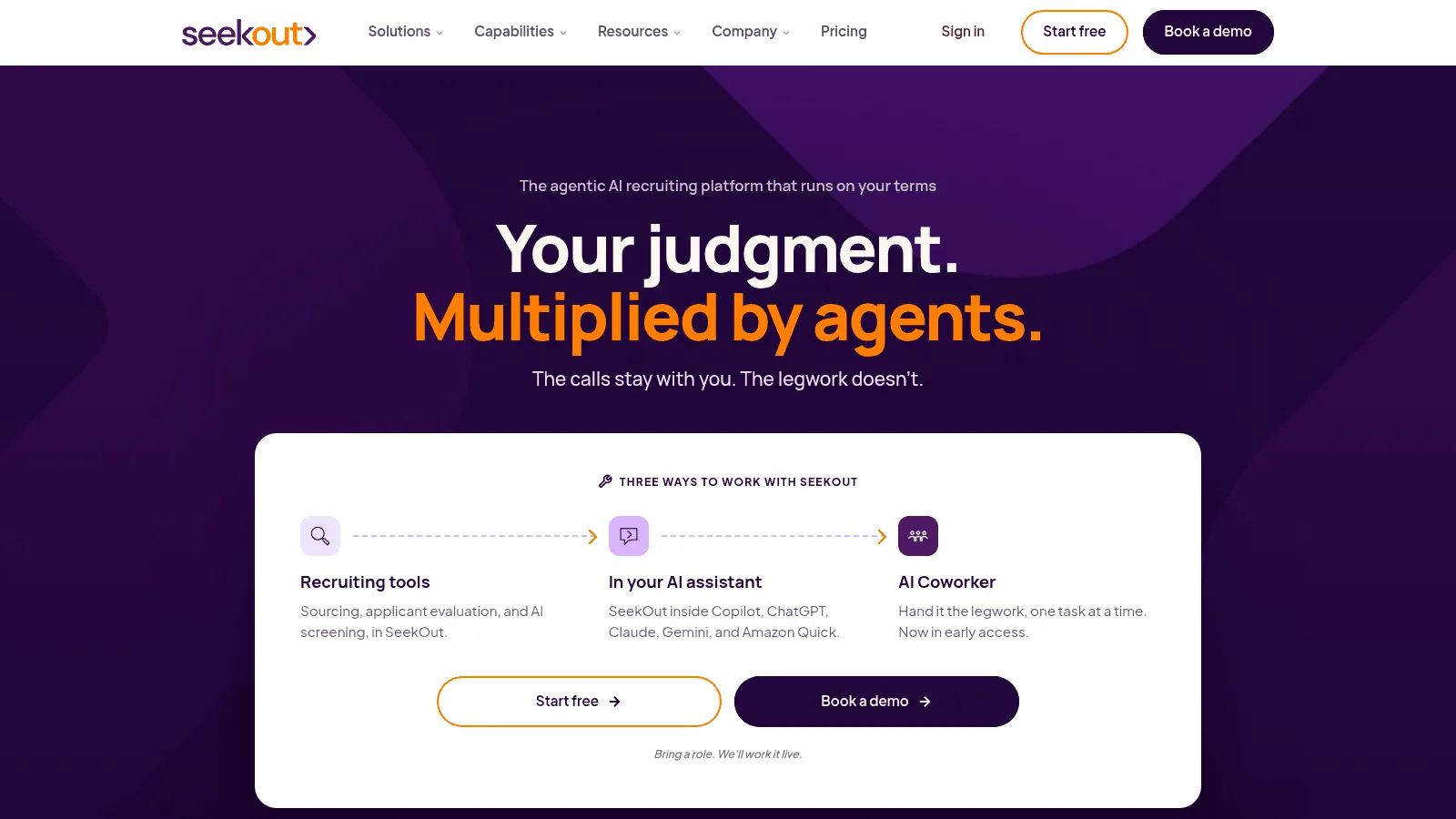
Overview: SeekOut pairs candidate search with AI outreach campaigns. Its entry tier, Sourcing Core, is self-serve with three seats.
Key features:
- Search across what SeekOut says are 1B+ candidate profiles.
- AI campaigns that run outreach to a shortlist.
- An MCP server an AI assistant can query.
Pricing: Sourcing Core is $149 a month paid annually up front, $1,788 a year, or $179 billed monthly. The Sourcing, Sourcing + Integration and Full Funnel tiers are custom and billed annually.
Pros: 14 free days on Core without a card, a monthly option, three seats included
Cons: The trial covers Core only, ATS integration starts at a custom tier, applicant evaluation is an add-on
Where it fits: A small team can run real searches for two weeks before talking to sales.
Final verdict: Easy to test, but budget for a custom tier if candidates must reach your ATS.
4. hireEZ
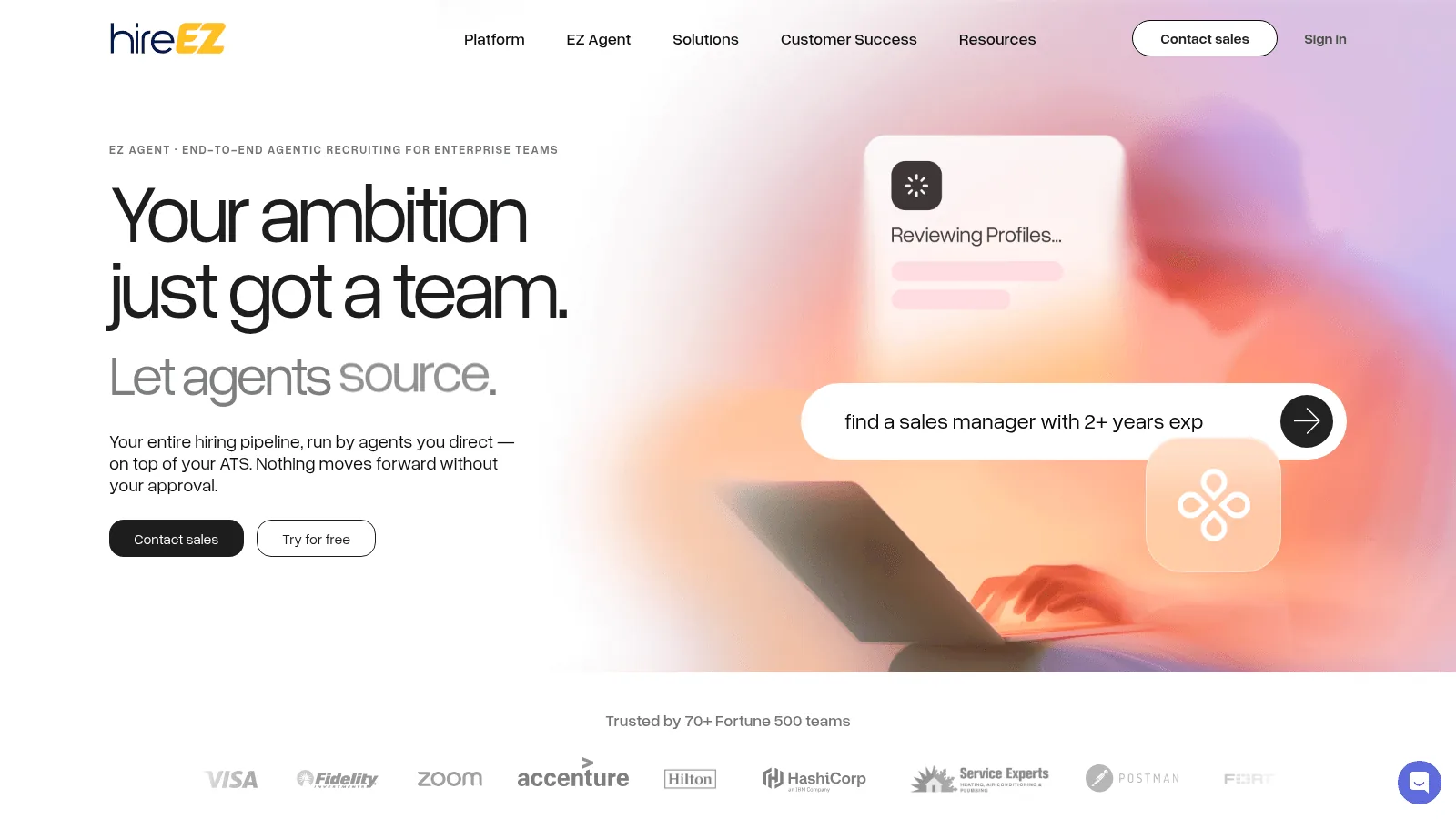
Overview: hireEZ now sells an enterprise agentic platform covering search, a recruiting CRM, outreach and screening.
Key features:
- An agent working across what hireEZ says are 1B+ candidate profiles.
- 40+ native ATS integrations on its pricing page, over 50 ATS partners on its platform page.
- A built-in CRM for candidates you aren't ready to hire.
Pricing: Solo recruiters start at $494 a month with a 7-day free trial, and the page doesn't state the billing basis. Enterprise is priced against the tools it replaces, confirmed in what hireEZ calls a four-week verification.
Pros: A self-serve route for one recruiter, wide ATS coverage, CRM included
Cons: A steep entry price for one user, billing basis unstated, enterprise pricing takes a month to confirm
Why buyers shortlist it: One contract covers search, outreach and a candidate CRM.
Final verdict: Built for enterprise teams; a solo recruiter should weigh $494 against the cheaper plans here.
5. Findem

Overview: Findem is a people-intelligence platform that searches by attributes rather than keywords. It acquired Getro on December 4, 2025, and announced on March 19, 2026 that it had agreed to acquire Glider AI.
Key features:
- Attribute search across what Findem calls 850+ million enriched profiles.
- Findem Studio, a self-serve version on credits.
- Links to Greenhouse, Lever, SmartRecruiters, Ashby, iCIMS, Jobvite and Workday.
Pricing: The main platform publishes no price. Studio offers $100 pay-as-you-go top-ups, or a seat at $2,499 a year or $249 monthly, and Studio + Platform is $5,999 a year or $599 monthly.
Pros: 1,250 free starter credits on Studio, many ATS links, a self-serve way in
Cons: No price for the full platform, credits add a second meter, the Glider AI deal's closing isn't confirmed
Its real strength: Attributes help where titles vary between employers, and company context matters as much as the person, the same ground company research tools cover.
Final verdict: Worth a Studio trial before an enterprise demo.
6. Pin
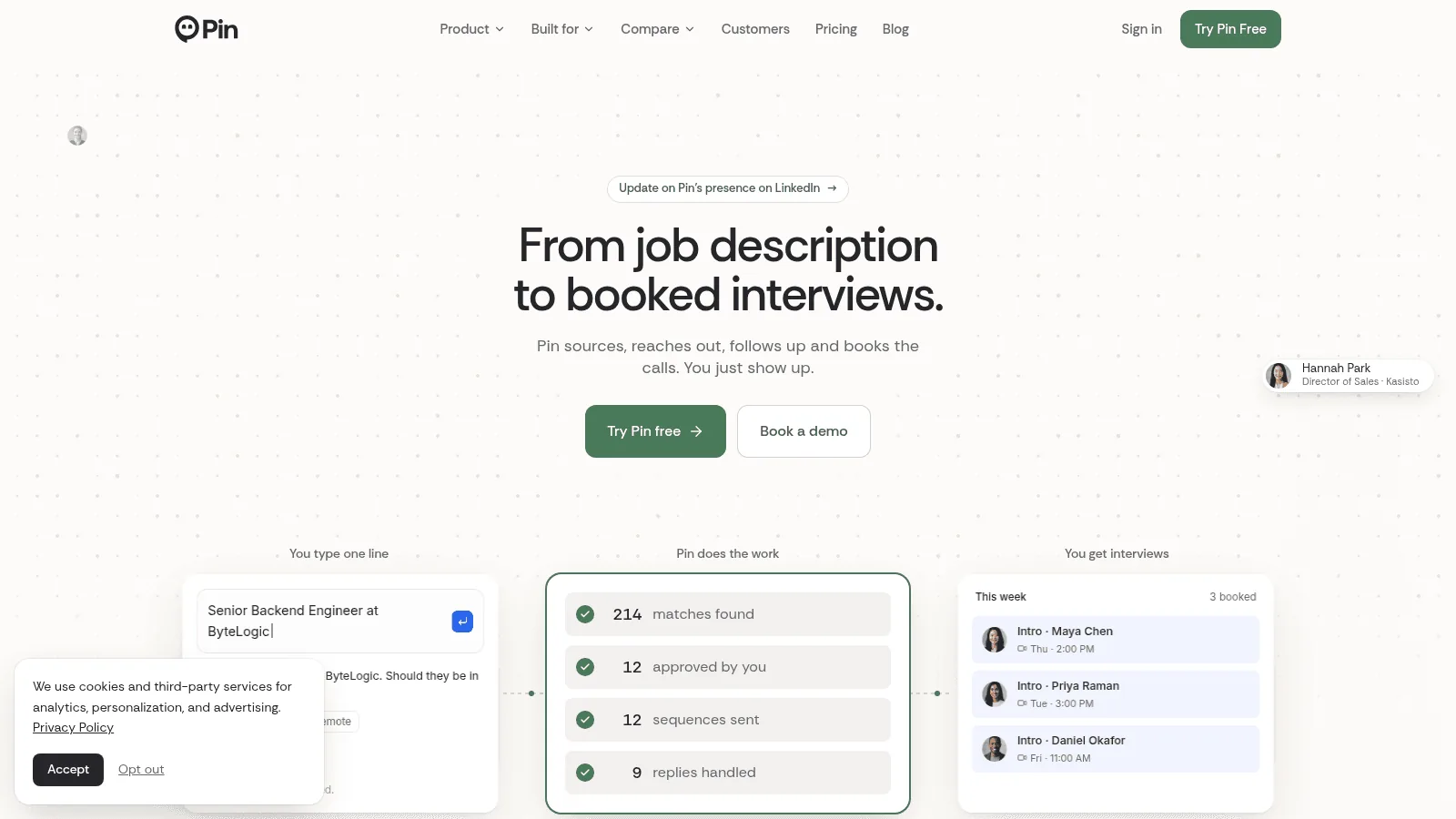
Overview: Pin sells an AI recruiter that searches, sends outreach and books meetings. Scheduling belongs to the screening stage, so judge it here on search and outreach.
Key features:
- Search across what Pin says are 850M+ profiles.
- Outreach sent by the agent to the people it finds.
- 120+ ATS integrations, including Greenhouse, Lever, Ashby, Bullhorn, iCIMS and Jobvite.
Pricing: The free plan gives 5 contact lookups a week, 1 job and 1 agent, with no card. Solo is $100 per user a month, billed annually only. Professional is $135 per user a month billed annually, or $179 monthly, and Enterprise is custom.
Pros: A real free plan, a low entry price, MCP access
Cons: Solo is annual only, ATS integration is a paid add-on below Enterprise, 5 lookups a week is a taste rather than a test
Why buyers shortlist it: The free plan includes a working agent, so you can judge its picks on a real job.
Final verdict: A low-risk try at agent-run search.
7. Noon
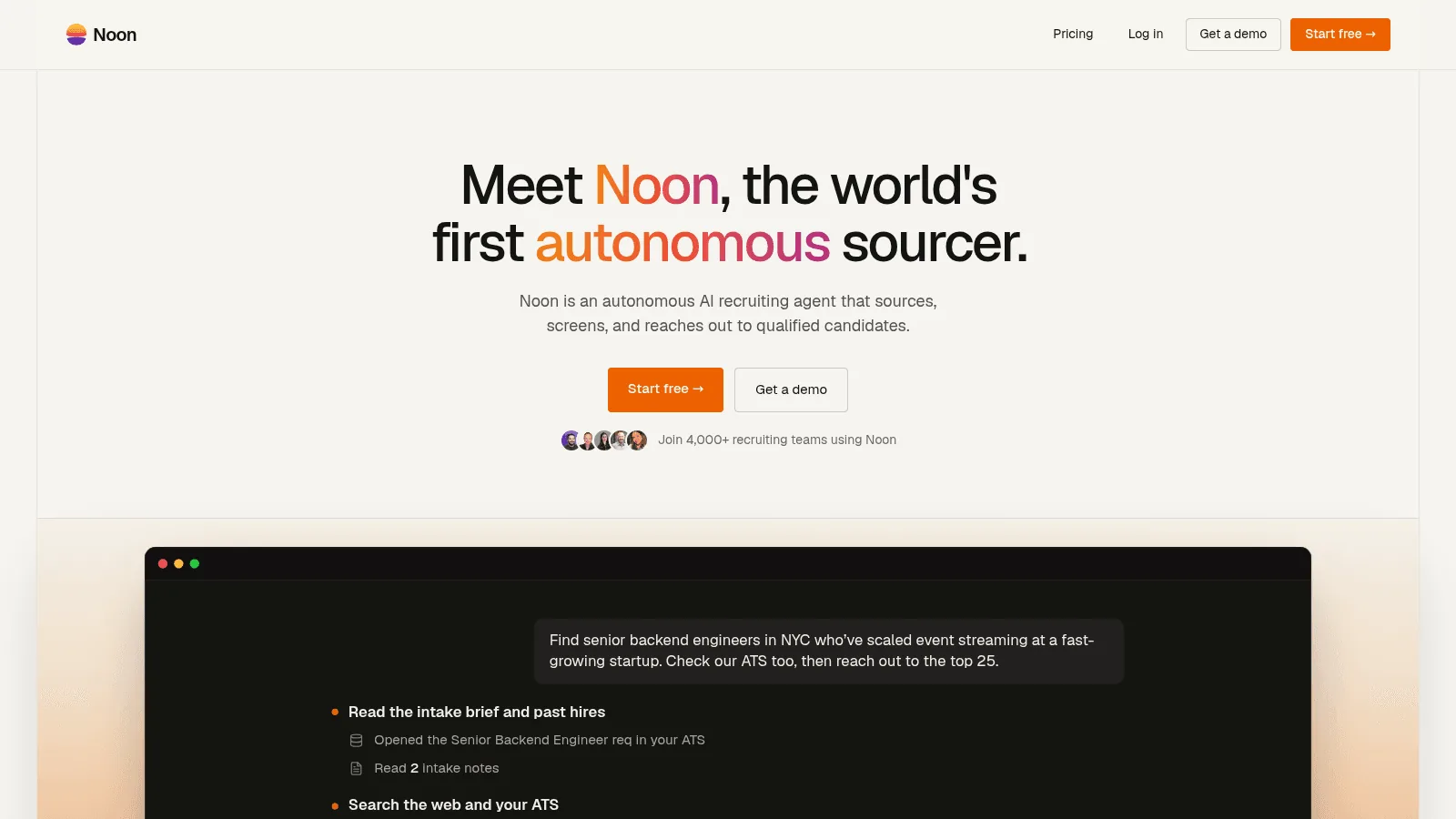
Overview: Noon calls itself an "autonomous sourcer" that finds candidates, enriches profiles, sends outreach and handles screening.
Key features:
- One plan with unlimited searches, contacts, agents and seats.
- Screening by the same agent.
- 20+ ATS integrations on its pricing page, 40+ on its integrations page.
Pricing: Noon is quote-based, with no tiers. Its pricing page says any dollar figure for Noon seen elsewhere "was not published by Noon."
Pros: No usage meter, every seat included, one plan to negotiate
Cons: No published price, demo only, no database size published
What it's good at: A team tired of metered pricing gets one number to agree on.
Final verdict: Worth a demo if unlimited volume matters more than a public price.
8. HeroHunt.ai
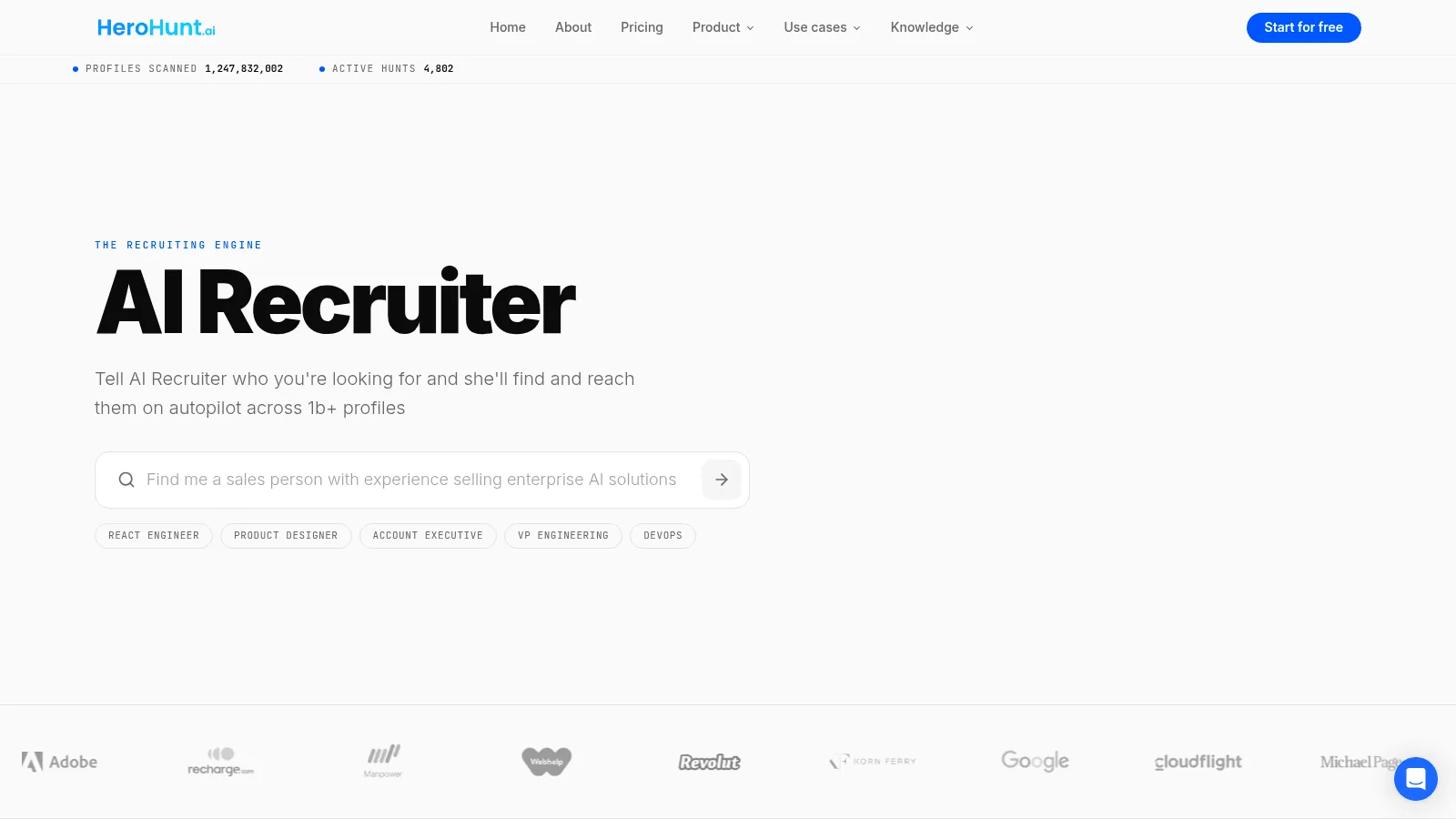
Overview: HeroHunt.ai sells an AI recruiter that searches, screens and sends outreach on autopilot. Each plan caps matched profiles and emails a month.
Key features:
- What it says are 750 million profiles on Starter, extended to 1 billion on Pro and Team.
- 2,000 matched profiles and 500 emails a month on Starter.
- An integrations page naming about 34 tools, including Greenhouse, Lever, Ashby, Workday and Gem.
Pricing: On monthly billing, Starter is $99, Pro $199 and Team $399 a month. Paying yearly gets 2 months free.
Pros: An 8-day free trial with 150 profiles and 75 emails, published caps, monthly billing
Cons: Monthly caps on new profiles and emails, a smaller pool on Starter, integrations listed only on Pro and Team
Where it beats the alternatives: A small agency sees its volume ceiling before paying.
Final verdict: A practical entry point for agent-run outreach, as long as you read the drafts before they go out.
9. Perfect
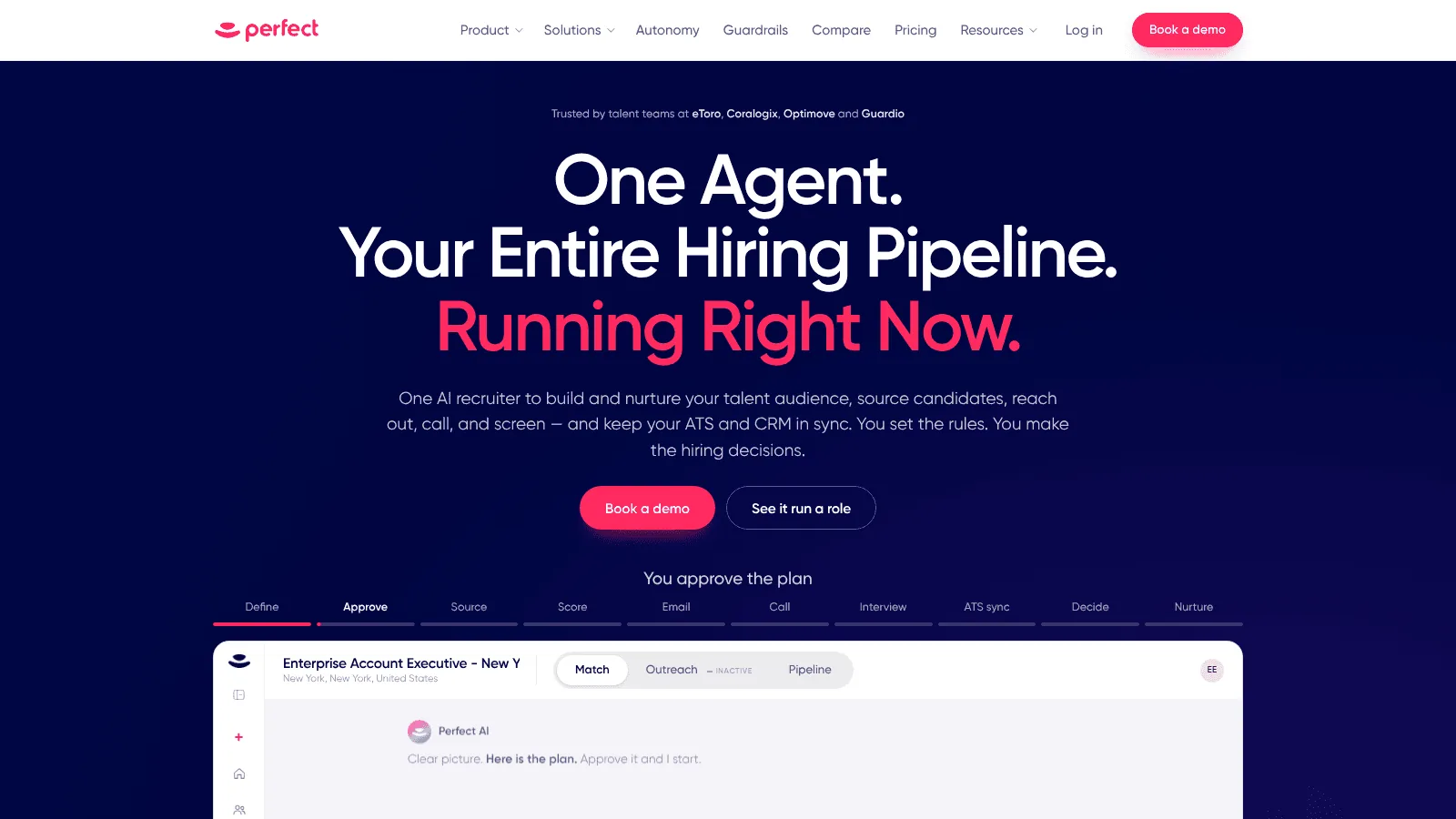
Overview: Perfect (GoPerfect) runs an autonomous recruiter workflow with its own ATS and CRM built in. No other tool here publishes a per-role price.
Key features:
- Unlimited seats and no add-ons.
- What it says are 800M+ profiles.
- 60+ ATS and HR integration options, by its count.
Pricing: Perfect charges $300 per open position per month, for 1 to 50 positions. Its calculator puts five roles at $1,500 a month.
Pros: Cost follows hiring volume, the whole team gets access, nothing sold on top
Cons: No free trial found, cost climbs fast with many open roles, the demo covers one live role in 15 minutes
Why it made this list: It shows pricing tied to the hire you're making rather than the people searching.
Final verdict: A good fit for a few open roles and many people who need access.
10. Gem

Overview: Gem combines an AI search agent with a recruiting CRM and an optional ATS.
Key features:
- An agent searching what Gem says are 800M+ profiles.
- A CRM that keeps past finalists ready for the next opening.
- Works over Greenhouse, Workday, iCIMS, SAP SuccessFactors and 100+ more ATSs, it says.
Pricing: Pricing is custom and "based on your company's FTE count." A self-serve startup plan for 1 to 10 FTE is $130 a month billed yearly, or $300 monthly.
Pros: Runs over an existing ATS, a CRM for repeat hiring, a real startup offer
Cons: No standard published price, cost scales with headcount rather than use, the startup plan stops at 10 FTE
Why it earns a place here: It searches beyond the ATS while keeping that ATS as the record.
Final verdict: Best suited to a growing in-house team with an ATS it likes.
11. Loxo
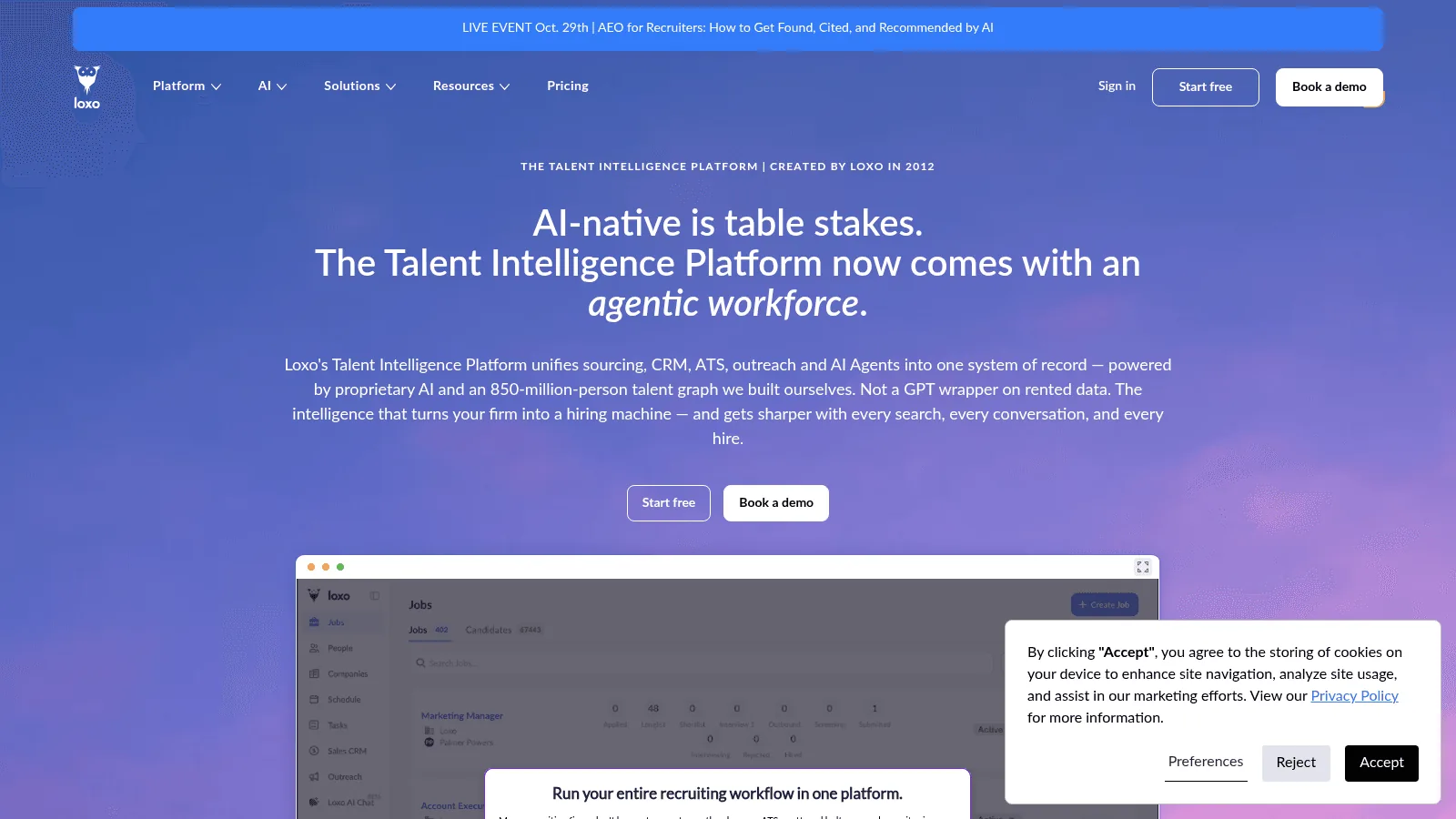
Overview: Loxo is an AI-native ATS and CRM with its own search layer, Loxo Source.
Key features:
- Loxo Source, on Professional, searching a talent graph Loxo puts at 850M+ professionals.
- ATS and CRM in one product.
- An integrations marketplace, including Indeed and Zoom.
Pricing: Core starts at $149 per user a month, billed annually and paid up front, with AI search, ATS and CRM but not Loxo Source. Professional and Enterprise are priced by demo, also annual.
Pros: A free 7-day trial with full Professional access and no card, AI search and pipeline in one system from Core, a published entry price
Cons: Loxo Source needs the demo-priced Professional tier, annual billing paid up front, swapping ATS is a big project
Why buyers shortlist it: Candidate search and the pipeline you track people in sit in one product.
Final verdict: Strong if you want to search and track candidates in one tool, heavy if you only need search.
12. Rival Recruit
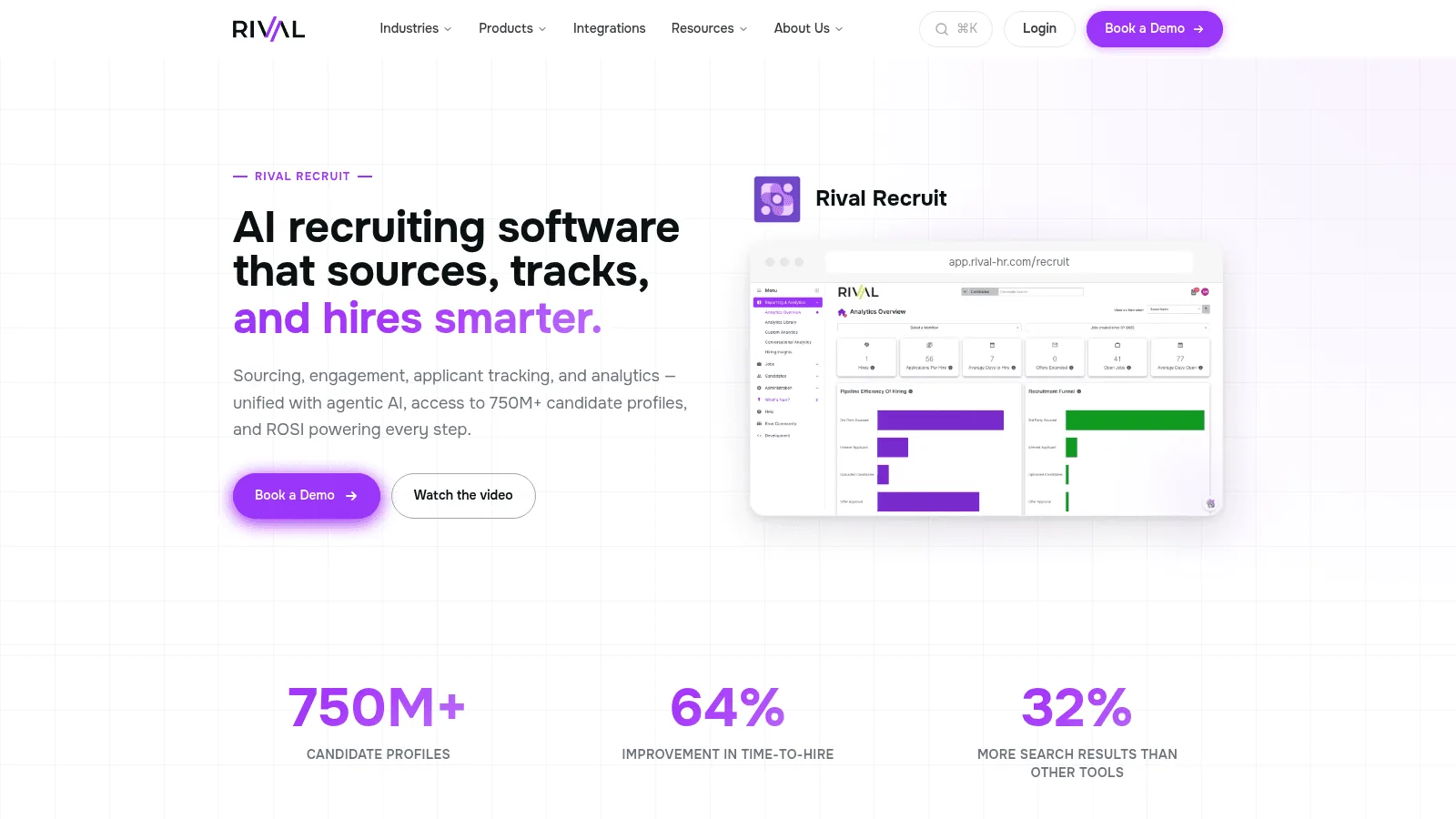
Overview: Rival Recruit works as an ATS with AI search built in, or as an outbound layer over the ATS you already use.
Key features:
- Search across what Rival says are 750M+ candidate profiles.
- An outbound mode on top of an existing ATS.
- Candidate transfer with your ATS, possibly a paid extra.
Pricing: Rival publishes no price, and its pricing link leads to a demo booking.
Pros: A full ATS or an add-on, keeps your current system, ATS import and export
Cons: No published price, no trial found, ATS integrations not named
Where it fits: It adds outbound search without ripping out an ATS.
Final verdict: Worth a demo, but ask for the price and the ATS list up front.
13. LinkedIn Recruiter
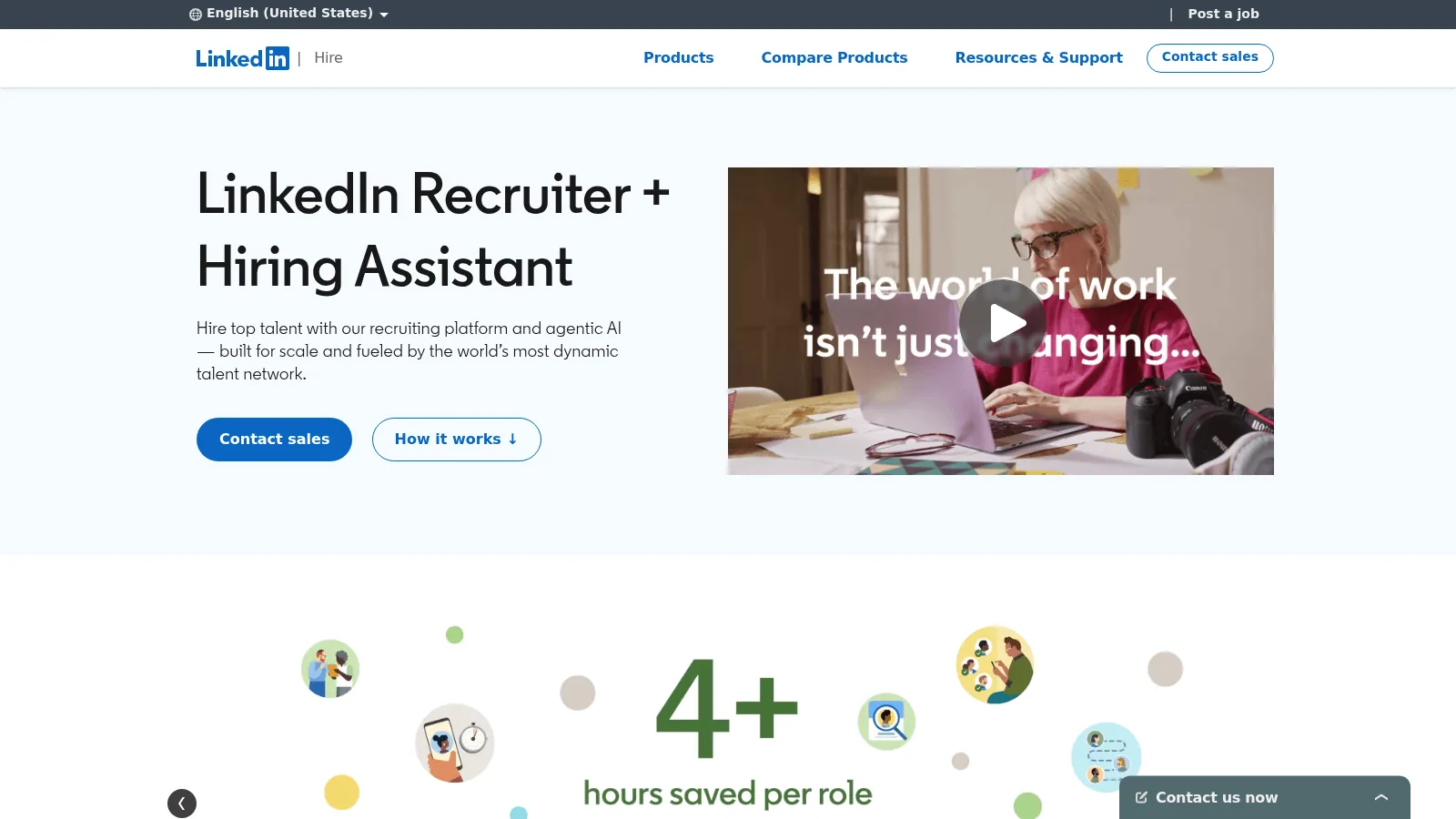
Overview: LinkedIn Recruiter is the network search many in-house teams already pay for, now with an add-on AI agent called Hiring Assistant.
Key features:
- Recruiter search across the LinkedIn network.
- Hiring Assistant, sold as a Recruiter add-on in a contract bundle.
- 1B+ professionals, by LinkedIn's own count.
Pricing: LinkedIn says Recruiter "does not have a single standard price."
Pros: A tool many recruiters know, no new vendor to onboard, AI available as an add-on
Cons: No published price, no free trial found, terms vary by volume, team size and region
Why it's on the list: It's the baseline many teams measure other tools against.
Final verdict: Keep it if the budget allows, and judge the rest on what they add.
14. SignalHire
Overview: SignalHire finds emails and phone numbers for people you've already found, through an extension, bulk search and an API. Its plans split by data type, with a slider for volume.
Key features:
- Emails, Phones, or both, as separate plans.
- "ATS/CRM integration" on every paid tier, no ATS partners named.
- A database it puts at 900M+ profiles and 30M+ companies.
Pricing: At the default slider, Emails and Phones cost $57 a month each billed annually and the combined plan $83, or $69, $69 and $99 monthly. Emails at its lowest setting is $39 a month billed annually, or $49 monthly.
Pros: 5 free credits, or 10 a month with the extension, a credit spent only when a contact is returned, ATS sync on every paid tier
Cons: Price and credits move together on a slider, phones need their own plan or the combined one, Scale is quote-only
Where it fits: It's the reach step once a search tool has found someone, and buyers usually compare a few SignalHire alternatives on price per contact.
Final verdict: A plain reach step, cheapest on annual billing.
15. ContactOut
Overview: ContactOut is a contact finder built around a browser extension and an API.
Key features:
- Email-only and Email + Phone plans.
- What its homepage calls 800M people profiles, 150M personal emails and 100M direct dials, though it also says 350M professionals.
- A team plan that connects to Salesforce and ATS integrations.
Pricing: The Email plan is $49 a month and Email + Phone $99, billed monthly. A free plan gives 5 emails, 5 phones and 5 exports a day, labeled "limited time only."
Pros: A daily free allowance, personal emails and direct dials, a recruiter-shaped workflow
Cons: Exports stop at 300 a month on Email and 600 on Email + Phone per its pricing page, its Terms cap the "unlimited" plans at 2,000 emails and 1,000 phones a month, the free plan is marked temporary
Why it earns a place here: Its personal emails give you a second route to a candidate who doesn't answer at work.
Final verdict: A natural pick for a recruiter working profile by profile.
How This List Was Built
Every tool here had to do part of the find-and-reach job, be live, and publish enough on its own site to describe it fairly. Fetcher was dropped because it's retiring.
Prices, trials, integrations and database sizes were read on the vendors' own pages on November 2, 2026, never copied from another roundup. That matters because this list comes from a vendor, as do many lists of talent sourcing tools.
There are no star ratings, since a list that rates its own author tells you nothing.
What to Look For in an AI Sourcing Tool
A demo always looks good, because the vendor picks the role. These four checks show what happens on yours.
Search You Can Check
A match score is a ranking, which can carry bias. Wilson and Caliskan's AIES study tested embedding-based retrieval, a method some match scores use, on over 500 resumes across nine occupations. Its three models favored White-associated names in 85.1% of the tests. The authors corrected their gender findings in August 2026, and the race result stands.
Reading the top of a list can't show you who got pushed down. Compare who makes the shortlist with who appears in the full result set for the same search, then ask each vendor whether and how it tests rankings for adverse impact. Talent sourcing tools that can't explain a rank are asking for blind trust.
Contact Data and the First Message
A shortlist without contact details is just names. Ask what each tool returns (work email, personal email, phone), whether it's checked when you ask, and whether a lookup that finds nothing still costs you.
The message matters as much as the address. In a Reddit r/recruiting thread, a recruiter said every engineer now gets the same AI-written outreach, and one commenter said their response rate fell from about 40 to 45% to about 22%. That's one person's account, not a study.
If the thread is right, recruiting is learning what sales teams found with AI prospecting tools: a first line everyone sends gets ignored. Let the agent find and draft, then read the drafts before anything goes out at volume.
ATS Write-Back
Your ATS holds your hiring history, and buyers say it can run short of people. A data-integration PM at an AI recruiting platform for staffing firms told us: "we've realized that our clients sometimes need more candidates than what are already present in the ATS."
So search reaches outside the ATS, and whatever it finds has to come back in as a record. That's why the write-back path matters in recruiting sourcing tools. Ask whether a found candidate lands as a new record or merges into an old one.
Among the tools above, hireEZ, Noon and SignalHire list ATS connections on their pricing pages, SeekOut connects from a custom tier, Juicebox only on Business, and Pin as an add-on below Enterprise. Gem runs over your existing ATS, and Loxo and Perfect come with their own. Reverse Contact has no ATS connection of its own, so that step runs through your code, Zapier or Make.
Test on the Roles You Actually Fill
In another r/recruiting thread on Reddit, an experienced recruiter reported AI tools missing candidates a basic Boolean search found. It's anecdotal, and cheap to test.
Pick two or three roles you filled last year. Run the same brief through each tool on the same day, then count how many of your real finalists each surfaces and how many of its top picks you'd never call. That test favors tools that copy your old method, so also read each tool's top results on one open role.
What AI Sourcing Tools Cost
This list's prices fall under six models, and the table files all 15 by the model each uses.
| Pricing model | Tools on this list | What drives your bill |
|---|---|---|
| Per seat or user, published | Juicebox, Pin, Loxo, Findem Studio | Number of recruiters |
| Flat monthly plan | SeekOut, HeroHunt.ai, hireEZ (solo, basis not stated) | Plan tier and its caps |
| Per open role | Perfect | Open positions |
| Contact-data subscription | SignalHire, ContactOut | Emails and phones revealed |
| Credits per call, or a plan for your own team; a quote once customers see the data | Reverse Contact | Calls made, or plan tier |
| Quote only | Noon, Gem (outside its startup plan), Rival Recruit, LinkedIn Recruiter | The contract |
Seat pricing works here the way it does in sales prospecting tools: it suits recruiter sourcing tools that every person on the team opens daily. Per-role pricing suits many users and few open roles, and credits suit software that makes the calls itself.
The cheapest line on the invoice isn't the real cost. A tool that returns the wrong people costs recruiter hours. Divide what you spend by the candidates you'd call and could actually reach, because a wrong email takes a candidate off that list, and compare recruiter sourcing tools on that number.
The Legal Line Between Sourcing and Screening
Where a tool sits in the workflow can change which rules apply, and New York City and the EU draw the line in different places.
In New York, the DCWP's AEDT FAQ says Local Law 144 doesn't apply when a tool is used to "scan a resume bank, conduct outreach to potential candidates, or invite applications." It defines a candidate as someone who has applied for a specific position. Pure outbound search falls outside Local Law 144, while screening applicants with an automated decision tool can fall inside it, with a bias audit and notice.
The EU draws it earlier. The Commission's draft guidelines, published May 19, 2026 and still a draft, say recruitment starts with identifying potential candidates in databases and name candidate sourcing as an example. HR sourcing tools may or may not be high-risk, depending on whether they affect the substance of a hiring decision, and an exemption covers purely preparatory tasks.
None of this is legal advice. Several tools here also screen, including Noon, HeroHunt.ai and hireEZ, and that's where New York's rule can start. If you hire in the EU or screen applicants in New York City, check with counsel before you rely on HR sourcing tools that rank people.
Choosing an AI Sourcing Tool for Hiring
Start from who will use it and where the candidates need to end up.
A solo recruiter or small agency picking an AI sourcing tool for hiring should start free: Juicebox and Pin have free plans, and SeekOut and HeroHunt.ai offer trials. An in-house team with an ATS it likes should look at Gem, Rival Recruit or SeekOut's integration tier, while a team that wants search and its pipeline in one product can look at Perfect or Loxo (Loxo Source needs Professional).
Enterprise teams comparing AI candidate sourcing tools will meet hireEZ, Findem, Noon and LinkedIn Recruiter, and should run the four checks above before those demos. If you already have search and only need to reach people, SignalHire and ContactOut sell just that step.
Building search into your own recruiting product is a different job, and Reverse Contact is built for it. Get a free API key and size a real search: the free count shows how many profiles match and what a full pull would cost, before anyone signs anything.
FAQs
What are AI sourcing tools?
AI sourcing tools find people for an open role and help you reach them. They take a job description or a plain sentence, search a database of profiles, rank the matches, then supply contact details or send outreach. AI sourcing tools for recruiting usually stop before screening and interviews.
Which AI sourcing tools have a free plan?
Juicebox, Pin and ContactOut have free plans, though ContactOut labels its own "limited time only," and SignalHire gives free credits. SeekOut, hireEZ, HeroHunt.ai and Loxo offer time-limited trials, and Findem Studio gives starter credits. Reverse Contact offers free trial credits, no card required, rather than a free plan.
Can AI search replace Boolean search?
AI search can build the query faster, because you describe the person instead of writing the string. It can also miss people, so run a Boolean search beside it on your first few roles. Keep whichever finds more of the people you'd hire.
Do I need a separate tool for contact details?
Not always. Several recruiting sourcing tools here bundle contact lookups with a cap: HeroHunt.ai's Starter includes 500 emails a month, and Pin's free plan 5 lookups a week. If yours runs short, SignalHire or ContactOut covers the reach step on its own.
Can I build my own AI sourcing tool?
Yes, with an engineer. You need a people-data API for search and enrichment, a way to rank matches against the job description, and a contact lookup for the shortlist. Compare raw data APIs first, the ground covered in People Data Labs alternatives, then build AI sourcing software on top.
The data layer behind your GTM engine
Access fresh people and company data through one API and power every enrichment, prospecting, and automation workflow.
- Profiles
- 800M+
- Refreshes / month
- 200M
- Response time (P95)
- 500ms