
18 Best Executive Search Tools in 2026
Julien K.Published
Key takeaways:
- A senior search runs through seven steps. Loxo's pages claim all seven, while 11 of the 18 tools here cover one or two, so plan on a search CRM plus one or two data tools.
- Ten of the 18 publish a price, ours included, though Clockwork's sits in its FAQ, not its pricing page. The other eight start with a demo, a quote, a trial or a paid pilot.
- Search CRMs differ most on off-limits flags, consent records, retainer fee tracking and control over what a client portal shows, so test those before the AI features.
- Hiring a firm is the other route: Korn Ferry reports search fee revenue of "generally one-third" of the hire's estimated first-year cash pay.
Challenger, Gray & Christmas counted 1,337 CEO exits in the first nine months of 2026, and its CEO Turnover Report found 53% of the named replacements came from inside the company. The other 47% came from outside, and those searches start with a long list of possible candidates and careful phone calls.
Executive search tools are the software for that work. This guide maps 18 of them to the step each one serves, so you can spot your gap.
What Is Executive Search Software?
Executive search software helps a search firm or an in-house team find, track and present senior candidates for one confidential role at a time. Unlike an applicant tracking system (ATS), it's built for people who aren't applying.
A retained search, paid partly up front, moves through seven steps, from the long list to interviews, and the mapping step leans on general company research tools as much as on search software.
Vendor lists of the best executive search software we read put their own product first, as ours does, and none maps tools to steps. This table does.
| Step of the search | Tools on this list that cover it |
|---|---|
| Research and long list | HelloSky, MapX AI, LinkedIn Recruiter, Talentis, Loxo |
| Org and market mapping | MapX AI, The Org, BoardEx, Thrive TRM, Talentis, Loxo |
| Contact and profile data | Reverse Contact, RocketReach, Lusha, plus finders inside Loxo, Stardex, HelloSky, Talentis Connect and Crelate |
| Discreet outreach | Thrive TRM, Ezekia, Stardex, Loxo, Crelate, HelloSky |
| Interviews | Metaview, Loxo (AI Notetaker) |
| Search CRM and pipeline | Invenias, Clockwork, Thrive TRM, Ezekia, Talentis, Cluen Encore, Stardex, Loxo, Crelate |
| Client portal and reporting | All nine search CRMs above |
Every search CRM here has a client view, so test what each view hides.
The 18 Best Executive Search Tools Compared
Reverse Contact leads the list since it's ours. The other 17 are grouped by step (search CRMs, research and mapping, contact data, then interviews), and the order inside each group isn't a ranking.
We read all prices and features on each vendor's site between November 3 and 8, 2026. MCP, short for Model Context Protocol, lets Claude or another AI assistant pull a tool's data directly.
| Tool | Step it covers | Pricing | Client portal? | Trial or free tier |
|---|---|---|---|---|
| Reverse Contact | Long list, contact and profile data | Packs from $100; plans from $249 a month | No CRM | Free trial credits, no card |
| Invenias by Bullhorn | Search CRM | Demo | Yes, plus branded documents | None stated |
| Clockwork | Search CRM | One plan; $149 per user a month, yearly (FAQ) | Yes | No free trial (FAQ) |
| Thrive TRM | Search CRM, market mapping, outreach | Demo | Yes, an invite-only client view | None stated |
| Ezekia | Search CRM, outreach | No fixed plans | Yes | 30-day free trial, no card |
| Talentis (with FileFinder) | Search CRM, research | From $137 a month, paid annually | Yes, in both | 7-day trial after a demo, no card |
| Cluen Encore | Search CRM | Demo | Yes, Searchlight 360 | Demo request only |
| Stardex | Search CRM, outreach | From $79 per user a month, yearly | Yes | Two-week refund, no trial |
| Loxo | Search CRM, outreach | From $149 per user a month, billed annually | Yes, Hiring Manager Portal | 7-day trial |
| Crelate | Search CRM, outreach | From $85 per user a month, paid annually | Yes, from Business | Free trial, no sales call |
| MapX AI | Research, market mapping | Quote | No CRM | Demo and free sample pack |
| HelloSky | Research, long list | No list price; annual, per seat | No CRM | Paid pilot, no free trial |
| BoardEx | Relationship mapping | Demo | No CRM | None stated |
| The Org | Org charts | Free; Basic $232 a year per seat | No CRM | Free plan; paid-tier trials |
| LinkedIn Recruiter | Research, long list | Varies by size and seats | No CRM | Only on Recruiter Lite |
| RocketReach | Contact data | From $33 a month per seat, billed annually (US prices) | No CRM | Free, 5 lookups |
| Lusha | Contact data | From $37.45 a month, billed yearly | No CRM | Free, 40 credits a month |
| Metaview | Interviews | Notes free, or Pro $60 per user a month; sourcing Pro $100 | No CRM | Free tier |
Ten of the other 17 list an MCP server or AI assistant connection: Clockwork, Thrive TRM, Ezekia, Stardex, Loxo, Crelate, MapX AI, HelloSky, RocketReach and Lusha. Cluen offers MCP on request.
1. Reverse Contact
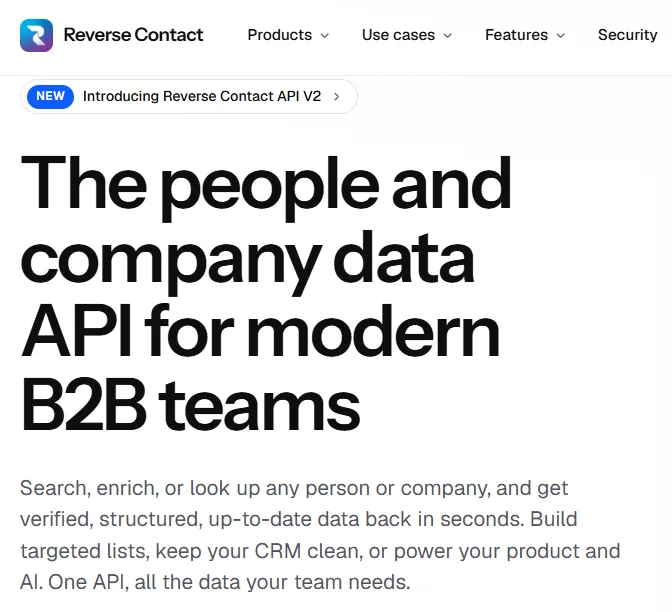
Best for: Current roles and contacts for long lists.
Overview: Reverse Contact is our people-data API, which your software or a no-code tool can call. Give us the names and companies on a long list, and we return each person's current role, employer and profile, plus a business email or phone if you ask.
People search works the other way round, filtering our 800M+ profiles by current or past title and employer, seniority and location, with a free count before you spend.
We check each email and phone at request time and hold back what fails. When a name could fit two people, you get the best match first, with up to nine other candidates beside it.
Key features:
- People search on 30+ criteria, at 1 credit per profile on packs.
- Enrichment from a name and company domain, or from an email, answered in the same call.
- Business emails at 3 credits per email found.
- Phones at 20 credits per lookup that finds one, and coverage we measure at over 90% on Director-and-above profiles with a professional online presence.
- Free checks of a profile's last refresh date, as long as the workspace holds 2 or more credits.
- API, CSV, webhooks, MCP or CLI, plus Clay, Zapier and Make apps and an HTTP step for n8n.
Pricing: A $100 pack of 5,000 credits, valid three months, is the smallest way in. Go at $249 a month removes the meter on cached profile lookups by ID, Plus at $449 on search too, and Max at $699 on enrichment, all capped at 100,000 plan-covered profiles a workspace per UTC day.
Emails, phones and live refreshes cost credits on every plan. Plans carry a monthly commitment and packs none. Plans are for your own team; showing our data to your customers in your software needs Platform, priced by sales.
Pros: Search on past titles and employers, a minimum-tenure filter by function or seniority, current roles for up to 25,000 names in one bulk request, Lists that don't charge twice for anyone already on them, a spend cap per API key
Cons: No search CRM, candidate tracking or outreach, so those live in another tool; our email finding is built for business addresses
How to start using it:
- Without a card, sign up for free trial credits.
- Export 50 names and companies from a finished long list.
- Enrich them and check each title against your research.
- Ask for emails, and phones only for the shortlist.
- Divide the credits spent by usable contacts, then pick a pack or plan.
Why it's a good executive search tool: It adds long-list search and contact data beside a search CRM. Email and phone lookups run in the background: results should land within 15 seconds but can take tens of minutes, so queue them.
Final verdict: Choose us if someone on your team can call an API or set up a no-code connector. Need a pipeline first? Start with a CRM below.
2. Invenias by Bullhorn
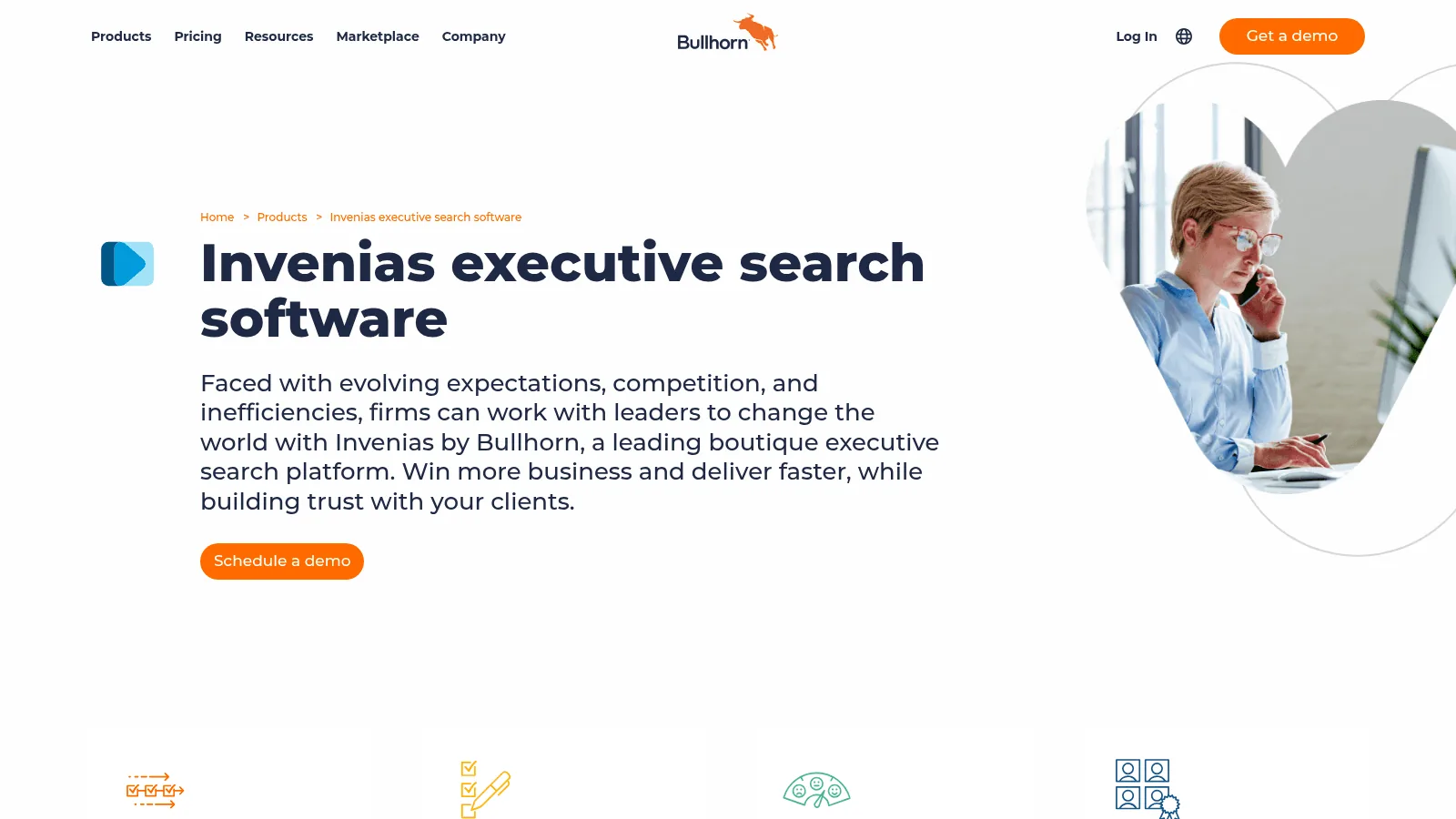
Overview: Invenias is Bullhorn's search CRM for executive search firms. It builds long lists "by targeting your client's competitors and researching previous similar assignments".
Key features:
- A client portal where clients log in to check assignment status.
- Branded client deliverables built from candidate profiles.
- GDPR (EU privacy law) tools that mass-send notices and consent requests.
Pricing: Bullhorn publishes no price, so you start with a demo. Its Power BI analytics need paid Power BI licenses as well as Invenias ones.
Pros: Built for retained assignments, consent handling, reuse of past research
Cons: No published price, analytics need extra licenses, no candidate database described
Where it fits: Established firms whose next search looks like the last one.
Final verdict: Strong for consent records and client documents in one place.
3. Clockwork
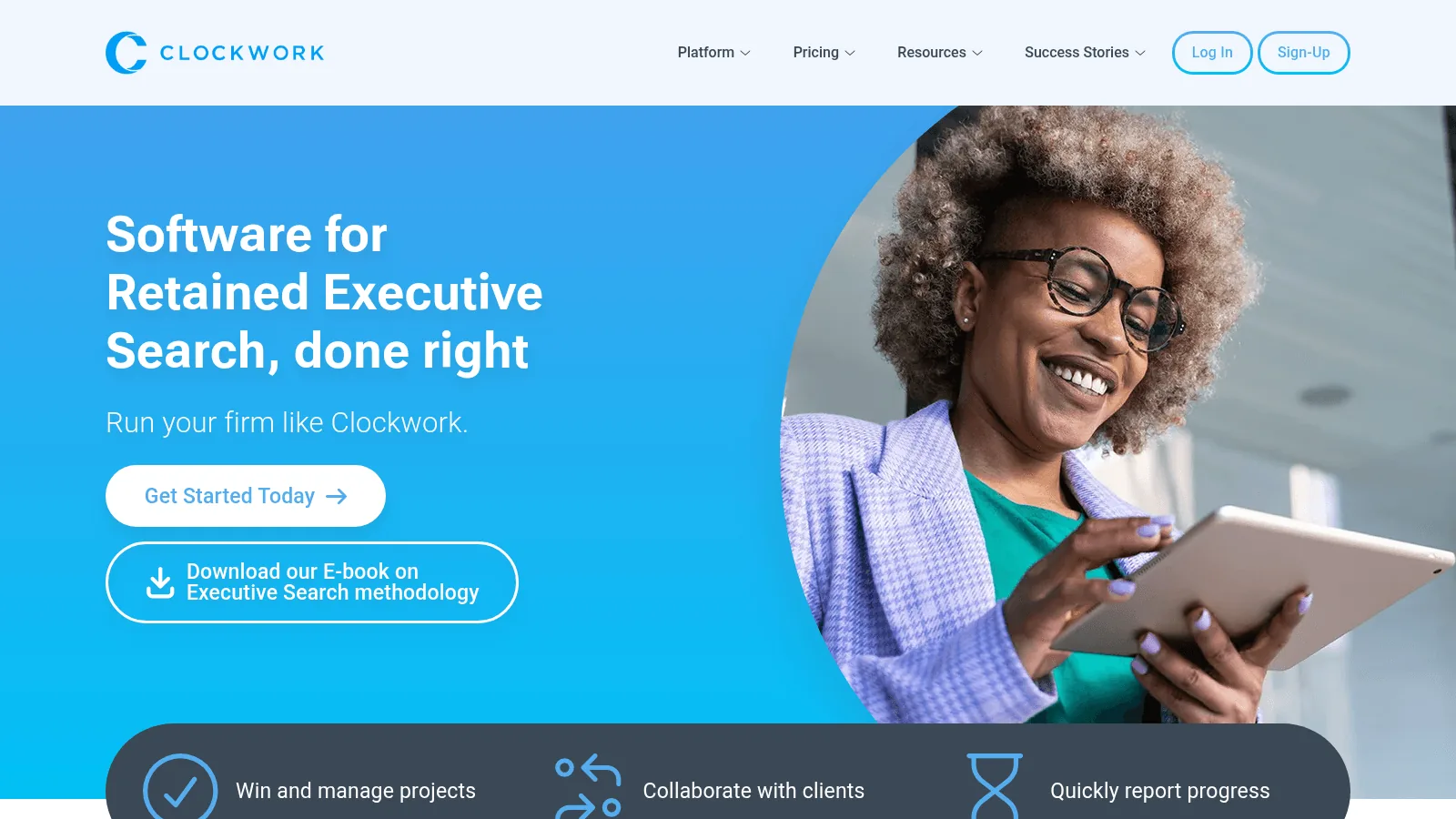
Overview: Clockwork Recruiting builds its search CRM around the client. Its Client Collaboration Portal lets clients upvote, downvote and comment on candidates in real time.
Key features:
- Shared long lists and scorecards.
- Automated real-time status reports.
- Deal tracking, contract management, GDPR consent management, an API and an MCP server.
Pricing: The pricing page shows "One plan. All the features." with no figure, but Clockwork's FAQ lists $149 per seat a month billed annually, or $179 billed monthly, and its other pages show different figures, so confirm before you budget. Its FAQ says there is no free trial.
Pros: Live client feedback, every feature in one plan, deal tracking
Cons: Figures differ across its own pages, no free trial, no candidate database listed
Why buyers shortlist it: The portal can stand in for many status calls.
Final verdict: A good fit when clients want to watch the shortlist build.
4. Thrive TRM
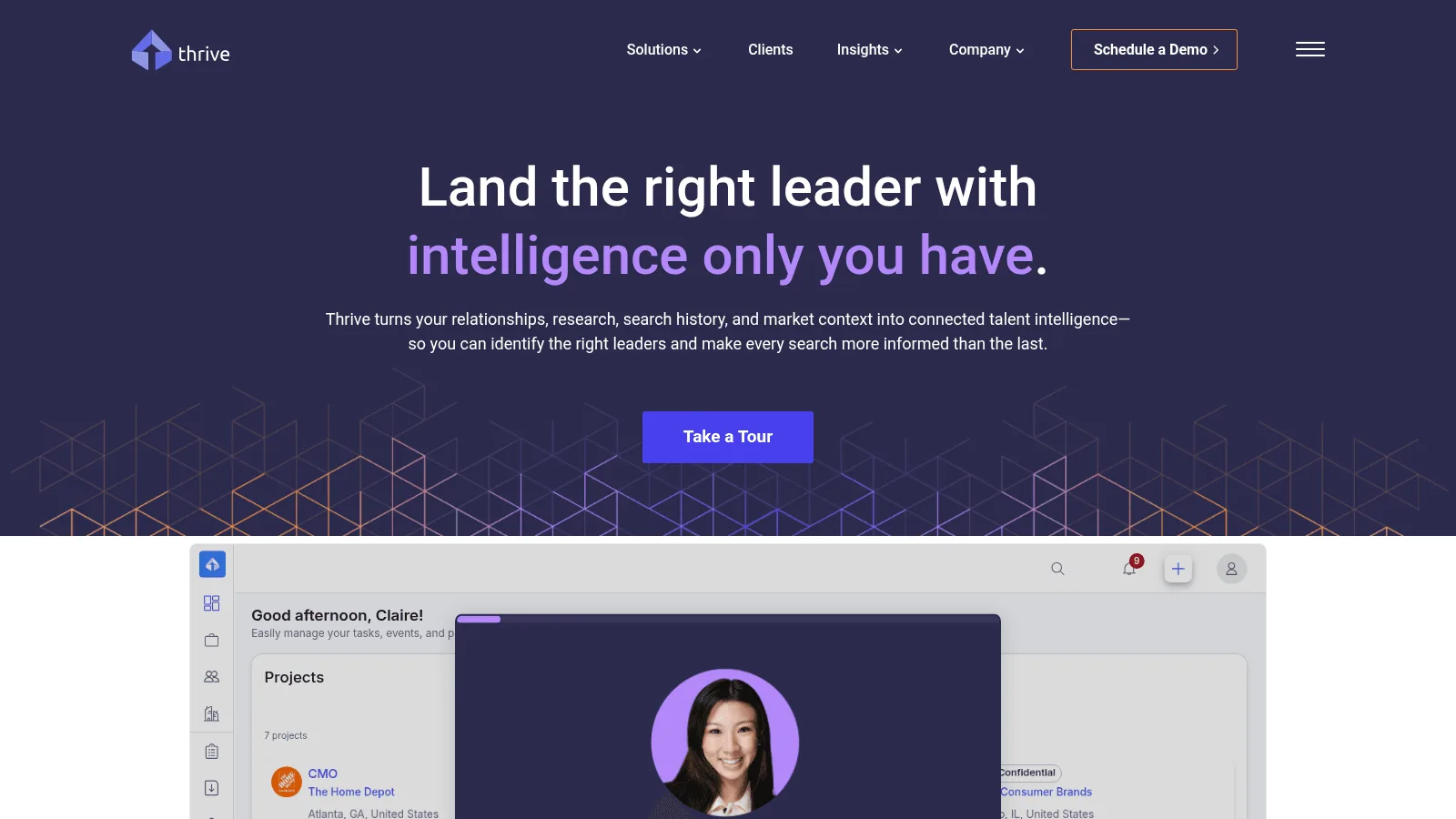
Overview: Thrive TRM puts AI at the start of a search. In its homepage demo, you paste a kickoff-call transcript and Thrive drafts a position description, scorecard and three-step outreach sequence, then maps the market by company.
Key features:
- Match grades with reasons, evidence and an off-limits flag.
- A map view of who your team has already contacted.
- An MCP server for working with Thrive inside Claude.
Pricing: Thrive publishes no price, and the only route in is "Schedule a Demo".
Pros: Kickoff to outreach in one flow, off-limits shown per match, ISO 27001 security certified
Cons: No published price, no trial stated, AI drafts you must check before use
Its real strength: A working search plan on day one.
Final verdict: Book the demo if you want the CRM to draft the search.
5. Ezekia
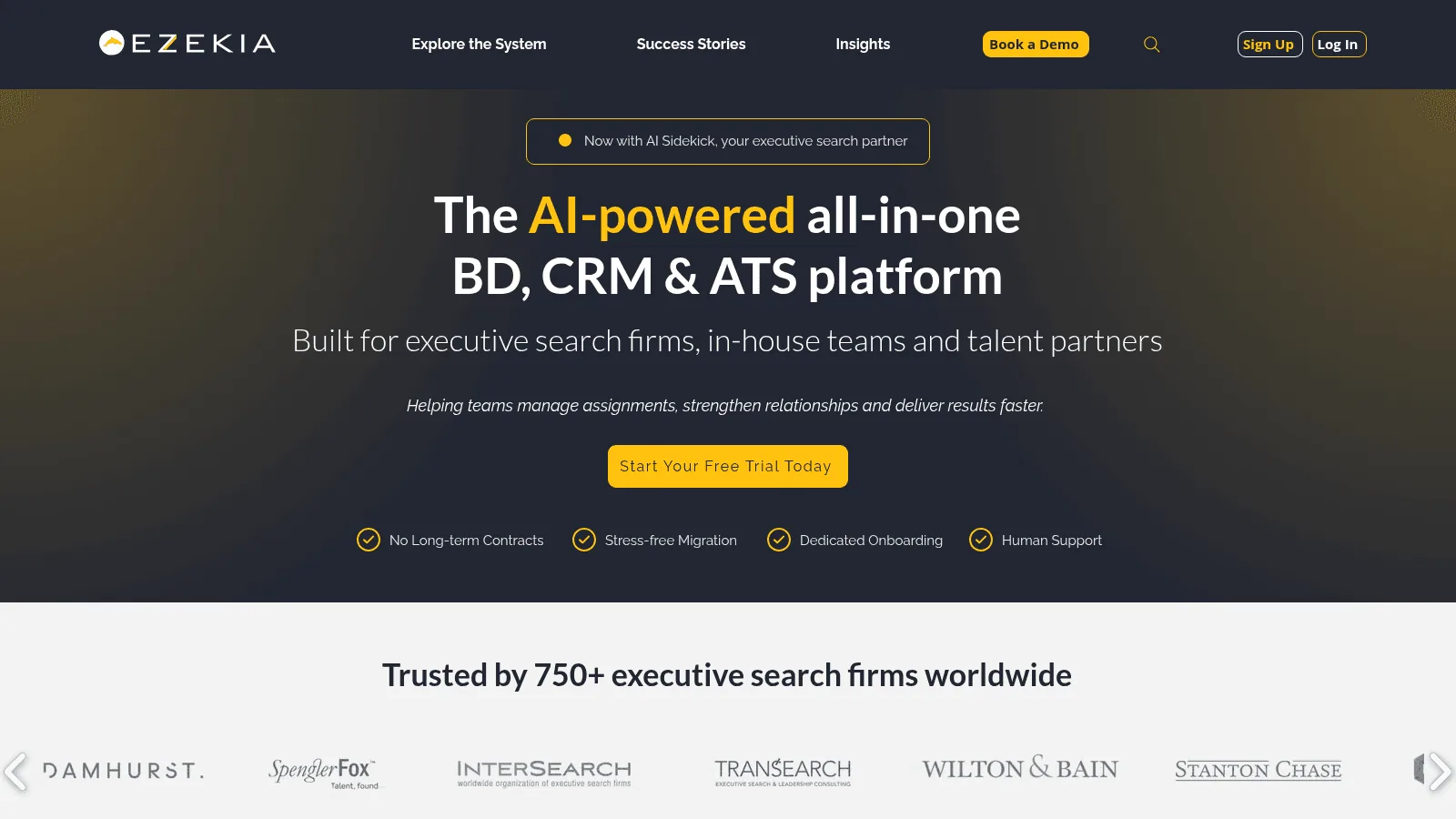
Overview: Ezekia is a London-based search CRM built around client portals, which you archive when the search closes.
Key features:
- Per-portal control of which candidates and documents a client sees.
- Email sequencing, plus transcripts from partners such as Metaview (its own notetaker is listed as coming soon).
- Chrome and Outlook extensions, plus links to Claude, Copilot, OpenAI and Zapier.
Pricing: Ezekia states "No fixed plans. No per-search fees." The 30-day free trial covers the full platform with no card, and Enterprise is custom per user, monthly, with no annual commitment.
Pros: A month's trial without a card, no annual commitment, ISO 27001 certified
Cons: No list price to plan around, its own notetaker still coming soon
Why it made this list: A month on a live search before you pay.
Final verdict: Best when each client should see only some candidates.
6. Talentis (with FileFinder)
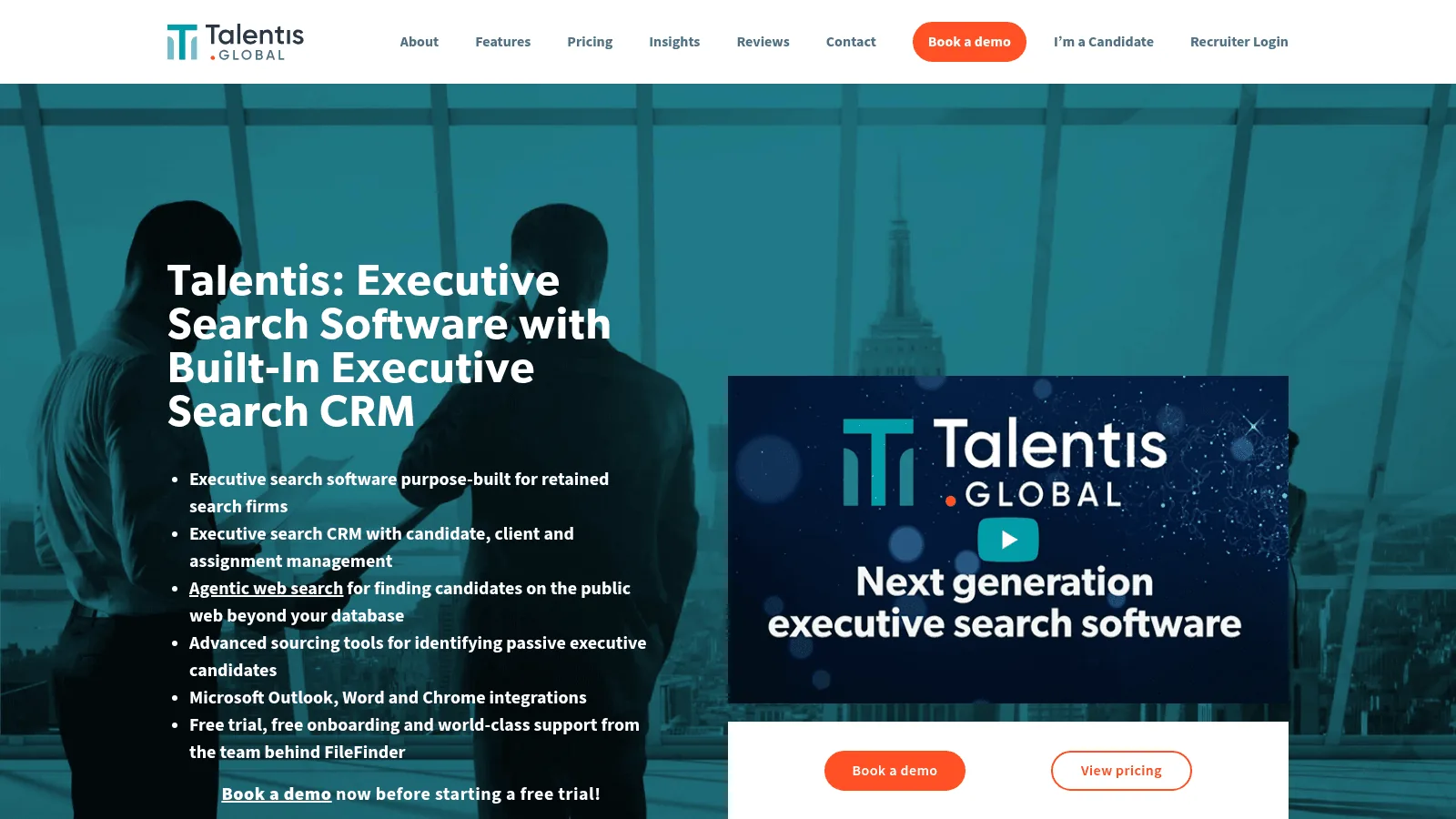
Overview: Talentis and FileFinder come from one supplier, Dillistone Group. Talentis is the cloud platform, with AI web search across what it calls "more than 800 million public professional profiles". FileFinder is the Outlook-based system, and both come with a client portal.
Key features:
- Company and market mapping with org charts.
- OpenAI and Sonar (Perplexity) built into the standard platform, inside Outlook and Word.
- A link to GatedTalent, a network executives join for free.
Pricing: Talentis lists plans from $137 a month paid annually, with a month-to-month option. Talentis Connect, at $146 a month paid annually, adds email and phone lookups under fair use. A 7-day free trial, with no card, follows a demo.
Pros: Research and CRM from one supplier, AI in the standard platform, market mapping
Cons: The price page doesn't say if it's per user, two products can blur what you're buying, public profiles only by its own description
What it does best: Long-list research without leaving the CRM.
Final verdict: A fit for firms that live in Outlook.
7. Cluen Encore
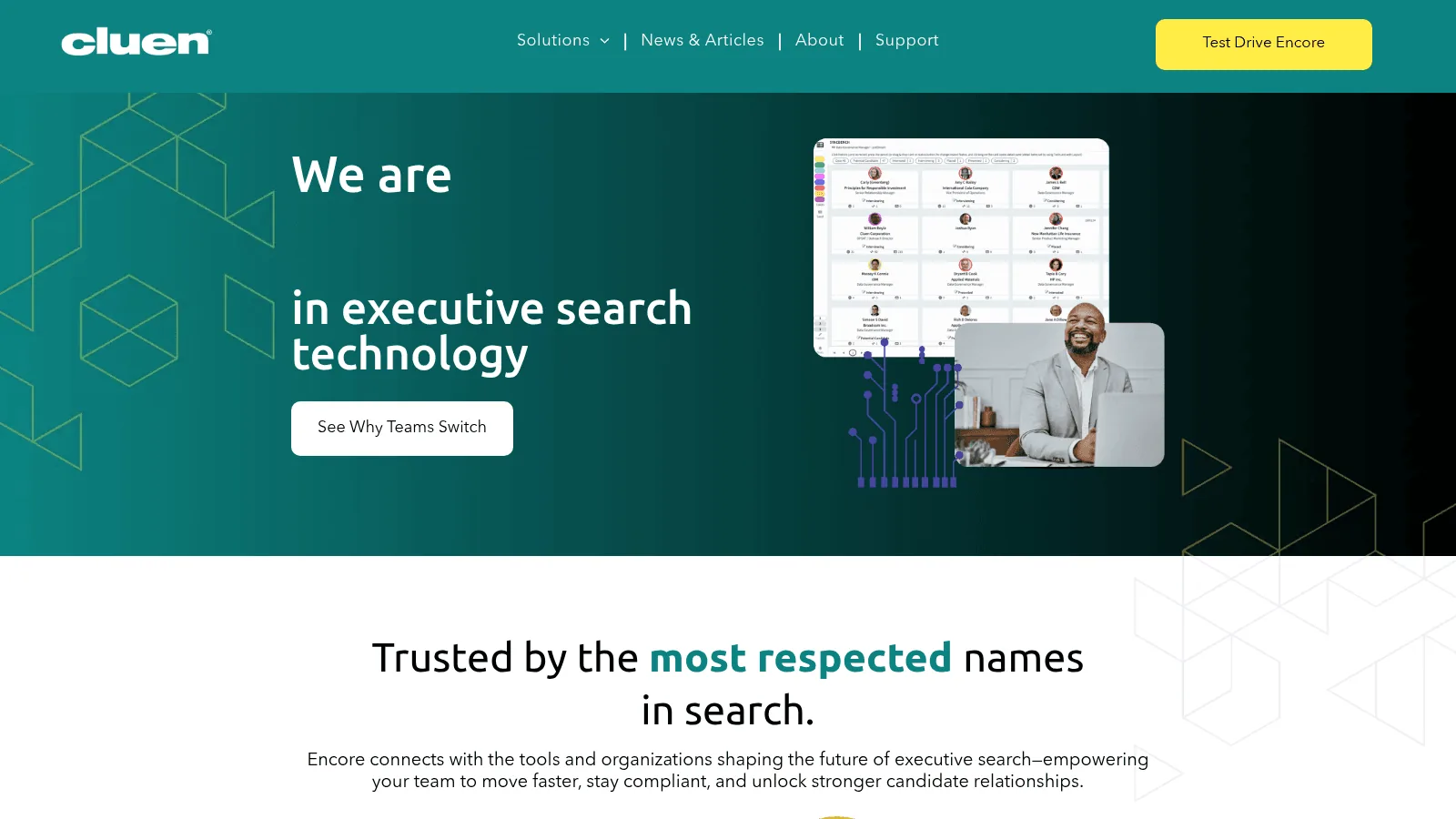
Overview: Cluen's Encore is a browser-based search CRM for search firms, in-house search teams and legal recruiters. Its DoubleTime technology lets teams on different continents work the same search at once.
Key features:
- Engagement tracking that shows when a candidate goes cold.
- Relationship intelligence that surfaces past touchpoints and warm introductions.
- Consent tracking, audit trails and a candidate survey powered by Searchlight.
- Searchlight 360, a client portal that shows clients selected search updates.
Pricing: No price is published: the "Test Drive" button books a demo.
Pros: Warm-introduction history, consent records, built for legal recruiting too
Cons: No published price, MCP only by request, no self-serve trial
Where it stands out: It shows who already knows a target executive.
Final verdict: Worth a look for multi-office firms.
8. Stardex
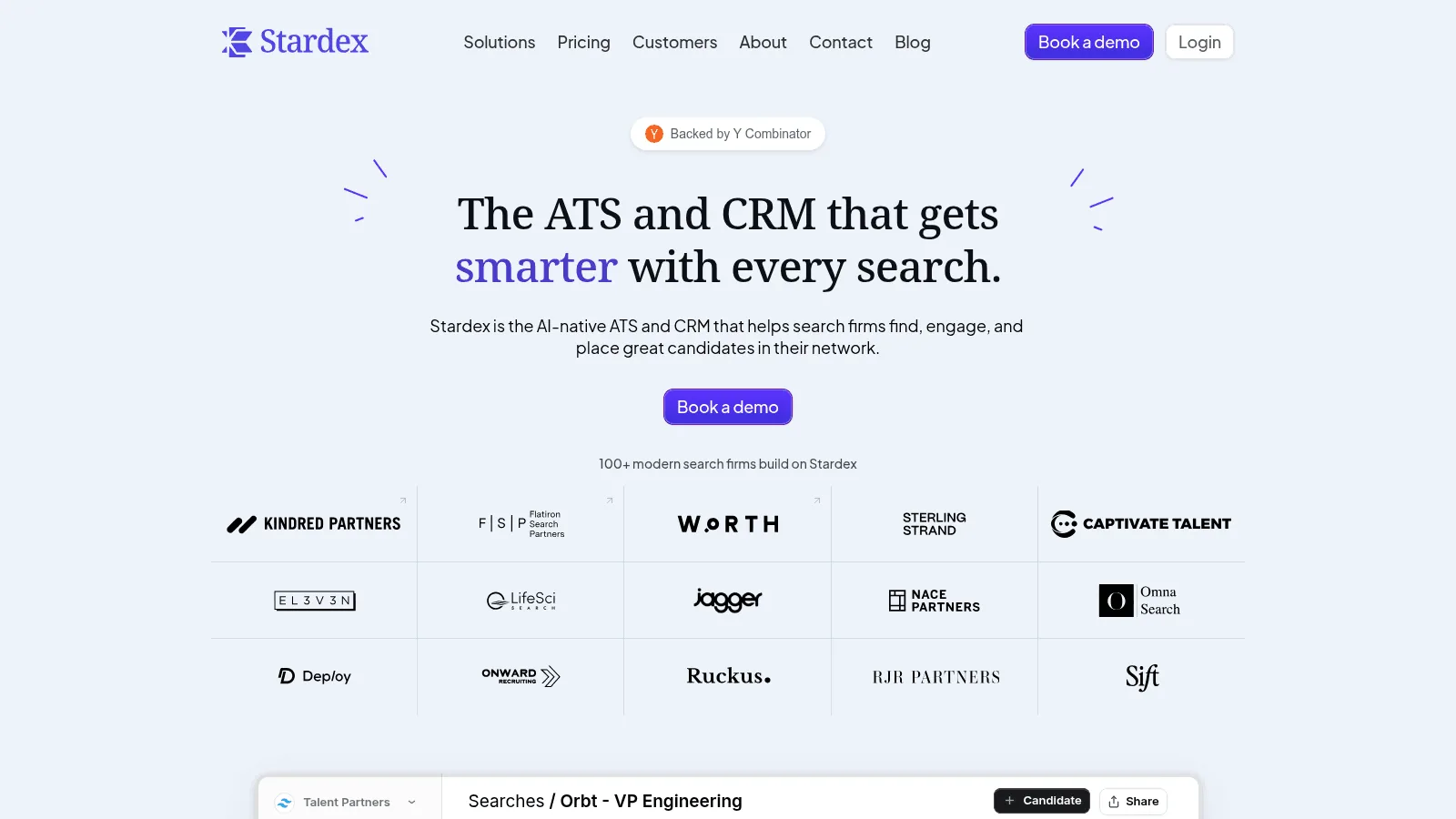
Overview: Stardex is a Y Combinator-backed search CRM whose executive search page lists "pipelines, fee tracking, and outreach tools" for retained search.
Key features:
- One-click client portals on Starter.
- Company enrichment, org charts, an AI contact finder and field updates from call transcripts.
- A native MCP server, plus multichannel sequences and webhooks on Pro.
Pricing: Starter is $79 and Pro $119 per user a month on the yearly toggle, and Copilot is custom. There's no trial, but the first two weeks are fully refundable.
Pros: Published prices, fee tracking for retainers, API access and data exports on every plan
Cons: Sequences and webhooks only on Pro, Copilot priced on request, a refund window instead of a trial
Best use: Boutiques that want portals and fee tracking fast.
Final verdict: A strong pick if retainer tracking is your gap.
9. Loxo
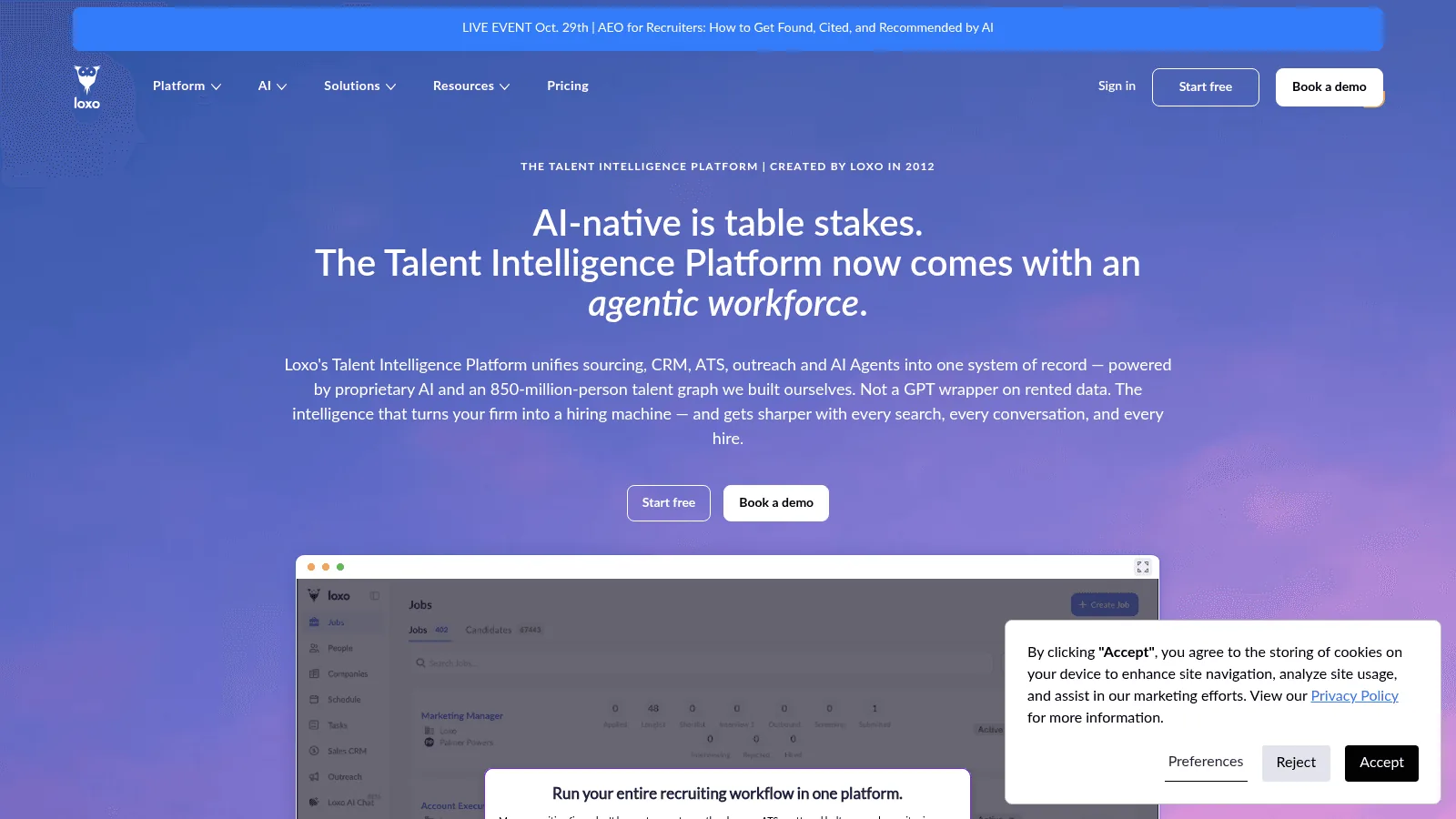
Overview: Loxo's executive search page promises target lists in days rather than weeks to months and instant market mapping, then one-click contact details, a pipeline and outreach in one product. It claims "personal contact info for over 800 million professionals".
Key features:
- A Hiring Manager Portal and an AI Notetaker for interviews.
- MCP included from the Core plan.
- 2,500 credits per seat a month and API access on Professional.
Pricing: Core "starts at $149 per user / month, billed annually". Professional is priced by demo and Enterprise is custom.
Pros: A published entry price, MCP from the first tier, research to outreach in one tool
Cons: Core billed annually and paid up front, credits and API only from the demo-priced Professional tier up
Why it earns a place here: It folds the contact step into the CRM, from Professional up.
Final verdict: Good if you want one vendor from target list to first message.
10. Crelate
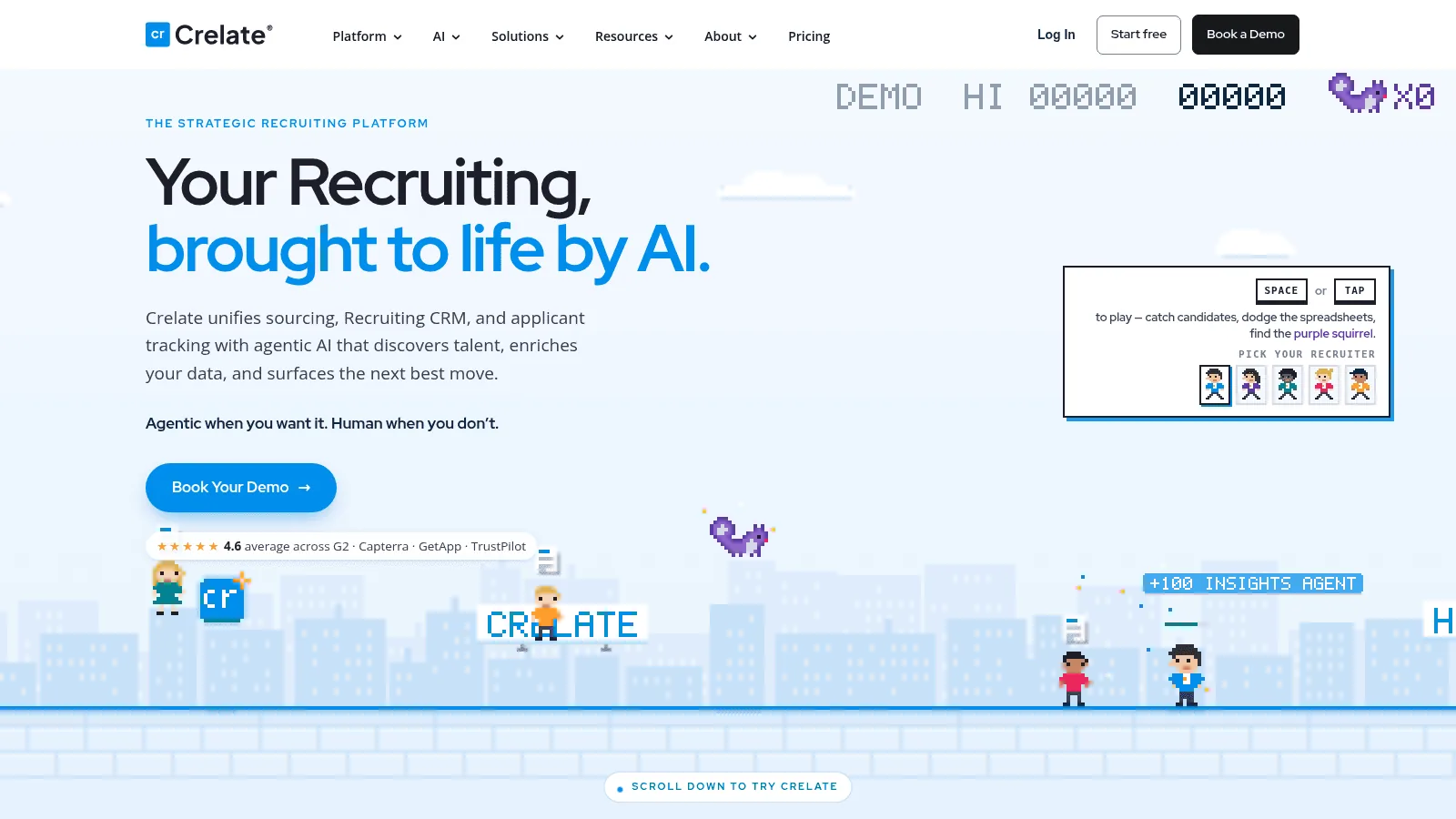
Overview: Crelate lists "Executive Search Firms" and "In-House Executive Search" among its solutions, though it leans toward staffing.
Key features:
- Client portals for 10 users on Business, and 100 with your own branding on Business Plus.
- A Discover Agent for finding new talent, plus outreach and sequences.
- An MCP server, which its homepage places on Business Plus and its pricing page sells as an add-on.
Pricing: Essentials is $85 per user a month paid annually, for up to 2 users and 20,000 contacts. Business is $119 per user a month, annual or monthly, and higher tiers are custom. A free trial starts without talking to sales.
Pros: Published prices, a monthly option on Business, branded portals on Business Plus
Cons: Email campaigns and contact enrichment cost extra, MCP outside the published tiers, built mainly for staffing
What it does well: Agency and in-house search in one product.
Final verdict: Sensible for firms running staffing and executive search together.
11. MapX AI
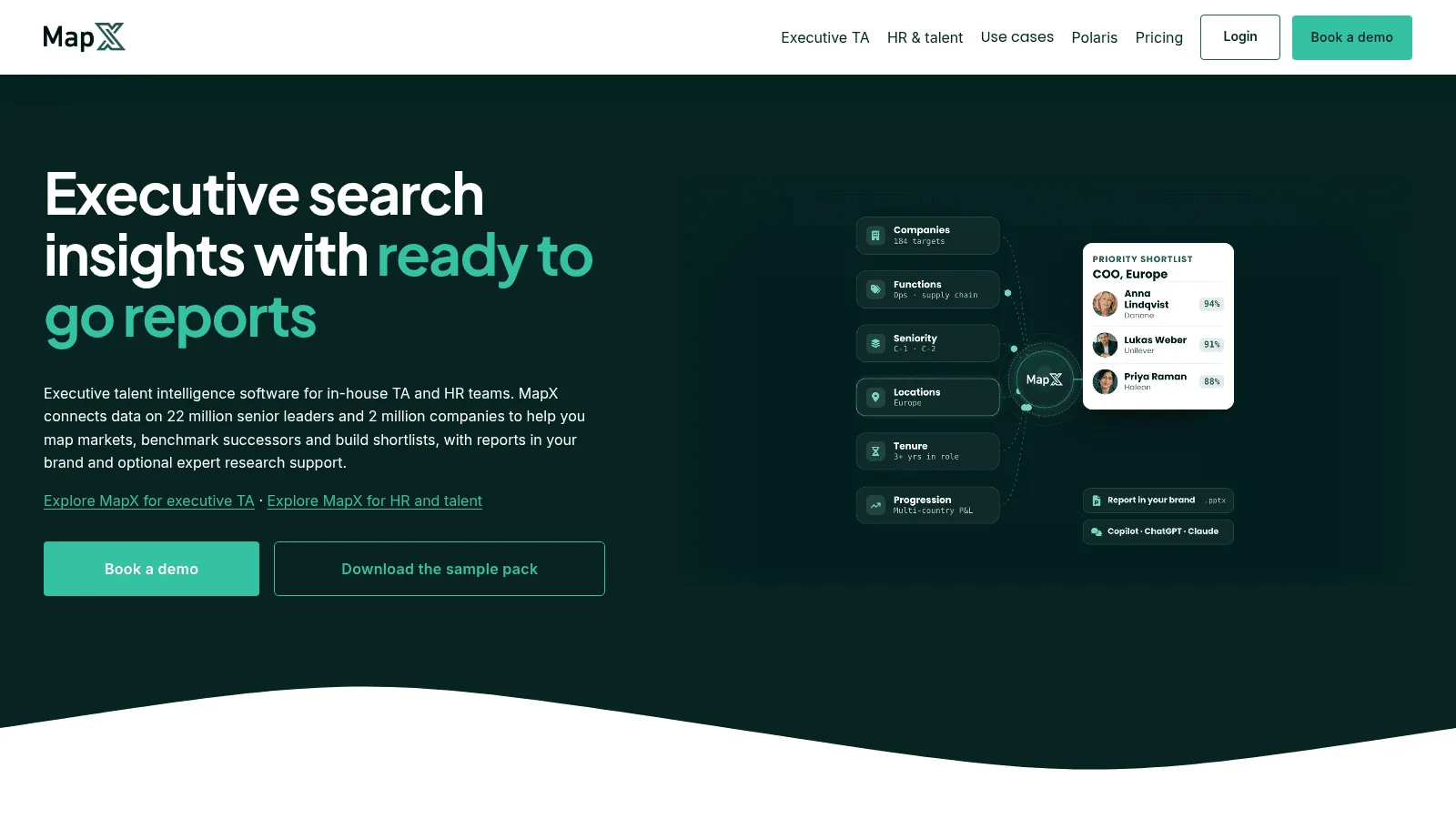
Overview: MapX AI builds target company lists, market maps and ranked shortlists with reasons. Built inside Savannah Group, now part of 6 Group, it aims at in-house talent teams.
Key features:
- MapX's count of 22 million senior leaders across 2 million companies, in 16 functions and 7 seniority levels.
- Org charts and shortlist packs in your branding.
- Access from Copilot, ChatGPT and Claude, plus optional 6 Group researchers who screen candidates.
Pricing: MapX quotes an annual license sized to your team, plus optional research credits, with no per-search fees. It offers a 45-minute demo on a live role and a free sample pack.
Pros: Market maps without a staff researcher, fine-grained seniority levels, human help on call
Cons: No list price, no self-serve trial, no CRM
Who it suits: Teams that would otherwise pay a research firm.
Final verdict: Best for corporate teams running their own senior searches.
12. HelloSky
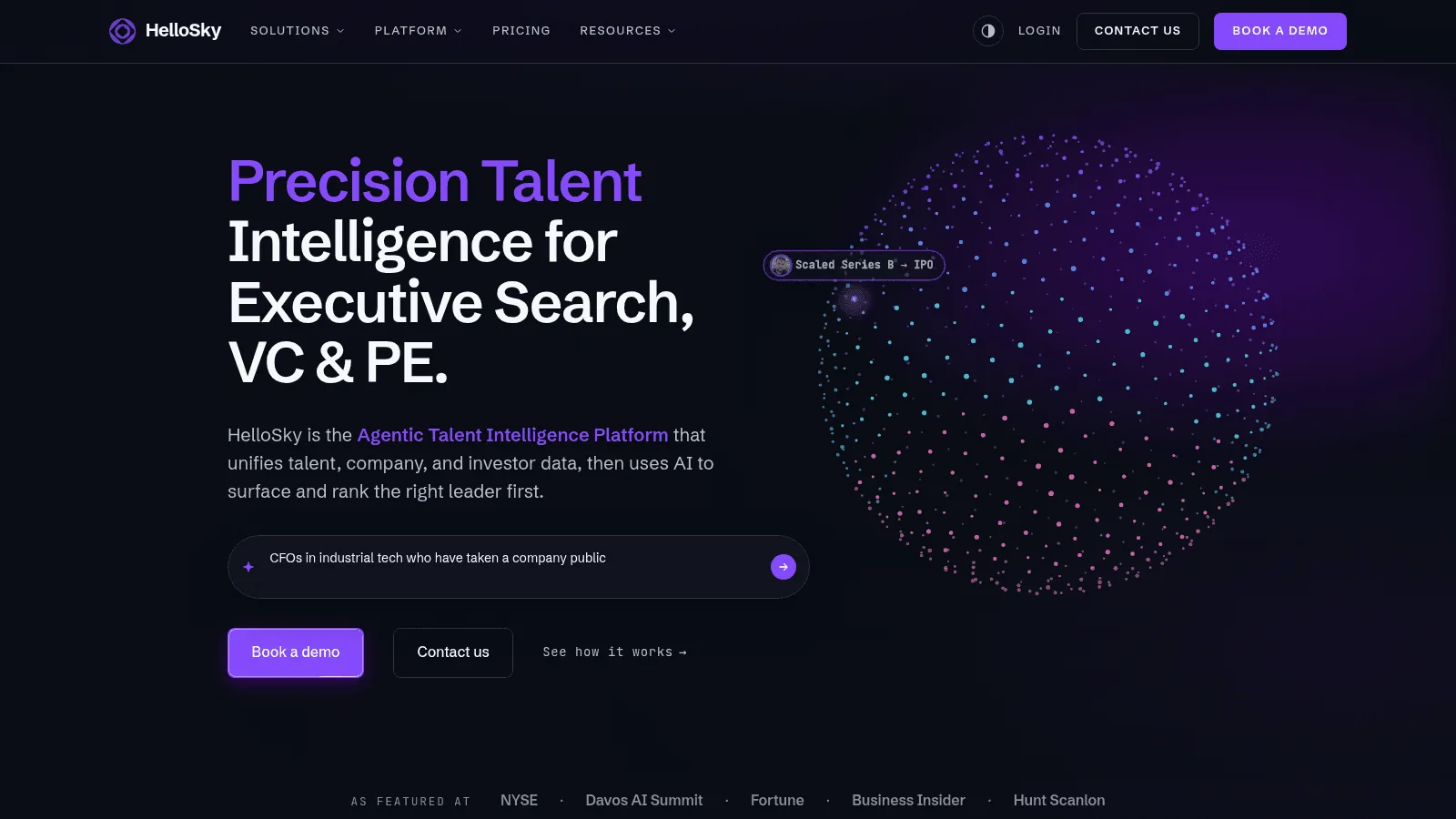
Overview: HelloSky is an AI research tool that claims 100M+ executive profiles. Its SmartRank scores candidates against your scorecard and shows the evidence behind each score.
Key features:
- Venture capital and private equity (PE) filters for portfolio-company searches.
- Verified contact data, AI Compose drafts sent from Gmail or Outlook, and email sequencing.
- CRM integrations including Thrive, Invenias, Ezekia, Loxo and Clockwork.
Pricing: HelloSky's FAQ says it doesn't list prices. Seats are sold on an annual agreement after a 30-minute walkthrough, and instead of a free trial it runs scoped pilots whose fee counts toward your first year.
Pros: Beacon agents in every seat, evidence behind each score, named CRM integrations
Cons: No published price, a paid pilot instead of a trial, MCP sold as an add-on
What it adds: A scored long list lands straight in your CRM.
Final verdict: A good research layer if you run one of its connected CRMs.
13. BoardEx
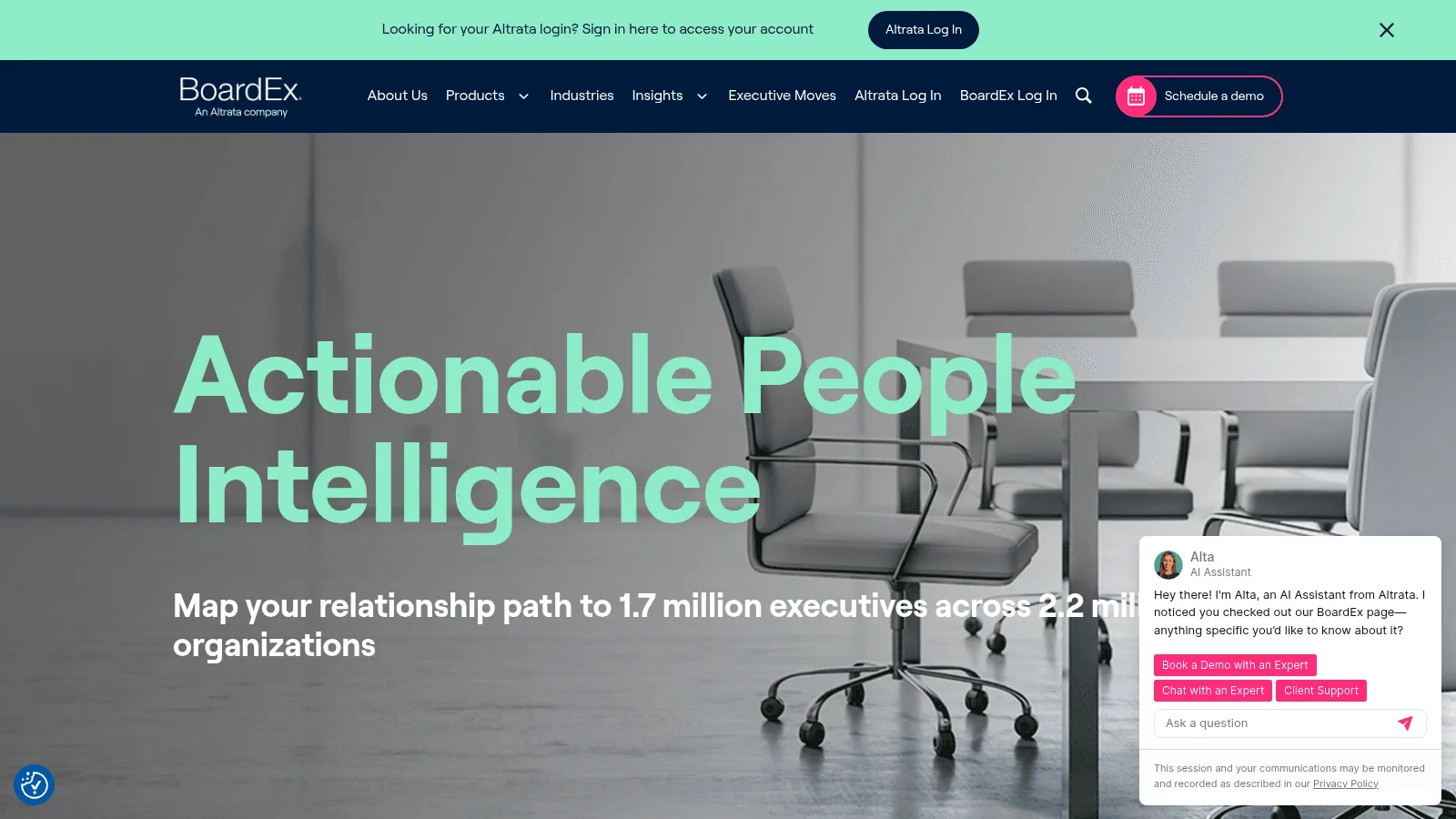
Overview: BoardEx, part of Altrata, puts its data at 1.7M executive profiles and 2.2M company profiles.
Key features:
- Relationship paths that show who can introduce you to a target executive.
- Profiles that its executive search page says analysts research and maintain.
- A Salesforce app, a developer API and data feeds.
Pricing: BoardEx publishes no price and starts with a demo.
Pros: Warm paths to board-level people, analyst-researched profiles, API and feeds
Cons: No trial stated, no published price, sold for business development and fundraising as much as search
Best fit: Board searches, where who sits with whom matters most.
Final verdict: Worth it when a warm introduction decides the call.
14. The Org
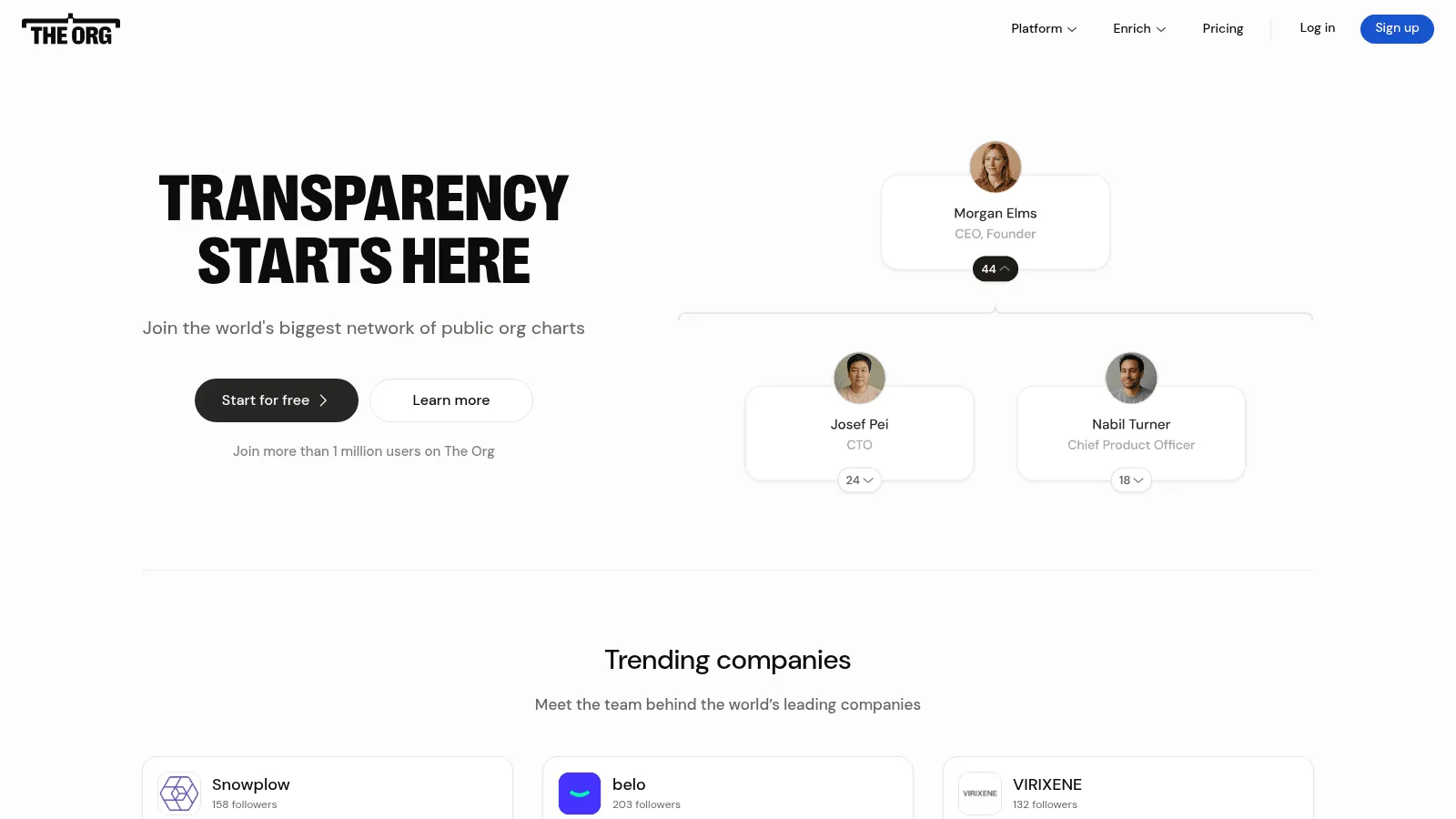
Overview: The Org publishes public org charts, listing 850,000 organizations and 51 million positions, and names recruiting as a use case.
Key features:
- Reporting lines above and below a target executive.
- CSV and CRM export plus team collaboration on Premium, up to 10 seats.
- Access through the platform, an API or a data license.
Pricing: The free plan gives limited org views and 10 credits a month. Basic, with unlimited org views, is $232 and Premium $392, each a year per seat.
Pros: A free plan, the lowest published seat price here, reporting lines at a glance
Cons: No stated value per credit, export only on Premium and up, Premium stops at 10 seats
What it's good at: Showing the team around a target before your first call.
Final verdict: A low-cost first step for market mapping.
15. LinkedIn Recruiter
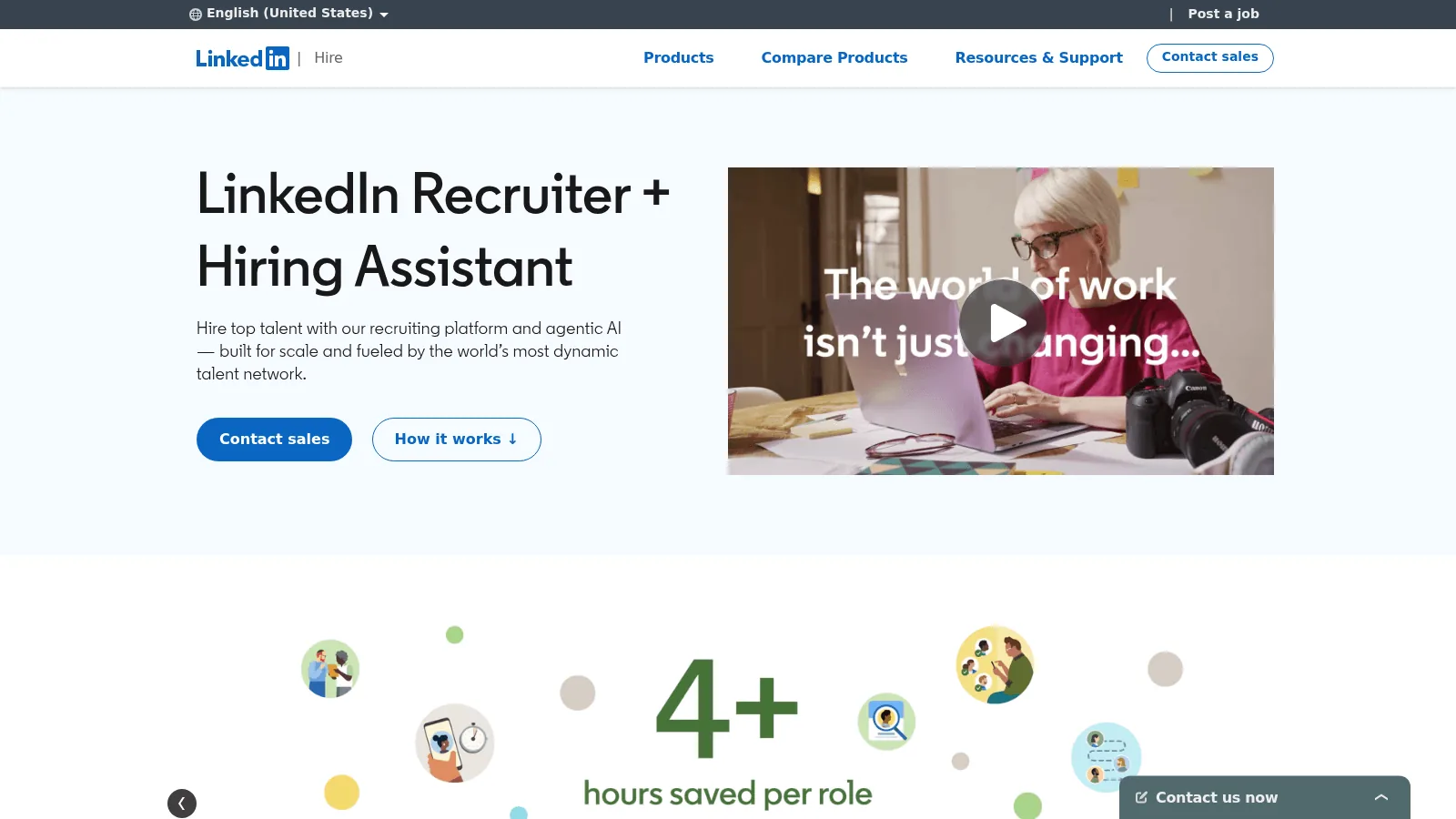
Overview: LinkedIn Recruiter is where many executive researchers start a long list, since senior people keep profiles there. LinkedIn puts its membership at more than 1 billion.
Key features:
- Search across that membership from a Recruiter seat.
- Profiles that members write and update themselves.
- Hiring Assistant, an AI agent sold as an add-on.
Pricing: LinkedIn says pricing varies with your organization's needs, such as company size and the number of Recruiter seats.
Pros: A network most candidates already use, member-written profiles, an optional AI agent
Cons: No published price, no trial for Recruiter itself, Hiring Assistant costs extra
Why it's still on the list: It's the baseline many researchers already know.
Final verdict: Keep it as the reference point and buy others for its gaps.
16. RocketReach
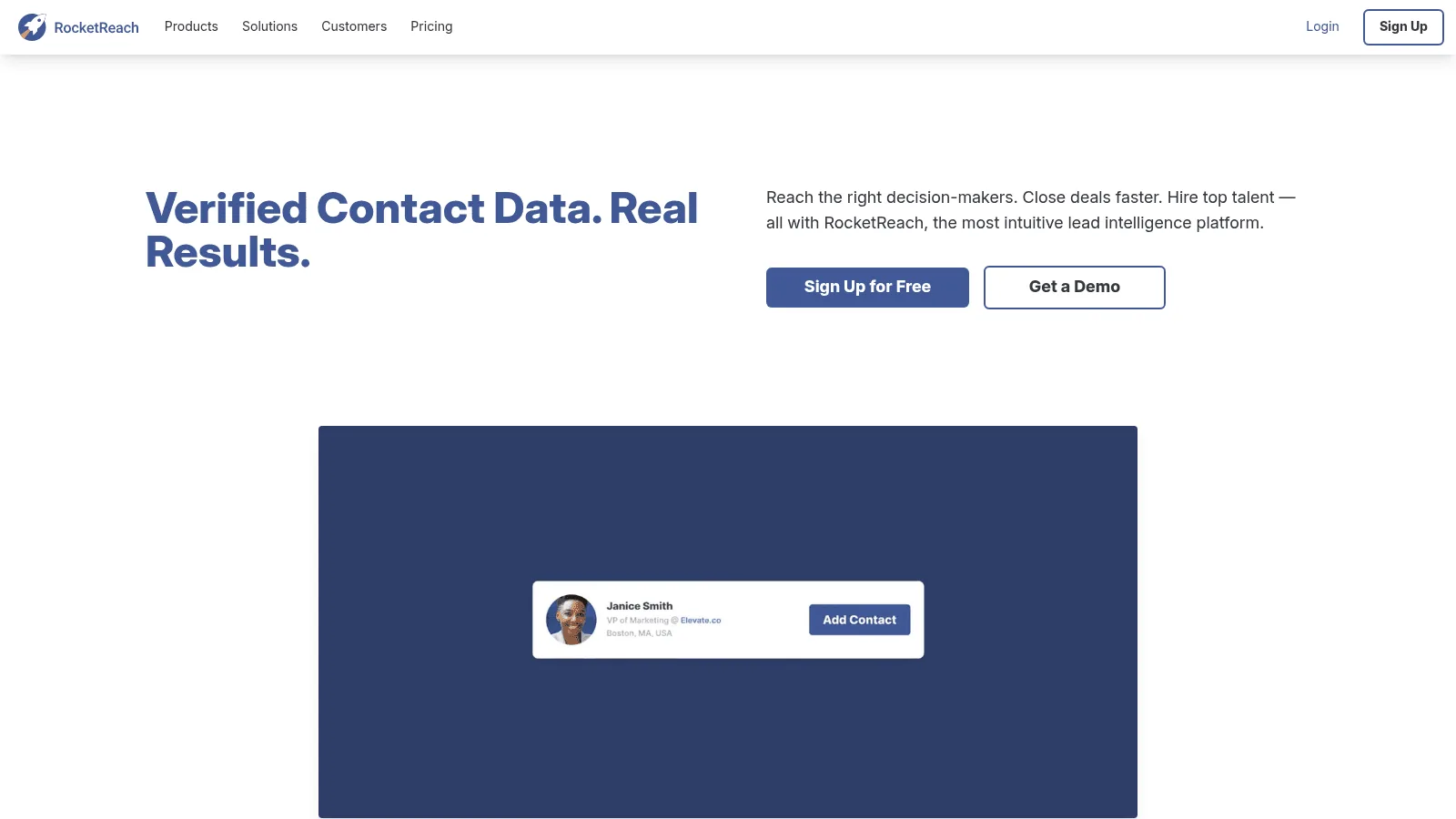
Overview: RocketReach sells email and phone lookups by the seat, and its homepage puts "Hire top talent" beside its sales uses. For a passive executive, check the plan: Essentials is email only.
Key features:
- A Bullhorn connection from Pro.
- MCP and API access on paid plans.
- A lookup refunded when no email or phone is found and verified.
Pricing: On RocketReach's US pricing page, billed annually per seat, Essentials is $33, Pro $75 and Ultimate $142 a month. Monthly billing costs $69, $119 and $209, and the free plan gives 5 lookups.
Pros: Prices for both billing terms, a Bullhorn link, no charge on a miss
Cons: Monthly plans cap lookups at 100 to 1,000 a month, annual plans cap exports
When to reach for it: A quick phone and email for one named executive.
Final verdict: A practical add-on beside your search CRM.
17. Lusha
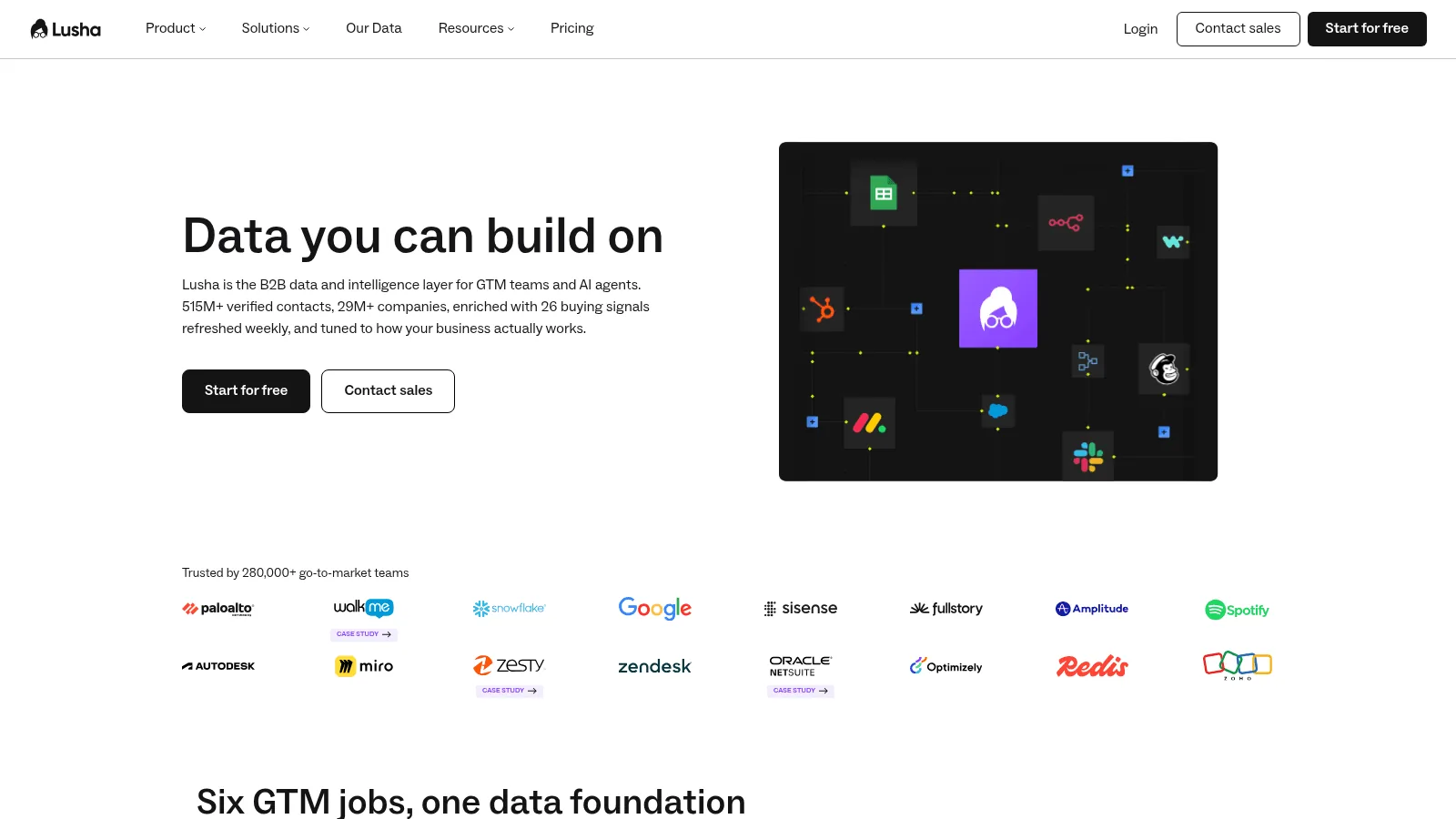
Overview: Lusha's recruiter page pairs contact data with "timing signals", such as time in role or a new manager, that hint an executive might take your call.
Key features:
- Filters by role, skills, seniority and location.
- Email at 1 credit and phone at 5 credits.
- A Chrome extension, credit limits per recruiter and an MCP server.
Pricing: Lusha's free plan carries 40 credits a month, and Starter costs $37.45 a month billed yearly for 4,800 credits a year. Pro, at $52.45 a month billed yearly, adds a second seat and the API.
Pros: A free plan, timing signals, spend caps for each recruiter
Cons: Annual credits don't roll over, a phone costs five times an email, one seat on Starter
What sets it apart: It tells you when an approach is worth making.
Final verdict: Useful when you need a contact and a reason to call now.
18. Metaview
Overview: Metaview is an AI notetaker for interviews. For a search firm, those interviews become material for the shortlist and client report.
Key features:
- Notes and scorecards written for you after each interview.
- An audit trail, so you can check where a summary came from.
- Interviews and searches stored as data you can query later.
Pricing: Interview notes are priced on their own: Free covers 25 calls a month and Pro is $60 per user a month. The sourcing tab is free for the first 100 profiles, with Pro at $100 a user a month and Max at $300.
Pros: A free tier, traceable summaries, works beside your existing CRM
Cons: Notes, sourcing and application review priced separately, sourcing tiers counted in profiles, no pipeline of its own
Why it belongs here: Most CRMs above leave interview notes to a partner tool or to you.
Final verdict: Add it once shortlists move faster than your write-ups.
How We Chose These Tools
We started from the vendor-written lists ranking in search results and kept tools that serve a clear step of a senior search. Staffing back-office tools, research sold as a service and ATSs that say they lack executive search features stayed out.
Where a vendor's own pages disagreed on a price, we said so.
What to Look For in an Executive Search Platform
Most of the executive search solutions here carry an AI badge, so check these three things instead.
What Search CRMs Really Differ On
Ask each vendor to show these on a live search:
- An off-limits flag on people at clients you've agreed not to recruit from.
- Confidential searches, with the client portal hiding who you've approached.
- Consent records for European candidates, with the date and the notice sent.
- Retainer and fee tracking per search, and a link to your accounting software.
The last one trips firms up. In a Reddit thread, a recruiting firm that had moved into executive search said its recruiting CRM, which markets itself to executive recruiters, had no way to show a retainer fee and no integration with its accounting tool, so invoicing was drifting into spreadsheets.
A commenter said a retainer can be shown with configuration, which the poster called a workaround, so make each vendor show you.
Recruiting-software teams on our calls have described another fee safeguard: client-ready resumes with the phone and email hidden, so the client can't hire around you.
Contact Data for Passive Senior Candidates
Senior people rarely publish a direct line, so check what each tool returns for a Director-level name and what a miss costs. Phone pricing varies: RocketReach puts phones on Pro, Lusha charges 5 credits and Reverse Contact 20 per lookup that finds one. A credit costs a different amount at each vendor, so compare cost per found contact, which differs a lot across email finder tools.
Test Research Data on Companies You've Mapped
Senior searches often turn on history, not the current title. A product leader at a company-intelligence platform told us: "we've got some recruiters who are trying to find CFOs who have, you know, taken their businesses through PE buyouts." So check whether a tool searches current roles, past roles or both.
Seniority labels vary too. Buyers tell us "C-suite" at a small company can include VPs, so check raw titles, not just a vendor's seniority buckets.
The simplest test is to pull 100 to 500 profiles from each tool and check whether those people still hold the same employer and title. Run it on companies you've mapped by hand.
What Executive Search Software Costs
Executive search solutions here are priced per seat, per credit or by quote. Nine of the other 17 tools publish a figure, and Reverse Contact does too.
Published entry prices for search CRMs run from $79 per user a month at Stardex to $149 at Loxo and Clockwork (Clockwork's own pages disagree), all on yearly billing. Invenias, Thrive TRM and Cluen Encore start with a demo, and Ezekia shows no figure.
Budget for the stack, not one tool. A two-partner firm pays per user for the CRM and per lookup for contact data, so model a month with your real number of searches.
Executive Search Tools vs Executive Search Firms
Executive search tools help you run a search, while a firm runs it for you.
Korn Ferry's FY2026 annual report (10-K) says its executive and professional search fees are "generally one-third of the estimated first-year cash compensation of the placed candidate", plus a share for expenses. On $450,000 of estimated first-year cash pay, that's about $150,000 before expenses, plus an extra fee if the actual pay comes in higher.
If you're comparing the best executive search companies, the same filing names Egon Zehnder, Heidrick & Struggles, Russell Reynolds Associates and Spencer Stuart as its traditional competitors, and warns that AI-enabled companies and LinkedIn, among others, may cause "disruption in the executive search industry".
The industry's professional body says in its AESC Candidate Bill of Rights that members hold "an exclusive agreement for each assignment" and protect candidate confidentiality, in what it calls "an unregulated profession".
Hire executive search services for a CEO replacement, a board seat or a role you fill once a decade. Buy an executive search system when you run several senior searches a year.
Choosing Executive Recruiting Tools by Team Type
A one- or two-person boutique needs an executive search system with a published price, such as Stardex or Crelate (or Ezekia, if a free month beats a list price), plus RocketReach or Lusha when phones matter.
A mid-size retained firm should weigh off-limits handling, consent and multi-office work, which points to Thrive TRM, Cluen Encore, Invenias or Clockwork, with BoardEx for board work.
An in-house executive search team often lacks a researcher, a gap MapX AI or HelloSky fills, with The Org for org charts.
A recruiting-tech company building its own product needs data it can call from code, and people data APIs differ a lot on fields and price.
Start With the Step That Costs You the Most Time
Pick the step where your team loses the most hours on each search. For many firms that's research and contact details, still done by hand, so test executive recruiting tools there first, on a live search.
If the gap is current roles for a long list you've already built, person enrichment returns them from a name and company.
To see how our data holds up, try it on your records with free trial credits.
FAQs
What are executive search tools?
Executive search tools are software for finding, tracking and presenting senior candidates who aren't job hunting. They cover steps from research to interviews, and many firms combine two or three.
What is the best executive search software for a small firm?
Start with a search CRM that publishes its price and has a client portal, such as Stardex or Crelate, then add a data tool once you see where your hours go.
Do I need a separate tool for contact details?
Often, yes. Five of the nine search CRMs here list no contact finder, so contact details come from recruiting contact tools or a data API.
How much do the best executive search companies charge?
Among top executive search companies, Korn Ferry publishes a figure: its annual report says search fee revenue is generally one-third of the placed candidate's estimated first-year cash pay, plus a percentage of the fee for indirect expenses. Get any firm's terms for executive search services in writing.
Can I build my own executive search platform?
Yes, if you have engineers. Pair a CRM or your own database with a people-data API for profiles and contacts, then run the 100 to 500 profile test above before you commit.
The data layer behind your GTM engine
Access fresh people and company data through one API and power every enrichment, prospecting, and automation workflow.
- Profiles
- 800M+
- Refreshes / month
- 200M
- Response time (P95)
- 500ms