
10 Best Firmographic Data Providers, Compared (2026)
Julien K.Published
Key takeaways:
- Most providers claim the same core fields, so compare the extras (revenue, funding, tech stack, hierarchy) and the delivery model. ZoomInfo, SalesIntel and Cognism are built around an app for reps, while Reverse Contact, Coresignal, Veridion and Dun & Bradstreet's Direct+ are built around API calls.
- Reverse Contact (ours) is built for company data that feeds code or an AI agent: describe the companies you want in a sentence or set filters, count filtered matches for free, and check a record's age before paying to refresh it.
- Young businesses close often. Bureau of Labor Statistics data shows roughly one in five US establishments opened in the 12 months to March 2025 had closed a year later, so check refresh dates most closely on your youngest accounts.
- Before you sign, send 200 of your own accounts to two or three vendors and score every field you plan to filter on.
Firmographic data providers sell the company-level facts behind your targeting: what a business does, how big it is, where it operates, how much it earns and who owns it. Most vendors claim most of those fields; far fewer publish which ones they return and how often each is refreshed.
This guide compares the best B2B firmographic data providers field by field. You'll see each provider's strongest fields and main gap, how each one delivers its data, and a test you can run on your own accounts before you sign. Reverse Contact is ours, and it's listed first for that reason.
What Firmographic Data Providers Actually Sell
Firmographics are to companies what demographics are to people. The core set is industry, employee count, revenue and location, and most vendors now add founding year, funding, the technologies a company uses, and its place in a corporate family (parent, subsidiary, branch).
What you're buying is three things at once: the fields, how complete they are for your kind of account, and the way they reach you. A rep researching a single company needs a profile on screen. A product team scoring signups needs the same fields as JSON, thousands of times a day. Those are different products, even when the vendor's homepage lists the same fields.
The 10 Best Firmographic Data Providers
After our own entry, the other nine are grouped by what you're buying rather than scored: two enterprise firmographic data providers built on large reference databases (ZoomInfo, Dun & Bradstreet), then four that sell company data by API or file (Coresignal, Data Axle, Techsalerator, Veridion), then three tools built around one strength (HG Insights on technographics, SalesIntel on re-verified firmographics, Cognism on contacts with company data attached).
Position inside a group isn't a ranking. This firmographic data providers comparison uses each vendor's own pages, read on November 2, 2026. "Not stated" or "not listed" means we couldn't find the field on the vendor's public pages, which isn't the same as the vendor lacking it.
| Provider | Best for | Strongest fields | Main gap | Free way to test | Price (from) |
|---|---|---|---|---|---|
| Reverse Contact | Company data that feeds code or an agent | Identity, industry, headcount and size bracket, headquarters plus listed offices, founded year, specialties | No revenue or funding; tech stack and growth not in our published API schema | Trial credits, no card; free match counts and refresh-date checks | Packs from $100; team plans from $249 a month; Platform, custom |
| ZoomInfo | Enterprise RevOps on one contract | Revenue, funding, technographics, 1- and 2-year growth, SIC, NAICS, parent IDs | No platform list price; hierarchy and funding on higher tiers | Free Lite plan; GTM.AI starter credits | Quote; GTM.AI from $20 pay-as-you-go |
| Dun & Bradstreet | Corporate hierarchy at enterprise scale | Family trees keyed to the D-U-N-S Number, Company Financials block | No public API price; Direct+ field docs behind a login | Hoovers Essentials, first month free | Data Blocks quote; Hoovers $49 a month |
| Coresignal | Wide company records by API | Revenue, funding rounds, headcount trends and tech stack in one 500+ field record | 20 credits per full record | 7-day trial, 2,000 credits | $49 a month |
| Data Axle | US and Canadian small businesses | Corporate sales revenue, SIC, NAICS, corporate-family links | Centered on two countries; no published price | Sales call first | Quote; Scan API billed by records requested |
| Techsalerator | Revenue history across many countries | Revenue plus two prior years, funding events with investors, technographics | No published API price; headcount trend not listed | Paid samples | Quote; Data Shop samples from $100 |
| Veridion | Matching and classifying company records | NAICS 2022 codes, revenue and headcount with yearly change | No public price; contacts come from elsewhere | Sales call first | Quote; three packages |
| HG Insights | Technographics and IT spend | Verified tech installs, IT spend, hierarchies, revenue | No trial; modules from $22,000 | None | Quote; modules from $22,000 per its launch release |
| SalesIntel | Reps wanting human-checked company fields | Revenue, SIC, NAICS, subsidiaries, re-verified every 90 days | No public price | Free trial | Quote |
| Cognism | Contact-led teams needing company context | Revenue and headcount (90% coverage claim for 50+ staff), SIC, NAICS, ISIC, technographics | Coverage claim covers only 50+ staff; hierarchy not stated | Sales call first | Quote; Standard and Pro packages |
If revenue or tech stack is a hard filter, start with the providers that list it among their strongest fields. If code will call the data, compare what you can check for free and what each record costs.
1. Reverse Contact
Best for: Company data that feeds code.
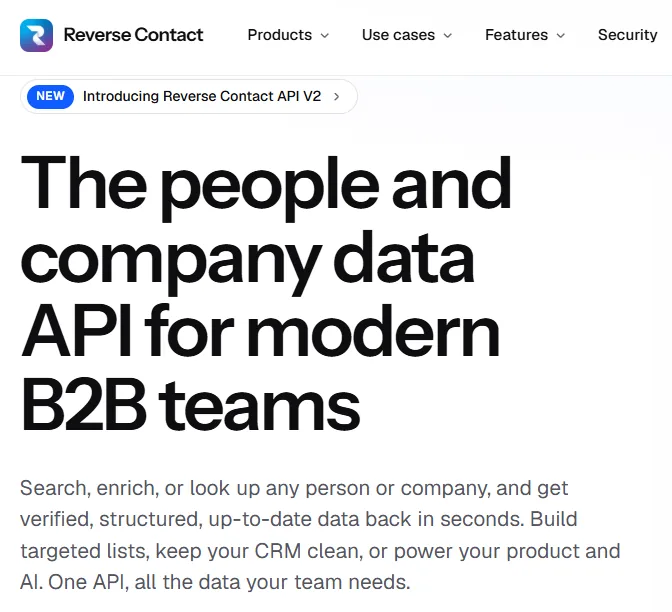
Overview: Reverse Contact is a company and people data API (an interface your software calls directly). Send a company domain, an ID, a set of filters or a plain-English description, and you get back structured company records. We list 70M+ company profiles across about 200 countries.
Each record covers who a company is and how it's built: name, website, industry from a closed list of 490 values, description, specialties, employee count plus a fixed size bracket, headquarters, every listed office, founded year, phone and logo. Enriched records carry the date they were last refreshed.
You can also ask for companies in a sentence, such as "fintech scale-ups in Berlin, 200 to 500 people", and our agentic company search returns the filters it read and flags any it couldn't apply, revenue among them.
Zuora shows why identity comes first. Its data team uses our company and people enrichment to help match records across its CRM, billing and product systems to the same customer, moving toward one trusted profile per customer.
Key features:
- Domain-to-company enrichment, so a signup's email domain turns into a full company record.
- Company search by industry, specialties, headcount, founded year and headquarters location, with a free count of matches before you spend a credit.
- A free check of each record's last refresh date (your workspace needs at least 2 credits), plus a search filter on record age.
- People search filtered by current company, so the contacts at your best-fit accounts come from the same API and credit balance.
- Lists that import up to 25,000 domains, skip companies already listed, stop at a credit budget you set and export as CSV.
- The same record shape by API, webhooks, our MCP server (for AI agents), CLI or SDK, plus company steps in Clay, Zapier and Make.
Pricing: Credit packs start at $100, with no commitment, and last three months from purchase. A company from a filtered search costs 1 credit, a plain-English search adds 1 credit per request, and a domain enrichment costs 2. A filtered search that finds no company costs nothing.
Go costs $249 a month for unlimited fetches of stored records by ID, Plus $449 adds unlimited search, and Max $699 adds unlimited enrichment from a domain, email or name, with unlimited use capped at 100,000 profiles per workspace a day.
Three things still cost credits on every plan: a live refresh (2), a business email (3 per email found) and a phone (20 when a lookup finds one). Plans cover your own team's use; data your customers see, or that you resell, needs a Platform contract quoted by sales.
Pros: Published self-serve prices and trial credits with no card, a free match count and a free refresh-date check before you spend, plain-English company search that shows the filters it applied, the people at each account from the same API, company steps in Clay, Zapier and Make
Cons: No revenue figure, funding-round history, technographics, headcount growth or parent-subsidiary links in our published API schema, and industry comes from our own list of 490 values rather than NAICS or SIC codes; company search filters headcount by fixed size brackets, not exact counts
How to start using it:
- Claim trial credits at signup; no card needed.
- Set the filters you already target on and run the free count, or describe your ideal account in a sentence and reuse the filters it returns.
- Enrich a few hundred account domains from your CRM and log which fields come back filled.
- Check refresh dates for free, then refresh live only the records you need current. Live refreshes run in the background: we target under 15 seconds per refresh, and conditions can push that to tens of minutes, so queue them.
- Find the people you sell to at your best-fit accounts with people search, filtered by company.
Why it's a good firmographic data provider: It fits when company data feeds code, an AI agent or a no-code workflow, and when identity, size, industry and location are the fields you filter on. You can size a filtered search for free and test a few hundred records before you talk to anyone.
Final verdict: Choose us when company records feed your product, your pipeline or an agent, and you want to test on your own accounts before you commit. If revenue or funding rounds drive your targeting, pair us with a provider that publishes them, such as Coresignal or ZoomInfo.
2. ZoomInfo
Best for: Enterprise RevOps on one contract.
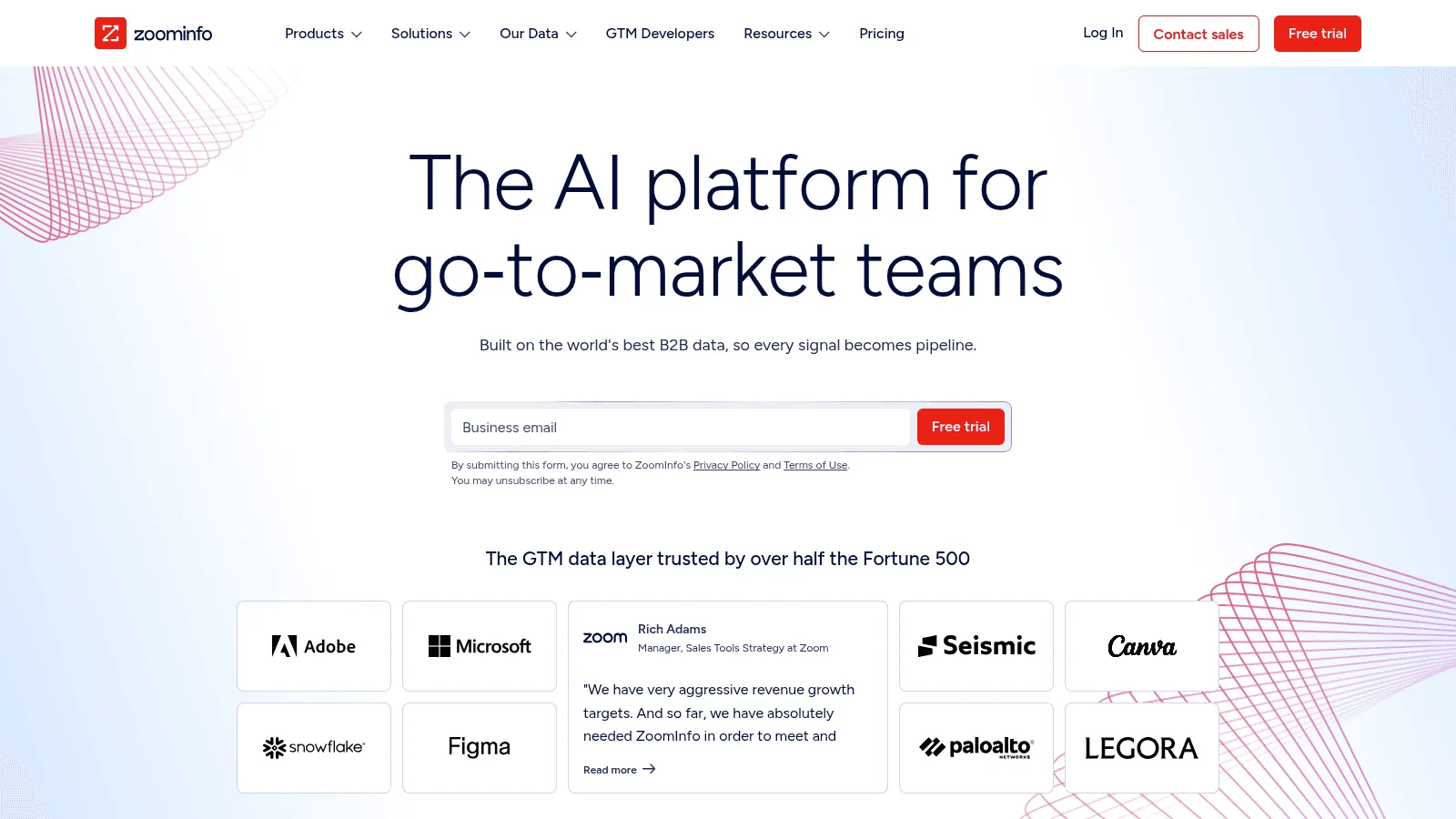
Overview: ZoomInfo publishes every extra field this guide covers: revenue, funding, tech stack, growth, industry codes and hierarchy. Its Company Core product names 80 fields across 100M+ company records, including revenue, employee count, sub-industry, SIC and NAICS codes, and both immediate and ultimate parent IDs.
Key features:
- Funding Signals tracks venture, private equity and debt rounds, linked to company records.
- Technographics across 30K+ products, with a 60-day average refresh cycle for tech-stack data.
- Delivery by app, enterprise API or warehouse share.
Pricing: The sales platform is quote only, and its pricing page shows hierarchy and funding data on higher tiers. ZoomInfo Lite is a permanent free plan, and GTM.AI, its API-only offering, runs pay-as-you-go from $20.
Pros: Revenue, funding and industry codes from one vendor, parent IDs for account rollups, a free plan
Cons: No platform list price, hierarchy and funding gated by tier, license terms that restrict putting the data inside a product you sell
Where it fits: A RevOps team that wants revenue, codes and hierarchy from one contract. Weigh it against ZoomInfo competitors on price before you renew.
Final verdict: A full field set under one contract, if you can live with a quote.
3. Dun & Bradstreet
Best for: Corporate hierarchy at enterprise scale.
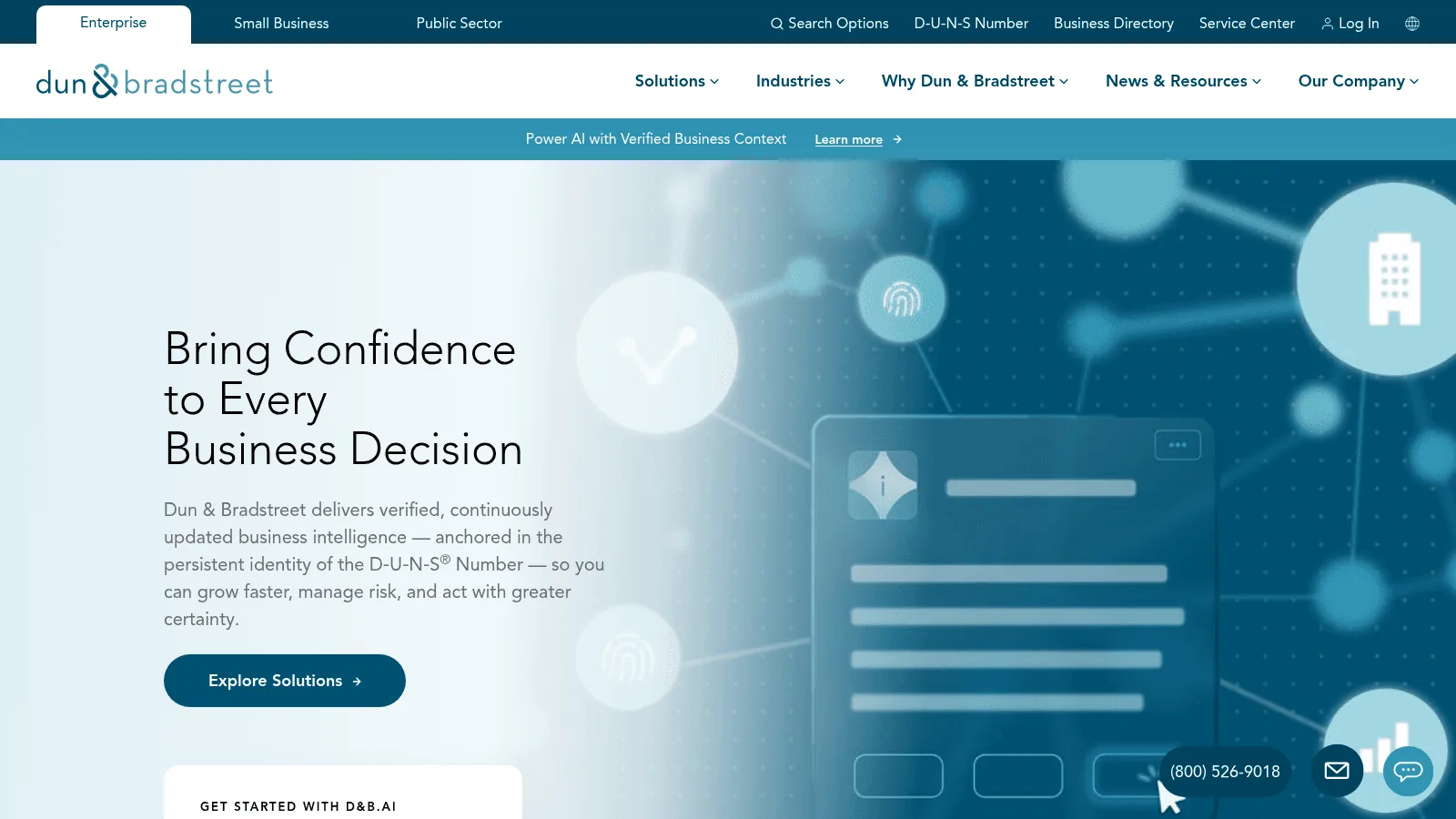
Overview: Dun & Bradstreet sells firmographics as Data Blocks, groups of fields keyed to its D-U-N-S Number. D&B's Data Blocks factsheet (June 2025) puts 100+ elements in the Hierarchies and Connections block alone, for mapping a company's family tree, and 300+ in Company Information.
Key features:
- A Company Financials block with financial statement data for private and public companies.
- Delivery through the Direct+ API, an MCP server, cloud platforms and batch files.
- One identifier that ties branches and subsidiaries to an ultimate parent.
Pricing: Data Blocks and Direct+ are quote only. Hoovers Essentials, its per-user app, runs $49 a month with 150 credits each for companies and contacts, or $529 a year with 1,800 each, with the first month free.
Pros: Family-tree hierarchy, financials for private companies, file and API delivery
Cons: Direct+ field documentation sits behind a login, no technographics on the Data Blocks pages, no public API price
Why it made this list: Its whole data model hangs on corporate families.
Final verdict: Pick it when rolling branches up to a parent matters more than tech stack or hiring signals.
4. Coresignal
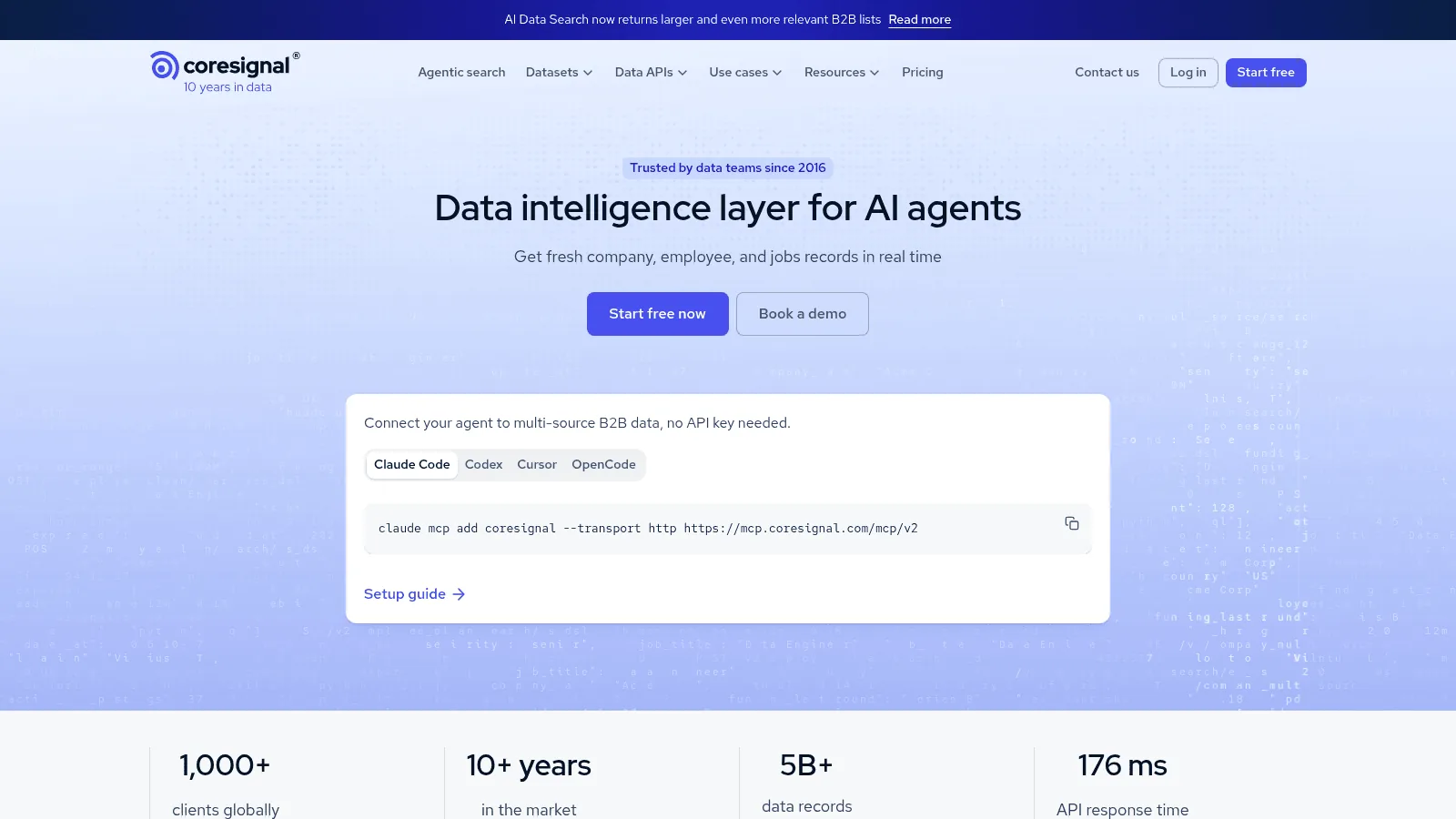
Best for: Wide company records by API.
Overview: Coresignal sells a 500+ field company record by API and as datasets, across 72M+ company records. One record can carry revenue, funding rounds and investors, headcount trends, hiring velocity and tech stack, with 10+ years of history overall. Headcount history is a separate API, up to eight years for 7M+ companies.
Key features:
- Full and core record types, so you pay for depth only when you need it.
- JSON or CSV datasets for loading into a warehouse.
- An MCP server alongside the REST API.
Pricing: Coresignal's entry plan, Mini, charges $49 a month for 2,500 credits, and a full company record costs 20 credits per its pricing page, so Mini covers 125 full records. Plans climb to $5,000 a month, yearly billing saves 10%, and a 7-day trial includes 2,000 credits. Datasets start at $1,000 a month on a yearly contract, with the final price set by agreement.
Pros: Published self-serve prices, revenue, funding and trends in one record, historical depth
Cons: 20 credits per full record adds up at volume, extra credits for each field bundle added to a core record, datasets only on a yearly contract
What it's good at: Growth and funding fields in the same record as size and revenue, which can save you a second vendor.
Final verdict: Revenue, funding and growth fields through an API, at a price you can read.
5. Data Axle
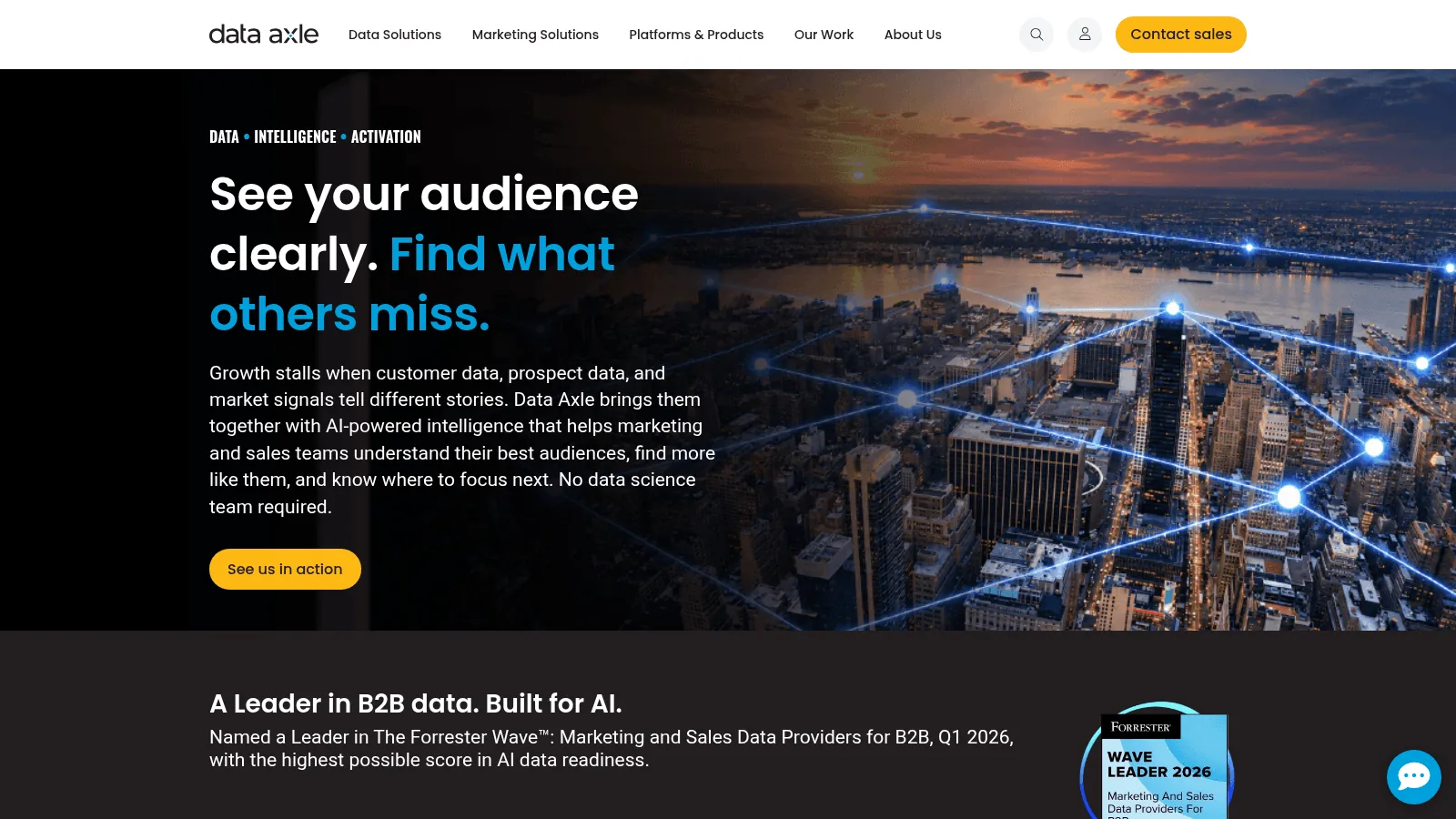
Best for: US and Canadian small businesses.
Overview: Data Axle publishes 90M+ business profiles with 400+ attributes, plus 19.5M+ it labels premium verified. Its business-data page focuses on the US and Canada, including freelancers, contractors and home-based businesses. Its developer attribute list goes further, naming corporate sales revenue, SIC and NAICS codes and corporate-family links.
Key features:
- Search and append by location, industry, employee count and job title.
- Data licensing for building its records into your own products.
- Prebuilt integrations for Salesforce and Microsoft Dynamics, plus APIs.
Pricing: Data Axle publishes no dollar prices; its developer docs describe the Scan API as pay-as-you-go by records requested, and API access needs an account.
Pros: Small-business depth, a licensing route for in-product use, records it labels premium verified
Cons: Coverage centered on two countries, fields documented only in its developer docs, and no price
Its real strength: Local and very small businesses, the segment its own page puts first.
Final verdict: A strong pick for SMB-heavy North American markets.
6. Techsalerator
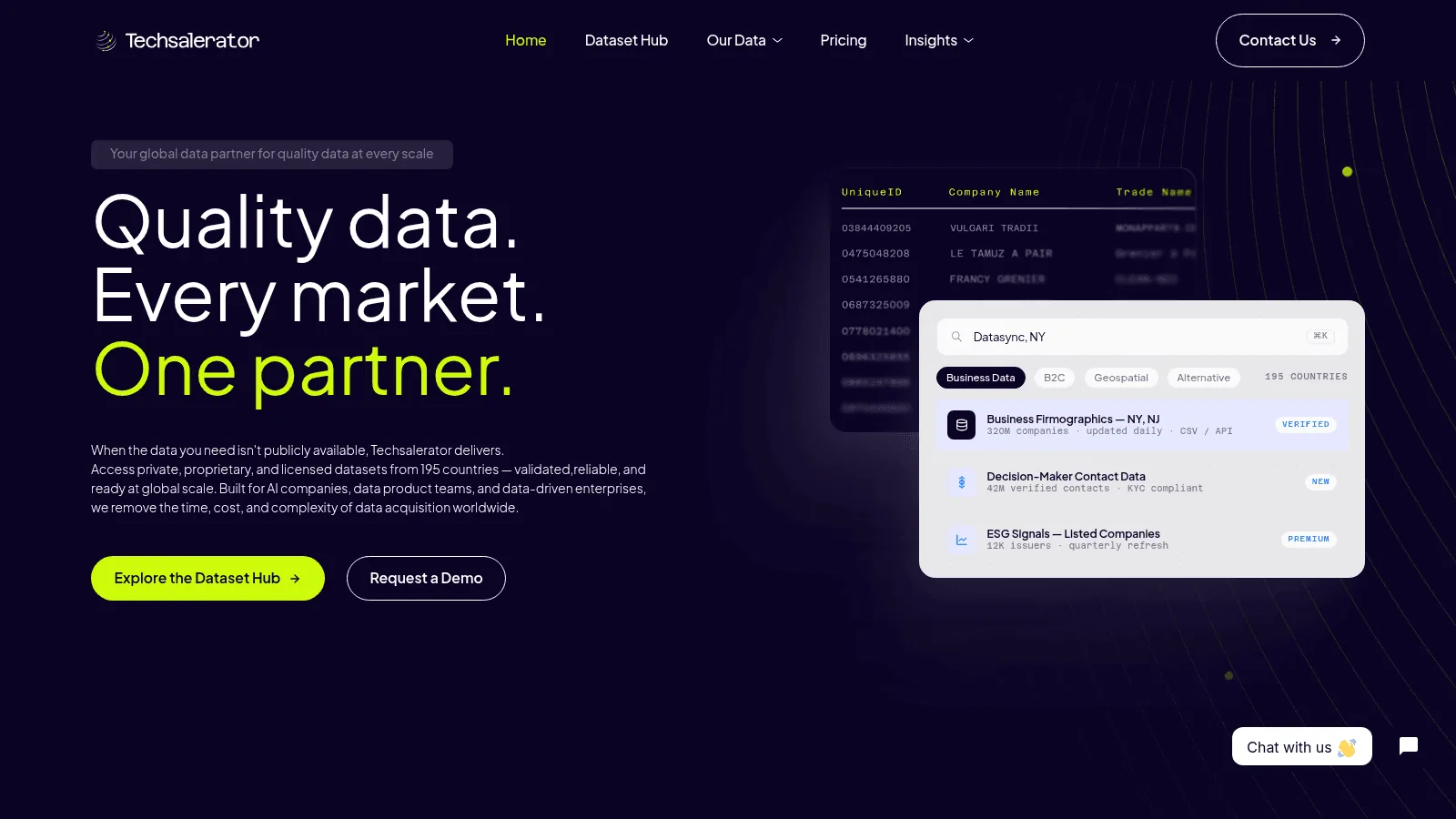
Best for: Revenue history across many countries.
Overview: Techsalerator sells company data as catalog files and by API. Its homepage claims 320M companies in 195 countries, and its financial dataset lists current revenue plus revenue one and two years ago.
Key features:
- A funding dataset of 220,000+ events over seven years, with investor, amount and date.
- Technographic data sold as a separate catalog.
- Delivery as CSV, by API, or through data marketplaces such as Databricks.
Pricing: API and catalog access are quote only, and its /pricing page returns a 404. Its Data Shop sells 1,000-row firmographic samples from $100 and single city lists for $350 to $400 each.
Pros: Three years of revenue in one record, funding events with investors, global reach claimed
Cons: No published API price, scale claims whose only method detail is "over 1,100 sources", headcount trend not listed
Why buyers shortlist it: It publishes past revenue as named fields, not just a current figure.
Final verdict: Worth a sample if revenue direction drives your scoring.
7. Veridion
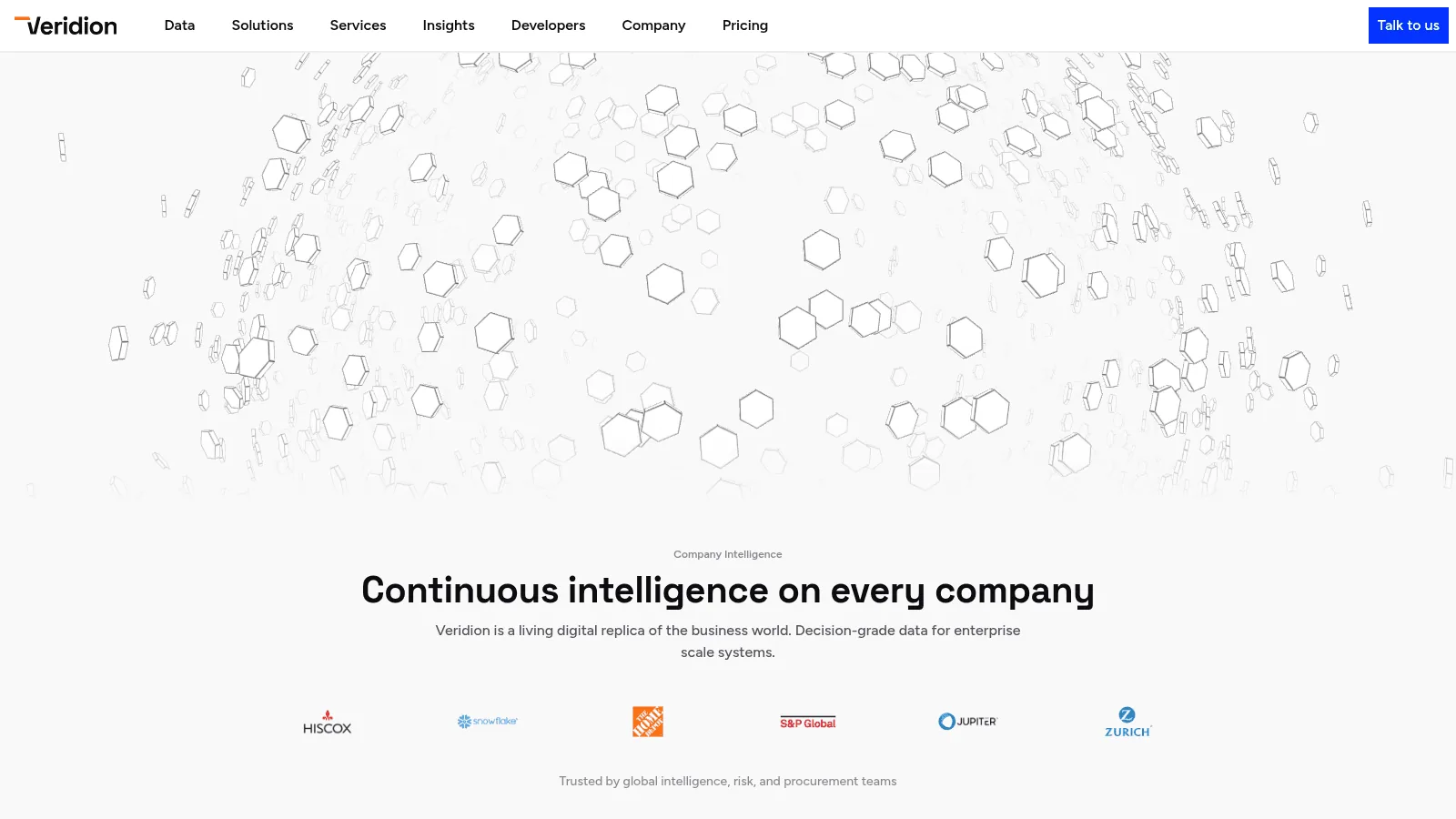
Best for: Matching and classifying company records.
Overview: Veridion sells a company graph through a match API. The sample record on its homepage shows revenue and employee count, each with year-over-year change, plus company type, business model and NAICS 2022 codes weighted by share of the business.
Key features:
- Match and enrich your own company list against its graph.
- Weekly refresh on its Company Intelligence package, quarterly on Data Foundations.
- Delivery by API, batch, warehouse or marketplace.
Pricing: Veridion doesn't publish prices. Data Foundations covers up to 50M entities, Company Intelligence covers the full graph, and a Strategic Program is custom.
Pros: NAICS codes with share, year-over-year size and revenue change, a weekly refresh tier
Cons: No public price, its own pages send outbound teams elsewhere for contacts, its 744.5M company count is a vendor claim we couldn't test
Where it fits: Data teams classifying and matching suppliers or accounts at scale.
Final verdict: Strong on classification, but bring a separate contact source.
8. HG Insights
Best for: Technographics and IT spend.
Overview: HG Insights is a technographics specialist. It tracks verified technology installs across 120M+ organizations, with IT, cloud and AI spend data, account hierarchies and buyer intent on top.
Key features:
- Tech footprint and spend by account, for sizing a software market.
- Accounts and hierarchies, so installs roll up to a parent.
- An API, a Direct Feed and an MCP server, plus exports from its Copilot apps.
Pricing: HG's pricing guide shows Starter, Growth and Enterprise tiers with no dollar figures, but its October 6, 2026 launch release says Copilot modules start at $22,000, without saying over what period. A company entity with firmographics and hierarchy costs 0.1 credits, a buyer-intent data point costs 3, and there's no free trial or pilot.
Pros: Install-level technographics, IT and cloud spend data, firmographic records at 0.1 credits against 3 for intent data
Cons: No trial, a $22,000 module floor with no stated period
Why it earns a place here: If what a company runs matters more than what it earns, this is the specialist.
Final verdict: Add it beside a general provider when you sell software into installed bases.
9. SalesIntel
Best for: Reps wanting human-checked company fields.
Overview: SalesIntel says its team re-verifies firmographics every 90 days, covering industry with SIC and NAICS codes, headcount, annual revenue, company type, headquarters and subsidiary relationships. A rep can build filtered account lists straight from the app.
Key features:
- Filters on industry, SIC or NAICS code, revenue, headcount and geography.
- Tech stack and IT spend data on accounts.
- Native connectors for Salesforce, HubSpot and Marketo, plus an API and webhooks.
Pricing: SalesIntel publishes no prices; its pricing page leads to a meeting booking, and it offers a free trial.
Pros: A stated 90-day re-verification cycle, industry codes and subsidiaries, research on request for missing records
Cons: No public price, delivery built around an app
Who it suits: Teams that want clean account filters without a data team.
Final verdict: A good fit when reps, not developers, use the data.
10. Cognism
Best for: Contact-led teams needing company context.
Overview: Cognism is mainly a contact database, but it publishes one firmographic claim: 90% coverage of revenue and headcount data for companies with 50+ employees. It also lists 20,000+ tracked technologies, funding alerts and hiring trends.
Key features:
- Revenue and headcount on accounts in its app and CRM enrichment.
- Funding and hiring signals as alerts on accounts.
- API and MCP access on both of its packages.
Pricing: Both packages, Standard and Pro, are quote only.
Pros: A scoped, published revenue coverage claim, technographics, and funding and hiring alerts
Cons: The coverage claim says nothing about companies under 50 employees, no hierarchy field stated, no public price
Why firmographic buyers consider it: You get company context on the same record as the contact your reps will call.
Final verdict: Choose it for contacts first, with revenue and headcount attached.
How We Chose These Providers
We started from the ten roundups ranking for this topic in November 2026 and found every one was written by a vendor, each ranking its publisher first or near the top. This one is too, which is why every row in the table, ours included, carries a main gap.
Each provider had to clear three checks:
- It sells company-level data, not only contact details.
- Its own pages name at least some of the fields it returns, so every filled cell traces to the vendor.
- You can get the data out by API, file or app, and the vendor names the route publicly.
Crunchbase, PitchBook and other company research tools are the usual sources for funding rounds. They're left out because their records center on deals, not company fields.
Firmographic Fields Compared, One by One
The table names each provider's strongest fields but can't show how each field fails, so here's what to check.
Revenue
Public companies file revenue and private companies mostly don't, so for a private company the figure is often an estimate.
The technical lead of an early-stage AI SDR startup told us that when a search filters on revenue, the number "either doesn't even exist in their database and they just return it just because, or it's way out of date." Ask every vendor which revenue values are reported and which are estimated.
Employee Count and Trend
Employee count is the filter almost everyone uses. Companies often declare a size range bigger than the staff you can count, so ask each vendor whether its headcount is declared or counted.
Most companies are small, too. For 2022, the Census Bureau's Statistics of U.S. Businesses puts 99.7% of the 6,395,635 US employer firms under 500 employees. Vendors usually fill big accounts best, so a fill rate measured on them will flatter any vendor.
Industry Codes
Vendors classify industry with SIC (the older US system), NAICS (its replacement), the UN's ISIC or their own lists. Codes are only as good as the classifier behind them, and buyers tell us inferred industries sometimes contradict the company's own description. Read 20 classified records by hand before trusting a code filter.
Funding and Technographics
Funding is an event, not a state, so ask whether a vendor stores rounds as records or just flags them. Coresignal and Techsalerator list investors with each round and ZoomInfo's Funding Signals links rounds to companies, while Cognism and SalesIntel flag funding on accounts.
Technographics vary more. HG Insights tracks verified installs, ZoomInfo covers 30K+ products, and Dun & Bradstreet names technographics for Hoovers without a field list. Test both on accounts whose stack and last round your team already knows.
Location, Founded Year and Hierarchy
Headquarters can mislead. A New York HQ may hold only the leadership while most of the team works abroad. Founded year is simpler, and useful for spotting young companies.
Hierarchy is where buyers ask the sharpest questions, usually how a vendor handles a global brand against its country entities. Among the ten, ZoomInfo, Dun & Bradstreet, Data Axle, HG Insights and SalesIntel name parent, family or subsidiary links, and Coresignal lists ownership structure.
Seat Tool, API or Bulk Files: Picking a Delivery Model
The same fields arrive in three forms, each with its own price model. Here's how the ten providers sort, from B2B intelligence tools with firmographic filters for reps to files for a warehouse.
| Delivery model | Providers here | Typical price model | Fits when | Watch for |
|---|---|---|---|---|
| Seat app | ZoomInfo, SalesIntel, Cognism, HG Insights, D&B Hoovers | Quote per license or package; Hoovers Essentials from $49 a month | Reps build lists and research accounts | Paying for seats nobody opens |
| API | Reverse Contact (also as Clay, Zapier and Make steps), Coresignal, Veridion, D&B Direct+, Techsalerator, Data Axle, HG Insights, plus ZoomInfo, SalesIntel and Cognism beside their apps | Credits per call or record | Data feeds a product, a CRM or an agent | Credit cost at your real volume |
| Bulk files | Coresignal, Techsalerator, Data Axle licensing, D&B batch, HG Direct Feed, Veridion batch and warehouse, ZoomInfo warehouse share | Per file or license | A warehouse needs the whole universe | Refresh cost and stale snapshots |
Seat apps suit a rep working accounts by hand. An API suits anything automated, such as the data enrichment tools that fill CRM fields on a schedule, and bulk files suit teams that model a whole market in their own warehouse.
Why Firmographic Records Go Stale
Company data ages because companies change. The Bureau of Labor Statistics tracks the pace: of the 976,437 US private establishments that opened in the year to March 2025, 78.9% were still operating in March 2026. Those are establishments (individual sites), not whole companies, but every closure, move and merger leaves a stale record.
So refresh timing belongs in your evaluation. SalesIntel states a 90-day re-verification of firmographics, Veridion a weekly refresh tier, and ZoomInfo a 60-day average for tech-stack data.
We publish the date rather than a single cycle: our free status check returns each company record's last refresh date, and a search can skip records older than a date you set. A CRM data enrichment schedule built on those dates keeps records closer to current.
Run a Fill-Rate Test Before You Sign
A demo shows you the vendor's best accounts. A fill-rate test shows you yours.
- Pick 200 accounts: half closed-won deals, half small companies from your target market.
- Send the same list, as domains, to the two or three vendors on your shortlist.
- Score each field you filter on as filled, empty or wrong: against your CRM for the closed-won half, and against each company's own website for the small companies.
- Allow a margin on headcount, such as plus or minus 20%, since sizes shift between updates.
- Check every office in the location fields, not just the headquarters.
- Re-run the same list 30 days later to see which fields changed.
Once the scores are in, divide each vendor's price by the records that passed. One commenter in a Reddit thread on data accuracy put it plainly for contacts: judge the cost per valid contact, not the cheapest invoice. The same holds for company records.
To test search instead, run your targeting filters through each vendor and score 50 results from each, because a bigger count isn't a better one. We return the count for free on our company search API, so you pay only for the results you score.
Healthcare and Real Estate: When You Need a Vertical Source
Healthcare breaks general firmographics. Provyx, a healthcare data vendor, lists the reasons: SIC codes are too broad, private practices rarely report revenue, and the account you sell to is the practice, not the clinician. Definitive Healthcare is one of the healthcare firmographic data providers built for that account unit, tracking physicians, physician groups, hospitals and health systems.
Real estate searches turn up a separate product. Results for real estate firmographic data providers lean toward property data (parcels, owners, mortgages, listings) from vendors such as ATTOM or CoStar, not company fields.
Choosing by the Field You Can't Do Without
To pick among the best firmographic tools, start with the field your targeting can't run without, then the way you need it delivered. Revenue as a hard filter leaves nine of the ten in play. Funding rounds narrow it to ZoomInfo, Coresignal and Techsalerator; HG Insights added funding and M&A data in October 2026.
Corporate families point to Dun & Bradstreet, and tech stack points to HG Insights. If reps will do the filtering, B2B intelligence tools with firmographic filters, such as SalesIntel or ZoomInfo, save you building anything.
If your product, pipeline or AI agent runs on company records, start with us. Count your filtered matches for free, or ask for your ideal accounts in a sentence, then run the fill-rate test alongside Coresignal or Veridion. You can try it on your records with free trial credits and no card.
FAQs
What is firmographic data?
Firmographic data is the set of company-level facts used to target and segment accounts: industry, employee count, revenue, location, founding year, and often funding, technologies used and corporate hierarchy. Sales and marketing teams use it to define an ideal customer profile, score accounts and route leads.
Which firmographic data providers include revenue?
In this list, nine of the ten publish a revenue figure or financials block: ZoomInfo, Dun & Bradstreet, Coresignal, Data Axle, Techsalerator, Veridion, HG Insights, SalesIntel and Cognism. Our API covers identity, size, industry and location instead, so if revenue is a hard filter, pair it with one of them.
How often should firmographic data be refreshed?
Headcount, funding and tech stack can change within months at growing companies, while industry and founded year rarely change. Check vendor cycles field by field, from ZoomInfo's 60-day tech-stack average to SalesIntel's 90-day firmographic re-verification, and refresh the accounts you're actively working first.
Can you get firmographic data through an API?
Yes. Dun & Bradstreet's Direct+, Coresignal, Veridion and Reverse Contact are built around API delivery, ZoomInfo offers API access through its enterprise plans and GTM.AI, and the other five list an API beside their app or files. Before you build, check the cost per record at your volume and what the API returns when it finds nothing.
Are there free firmographic data providers?
ZoomInfo Lite is a permanent free plan. Coresignal offers a 7-day trial with 2,000 credits, and our signup comes with free trial credits, no card required. SalesIntel offers a free trial, ZoomInfo's GTM.AI starts you with 1,000 data credits and 1,000 AI credits at no cost, and D&B's Hoovers Essentials has a free first month.
HG Insights has no free trial or pilot, Techsalerator sells paid samples, and Cognism, Data Axle and Veridion start with a sales call. A trial is the cheapest way to find the best firmographic tools for your accounts, so run the fill-rate test above during one.
The data layer behind your GTM engine
Access fresh people and company data through one API and power every enrichment, prospecting, and automation workflow.
- Profiles
- 800M+
- Refreshes / month
- 200M
- Response time (P95)
- 500ms