
10 RocketReach Alternatives for Finding B2B Contacts (2026)
Julien K.Published
Key takeaways:
- RocketReach meters two things. Monthly plans cap lookups at 100, 250 or 1,000 a month, while annual plans call lookups "unlimited" and cap exports at 1,200, 3,600 or 20,000 a year (RocketReach pricing page, November 2, 2026).
- RocketReach's pricing FAQ says a lookup that finds no verified email or phone is refunded. RocketReach publishes no credit-back for an email that bounces later, and its refunds page says subscription payments aren't refunded.
- Pick by reader. Reps in a browser: Apollo.io, Lusha, ZoomInfo, Cognism or UpLead. Recruiters: SignalHire. Product teams on an API: Reverse Contact, People Data Labs or LeadMagic. Ops teams chaining tools: Clay.
- Test on records whose answers you know: to switch, a mix RocketReach found and missed; to add a fallback, only its misses. Score mobiles separately.
RocketReach suits one person looking people up one at a time: search a name, reveal an email or phone, pay nothing when it comes back empty. Plenty of people searching for RocketReach alternatives like that loop but not the meter around it. Others leave because the phones disappoint.
Which alternative fits depends on who's looking. A rep in a browser, a recruiter, a product team calling an API and an ops team chaining data tools need four different purchases, even when each would call the need a B2B contact database.
So what are some alternatives to RocketReach worth testing? This guide covers ten, grouped by reader. Some change the meter, while Lusha and UpLead are like-for-like options for teams happy with the model. Reverse Contact is ours, so it's first, with its limits in its Cons. Prices come from each vendor's site on November 2, 2026, in USD; RocketReach's are US prices and vary by region.
Why Teams Look for RocketReach Alternatives
For some teams the complaint is arithmetic. In a Reddit thread in r/b2bmarketing, one growing team said its bill had reached "almost 3x" a $100 monthly budget while it was "not utilizing half the features." It's one team's anecdote, but a commenter named the pattern: credit meters push you to hoard lookups or burn them in a week.
Three published rules tighten that meter. Monthly plans cap lookups, annual plans cap exports, and teams of five or more, per RocketReach's custom-plans page, move to team plans that its pricing page says "start at $6K annually."
A recruiting-software founder told us free search, with credits spent only on a reveal, is far more predictable for a per-seat product. RocketReach's help center says searching uses no credits; our search bills 1 credit per profile returned, unless a Plus or Max plan covers it.
The refund rule is fairer than some comparison pages claim. RocketReach's pricing FAQ reads: "A lookup is used if we find and verify email or phone, otherwise it is refunded." A later bounce gets no published credit-back, and that bounce costs more than a credit.
M3AAWG's sender best practices warn that hard bounces "can subtract points from an IP's reputation score" and that "B2B mail may have a higher rate of asynchronous bounces." Whichever tool you pick, verify before you send and drop addresses that bounce across consecutive sends. A refund doesn't protect your domain.
How RocketReach's Lookups and Exports Actually Bill
RocketReach's credits FAQ separates two units. A lookup stores a contact inside RocketReach. An export moves it out, and the FAQ counts "API lookups, bulk lookups, downloading your data in a CSV file, uploading a list, and exporting your data to a CRM" as exports. Per seat, the caps fall like this:
| Plan | Billed annually | Billed monthly | Lookups, monthly plan | Exports, monthly plan | Exports, annual plan |
|---|---|---|---|---|---|
| Essentials (email only) | $33 a month, $399 a year | $69 a month | 100 a month | 100 a month | 1,200 a year |
| Pro (email and phone) | $75 a month, $899 a year | $119 a month | 250 a month | 250 a month | 3,600 a year |
| Ultimate (email and phone) | $142 a month, $1,699 a year | $209 a month | 1,000 a month | 1,000 a month | 20,000 a year |
On annual billing, the same FAQ limits "unlimited" lookups to 10,000 a month for fair use, so exports are the real limit: an Essentials seat pushing every contact into a CRM gets about five a working day over 250 working days, by our count.
Divide each price by its export cap for the cost of one contact moved out, if every export is used. This is our arithmetic, not RocketReach's:
| Essentials | Pro | Ultimate | |
|---|---|---|---|
| Per export, billed annually | $0.33 | $0.25 | $0.085 |
| Per export, billed monthly | $0.69 | $0.48 | $0.21 |
| 12 months on monthly billing | $828 | $1,428 | $2,508 |
| Annual saving against monthly | 52% | 37% | 32% |
Ultimate is the cheap seat per export, and the "Save 50%" badge fits only Essentials. The API runs on the same meter, one export per API credit, and RocketReach's API docs cap person lookups at 500 a day on Essentials and 3,000 on Ultimate, against 10,000 on custom plans.
Four Readers, Four Different Purchases
A rep working a fixed list of accounts mostly needs an extension, a decent reveal rate and a push into the CRM. Smaller teams we talk to still do this by hand, each salesperson searching target accounts on their own seat. For that reader the meter is the whole question, and most browser-based email finder tools compete on how they count seats and credits.
A recruiter needs more personal contact details and a push into an ATS. RocketReach's Bullhorn integration starts at Pro, $75 a seat a month billed annually, and a desk of five or more moves to team plans from $6K a year.
A product team is the reader RocketReach's Terms fence off. They say you "may not develop or derive for commercial sale" any data that uses its Lookup Information without prior written consent (Terms updated January 31, 2024). With each API lookup also spending an export, a self-serve plan isn't built to sit under software your customers use.
Builders have a second worry. Teams reselling contact data fear what a bad email does to their name, and the founder of a recruitment market-mapping tool told us bluntly: "what I don't want to do is damage my reputation." For this reader, a license that allows embedding is the first filter, and validation on every record is the second.
The fourth reader, an ops team chaining several data tools, needs orchestration more than any single database.
The 10 Best RocketReach Alternatives
The table compares all ten on what you pay for and what an empty lookup costs. Where a vendor publishes no rule for a miss, the cell says so.
| Tool | Built for | Unit you pay for | What a miss costs | Price from (basis) |
|---|---|---|---|---|
| Reverse Contact | Product teams calling an API | Credits per lookup or profile returned, or a flat plan per endpoint family | An empty live fetch bills 2 credits; cached lookups, filtered searches, emails and phones that find nothing are free | Packs from $100, or Go $249 a month |
| Apollo.io | Reps who also want sequencing | Seats, with credits per seat (email 1, phone 8) | Standard lookups bill only when found; waterfall enrichment can bill a miss; email bounces within 30 days refunded | $49 a seat a month, billed annually |
| Lusha | Reps revealing contacts in a browser | Credits (email 1, phone 5), seats bundled | Free in the web app; on an empty API request, its pages disagree | $37.45 a month, billed yearly |
| ZoomInfo | Enterprise sales teams | Licenses plus credits, one credit per export | Not published for the suite; GTM.AI bills only matched rows on audience loads | Suite quote only; API credits $0.25 to $0.45 each by volume |
| Cognism | Sales teams dialing verified mobiles | Credits, one per revealed contact, five seats included | Per its help center, nothing for search or enrich, a credit per redeemed contact; its API docs describe a second model, search tokens per row returned | Quote only |
| UpLead | One rep buying self-serve | Credits, one per contact (email and mobile) | Valid Only mode bills only verified-valid emails | $74 a month, billed annually, one user |
| SignalHire | Recruiters | Credits by data type, unlimited users | Nothing: 1 credit only when a contact is returned | $39 a month, billed annually |
| People Data Labs | Developers building on raw records | Credits, one per record | A 404 costs nothing | $98 a month, billed monthly |
| LeadMagic | Builders on API, CLI or MCP | Credits (email 1, mobile 5) | Nothing for failed lookups ("Failed lookups are free"); its job-change detector bills per request | $99 a month for 5,000 credits |
| Clay | Ops teams chaining data tools | Data credits plus actions, unlimited seats | No data credits or actions when an enrichment returns nothing | $167 a month, billed annually; HTTP API from Growth |
After ours, the list runs by reader: five rep tools, one recruiter tool, two APIs, then Clay. Among RocketReach competitors, sales intelligence suites such as ZoomInfo and Cognism wrap more software around the data; raw data APIs wrap almost none.
1. Reverse Contact
Best for: Product teams putting contact data inside software.
Overview: Reverse Contact sells people and company data through an API. Your code sends an email, a name plus employer domain, a company domain or search filters, and gets back a structured profile in one documented format. Our published coverage is 800M+ profiles and 70M+ companies across about 200 countries.
There are no seats and no export meter: you pay per lookup or per profile returned. A cached lookup, a filtered search, or an email or phone lookup that finds nothing is free; an empty live fetch bills 2 credits. We'd sooner return nothing than data that fails our checks.
One example inside another product: allGood's marketing automation platform enriches the people and companies behind its customers' leads through our API, with company size, industry, role and seniority, before routing them. That routing is allGood's own logic.
Key features:
- A free
/checkcall returns a profile's last full refresh date, so you can pick cached or live. - One bulk request takes up to 25,000 people and asks for profiles, emails or phones, and each row bills only for what it finds.
- Emails pass syntax and MX, SMTP, catch-all, disposable and role-based checks at request time, and phones are validated too, neither guaranteed.
- A free count sizes a search before you pay.
- Ambiguous matches return candidates in an
alternativePersonsfield. - REST API, webhooks, CSV upload, an MCP server, a CLI and TypeScript and Python SDKs, plus Clay, Zapier and Make apps.
Pricing: Credit packs start at $100 with no subscription and last three months. Go at $249 a month lifts the meter off cached /fetch/* lookups, Plus at $449 a month adds /search/*, and Max at $699 a month adds /enrich/*, with plan-covered calls capped at 100,000 profiles per workspace a day. On every plan, a live fetch still costs 2 credits, a business email 3 when found, and a lookup that finds a phone 20.
Packs and unlimited plans cover your own team's use. Building the data into software your customers use, or reselling it, needs Platform, a contract our sales team prices. That's a gate like RocketReach's consent, but in-product use is what the plan exists for, and our pricing page offers it openly.
Pros: No seats or export meter, emails and phones billed only when found, a free refresh check and search count, up to 25,000 people per bulk request, ranked alternatives when a match is ambiguous
Cons: No browser extension for reps; email and phone finds and live lookups are asynchronous (our docs target under 15 seconds per lookup and warn it can take tens of minutes), so queue them
How to start using it:
- Claim free trial credits at signup, no card required.
- Run a free count query on your target segment.
- Send a test batch of your own records, including some RocketReach missed.
- Divide credits spent by usable records for your real cost per contact.
- Match the plan to the endpoint family your code calls most.
Why it's a good RocketReach alternative: It bills by lookup or profile returned, not seats and exports, so cost follows what your code calls.
Final verdict: Choose it when your code runs the lookups and your product shows the results; skip it if your reps want an extension.
2. Apollo.io
Best for: Reps who want data and outreach together.
Overview: Apollo.io puts a contact database and sequences behind one seat, so a RocketReach user exporting only to load a sending tool drops a step. Paid plans add a US dialer at 1 credit per 30 seconds; power dialing is an add-on.
Key features:
- Phones draw 8 credits from the seat's allowance, emails 1.
- An email sent from inside Apollo that bounces within 30 days gets its credit back.
- Paid plans include API enrichment, and an MCP server exists.
Pricing: Basic is $49 a seat a month billed annually, or $65 monthly, and Professional $79 annually, or $99 monthly. Organization is $119 a seat a month, annual only, for three seats or more; the free plan gives 900 credits a seat a year.
Pros: Sequencing in the seat, a free plan, bounce credits for 30 days
Cons: Credits expire each billing cycle, add-ons included; seats can't be cut mid-term; its Terms limit plans to internal business use
Where it fits: A rep who'd otherwise buy RocketReach plus a sequencer.
Final verdict: A solid all-in-one swap for a sales team, a weak base for a product.
3. Lusha
Best for: Reps who reveal contacts from a browser.
Overview: Lusha keeps RocketReach's click-and-reveal habit but bundles seats into each plan, a like-for-like move with a published price.
Key features:
- A phone reveal takes 5 credits and an email 1.
- Pro opens full API access, CSV and webhooks.
- MCP comes on every tier.
Pricing: Starter is fixed at $37.45 a month billed yearly, or $49.90 monthly, for one seat and 4,800 credits a year. Pro, with two seats, starts at $52.45 a month billed yearly for 7,200 credits a year, or $69.90 monthly for 600 a month. Premium, with five, starts at $299.95 a month billed yearly, or $399.90 monthly; Scale is quoted.
Pros: A free plan, seats bundled in, credit costs published per data type
Cons: Its pages disagree on empty API requests (the user guide bills at least 1 credit, the FAQs nothing); annual credits don't roll over; Free and Starter have strict API rate limits
Why buyers shortlist it: Published credit costs let a rep price it against RocketReach line by line, and again against the Lusha alternatives once API volume grows.
Final verdict: A clean swap for a rep; test API billing before automating.
4. ZoomInfo
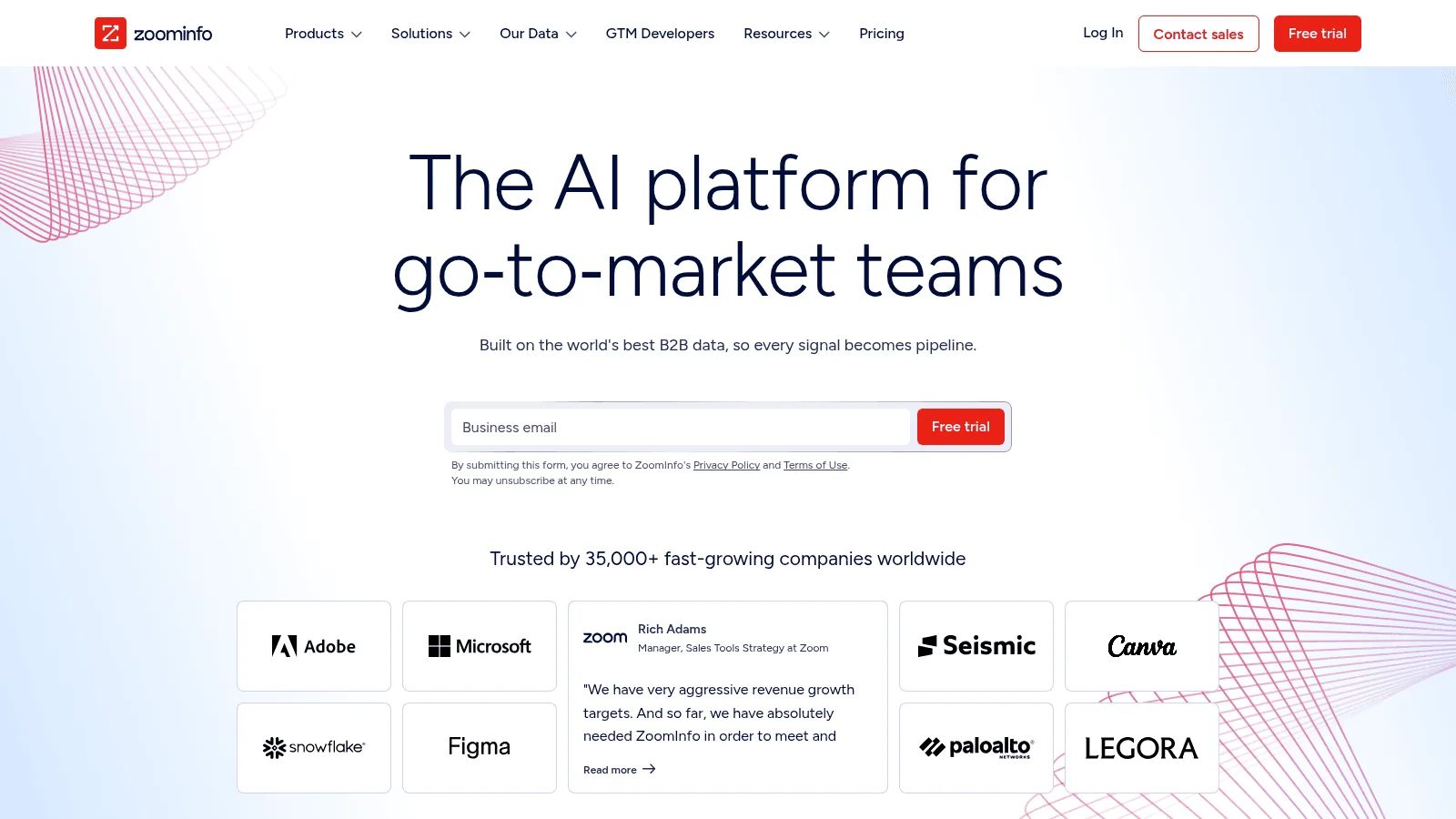
Best for: Enterprise sales teams buying a full suite.
Overview: ZoomInfo sells contacts inside a platform with intent data and workflow tools, priced by license and credit; its 10-K says subscriptions run one to three years.
Key features:
- Each export costs one credit, from the extension and the API alike.
- API, CLI and MCP access are all sold.
- A pay-as-you-go developer option, GTM.AI, bills $0.25 to $0.45 per data credit by volume, with search free.
Pricing: The sales suite is quote only, priced on features, licenses and credit usage. Vendr, a third-party buying platform, puts the median contract at $33,500 a year.
Pros: Contacts, intent and workflow in one contract, a public developer route, plainly stated export billing
Cons: No published suite price, non-cancelable contracts under its license terms, subscription License Terms that bar putting the data into your own products (GTM.AI buyers should confirm which terms apply)
Why buyers shortlist it: It wraps workflow around the contacts, and a quote-only price is reason to compare ZoomInfo competitors before signing.
Final verdict: Worth a quote for an enterprise sales org, too much contract for a team escaping a $6K floor.
5. Cognism
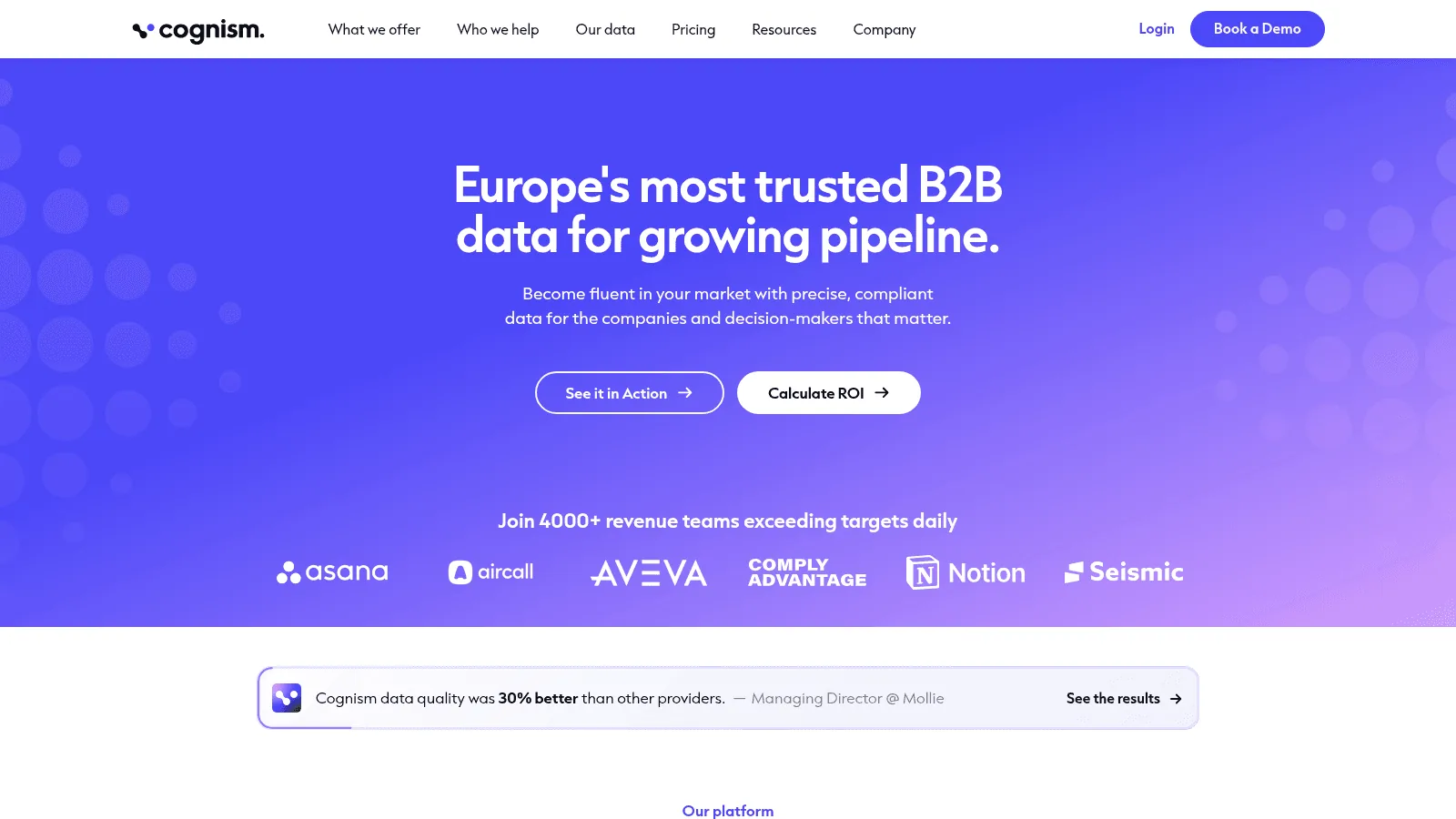
Best for: Sales teams that dial verified mobiles.
Overview: Cognism focuses on mobile numbers for outbound calling. If your RocketReach complaint is the phone column, not the meter, start here.
Key features:
- One credit reveals one contact in the app, in enrichment or over the API.
- It says 95% of its contacts at Director level and up get refreshed every 30 days.
- Do-Not-Call and TPS screening is included.
Pricing: Quote only. Standard and Pro both include five seats with emails and mobiles, and Pro adds intent data, a premium mobile filter and on-demand mobile checks.
Pros: A phone focus, DNC screening included, MCP and API from Standard
Cons: No published price, packages built around five seats, CRM Enrichment priced as a separate add-on
Its real strength: A refresh cadence for senior contacts, published on its own data page.
Final verdict: Get a quote if verified mobiles are the gap; look elsewhere if you need a price first.
6. UpLead
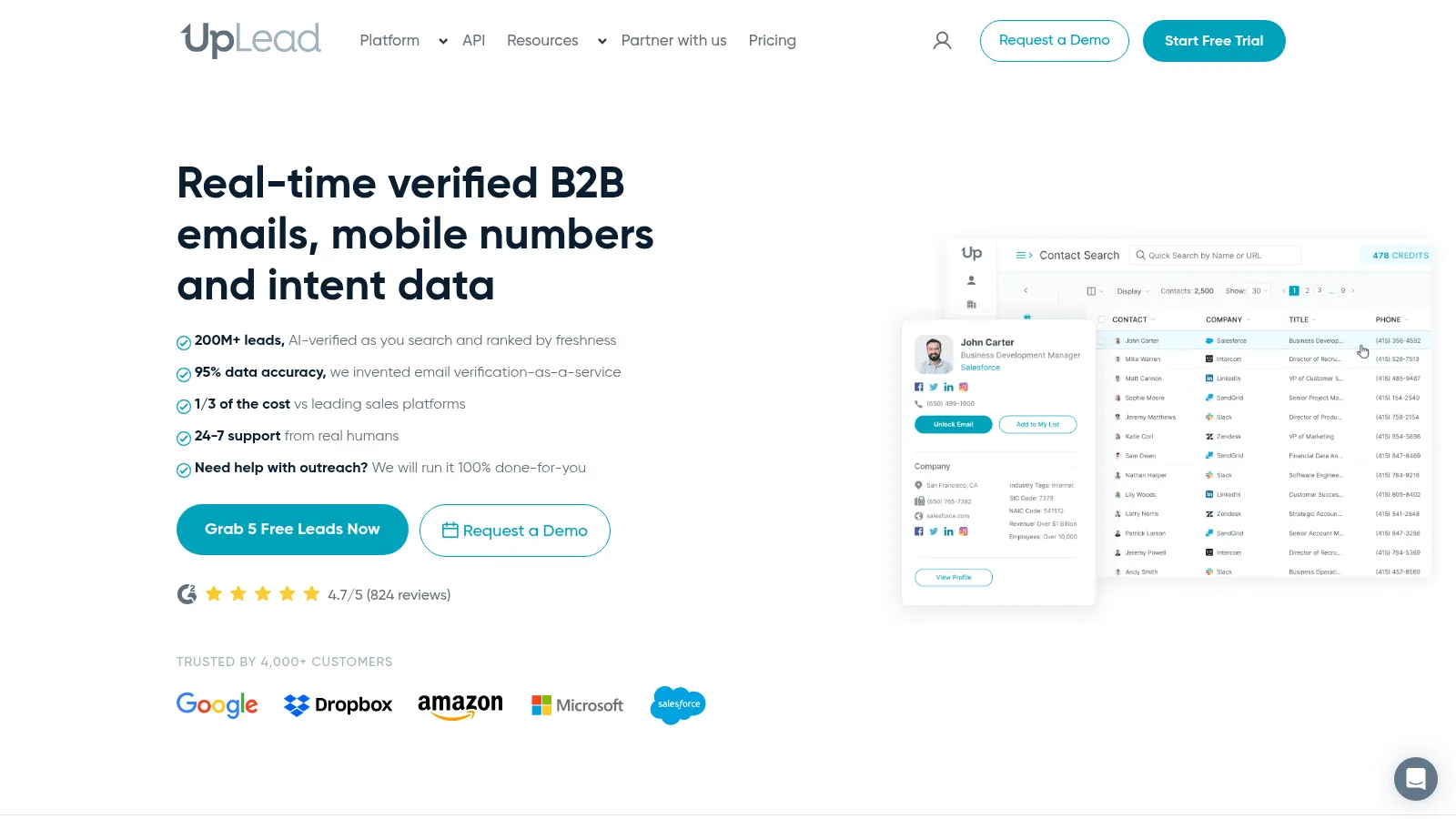
Best for: A single rep who wants self-serve pricing.
Overview: UpLead is a searchable contact database where one credit buys the whole contact, email and mobile, so a budget is simple multiplication.
Key features:
- One credit covers email and mobile direct dial.
- A Valid Only download mode bills only verified-valid addresses; the other two bill accept-all and unverified ones too.
- Extra credits cost $0.60 on Essentials and $0.50 on Plus.
Pricing: Essentials is $74 a month billed annually, or $99 monthly, and Plus $149 annually, or $199 monthly, both single-user. Professional is custom, annual only, and the tier with full API access.
Pros: Whole-contact credits, published self-serve prices, a mode that skips unverified emails
Cons: One user per published tier, full API on a quoted annual plan, a 7-day trial with 5 credits
Why it made this list: It's a close self-serve match for an individual RocketReach license.
Final verdict: Good for one rep watching spend, awkward for a team or a build.
7. SignalHire
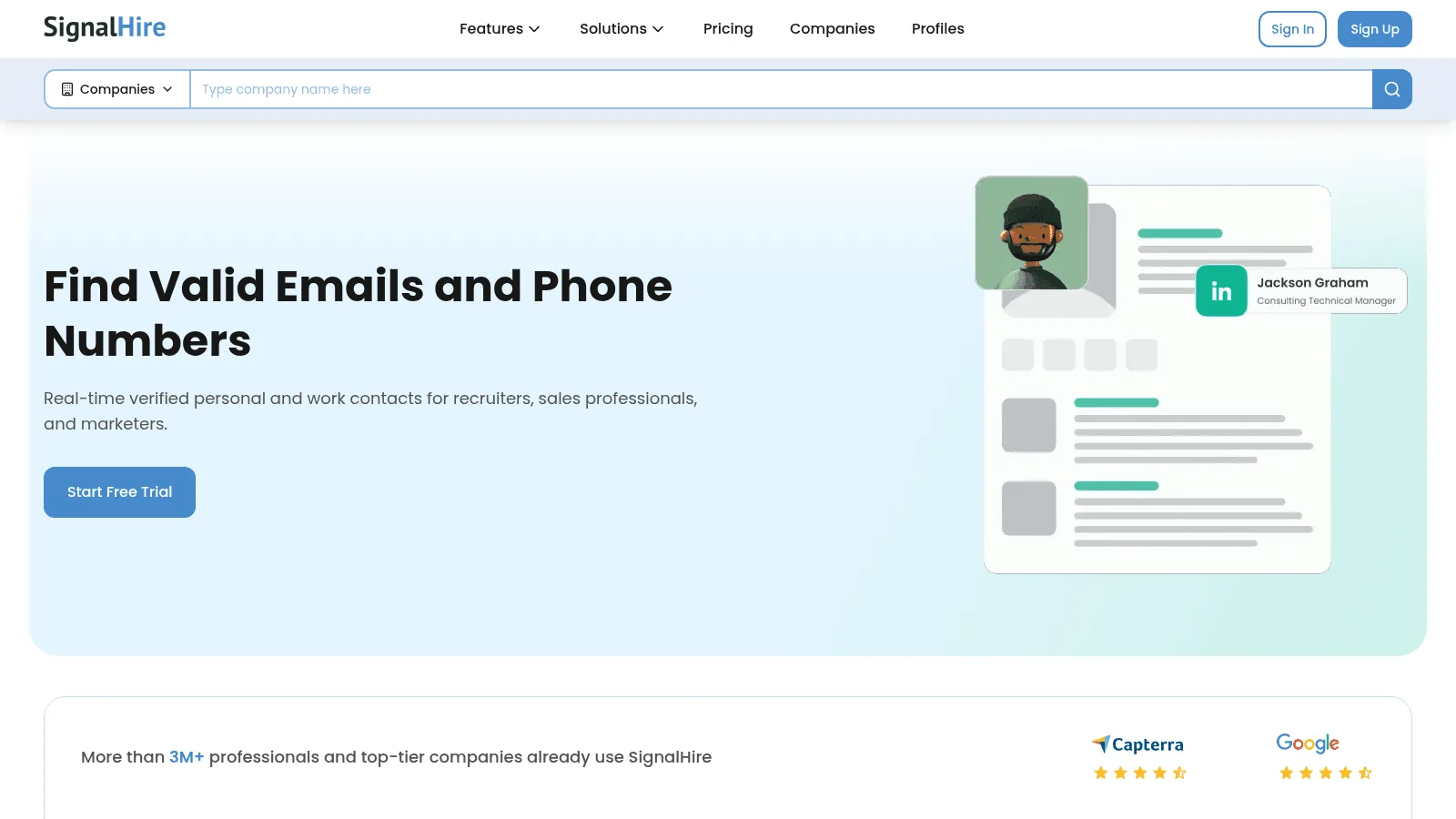
Best for: Recruiters who need personal and work contacts.
Overview: SignalHire sells personal and work contact details through an extension, bulk search and an ATS integration. It drops RocketReach's per-user charge and export cap.
Key features:
- Unlimited users and exports on every paid tier.
- ATS and CRM integration, CSV enrichment and API access on paid plans.
- Plans split by data type: emails, phones or both.
Pricing: The slider sets price and credits together. Emails starts at $39 a month billed annually for 7,200 credits a year, or $49 monthly for 600. At the default setting, Emails and Phones each cost $57 a month billed annually or $69 monthly, and the combined plan $83 annually or $99 monthly, with no credit cap shown.
Pros: No export cap or per-user pricing, a credit only when a contact comes back, personal contacts for candidate outreach
Cons: Credit allowances that move with the price slider, email and phone sold as separate plans below the combined tier
Why recruiters shortlist it: A whole desk can search at once without buying a seat each.
Final verdict: The recruiter pick here, once you've read the slider.
8. People Data Labs
Best for: Developers who build on raw records.
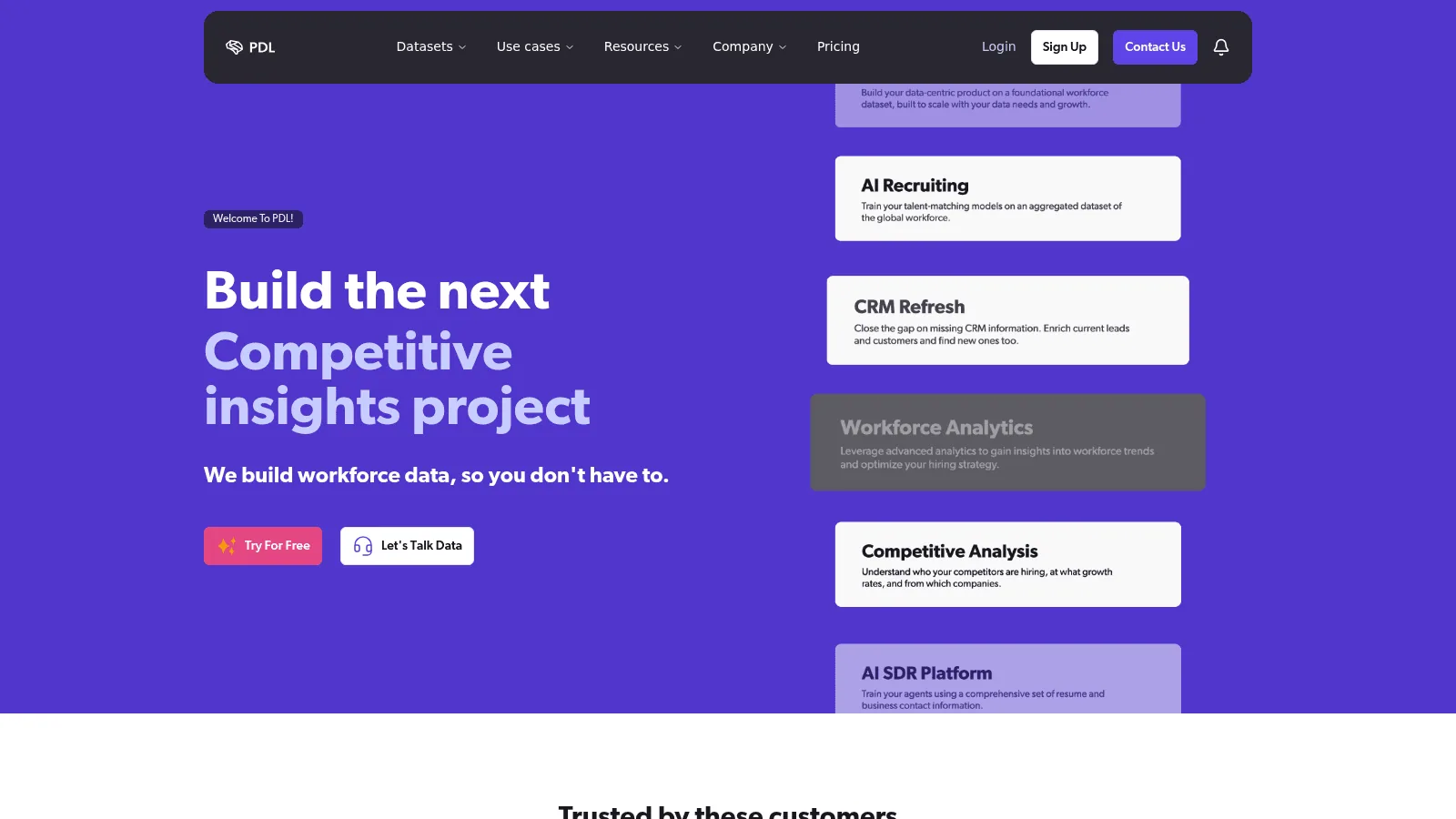
Overview: People Data Labs sells person and company records as APIs, with no prospecting app on top, so it replaces RocketReach's API, not its interface.
Key features:
- One credit buys one record, and a 404 costs nothing.
- API access on every plan, the free one included.
- Enterprise adds annual contracts and bulk data license feeds.
Pricing: The person API is free up to 100 credits a month with contact fields obfuscated, and Pro opens at $98 a month, $940 if paid yearly, with 350 monthly credits. The company API runs $100 a month, or $960 a year.
Pros: Free misses, a working API on the free tier, published per-record pricing
Cons: A free tier that hides emails and phones, no interface for a rep or recruiter, bulk licensing on Enterprise terms
Where it fits: A data team that wants whole records and writes its own matching.
Final verdict: A strong base for a build, with nothing a seller can open.
9. LeadMagic
Best for: Builders who want one credit pool everywhere.
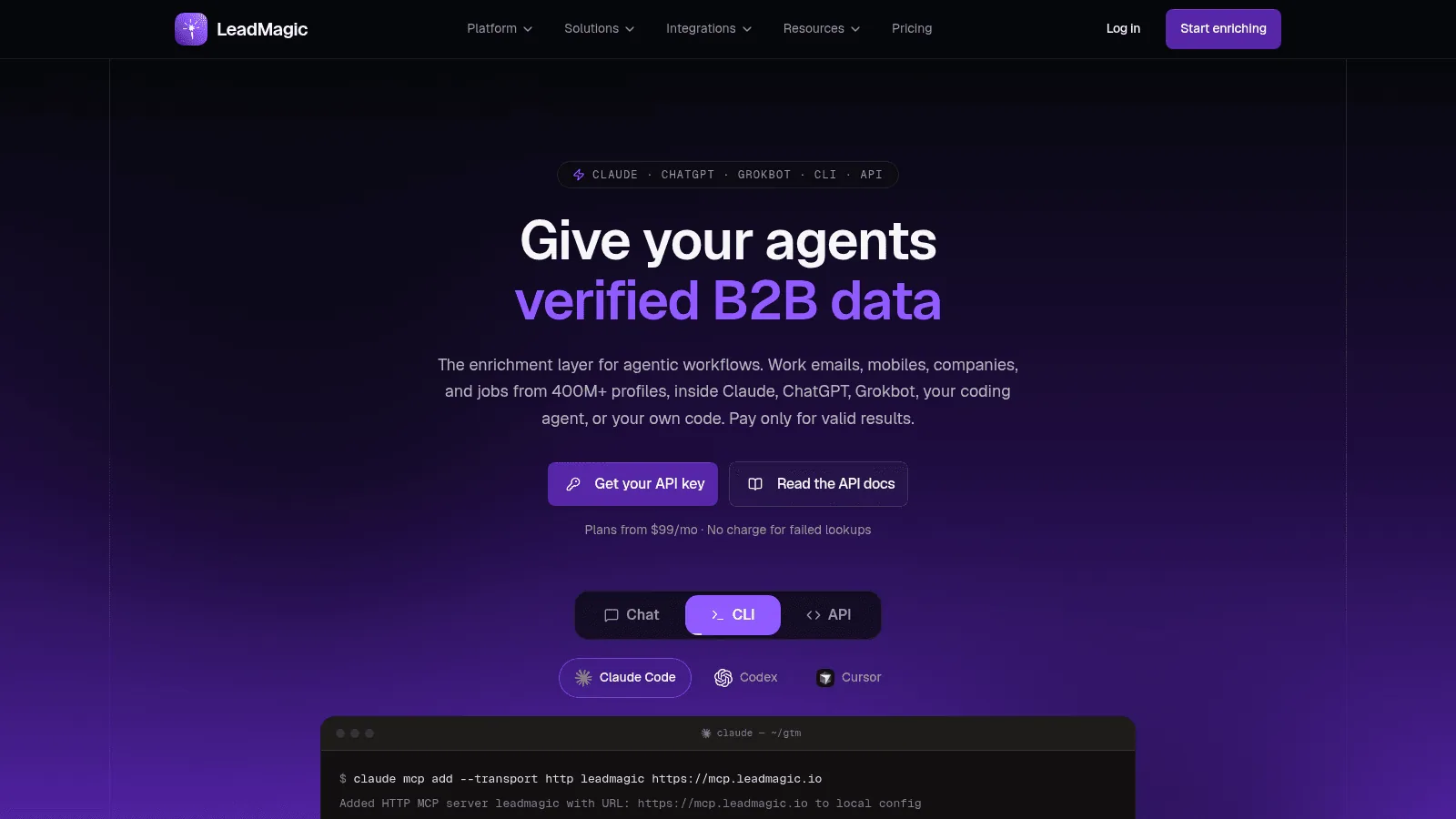
Overview: LeadMagic sells email, mobile and validation lookups from one credit pool, shared across its API, CLI and MCP server on every plan.
Key features:
- Validation runs 0.25 credits, an email 1 and a mobile 5.
- Its pricing page says "Failed lookups are free."
- Monthly credits bank up to twice the plan's amount.
Pricing: Essential is $99 a month for 5,000 credits, or $990 billed yearly, and Growth $249 a month for 20,000, or $2,490 yearly. Professional runs $499 a month for 50,000 and Ultimate $849 for 100,000, or $4,990 and $8,490 yearly.
Pros: Free misses by stated policy, every channel on every plan, published credit costs
Cons: Team access by request, Enterprise Security annual only from $10,000 a year, a recurring subscription even at entry
Why it's a good RocketReach alternative: Misses stay free and every lookup bills from one pool, which suits a pipeline calling it all day.
Final verdict: A clean per-lookup option, if you ask about team access early.
10. Clay
Best for: Ops teams chaining several data tools.
Overview: Clay is a workflow layer rather than a database. You build tables that call enrichment providers in sequence, and its pricing FAQ says it works with 150+ of them.
Key features:
- Data credits from $0.05 each, with no charge when an enrichment returns nothing.
- Unlimited seats on every plan.
- HTTP API, webhooks and CRM integrations from Growth.
Pricing: Launch runs $167 a month billed annually, or $185 monthly, Growth $446 a month billed annually, and Enterprise is custom. The free plan includes 100 data credits plus 500 actions each month.
Pros: Unlimited seats, no charge for empty enrichments, many providers in one table
Cons: Two meters to watch, data credits and actions; CRM sync and the HTTP API need Growth; no phone enrichment on Free
Its real strength: Orchestration, when one tool won't cover every row and you want others tried in order.
Final verdict: Choose it to run several tools as one, not for one vendor and one meter.
Matching the Tool to the Reader
Once you know which reader you are, the list of alternatives to RocketReach gets short.
Reps choose Apollo.io to drop a separate sequencer, Lusha to keep click-to-reveal with seats bundled, UpLead for one self-serve seat, and Cognism or ZoomInfo when verified mobiles or a full suite justify a sales call. Recruiters get SignalHire.
Builders should read each vendor's Terms on embedding before its price; we checked only RocketReach's, Apollo's and ZoomInfo's. People Data Labs suits raw records and LeadMagic a single credit pool, both with free failed lookups. Reverse Contact fits when you want one identity resolved per call and ambiguous matches surfaced.
Ops teams chaining several tools should look at Clay.
What RocketReach Alternatives Cost
Headline prices hide the real trade: commitment. Most RocketReach alternatives charge more to stay flexible, and the gap shows how hard each pushes you toward a year:
| Tool | Entry tier, committed | Entry tier, flexible | Seats |
|---|---|---|---|
| RocketReach | Essentials $33 a month, billed annually | $69 a month | One per license |
| Reverse Contact | Go $249 a month, monthly commitment | Packs from $100, no subscription | Not priced by seat |
| Apollo.io | Basic $49 a seat a month, billed annually | $65 a seat a month | Per seat |
| Lusha | Starter $37.45 a month, billed yearly | $49.90 a month | One included |
| UpLead | Essentials $74 a month, billed annually | $99 a month | One user |
| SignalHire | Emails $39 a month, billed annually | $49 a month | Unlimited |
| People Data Labs | Pro $940 a year | $98 a month | Not priced by seat |
| LeadMagic | Essential $990 a year | $99 a month | Team access by request |
| Clay | Launch $167 a month, billed annually | $185 a month | Unlimited |
| ZoomInfo, Cognism | Quote only | Quote only; ZoomInfo API credits $0.25 to $0.45 each by volume | Licensed or packaged |
RocketReach's own Essentials seat more than doubles on monthly billing, and that premium buys the right to leave. RocketReach doesn't refund subscription payments, and individuals get only a 7-day window to switch annual to monthly, so pay monthly for a replacement until it passes your test.
This table still uses the wrong denominator. You're paying for a usable record: the right person, a deliverable email, a phone that rings. A tool that returns more records can still cost more once wrong matches, bounces and re-runs count, and only a test on your own records shows that.
How to Test an Alternative Before You Switch
Switching and adding a fallback need different tests. To switch, take records whose answers you know, some RocketReach found and some it missed, and count right, wrong and empty results for both tools. To add a fallback, run the new tool only on RocketReach's misses. A founder of a hiring-fraud detection startup told us to judge a vendor that way: "just go around the people we missed."
Mobiles need their own scorecard. In a Reddit thread in r/SaaS, an executive-search agency said RocketReach's mobiles came back "old or wrong" and its lookups ran short fast. It's one agency's account, but the advice in the comments travels: test a sample of your own pool, since no vendor can promise your regions.
Set-up is quick, but we'd budget one to two months to evaluate a product integration, and bounce and phone outcomes need weeks of sends. Reps send and dial; product teams measure match, wrong-match and empty rates on their own records and let users' outcomes come later. Either way:
- Pull a few hundred records you can check by hand, across your regions and seniorities.
- Agree the success metric before anything runs.
- Count wrong answers apart from misses, since a wrong person costs more than a blank.
- Score mobile, landline, wrong person and dead number as four outcomes.
If your records start as email addresses, finding a phone number from an email is a separate lookup with its own price. Then divide what the test cost by the records that passed: that's the per-contact price to compare.
Moving Off RocketReach
RocketReach's refunds page says subscriptions renew automatically and cancellation takes effect at the next cycle. Credits stay usable until then, then expire for good, and API keys are invalidated, so any integration still calling RocketReach stops on the day the cancellation takes effect.
Exporting your saved lookups draws on the meter too, since a CSV download counts as an export, so spend what's left on contacts worth keeping.
Don't load that file into a new tool as if it were current. The Census Bureau's Job-to-Job Flows series puts job-to-job hires at about 4.8% of U.S. jobs in the third quarter of 2025, seasonally adjusted, roughly one move for every 21 jobs in that quarter alone. A list bought a year ago has sat through four quarters of churn.
So run the exported file through a CSV enrichment pass with whichever tool you pick, flag every record that comes back with a different employer, and only then push the list to your CRM. Rebuild integrations against the new API's response shape and rate limits while the old keys still work.
Which RocketReach Alternative to Shortlist First
Start from the limit that sent you looking. If it's the per-seat license, SignalHire, Clay, People Data Labs and Reverse Contact don't price by user. If it's the export cap, SignalHire drops it on every paid tier, and the API tools bill per lookup or record instead. If it's the phone column, get a Cognism quote and run the four-outcome test above.
If the data will end up inside your own product, settle the license first. To run the test on Reverse Contact, get a free API key, size the segment with a free count, and run records whose answers you know before anyone signs.
FAQs
What are some alternatives to RocketReach?
By reader: Apollo.io, Lusha, ZoomInfo, Cognism and UpLead for reps in a browser; SignalHire for recruiters; Reverse Contact, People Data Labs and LeadMagic for product teams calling an API; Clay for ops teams. The best RocketReach alternatives for you depend less on database size than on what you pay for: seats, lookups, exports or calls.
Does RocketReach charge for a lookup that finds nothing?
No. Its pricing FAQ says a lookup is used only when it finds and verifies an email or phone, and its API FAQ adds that B and F grade emails use no credit. It publishes no credit-back for a later bounce, and subscription payments aren't refunded.
Are RocketReach's annual plans really unlimited?
Lookups are, within a fair-use limit of 10,000 a month. Exports aren't: 1,200 a year on Essentials, 3,600 on Pro and 20,000 on Ultimate, and every API lookup or CRM sync counts as one.
Can I build RocketReach data into my own product?
Not without permission. RocketReach's Terms bar developing or deriving data "for commercial sale" from lookup information without prior written consent. RocketReach competitors set their own rules: ZoomInfo's subscription license terms bar it too, and Apollo.io runs a separate reseller program.
Whichever vendor you pick, get the embedding license in writing before your customers see the data. Our version is the Platform plan, which sales quotes per deal.
Which RocketReach alternatives have a free plan?
Apollo.io gives 900 credits a seat a year, Lusha 40 credits a month, People Data Labs 100 a month with emails and phones masked, and Clay 100 data credits plus 500 actions a month. ZoomInfo Lite is free, SignalHire's free account carries 5 credits, or 10 a month with its browser extension installed, and RocketReach's own gives 5 lookups.
Reverse Contact has no free plan. Signup comes with free trial credits, no card required, for a first test on your own records.
The data layer behind your GTM engine
Access fresh people and company data through one API and power every enrichment, prospecting, and automation workflow.
- Profiles
- 800M+
- Refreshes / month
- 200M
- Response time (P95)
- 500ms