
8 Best Talent Intelligence Tools in 2026
Julien K.Published
Key takeaways:
- Talent intelligence answers market questions (how many people have a skill, who employs them, what they cost), which is a different job from tools that hand you a list of candidates.
- The real choice is what the data describes and who will use it: records you build on, a labor-market platform, or an HR suite. Seven of the eight tools here put analytics in a dashboard or app, and six sell data through an API or a feed. Eightfold and Beamery document APIs too, but those connect to their own suites.
- Two of the eight, Reverse Contact and Revelio Labs, publish a price and let you try the product without a sales call. Live Data Technologies also lets you open a free trial account, but it quotes through sales, like the other five.
- Skills counts aren't comparable. The EU's free ESCO taxonomy lists 13,939 skills, while vendors here claim anything from 27,000+ to 1.6 million.
Talent intelligence tools answer questions about a labor market or a workforce. Most talent intelligence is sold as a dashboard you read.
But a dashboard is only one way in, and most of these tools also let you take the data out. So this list of the best talent intelligence software is grouped by what the data describes: people and workforce records, labor-market data, and finished HR suites.
What Is Talent Intelligence?
Talent intelligence is the use of outside data on people, companies and labor markets, next to your own HR data, to make workforce decisions. It tells you where a skill sits, which competitors hire for it and what they pay, so you can decide where to hire, whether to build or buy a skill, and who could move internally.
It's easiest to place against its neighbors. Sourcing tools return a list of people to contact, and recruiting tools run the hiring process after that. Talent intelligence returns an answer about a market: counts, trends, benchmarks and skills gaps. A sourcing tool gives you 50 candidates. Talent intelligence tells you whether 50 exist, who employs them, and what they cost.
Skills change is what drives demand for it. The World Economic Forum's Future of Jobs Report 2025 expects 39% of workers' existing skill sets to be transformed or outdated between 2025 and 2030. Skill gaps also top its list of barriers to business transformation, named as a major barrier by 63% of employers.
The label itself is stretched. Some lists for this keyword include interview-notes apps and staffing tools, and a co-founder of an AI recruiting startup told us their competitors are adding market research and talent mapping to sourcing products. We kept tools that answer a market or workforce question. If your question is about one company rather than a market, our company research tools guide covers that job.
The 8 Best Talent Intelligence Tools by Type of Data
Reverse Contact sits at #1 because it's ours, not because we scored it. The other seven are grouped by what their data describes: workforce records (Revelio Labs, Live Data Technologies), the labor market (Lightcast, TalentNeuron, Draup), and your own people, inside skills and workforce suites (Eightfold, Beamery). Within each group, the order isn't a ranking.
Every price and product claim below comes from each vendor's own pages, read in November 2026. MCP, which appears in several rows, is a standard way for AI assistants to call a data source directly.
| Tool | Best for | What you get | Main limitation | Data coverage (vendor's own figure) | Start without a sales call? |
|---|---|---|---|---|---|
| Reverse Contact | Building talent data into your own systems | People search on 30+ criteria, person and company records by API, MCP, CLI or web app | No dashboards, labor-market analytics or skills taxonomy | 800M+ profiles, 70M+ companies | Yes, free trial credits, no card |
| Revelio Labs | Workforce trends you can read or pull | Terminal app, plus feeds, API and MCP on headcount, skills, pay and attrition | Annual commitment on the Terminal, feeds, API and MCP | 30M+ companies in 195 countries, ~2B career profiles | Yes, free Terminal trial, no card |
| Live Data Technologies | Job changes as a data feed | Job and title changes by API, bulk file exports, warehouse or MCP, plus the Live Data app | History only from 2019; annual license | 124M professionals, about 1 to 2 million job changes a month | Yes, a free trial account in the app; the data test goes through sales |
| Lightcast | Labor-market and skills analysis | Talent Analyst app, data delivery, API, MCP server, consulting | Three product lines to scope with sales | 1B+ job postings | No for the apps; limited free-to-try data on Snowflake Marketplace |
| TalentNeuron | Global labor-market planning | Platform, APIs and data feeds, consulting | No published price | 200+ countries and markets, 26M companies | No, demo first |
| Draup | Workforce planning for AI-driven change | Platform, REST API with SDKs, MCP, scheduled feeds | No published price | 1B+ profiles, 3,500+ roles across 140+ countries | No, demo first |
| Eightfold | Skills-based internal mobility | HR suite with a skills model, plus the TalentForge builder | API covers your own suite records, no market-data feed seen | 1 billion profiles | No, demo request |
| Beamery | Turning workforce plans into hiring | Data platform, scenario modeling, Ray AI assistant, execution suite | API and daily export cover your own Beamery records, no market-data feed seen | 600M+ talent profiles, 20B+ talent data points | No, demo first |
Read the last column first if you'd rather try before you talk. Three of the eight let you start without a sales call: Reverse Contact, Revelio Labs and Live Data Technologies. The other five begin with a demo or a conversation with sales, though Lightcast also lists limited free-to-try data on the Snowflake Marketplace.
The coverage column is each vendor's own count of different things, so it shows what each dataset describes, not which one is biggest. Only Reverse Contact and Revelio Labs publish a price, and the cost section below covers what each one buys.
1. Reverse Contact
Best for: Teams building their own talent data.
Overview: We sell people and company records through an API, which is a service your code calls to get structured data back. Reverse Contact has no analytics dashboard, so it's the layer you build talent intelligence on, in your warehouse, HR tool or product.
Talent questions start with search. You filter our 800M+ profiles on 30+ criteria, such as role, job function, seniority, region, industry and company size. Agentic search writes those filters for you from a single plain sentence, and lookalike search returns people similar to a profile you pick, such as your best hire.
We also publish open workforce research. Our job-change study of 483 million professional profiles worldwide found 5.5% changed jobs in the last 12 months. That share is conservative, since profiles are self-declared. The data is free to reuse as long as you credit us.
Each person record carries job and company, work history, location, education, skills and languages. Skills arrive as raw text fields, not mapped to a taxonomy. Company records cover size, industry, headquarters, locations and age across 70M+ companies. Both reach you by REST API, webhooks (results pushed to you once they're ready), the MCP server, our command-line tool (CLI) or a web app that saves searches to Lists and exports CSV.
Key features:
- People search on 30+ criteria, so "how many data engineers work at our five biggest competitors?" becomes a query.
- A free match count, so you size a talent pool before paying 1 credit per profile on credit packs.
- Agentic search from one sentence, included on Plus and Max, otherwise 1 credit per request plus 1 per profile.
- Lookalike search from a single seed profile, to map people who resemble a strong hire.
- Skills, languages, education and work history as fields on the person record.
- One response shape across the API, webhooks, MCP and CLI, so an AI agent and your warehouse read the same record.
Pricing: Credit packs range from 5,000 to 1M credits and start at $100; each stays valid for three months. Plans make whole types of request unlimited for $249, $449 or $699 a month: Go covers cached record fetches by ID, Plus adds search, and Max adds enrichment that starts from an email, a name or a domain. Plans bill as a monthly commitment, credit packs carry none, and unlimited use stops at 100,000 profiles per workspace each UTC day.
Business emails (3 credits per email found), phones (20 per lookup that finds one) and live refreshes (2 credits, even when nothing is found) cost credits on every plan. Plans cover your own team's use; records that power a product your customers use need our Platform plan, priced by sales.
Pros: Search by 32 job functions and 386 sub-functions, past-employer filters that show where a competitor's former staff went, region and market zones such as EMEA or DACH, our job-change study open for anyone to reuse, published prices and trial credits with no card
Cons: No dashboards, labor-market analytics or skills taxonomy, so the analysis is yours to build; no job postings, pay data or headcount history in our published schema
How to start using it:
- Open a workspace on the free trial credits; no card is needed.
- Write down three questions your team asks every quarter, such as how many product designers work at your three closest competitors.
- Turn each question into search filters and run the free count to see its size and credit cost.
- Pull 25 profiles per question and read how the titles and skills come back.
- Decide which fields you'll group or compute yourself, then connect the search to your warehouse or HR tool by API or MCP.
Why it's a good talent intelligence tool: It gives a technical team people and company records to query directly, at a published price. That suits snapshot questions, such as which competitors employ people in one role, not trends over time.
Final verdict: Choose us if you have an engineer or a data team and want talent questions answered inside your own systems. For labor-market trends or salary benchmarks, pair us with a tool below. Try it on your records.
Revelio Labs and Live Data Technologies also hand you records to pull, but they're workforce records: headcounts, moves and history across whole companies.
2. Revelio Labs
Overview: Revelio Labs sells workforce data on more than 30 million companies in 195 countries, with history back to 2007. It covers headcount, hiring and attrition, salaries, tenure, seniority, skills and employee sentiment, and you can read it in its Terminal app or pull it out.
Key features:
- A Terminal with a company screener and talent search, so analysts get answers without code.
- Data feeds to S3, Snowflake, Databricks, AWS Marketplace or SFTP, including job postings, transitions and layoffs databases.
- 15,000 occupation clusters and 33,500 skills, so roles group the same way across companies.
Pricing: The Terminal starts at $1,250 a month on an annual commitment, and the page doesn't say how many seats that covers. A free trial needs no card or sales call. Feeds are priced by database type, volume and recency, and the API and MCP by users and monthly call allowance, all on annual agreements, while a one-time project pull covers up to 12 companies for a flat fee.
Pros: A published Terminal price, a free trial without a sales call, the same data in an app, feed, API or MCP
Cons: An annual commitment on the Terminal, feeds, API and MCP; feed and API prices set in scoping
What it does best: It's a workforce dataset you can both browse and pipe into your own warehouse.
Final verdict: Pick Revelio Labs when you want workforce trends with long history and the option to take the raw data out.
3. Live Data Technologies
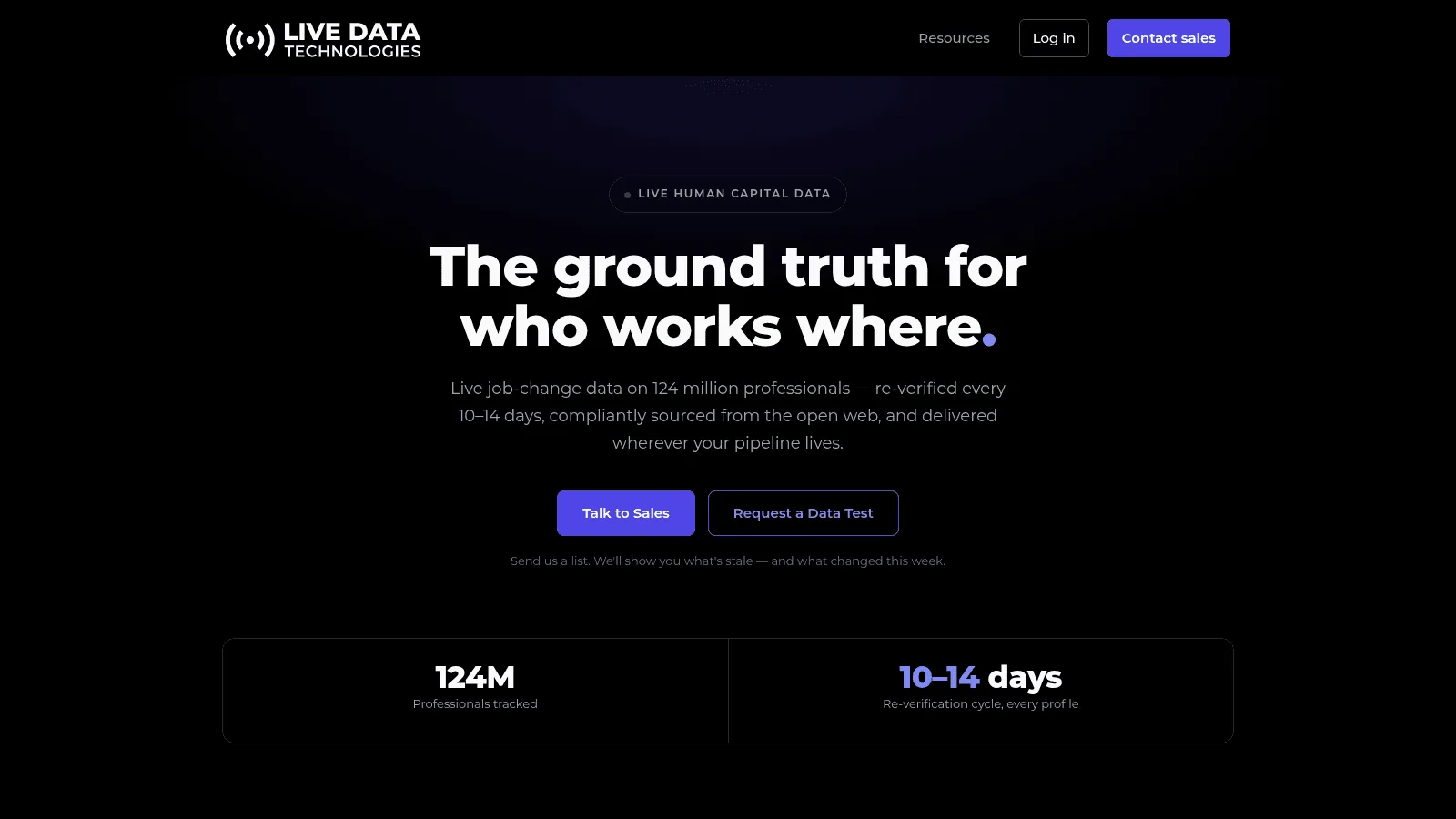
Overview: Live Data Technologies sells job-change data. It tracks 124 million professionals, re-verifies each one every 10 to 14 days and records about 1 to 2 million job and title changes a month, with history from 2019. Its homepage pitch is blunt: "No dashboards to adopt. No seats to buy." It also runs a Live Data app for analysts, though.
A feed of job moves is the part of the picture Reverse Contact doesn't sell, so if you need to see moves as they happen, Live Data is built for it.
Key features:
- Job and title changes delivered by REST API, bulk file exports, straight into your warehouse, or through an MCP server for AI assistants.
- Named uses that include headcount and hiring velocity, executive moves and talent flow between competitors.
- A license that covers internal use, resale and AI training, so a product team can build on it.
Pricing: No price is published. Annual licenses are scoped to your coverage and delivery, and you can request a data test through sales. You can also open a free trial account in the Live Data app, where its docs say every user gets 500 credits a month by default.
Pros: A focused job-change feed, re-verification every 10 to 14 days, resale and AI-training rights in the license
Cons: Quote only on an annual license, history only from 2019
Why buyers shortlist it: It treats job moves as the product, not as one chart inside a broader app.
Final verdict: Choose Live Data Technologies when job changes are the signal you need in your own systems.
The next three start from the labor market rather than from people records: job postings, skills and pay across regions and industries.
4. Lightcast
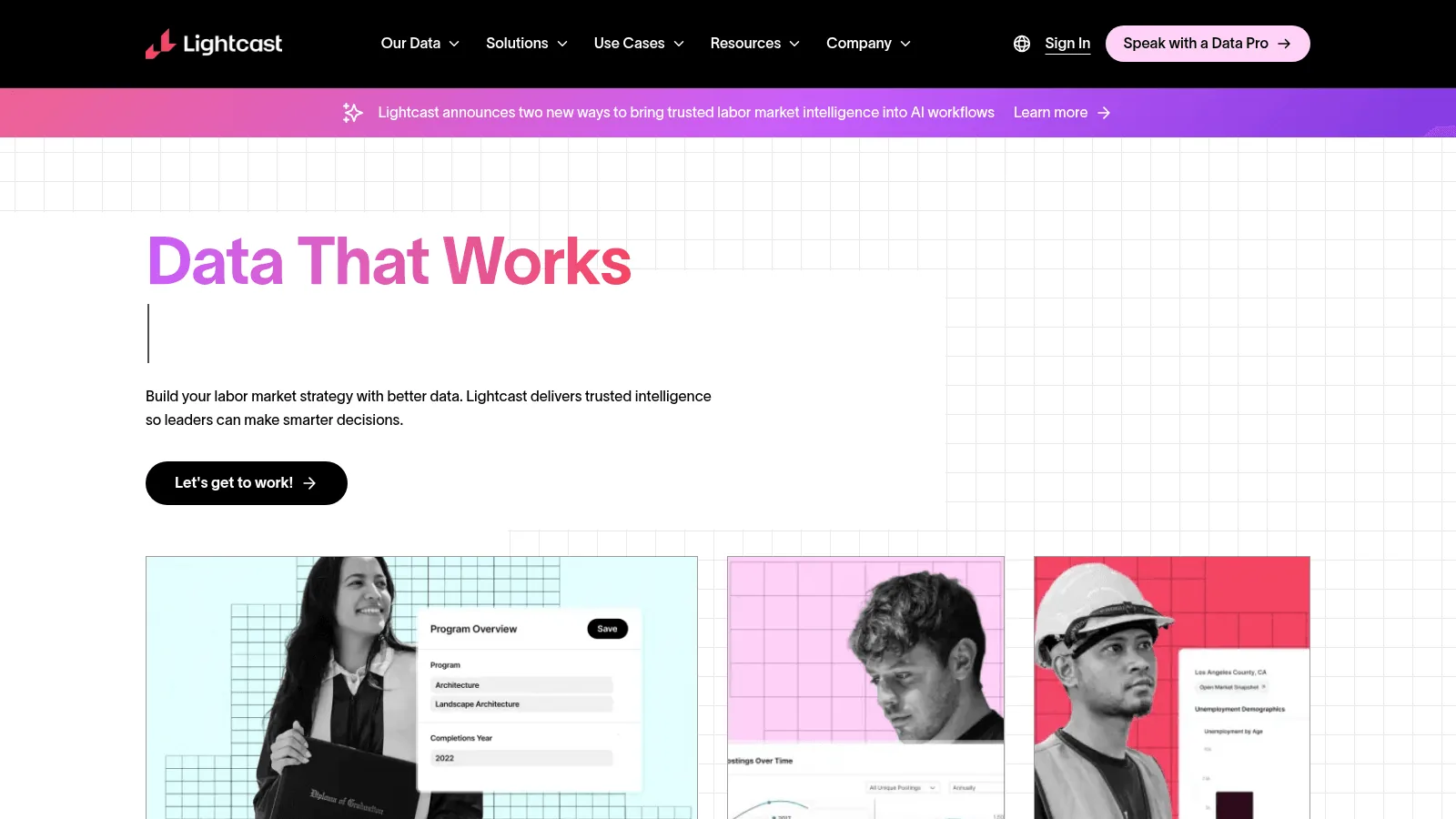
Overview: Lightcast is a labor-market data company built on job postings and skills, and its talent intelligence report cites over one billion postings. Its Talent Analyst app covers supply trends and projections, compensation benchmarks, location strategy, competitor benchmarking and hiring trends.
Key features:
- A skills taxonomy of 34,000+ skills that anyone can browse free, so you can check its structure before buying.
- ASK, a conversational assistant inside its Analyst platform, and a Lightcast MCP server, both announced on October 20, 2026.
- A documented API, with access by request, and data shares to S3, Snowflake, Databricks and BigQuery.
Pricing: Lightcast publishes no price. Software, data delivery and consulting are all scoped with its sales team.
Pros: Deep job-postings and skills data, a free-to-browse taxonomy, data delivery as well as apps
Cons: No published price, three product lines to scope (software, data and consulting), an AI assistant and MCP server that are only weeks old
Where it fits: It suits teams who need to know where a skill is in demand, what it pays and where the supply sits.
Final verdict: Choose Lightcast when labor-market and skills data, not individual records, drive the decision.
5. TalentNeuron
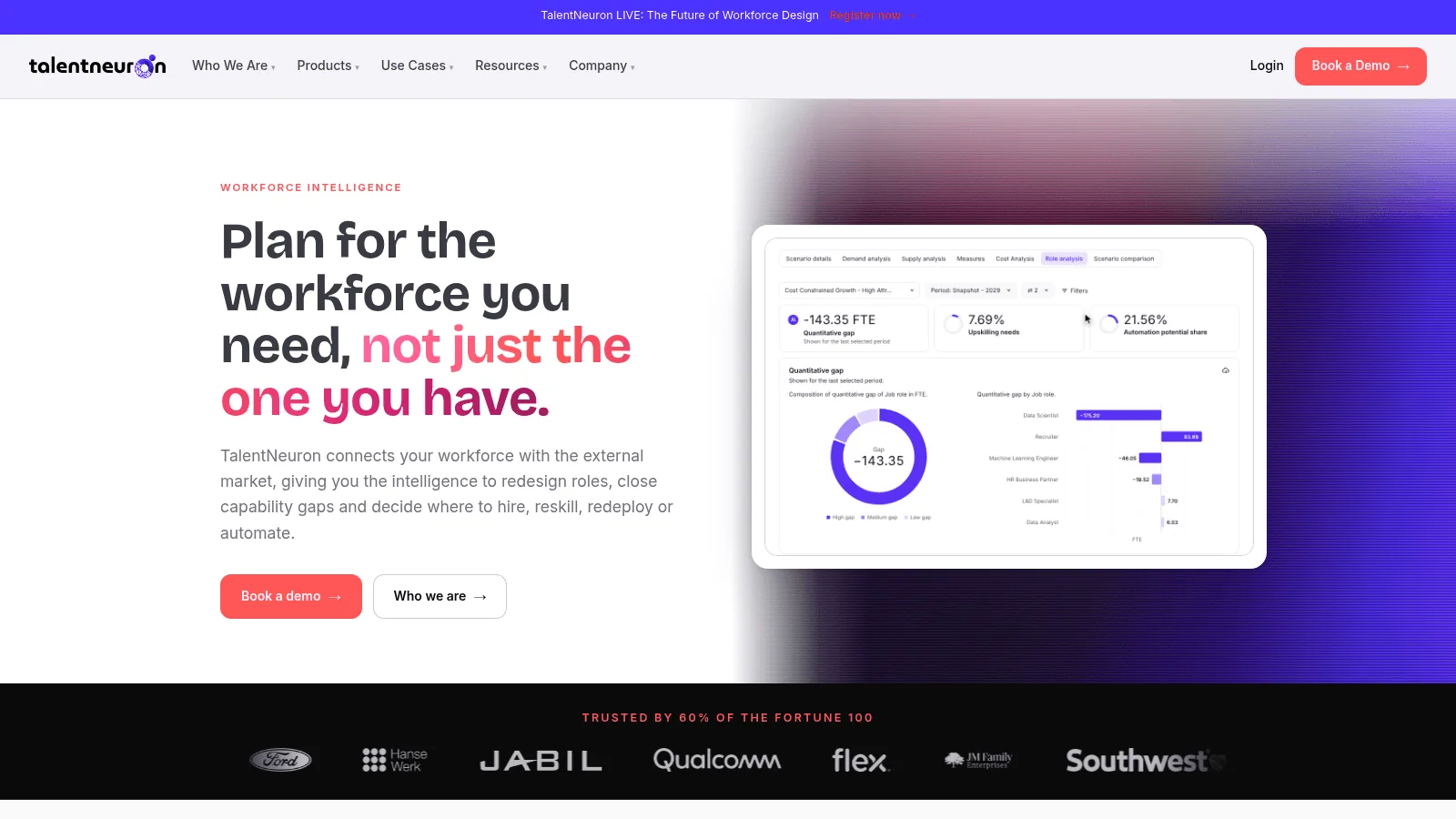
Overview: TalentNeuron sells labor-market intelligence across 200+ countries and markets, with 65,000+ skills and 26 million companies in its data. Older articles still call it Gartner TalentNeuron, but it was carved out of Gartner in February 2023 and is owned by Leeds Equity Partners.
Key features:
- A labor-market platform spanning 200+ countries and markets, so you can compare locations for a role.
- APIs and multi-format data feeds, so the same data can reach your own systems.
- Consulting for teams that want the analysis done alongside them.
Pricing: No price is published. You start by booking a demo, and the quote follows.
Pros: Wide country coverage, a large skills library, a platform plus APIs and feeds
Cons: Quote only, a demo-first start
Why it made this list: It's built for the questions a global employer asks before opening an office: where a skill exists, and in what volume.
Final verdict: Choose TalentNeuron for global labor-market planning with a consulting team behind it.
6. Draup
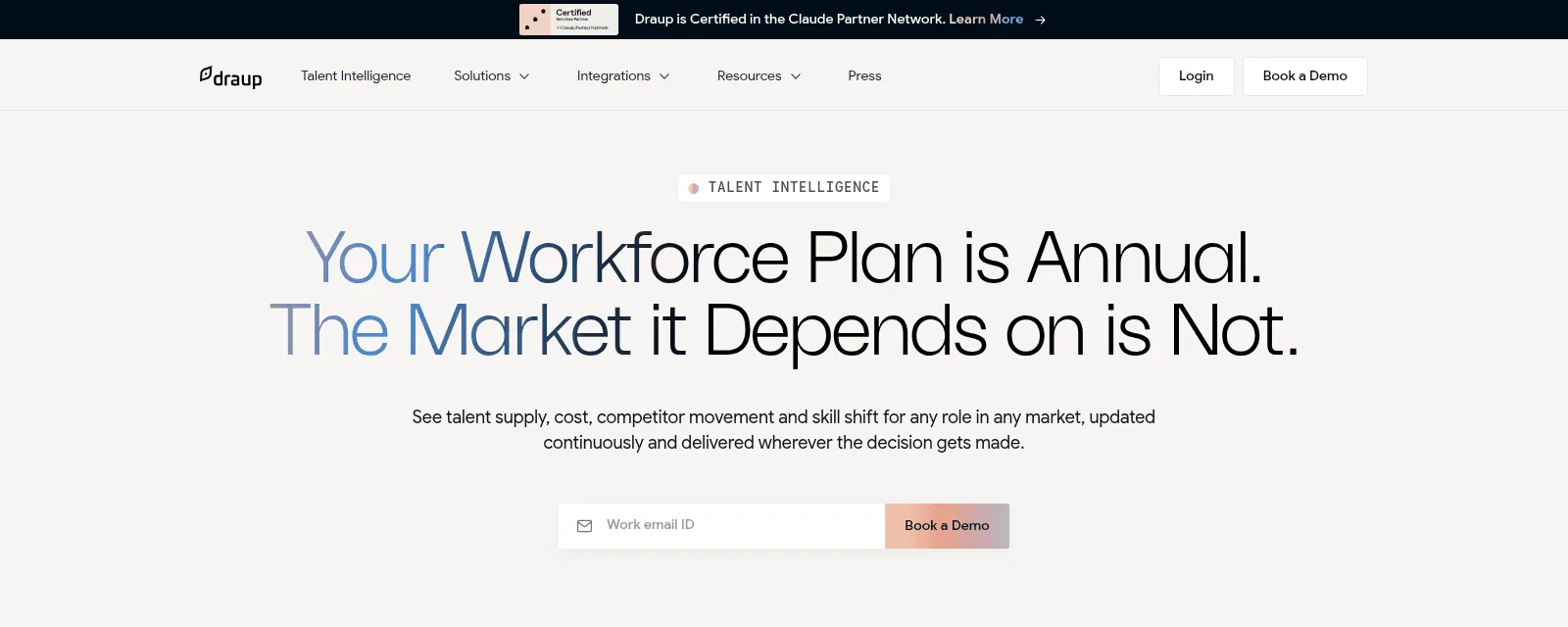
Overview: Draup pairs labor-market data with work architecture, meaning how roles break down into tasks and skills. Its Talent Intelligence product covers workforce planning, peer benchmarking, location analysis and reskilling, while its Etter product models which tasks AI could take over and writes results back to your HR system.
Key features:
- A REST API with Python and JavaScript SDKs, plus delivery by MCP, agent-to-agent (A2A), native integrations or scheduled feeds.
- More than 27,000 skills and 3,500+ roles across 140+ countries, so skills work starts from a ready map.
- A free AI Workforce Diagnostic, which Draup says returns a board-ready AI transformation roadmap in 14 days and which you request through its demo form.
Pricing: No price is published. The platform starts with a demo.
Pros: An API, MCP and scheduled feeds all on offer, task-level AI-exposure modeling, SDKs for developers
Cons: Quote only, demo first
Its real strength: It ties skills data to the tasks inside each role, which is what planning for AI-driven change needs.
Final verdict: Choose Draup when the question is how roles will change, not only where talent sits.
The last two are HR suites. They put skills intelligence to work inside hiring, internal mobility and workforce planning rather than handing you the data.
7. Eightfold
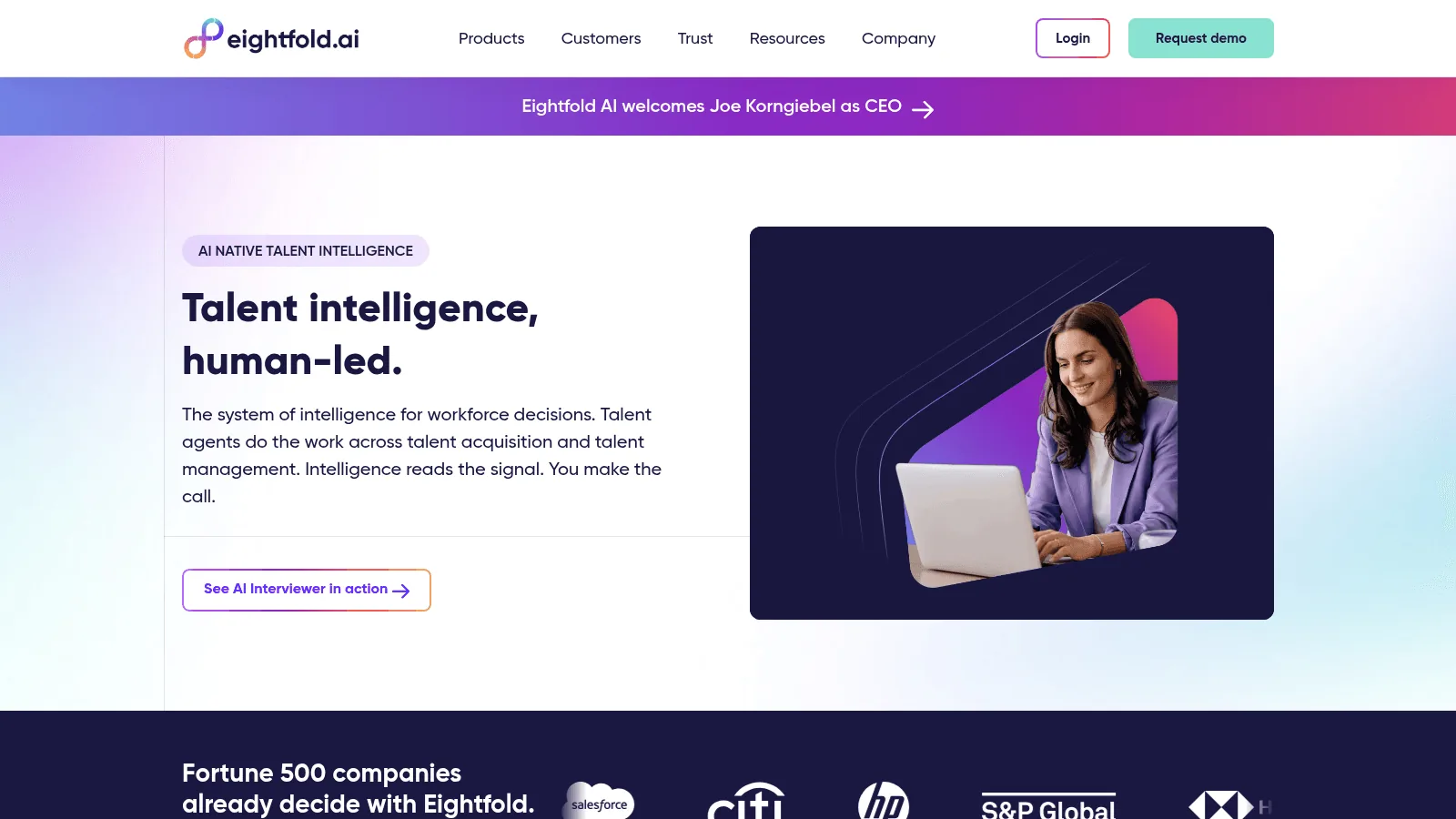
Overview: Eightfold sells a talent intelligence suite built on a skills model it says spans 1.6 million skills. Joe Korngiebel, who spent 14 years at Workday, was named CEO on October 13, 2026, and co-founder Ashutosh Garg became chairman of the board.
Key features:
- The same skills intelligence runs through its hiring, talent management and workforce-planning applications.
- Talent management, Workforce Exchange and resource management modules for moving people into open roles internally.
- TalentForge, a builder for extending the platform with your own tools.
Pricing: Eightfold publishes no price, and the first step is a demo request.
Pros: The same skills intelligence across hiring, development and planning, a full HR suite, a builder for extending it
Cons: Quote only, an API for your own suite records rather than a market-data feed
Why HR teams pick it: It turns a skills model into internal mobility and workforce planning inside the HR stack.
Final verdict: Choose Eightfold if you're a large employer that wants skills-based mobility in one suite.
8. Beamery
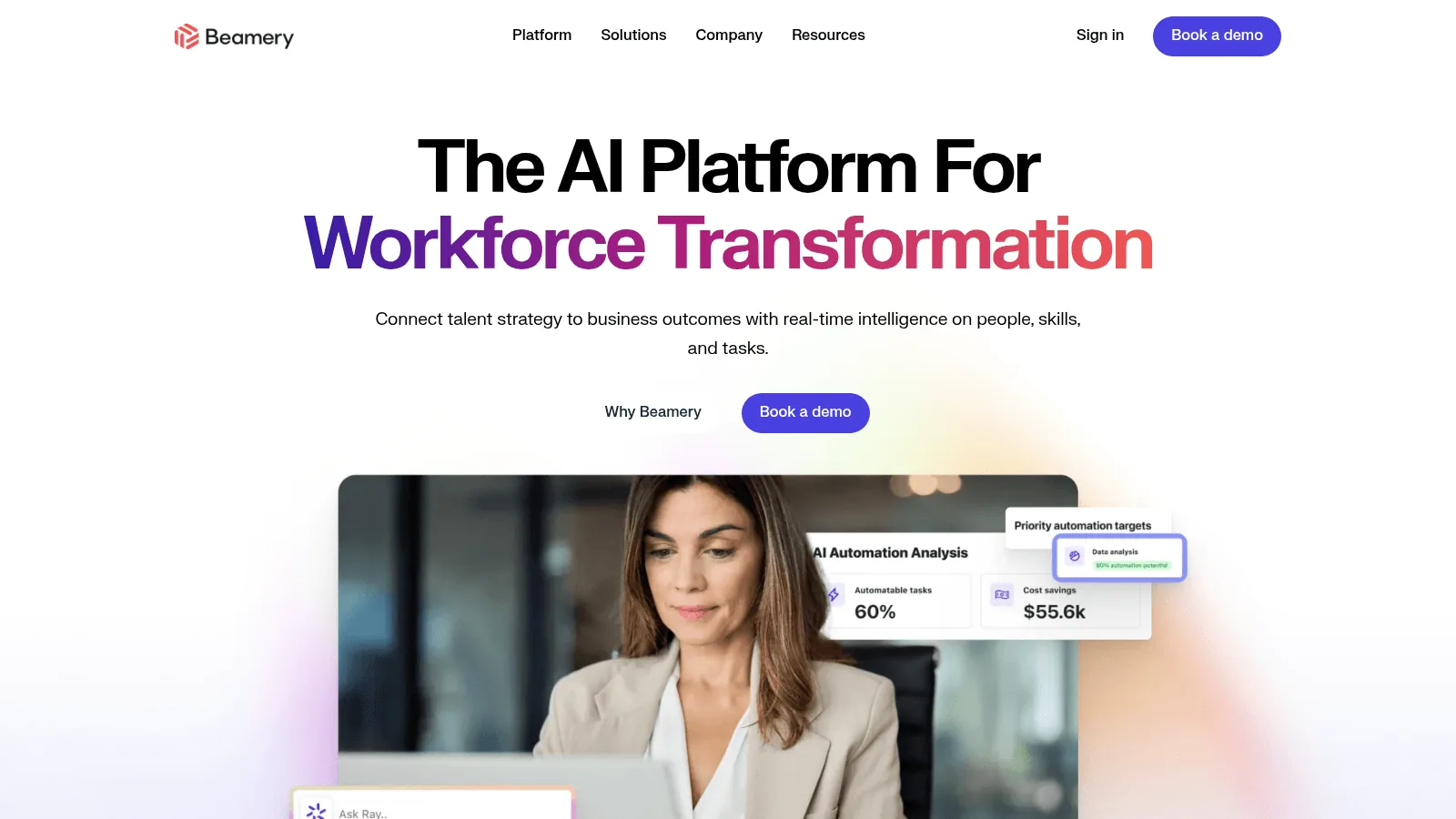
Overview: Beamery calls itself "The AI Platform For Workforce Transformation." It combines a data platform, a Workforce Intelligence Suite for scenario modeling, an agentic AI assistant called Ray, and an Execution Suite for sourcing, matching and engagement.
Key features:
- Scenario modeling for workforce plans that balance automation, reskilling and hiring.
- Ray, an agentic AI assistant that works across the platform.
- Workday and SAP integrations, so plans connect to the HR systems large employers already run.
Pricing: No price is published. Beamery starts with a demo booking.
Pros: Planning and execution in one platform, scenario modeling, Workday and SAP integrations
Cons: Quote only, demo first, an API and daily export that cover your own Beamery records rather than market data
Why it earns a place here: It links the workforce plan to the hiring that delivers it, so HR doesn't plan in one tool and recruit in another.
Final verdict: Choose Beamery when a workforce plan has to turn into hiring and reskilling in the same system.
Dashboard, API, Feed or MCP: How Each Tool Delivers
Where the data lands decides who on your team can use it. A dashboard serves analysts and HR partners, while an API, a data feed or an MCP server serves engineers, warehouses and AI agents. If the API route is new to you, our data enrichment API guide explains how calls and credits work.
The table records what each vendor's own pages show. "Not seen" means we didn't find it on the pages we read, not that it doesn't exist.
| Tool | Dashboard or app | API | Data feed or warehouse | MCP |
|---|---|---|---|---|
| Reverse Contact | Web app for search and Lists, no analytics | Yes | No (CSV export, no datasets) | Yes |
| Revelio Labs | Yes (Terminal) | Yes | Yes | Yes |
| Live Data Technologies | Yes (Live Data app) | Yes | Yes | Yes |
| Lightcast | Yes (Talent Analyst) | Yes (documented API, access by request) | Yes | Yes |
| TalentNeuron | Yes | Yes | Yes | Not seen on the pages read |
| Draup | Yes | Yes | Yes | Yes |
| Eightfold | Yes (suite) | Yes (integration API for your own records) | Not seen on the pages read | Not seen on the pages read |
| Beamery | Yes (suite) | Yes (developer API for your own records) | Yes (daily SFTP export of your own records) | Not seen on the pages read |
Seven of the eight put analytics in a dashboard or app, and all eight document an API, though Eightfold's and Beamery's connect to their own suites rather than sell you market data. Revelio Labs, Live Data Technologies, Lightcast and Draup offer all four routes, while Reverse Contact has no analytics, so plan where its data will live before you buy.
How We Chose These Talent Intelligence Tools
To pick the best talent intelligence software for this list, we started from the pages that rank for this keyword and kept tools that answer a question about a market or a workforce, not just "who should I contact?" That ruled out recruiting suites, interview-notes apps and pure sourcing tools that show up on other lists.
Each tool had to describe its data and delivery on its own site, and we read every product and pricing page on November 3, 2026. We dropped Aura, a workforce-data name on several lists, because its domains now redirect to a Bain & Company consulting page. Other people-data APIs and bulk data sellers were left out as well, and our People Data Labs alternatives guide compares them.
We didn't run our own data tests on these tools. Every vendor count in this article is that vendor's own figure, so treat it as a claim to check in your trial or demo.
What to Look for in Talent Intelligence Software
Four checks separate a useful talent intelligence platform from an expensive one. Each can be run during a trial or a demo, before you sign.
A Skills Taxonomy You Can Check
Skills counts vary wildly and don't compare. The EU's ESCO classification describes 3,039 occupations and 13,939 skills linked to them, translated into 28 languages, and it's free. Vendors claim far more: Draup 27,000+, Revelio Labs 33,500, Lightcast 34,000+, TalentNeuron 65,000+ and Eightfold 1.6 million. A bigger number can mean finer skills, or more synonyms and duplicates, so ask how each vendor groups them.
Grouping is the hard part. A data engineer supporting recruiting projects asked us whether that was their job "or do you have some broader abstraction on top of those skills." Raw skills lists need mapping into families like "data analytics" before they answer anything, and our person record is an example of raw input: skills arrive as unmapped text.
History Deep Enough for Trends
A headcount today tells you little, because a trend needs history. Revelio Labs goes back to 2007 and Live Data Technologies to 2019. For trend lines, use a vendor that holds history, and ask each one how far back its history runs for your segment, not just overall.
Detail for Niche Roles
Broad coverage can still miss your roles. One poster hiring for niche UK executive consulting roles and about to renew a market-data license wrote on Reddit that broad labor-market platforms seemed strong on general, global insight but thin on the detail niche roles need. They wanted to know where similar companies get their people, where those people go when they leave, and accurate team sizes by sector and department.
That's one poster's view, but it's a fair test. Bring three hard roles you already know well to every demo and see what comes back.
License Terms for Where the Data Goes
Check what you're allowed to do with the output. Live Data Technologies licenses for internal use, resale and AI training. Our plans cover your own team's use, while a product your customers use calls for our Platform plan. Ask each vendor whether its data can feed an AI model or reach your customers before you sign.
Where Relationship Intelligence Fits for Talent Teams
Search for relationship intelligence tools for talent teams and you'll mostly find candidate CRMs: tools that log who on your team knows a candidate and keep nurture going. They answer "who do we know?" rather than "what does the market look like?", so none is on this list. If you need contact details for a candidate you've already found, that's a contact-finder job, covered in our SignalHire alternatives.
Building Talent Intelligence on Your Own Data
Some teams don't want another dashboard. They want the counts inside their own warehouse or product, next to their own HR data, and for a narrow question that build is smaller than it sounds.
One team we spoke with wanted to count the machine-learning engineers at each organization they were pitching, because headcount by role made their business case. Buyers also ask us whether they can search every employee of a company rather than look up one profile at a time. For talent mapping, that's the first thing to check in any API.
A workable order looks like this:
- Define the segment by role, seniority, location, industry, career length and company-size range.
- Run the free count first to map the market, then pull profiles only for the segments you'll analyze.
- Compute on your side the fields our filters don't cover.
- Group raw skills into the families your team already uses.
- Put the counts next to your own HR data, so the gap shows.
Our people search API handles the first two steps, returning full profiles. What a build like this can't give you is headcount trends over time or the demand side of the market, meaning job postings and pay. For those, Revelio Labs, Live Data Technologies and the labor-market platforms above are the better route.
How Much Talent Intelligence Tools Cost
Two of the eight publish a price. Revelio Labs' Terminal starts at $1,250 a month on an annual commitment. Our credit packs start at $100, and our plans for your own team at $249 a month, with a monthly commitment.
Revelio Labs' Terminal price and ours cover different things, a finished analytics app versus raw records you analyze yourself, so compare what a full project costs, not the entry price. The other six (Live Data Technologies, Lightcast, TalentNeuron, Draup, Eightfold and Beamery) quote through sales, and Live Data Technologies also offers a free trial account.
Whether the spend pays off depends on what you'll do with the data. On Reddit, a recruiter who lost access to TalentNeuron asked for free supply-and-demand and salary data by job title to keep coaching hiring managers.
In the replies, one commenter said they'd never seen anyone get solid ROI from such a platform, while another uses one to show hiring teams and HR business partners the market, to see if they can tweak salary and years-of-experience asks.
Anecdotes like these still point at the right test. Name the decisions the data will change before you buy, then check whether each tool's answers would have changed them.
Which Talent Intelligence Tool Fits Your Team
Start from who will use the answer, because that decides where the data should land:
- HR and workforce planning teams at large employers will find the best talent intelligence tools for HR teams among the suites: Eightfold for skills-based mobility, Beamery for plans tied to hiring.
- For recruiters who need market answers for hiring managers, the leading talent intelligence tools for recruiters are the labor-market platforms: Lightcast, TalentNeuron and Draup.
- People analytics and data teams that want workforce data in a warehouse should look at Revelio Labs and Live Data Technologies, or at the bulk employee-record vendors in our Coresignal alternatives.
- Teams building talent features into a product their customers use can start with Reverse Contact's API or Live Data Technologies' resale license for job changes, then add labor-market data for demand and pay.
Whichever group you start in, use the same three roles you know well in every trial or demo, so the answers compare side by side.
FAQs
What is a talent intelligence platform?
A talent intelligence platform combines outside labor-market and workforce data with your own HR data to answer workforce questions: where to hire, which skills you lack and who could move internally. Some, like Revelio Labs, also let you pull the raw data out, while others, like Eightfold, build it into an HR suite.
How is talent intelligence different from a sourcing tool?
A sourcing tool returns people to contact. Talent intelligence returns an answer about the market: how big a skill pool is, which employers hold it, what it pays and where people are moving. Many teams use both, one to size the pool and the other to reach candidates in it.
How much does talent intelligence software cost?
Most vendors quote after a demo. Of the eight here, Revelio Labs publishes a Terminal price from $1,250 a month on an annual commitment, and Reverse Contact publishes credit packs from $100 and plans from $249 a month. The other six quote on request.
Do talent intelligence tools track job changes?
Some do. Live Data Technologies is built around job changes, re-verifying 124 million professionals every 10 to 14 days, and Revelio Labs sells a transitions database. Reverse Contact doesn't monitor people or send an alert when someone moves, so pair it with one of them when you need moves as they happen.
Can you build talent intelligence yourself?
Yes, for narrow questions. With a people and company data API you can count people by role, seniority, location and company, then group skills and compute extra fields on your side. A build won't give you headcount history, job postings or salary benchmarks, so you'd pair it with a labor-market source.
The data layer behind your GTM engine
Access fresh people and company data through one API and power every enrichment, prospecting, and automation workflow.
- Profiles
- 800M+
- Refreshes / month
- 200M
- Response time (P95)
- 500ms