
6 Crustdata Alternatives: B2B Data APIs Compared (2026)
Julien K.Published
Key takeaways:
- Crustdata sells three kinds of freshness from one credit balance: an indexed database it says is refreshed every 1 to 30 days, live retrieval at request time (7 credits a person, on Enterprise or the live add-on), and watchers at 5 to 150 credits per changed person.
- Crustdata is now self-serve, with $20 in free credits and credits that last 12 months, though older comparison pages still call it quote-only or say credits expire after six months.
- Pick an alternative by the kind of freshness you actually use. Coresignal sells all three kinds. Explorium, TheirStack and Specter push events or signals to you, ZoomInfo GTM AI sells an indexed database by the record, and Reverse Contact checks a record's age for free and refreshes it live on demand, but sends no change alerts.
- Test on records whose answers you know, including people who changed jobs recently, and count wrong answers as well as matches.
Crustdata sells people, company and job data through an API built for software and AI agents. You search with filters, enrich a person or company from an identifier, and set up watchers that tell you when something changes. Its docs are clear, an empty search costs nothing, and every response shows the credits that call used.
So why do teams look for Crustdata alternatives? Often it's the way the parts they need most are gated and metered. Batch jobs sit on Enterprise plans, live endpoints need Enterprise or the live add-on, and the freshest watcher tier costs 30 times the default one, a premium you only escape by accepting slower alerts.
This guide maps six alternatives onto the kind of freshness each one sells, because that's where the price differences hide. Alongside the list, you'll find Crustdata pricing broken down by call and Crustdata use cases matched to alternatives.
We make Reverse Contact, so it leads the list, and its Cons name its real limits. Prices are in US dollars, as each vendor listed them on November 2, 2026.
Three Kinds of Freshness, Three Different Prices
Crustdata sells three kinds of freshness, each at its own price. The first is the indexed database. Crustdata's pricing page says its 1B+ people and 60M+ companies (its own figures) are "refreshed every 1 to 30 days," and that tier is open on every plan.
The second is live retrieval, where the record is fetched at the moment you ask. A live person enrich costs 7 credits a profile.
The third is the watcher. You hand Crustdata a list of up to 10,000 people or companies, and it tells you when a field changes, by Slack, email or webhook (a message its server posts to yours). You pay per changed record, and the price climbs with how fresh you want the data behind each alert.
Which one you need depends on the field. A data-business founder we spoke with framed the first question as "what's durable data and what's ephemeral data." A profile identifier rarely changes, so a lag of a month or two doesn't hurt it. A current job title can be wrong a week after someone resigns.
Why Teams Look for Crustdata Alternatives
Crustdata has real strengths, so start with them: watchers with a choice of freshness, live endpoints, job search at 0.03 credits a result and a hosted MCP server with 40 tools (MCP is the protocol AI assistants use to call outside tools), plus spend caps per API key.
The reasons people leave come from its own published terms:
- Live search and live enrich need Enterprise or the live add-on; batch jobs need an Enterprise plan (live batch is an add-on).
- Default rate limits are 15 requests a minute on enrich, 30 on search and 10 on live endpoints, with higher limits through support.
- Keeping a watched person 1 day fresh costs 150 credits each time they change, against 5 on the default 30-day setting.
The rate limits matter most for agents. At the default 15 enrich requests a minute, 20,000 lookups take about 22 hours, so an agent looping over a large list needs higher limits, or a queue and a day's patience.
Some reasons in circulation are out of date. Comparison pages that rank for this search still say Crustdata has no self-serve plan, starts at $500 a month or expires credits after six months, but Crustdata's live pages say otherwise.
Crustdata Pricing: What Each Kind of Freshness Costs
Crustdata's pricing page opens with "Start free with $20 in credits, or talk to us about enterprise plans from four figures a month." You get an API key the same day, buy credits once or set auto top-up (reloads from 500 credits, with an optional monthly limit), and credits stay valid for 12 months. The table lists its standard credit costs.
| Call | Credits | Who can use it |
|---|---|---|
| People or company search | 0.03 per result, plus 0.1 to 2.5 for premium fields | All plans |
| Person enrich | 1 for the base profile, up to 9 with add-ons: work email +1, personal email +2, phone +2, developer platform +1, research profiles +2 on request | All plans |
| Company enrich | 2 to 4 | All plans |
| Job search | 0.03 per result | All plans |
| Contact Enrich endpoint (emails, phones) | 1 to 5.5 per matched person | Enterprise |
| Live person enrich | 7 per profile | Enterprise or live add-on |
| Person watcher | 5, 10, 20, 50 or 150 per changed person at a 30, 14, 7, 3 or 1-day setting | Open to all API customers; the 3-day tier is API only |
| Company watcher | 5 per changed company, 30-day setting only | No plan gate published |
Crustdata's own pages disagree on the person enrich ceiling: its pricing page says "1 to 9 credits per person" in the credits explainer and "1 to 4 per person" in the endpoint table, and its docs say 9 on their own pricing page and 4 on the person enrich page. The add-ons above reach 9, so plan for 9 if you add every field. Watchers bill nothing on a run that finds no change.
Dollars are harder to pin down. The only dollar-per-credit figure we found for Crustdata is on its own buying guide (updated October 16, 2026): "$0.30 to $0.01 per credit, lower depending on plan." Its pricing page example, a search of 1,000 people plus 35 enriched with a work email, comes to 100 credits, which by our arithmetic is $30 at the top of that range and $1 at the bottom.
Watchers are where the bill can move fastest. Say you watch 1,000 people and 40 of them change in a month. That's 200 credits at the default 30-day setting, 800 at 7 days and 6,000 at 1 day. The illustration is ours; the multipliers are Crustdata's.
The 6 Best Crustdata Alternatives
People Data Labs is off this list on purpose: it competes on dataset scale and bulk records you load into your own warehouse, so choosing among People Data Labs alternatives is a different purchase from replacing Crustdata's API.
The table maps the six Crustdata alternatives onto Crustdata's three kinds of freshness: indexed and live tiers in one column (every live tier we found is tagged), change alerts in the next, and Crustdata at the bottom for reference.
| Tool | Built for | Indexed and live tiers | Change alerts | Price from (basis) |
|---|---|---|---|---|
| Reverse Contact | Product lookups in code | Indexed: cached records, age checked free. Live: 2 credits, every plan, async by webhook or polling | None: re-fetch and compare | Credit packs from $100, valid 3 months; Go $249 a month |
| Coresignal | People, company and job records from one vendor | Indexed: full record 20 credits, core 10. Live: Real-time Employee API, 12 credits, from the Growth plan | Webhooks: employees weekly, companies daily; free notifications, but fetching the change costs Collect credits | Mini $49 a month for 2,500 credits; real-time endpoint from Growth, $1,000 a month |
| Explorium | Agents that act on business events | Not covered here (we review its events only) | Events pushed to your webhook, 1 credit an event on its pricing page (push metering not documented) | $29.99 one-time pack of 500 credits |
| TheirStack | Hiring and tech-stack signals | Indexed: jobs 1 credit, companies 3 | job.new, job.closed and company.new webhooks, billed per event | $49 a month for 1,500 credits |
| Specter | VC and private-market teams | Indexed, daily incremental updates (its claim); saved-search feeds you poll | Slack, email and webhook integrations | Not published; the API needs a platform seat |
| ZoomInfo GTM AI | ZoomInfo data without seats | Indexed: search and lookup free, 1 data credit per record enriched or exported | None found on the pay-as-you-go API; the separate GTM One app has job-change and funding triggers | Pay as you go from $20; $0.38 a data credit at the $1,000 tier |
| Crustdata (reference) | Agents and sales tools | Indexed: every 1 to 30 days. Live: enrich 7 credits, Enterprise or add-on | Watchers to webhook, Slack or email, 5 to 150 credits per changed person | $20 free credits; enterprise from four figures a month |
After ours, the Crustdata competitors fall into three groups: Coresignal, the closest like-for-like replacement; the event and signal specialists Explorium, TheirStack and Specter; and ZoomInfo's API-only database, which stands in for the indexed tier only. Credits are each vendor's own unit and differ in dollar value, so compare dollars per usable record, not credit counts.
1. Reverse Contact
Best for: Products that look people up on demand.
Overview: Reverse Contact is our people and company data API. Send it a work email, a full name with the employer's web domain, a company domain, or a set of filters, and it answers with one consistent JSON record (a text format programs read directly). We publish 800M+ profiles and 70M+ companies (our own figures). FullEnrich and allGood are examples of products that build on Reverse Contact.
Of Crustdata's three kinds of freshness, we cover the first two. Each person profile carries the date of its last full refresh, which /check reads for free (the workspace needs at least 2 credits left to call it).
Our docs' October 29 snapshot, self-reported, covers a quality-rated subset of profiles rather than the whole base: 62% were refreshed in the last 30 days and 94% in the last 90, so check each record's own date.
A recent copy comes from cache, the fast path: it's returned in the same request, with no queue. For an older one, you request a live refresh, 2 credits, delivered later by webhook or polling. Our docs target under 15 seconds a result, but one can take tens of minutes, so queue it.
We don't sell the third kind, watchers. To follow a known person, you schedule re-fetches yourself, and each live one costs 2 credits on every plan.
Key features:
- People and company search comes with a free count of matches, so you size a segment before paying.
- A business email costs 3 credits when found and a phone 20 when a lookup finds one, and we validate both at request time.
- Ambiguous identities can return alternative candidates, so the final call is yours.
- Bulk refreshes of up to 25,000 people per request with an age cut-off: newer profiles come from storage at 1 credit, older ones go live at 2.
- Delivery by REST API, webhooks, a CLI (command-line tool), TypeScript and Python SDKs and an MCP server your AI assistant can call, plus file uploads (people, or company domains) that come back enriched as CSV.
Pricing: The pay-as-you-go route is a credit pack, from $100, usable for 3 months. Three plans remove the meter one endpoint family at a time, each capped at 100,000 profiles a day per workspace.
Go at $249 a month makes stored /fetch/* lookups by profile ID or URL unlimited. Plus at $449 brings in /search/*, and Max at $699 brings in /enrich/*, the endpoints that take an email, a person's name or a company domain. Live refreshes, business emails and phones draw credits on every plan, and a live refresh that finds no profile still costs 2. Plans carry a monthly commitment; credit packs carry none.
Go, Plus and Max are for your own team. If your customers will see the data, inside your product or resold, that's a Platform deal, priced with our sales team.
Pros: A free age check, then cached or live chosen per call, live refresh on credits and on every plan, bulk runs that go live only for profiles past your age cut-off, nothing billed when an email or phone lookup comes back empty, 100 requests a minute by default on credits or any plan
Cons: No watchers or change alerts, so spotting a change means re-checking the record yourself; our published API schema has no job postings, revenue figures or funding rounds
How to start using it:
- Create a workspace with free trial credits, no card required.
- Build the 200-record test set from the testing section below.
- Run
/checkon each one to see its last full refresh date. - Read cached copies of the recent ones, request live refreshes for the oldest, and compare titles and employers with what you know.
- Size a pack or plan from how many records needed a live refresh.
Why it's a good Crustdata alternative: You decide per record whether the stored copy is fresh enough, and you pay for live retrieval only where it isn't.
Final verdict: Choose Reverse Contact when your product looks people and companies up on demand and you want to control freshness call by call. It fits best where each lookup happens at the moment of use, such as a signup, a CRM update or a step in an agent's task.
2. Coresignal
Best for: A like-for-like records and jobs API.
Overview: Coresignal is the closest match to Crustdata on this list: people, company and job-posting records by API, with an MCP server and push webhooks on every plan. Its Real-time Employee API, from the $1,000-a-month Growth plan, fetches a live profile on demand at 12 credits a call, in under 30 seconds when the record isn't already stored, per its docs.
Coresignal's webhooks map onto Crustdata's watchers: employee changes weekly, company changes daily, and experience webhooks for positions added or closed, subscribed by field. Notifications are free but carry only the profile ID, its status and the changed field names, so getting the new values is a normal Collect (record fetch) call.
Key features:
- Employee and company records at 20 credits for the full record, or 10 for the core fields.
- Job postings at 1 credit each, and contact enrichment at 10 credits per email found.
- Credits deducted only when a request succeeds.
- Rate limits from 5 requests a second (300 a minute) on Mini and Starter.
Pricing: Monthly plans start with Mini, 2,500 credits for $49, and climb through Starter at $199 for 12,000 and Growth at $1,000 for 150,000 to Elite, where $5,000 buys 10M. Yearly billing takes 10% off, and a free trial gives 2,000 credits for 7 days.
Pros: A full public price ladder, webhooks with no per-notification charge, job postings in the same account
Cons: A full employee record costs 20 credits, and on monthly plans unused credits roll over for 3 months only from the $1,500 Premium plan up (yearly plans' credits last 12 months and don't roll over)
Where it fits: Teams that want Crustdata's mix of people, company and job data, with change notifications that cost nothing until you fetch the changed record. Model the per-record cost against your volume first, since that unit cost is what sends some teams looking at Coresignal alternatives later.
Final verdict: The most direct swap on this list, at a published price.
3. Explorium
Best for: Agents that react to business events.
Overview: Explorium's events API is a different shape of freshness from Crustdata's watcher: instead of tracking every field on a record, you receive events, such as hiring trends or an IPO announcement, about the businesses and prospects you follow. Explorium's pricing page lists Events at 1 credit. Its docs don't say how pushed deliveries are metered, so confirm that before you rely on push.
Key features:
- Pull for up to 40 IDs per request, or enroll entities and receive each event at your webhook, with signed payloads.
- An MCP server for AI agents.
Pricing: Packs are prepaid: 100 free credits, then $29.99 for 500, $149.99 for 5,000, $749.99 for 30,000 and $7,499.99 for 500,000. Credits last 12 months, packs are non-refundable and don't renew automatically.
Pros: A low first pack, a published event credit rate, the same 12-month credit life as Crustdata
Cons: Events aren't full records, so you'd add its enrichment calls (not covered here) for profiles; packs are non-refundable, and its homepage gives two different coverage totals
Why buyers shortlist it: An agent that only needs to know when something happens can buy events rather than watch whole records.
Final verdict: Worth testing when events, not profiles, drive your workflow.
4. TheirStack
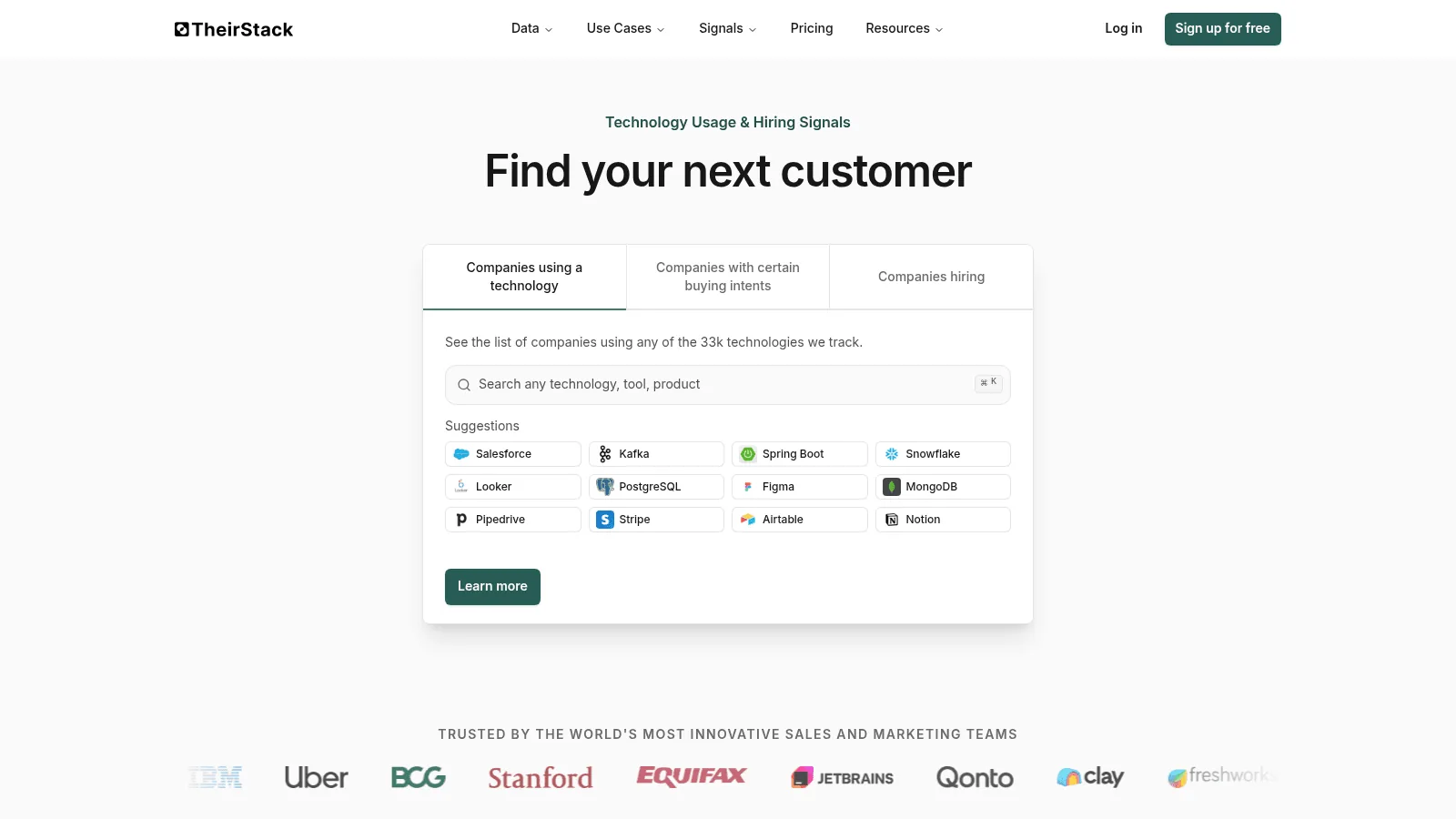
Best for: Hiring and technology signals by API.
Overview: TheirStack replaces the jobs side of Crustdata. It sells job postings, company records and technographics (which software a company uses), with no people database and no contact data of its own, though job records name the hiring-team person (name and role) where known.
Freshness arrives by webhook whenever a posting opens or closes or a new company appears, and every API plan includes those webhooks plus an MCP server. A webhook event costs the same as pulling the record.
Key features:
- 1 credit per job, 3 per company and 3 per technographics lookup.
- Unlimited team members on every paid plan.
- A rate limit of 4 requests a second (240 a minute).
Pricing: API plans are monthly, from $49 for 1,500 credits through $600 for 100,000 up to $5,500 for 5M, and unused credits roll over for 12 months. The free plan, with 50 company credits and 200 API credits monthly, is only for accounts that have never paid, according to TheirStack's docs.
Pros: Billed only when data is returned, closed postings flagged, a free monthly allowance before you pay
Cons: No people database or contact data, and its own pages give different job totals
Its real strength: Hiring signals pushed to you as they happen, with closed roles marked, at a published price.
Final verdict: Pair it with a people API if your Crustdata use was mostly job data.
5. Specter
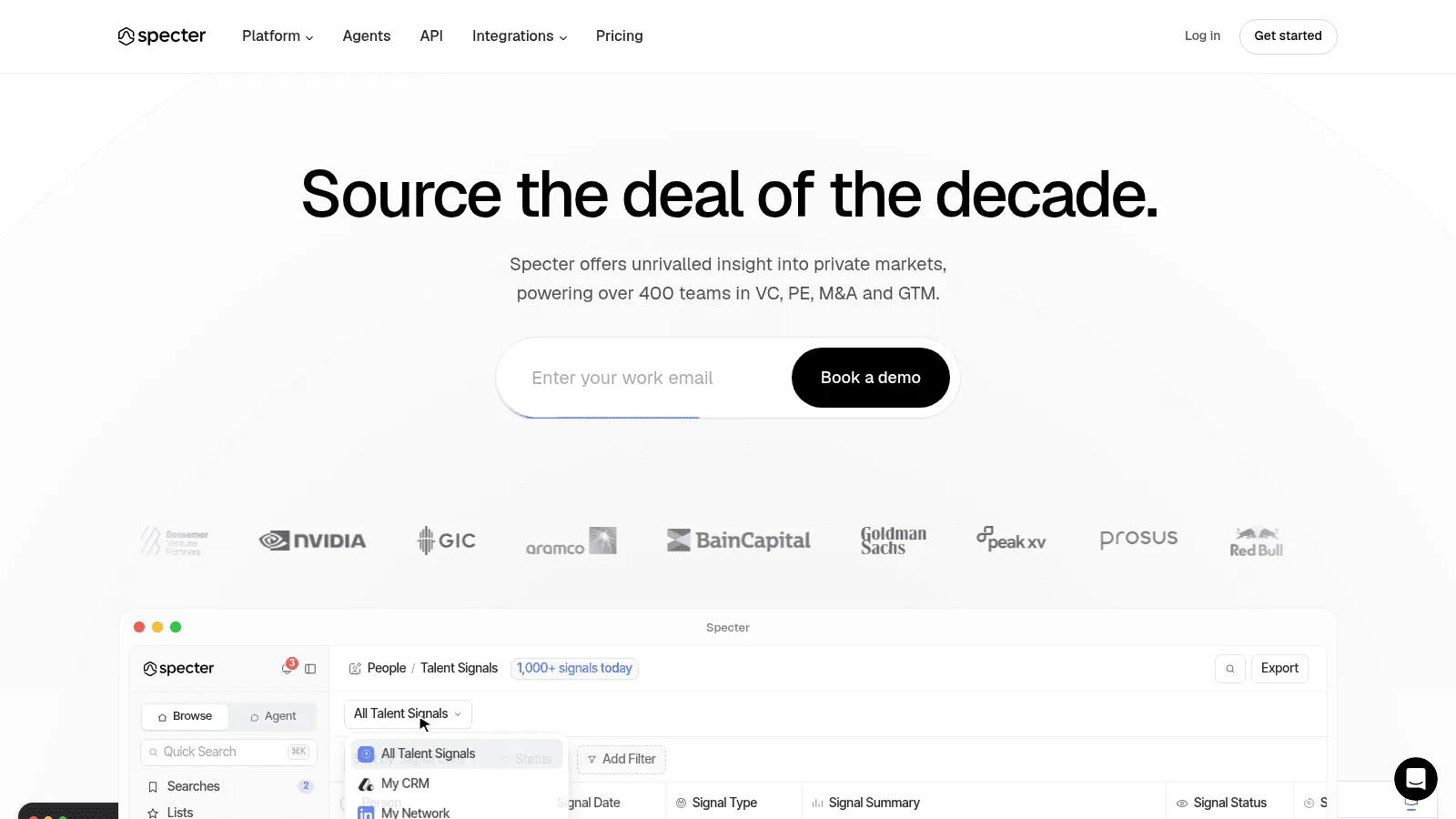
Best for: VC and private-market deal teams.
Overview: Specter covers the venture capital use case Crustdata markets: startups, founders, investors and transactions. Its 73 REST endpoints sit behind one API key, and it says it runs daily incremental updates across every dataset.
Freshness reaches you through saved searches you poll as feeds, or through Slack, email, Zapier and webhook integrations.
Key features:
- Signals for talent moves, investor interest, revenue and news.
- An MCP server with 29 tools and 100 free tool calls a day per user.
- Misses are free; enrichment is charged per matched result.
Pricing: Platform, API and bulk data are all "Get pricing," and its docs list credits per endpoint with no dollar rate. You can request 200 free API credits to start.
Pros: Investor and transaction data beside company and people records, 15 requests a second, free misses
Cons: No public price, an API that requires a platform seat, a weaker fit for general sales prospecting
Where it beats the field: Private markets, the Crustdata use case the general data APIs here cover least well; outside them, it's narrower than most company research tools.
Final verdict: Get a quote if you're a fund replacing Crustdata's founder data.
6. ZoomInfo GTM AI
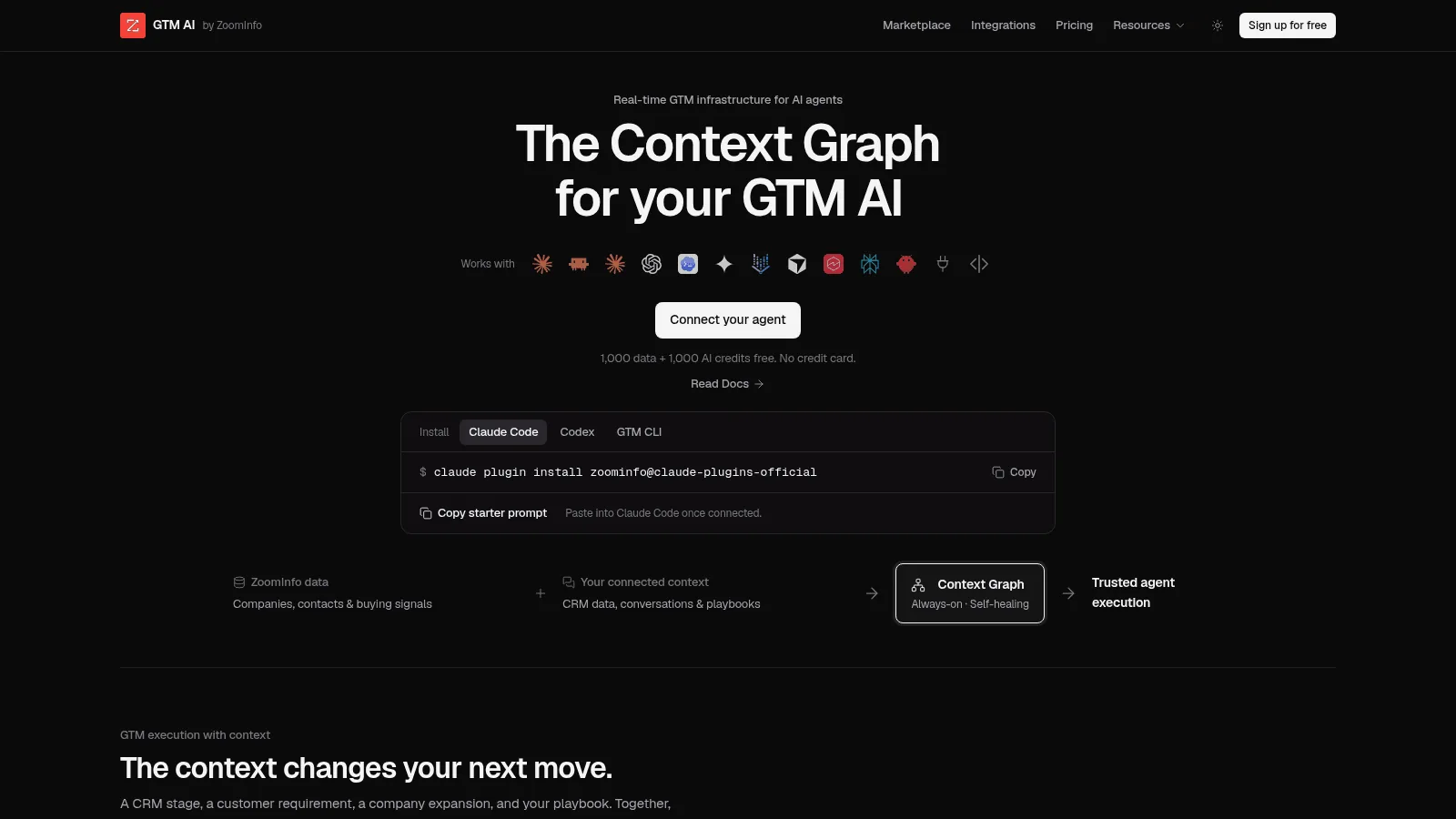
Best for: ZoomInfo's data, metered without seats.
Overview: GTM AI, at gtm.ai, is ZoomInfo's contact, company and intent data sold "headless," meaning by API, MCP or CLI with no app on top. It replaces Crustdata's indexed tier: search, lookup and find-similar are free, and you pay 1 data credit per record you enrich or export.
On the pay-as-you-go API we found no change-alert endpoint, so freshness means re-pulling records. GTM One, a separate ZoomInfo app, can trigger workflows on job changes, funding and ZoomInfo Scoops, and email saved-search alerts.
Key features:
- API, MCP and CLI access included, at 5 requests a second.
- AI credits for agent work at $0.05 each.
Pricing: Signup includes 1,000 data credits and 1,000 AI credits, no card. After that it's pay as you go from $20, "One tier, no contract, no seat fees," and a data credit costs $0.38 at the $1,000 tier.
Pros: A published price per data credit, free search and lookup, no contract
Cons: Mobile numbers and SLA-backed support are Enterprise only, its page gives two different credit-expiry rules, ZoomInfo's license terms bar incorporating its data into your own products (confirm what applies to GTM AI)
Why it's a good Crustdata alternative: ZoomInfo's records come without seats or a contract, and the 1,000 free data credits at signup cover a first test.
Final verdict: A good fit for internal agents and sales tools, less so if your customers will see the data.
Crustdata Use Cases, Matched to an Alternative
Crustdata markets six solutions. Data enrichment is what this whole guide compares, so the table matches the other five Crustdata use cases to an alternative.
| Crustdata use case | What it sells for it | Alternatives to test |
|---|---|---|
| AI SDR and prospecting on live signals | Real-time search and enrichment, self-updating lists, post data | Reverse Contact for lookups on demand, Explorium for events |
| Internal sales tools | Lists that update themselves, CRM kept current by watchers | Coresignal webhooks, Reverse Contact with scheduled re-fetches, or ZoomInfo GTM AI if lists can wait for a re-pull |
| Customer success | Watching champions for promotions and company moves | Coresignal employee webhooks |
| Recruiting | Candidate watchlists, scoring and new-candidate feeds | Reverse Contact or Coresignal for people search, TheirStack for hiring signals |
| Venture capital | Founder and stealth-startup discovery, portfolio tracking | Specter |
Not every signal needs a watcher. Teams we talk to often re-check a contact right before an outbound message goes out: a single lookup at the moment of use. If you're building sales products on top of people data, that lookup-first pattern keeps each message current without watching every contact.
Hiring signals deserve a caution before you build on them. Job postings measure who advertises online, not who hires. A September 2026 NBER working paper found that postings track large employers well but overstate how concentrated hiring is by nearly threefold, because small and mid-sized employers post less online.
OECD researchers found something similar when they compared one large postings provider with official US vacancy data. Postings matched the shape of hiring better than its level, and even the shape was off by sector: education, health care and social assistance roles were over-represented by 7 percentage points, and professional, scientific, technical and administrative services under-represented by 10. Both studies used Lightcast data, but the gaps apply to any hiring signal, Crustdata's included.
How to Test a Crustdata Alternative on Your Own Records
Crustdata's own buying guide tells you to send the same sample to two or three vendors, and that's the right instinct for any Crustdata alternatives you shortlist. What matters is how you build the sample and what you score.
A stale record does more damage than an empty one. An outdated employer leads to the wrong company domain, and the wrong domain leads to the wrong work email, so the error compounds before anyone notices. Build the test to catch it:
- Pull 200 records you know well, including 30 to 50 people whose jobs you know changed within the past six months.
- Send the same inputs to Crustdata and to each alternative you're testing.
- Score matches, empty results and wrong answers separately, because a vendor that returns more can also return more wrong.
- Note each returned record's age, where the vendor reports one.
- Time live calls at your real volume, against the vendor's default rate limit.
- Divide credits spent by usable records to get your real cost per record.
Run it twice if freshness is the reason you're switching, once on cached or indexed data and once live, wherever your plan includes live calls (on Crustdata, Enterprise or the live add-on). Almost every technical buyer we talk to asks the same thing first: is a profile fetched live or served from storage, and how old can it be? The test answers that for your own records.
If you're building the test harness from scratch, write it against the request and response shapes of a data enrichment API, so the same script can call every vendor.
Moving Off Crustdata Without Breaking a Pipeline
Plan for watchers first, because they're the hardest piece to replace. If your alternative has webhooks, as Coresignal, TheirStack and Explorium do, or Specter through its integrations, map each Crustdata watcher onto the closest event and check its cadence. Coresignal's employee webhooks run weekly, so a team on Crustdata's 3-day or 1-day watchers would see changes later, and its subscriptions last 91 days, so schedule renewals.
If your alternative has no alerts, as with Reverse Contact or ZoomInfo GTM AI's API, you build the loop yourself: re-fetch the records that matter on a schedule, compare each new record with the old one, and flag a changed title or employer. How often to re-run that loop is the same question our CRM data enrichment guide answers for sales records.
Price the loop in credits before you switch. With us, a live re-check costs 2 credits whether or not the person moved, so re-checking 1,000 people live every week comes to about 8,700 credits a month. A bulk run with an age cut-off goes live only for profiles past it and reads the rest from storage at 1 credit, but a record's age still can't tell you whether the person changed.
With alerts settled, line up the rest. Map response fields before you switch, because no two vendors name them the same way. Time the move around your Crustdata balance, since those credits last 12 months. Run both vendors in parallel on live traffic for a few weeks before you turn Crustdata off.
Which Crustdata Alternative to Pick
Stay on Crustdata if you rely on its 1-day or 3-day person watchers, or on person, company and job watchers drawing on one credit balance. Nothing here replaces that: outside Specter's private-market data, no entry publishes a person-change cadence faster than Coresignal's weekly employee webhooks.
Otherwise, start with the kind of freshness you actually pay Crustdata for. If it's watchers, look at Coresignal for records, TheirStack for hiring and Explorium for events. If it's live retrieval, Reverse Contact sells it on every plan and Coresignal from its $1,000 Growth plan. If it's mostly indexed search and enrichment, Coresignal, ZoomInfo GTM AI and Reverse Contact all sell that self-serve. If you're a fund, get a Specter quote.
If your product looks people up one at a time and you want to decide per call how fresh is fresh enough, test us. Try it on your records, with the people you know moved jobs in the sample. Signup gives you free trial credits, no card required.
FAQs
What are the best Crustdata alternatives?
Coresignal is the nearest like-for-like swap, Explorium and TheirStack push events and hiring signals, Specter covers private markets, ZoomInfo GTM AI meters its database per record, and Reverse Contact suits products that fetch people and company records on demand.
Who are Crustdata's main competitors?
Coresignal and Explorium both publish their own comparison pages against Crustdata, and Crustdata's own ranking post measures itself against People Data Labs, a bulk-records purchase we cover in a separate guide. Among other Crustdata competitors, ZoomInfo overlaps on enterprise accounts, TheirStack on job data and Specter on venture capital.
How much does Crustdata cost?
Crustdata pricing starts with $20 in free credits, and enterprise plans start "from four figures a month." Searches cost 0.03 credits per result, live person enrich 7 credits, and watchers 5 to 150 credits for each changed person. Its buying guide puts credits at $0.30 to $0.01 each, depending on plan.
Do Crustdata credits expire?
Yes. Purchased credits last 12 months from the purchase that added them, and the earliest-expiring credits are used first. Some comparison pages still say six months, but Crustdata's current pricing page and docs both say 12.
Which Crustdata alternatives send change alerts?
Coresignal sends employee changes weekly and company changes daily by webhook, TheirStack sends new and closed jobs, and Explorium pushes business and prospect events. Specter offers saved-search feeds plus Slack, email and webhook integrations. ZoomInfo GTM AI's API has none we found, though its separate GTM One app has job-change and funding triggers. Reverse Contact sends none: you re-fetch and compare records yourself.
The data layer behind your GTM engine
Access fresh people and company data through one API and power every enrichment, prospecting, and automation workflow.
- Profiles
- 800M+
- Refreshes / month
- 200M
- Response time (P95)
- 500ms