
Apollo vs Clay (2026): Database or Enrichment Engine?
Julien K.Published
Key takeaways:
- Apollo.io bills every seat, with paid plans from $49 a month per seat billed annually, and each seat brings database credits, sequences and a dialer. Clay charges a flat price per workspace, with paid plans from $167 a month billed annually, unlimited seats and two usage meters: actions and data credits.
- On annual sticker prices, Clay's Launch plan costs the same as 3.4 Apollo Basic seats, so a 4-rep team pays Apollo more before a single credit is spent.
- In our 3-rep, 1,500-contacts-a-month example, Apollo is the cheaper bill at list prices in all three scenarios: $147 a month against $167 for emails only, and for full records, $357 against about $468 or more.
- The pairing both vendors describe, 3 Apollo Basic seats plus Clay Launch, costs $314 a month on annual billing, before the hours of the person who builds the Clay tables.
Apollo is a contact database with a sequencer and a dialer, sold per seat. Clay is an orchestration layer that routes each row through many data providers, sold by usage with unlimited seats. Nearly every page comparing Clay vs Apollo for sales prospecting says exactly that in its first paragraph, and it's right.
What most Apollo vs Clay pages skip is the math. Few print both price ladders on both billing options, explain the two meters Clay has charged on since March 2026, or work out what one contact costs in each tool. None prices the hybrid most of them recommend.
Apollo and Clay are both sales prospecting tools that bill in different units, so this guide converts them into one: dollars per month for a typical 3-rep team.
Database or Enrichment Engine: What Each Tool Is
The Apollo vs Clay question has a short answer. Apollo starts from its own records and adds tools to act on them, while Clay starts from your rows and finds data for them wherever it can.
Apollo.io
Apollo's homepage sells a "connected GTM system" that works alongside Claude and ChatGPT.
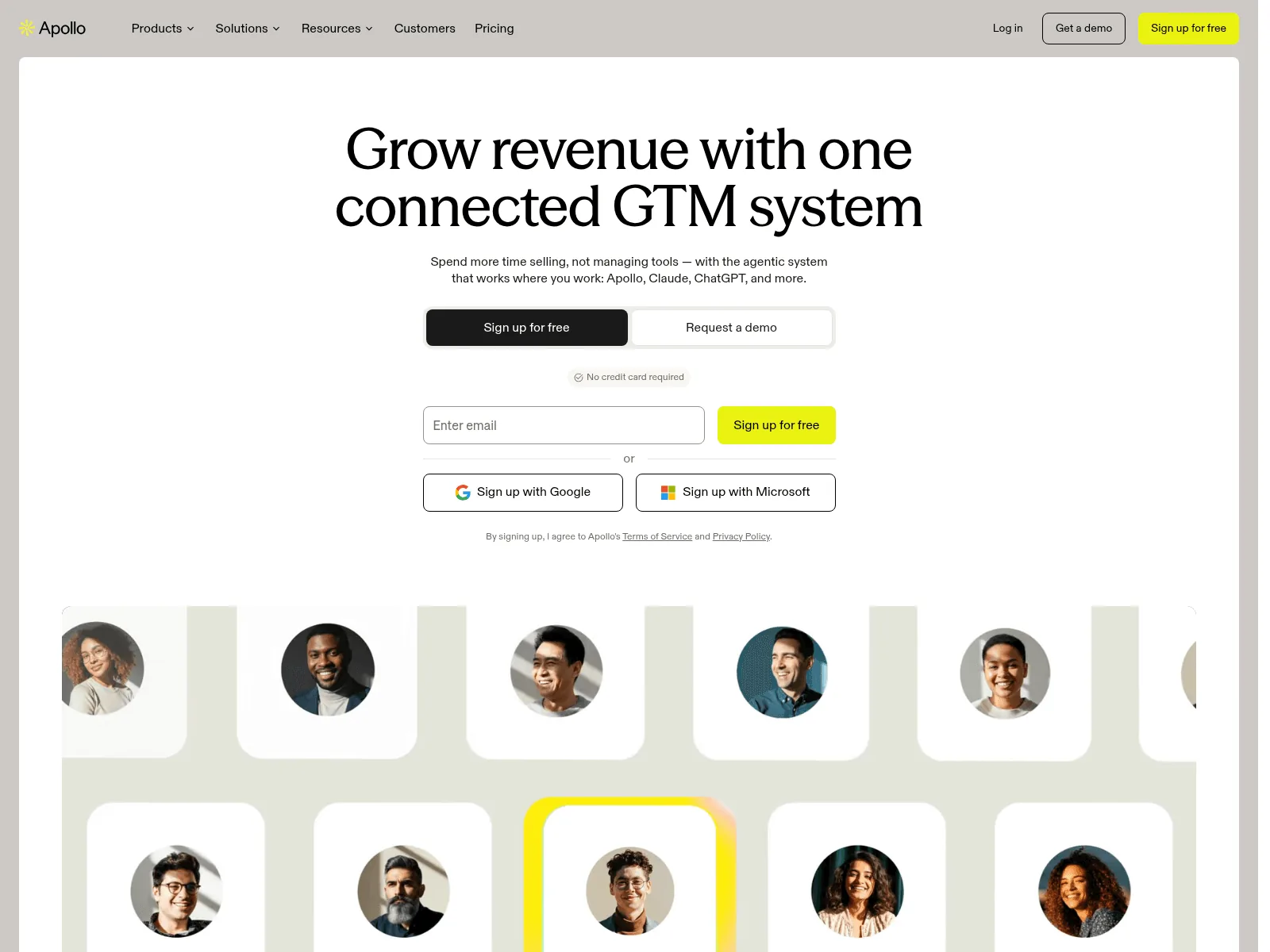
Apollo.io's homepage, apollo.io (November 2026).
Its data page claims 240M+ contacts and 30M+ companies, figures Apollo reports itself. Around that database sit email sequences, connected mailboxes, a US dialer that spends credits, intent topics, and automated workflows.
Apollo now runs a waterfall too, from Basic up, meaning it tries other vendors in turn when its own record is missing a field. With data, sequences and calls together, a rep can search, find an email and send a sequence from one screen.
Clay
Clay's homepage describes the product as "Infrastructure to get any data, run agentic workflows, and launch GTM plays." You work in tables: each column is an enrichment step, an AI research run (Claygent), a formula or an export, and each row is a company or a person.
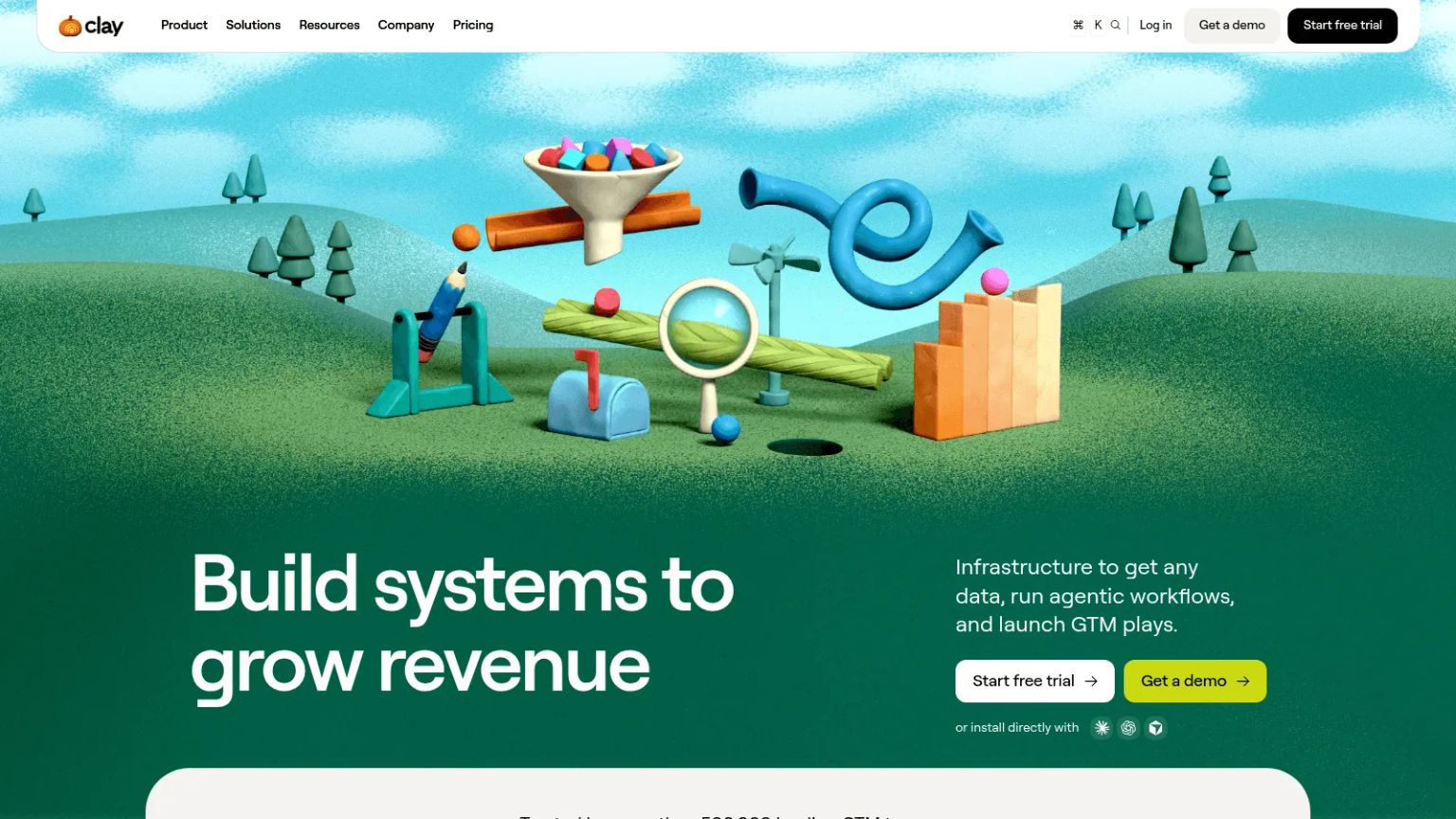
Clay's homepage, clay.com (November 2026).
Its strength is breadth of routing. Clay's pricing page says "150+ providers," and its homepage and blog say 200+. Signals such as job changes and news start on Launch.
Whether Clay has a database of its own is disputed. Apollo, ZoomInfo and several agencies say it has none, while Clay's developer docs describe "Clay's proprietary GTM database" for people and company search and price a search for 100 people there at zero data credits and zero actions. No record count is published, so treat Clay as a router first, which is why it usually sits among data enrichment tools rather than contact databases.
Apollo vs Clay Pricing, Side by Side
Apollo bills per seat, and one account can't mix plans: if a single rep needs Professional, every seat moves up with them. On annual billing, Apollo's pricing page shows $49, $79 and $119 a seat a month, with credits granted upfront for the year.
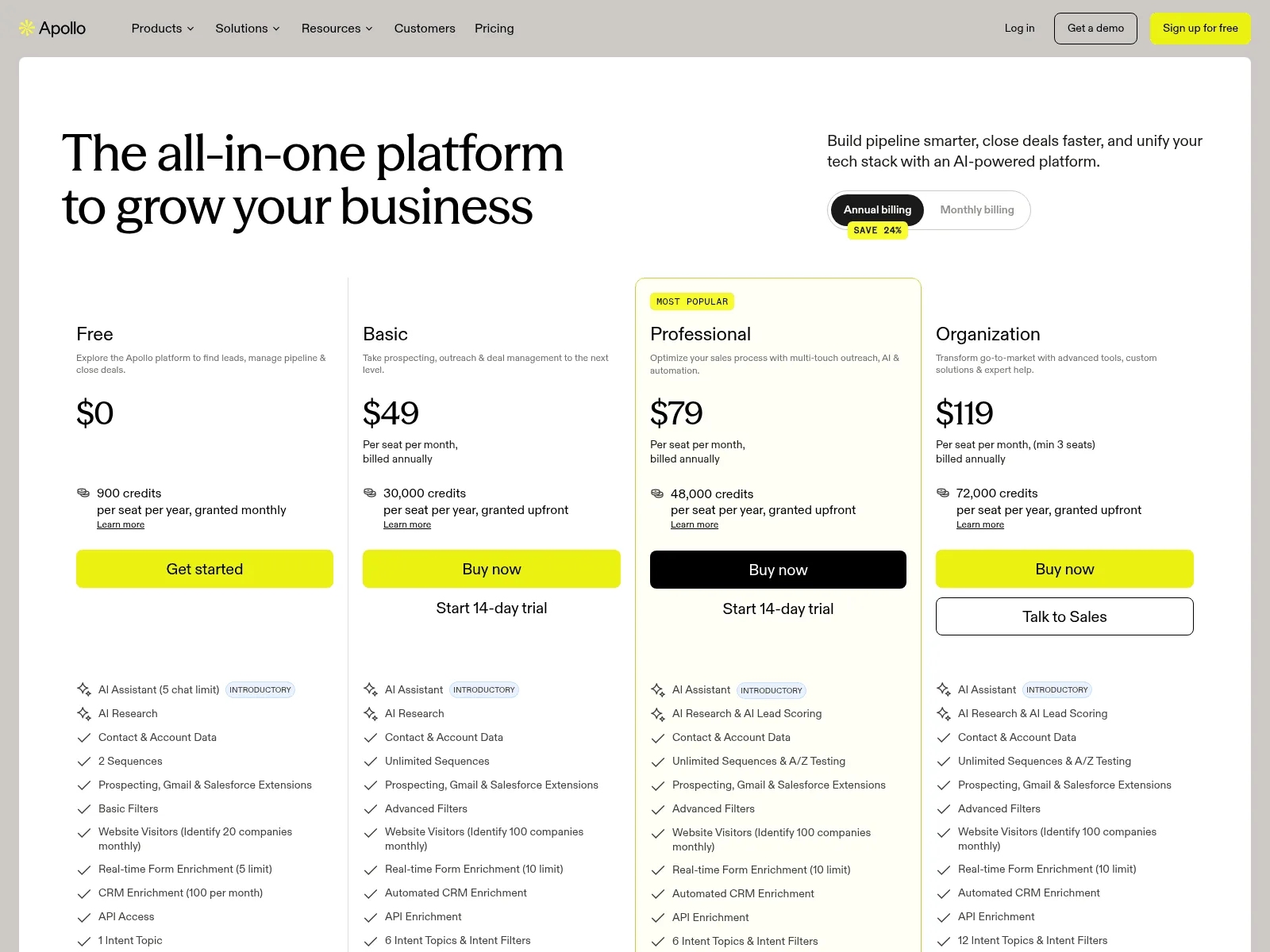
Apollo.io's pricing page on annual billing, apollo.io (November 2026).
Switch the toggle to monthly and Basic becomes $65 and Professional $99. The annual toggle's "Save 24%" label matches Basic's drop from $65 to $49, while Professional saves 20%. Organization shows $149 on the monthly view but is marked "Annual Only," so you'd pay $119 a seat on an annual term, with a 3-seat minimum.
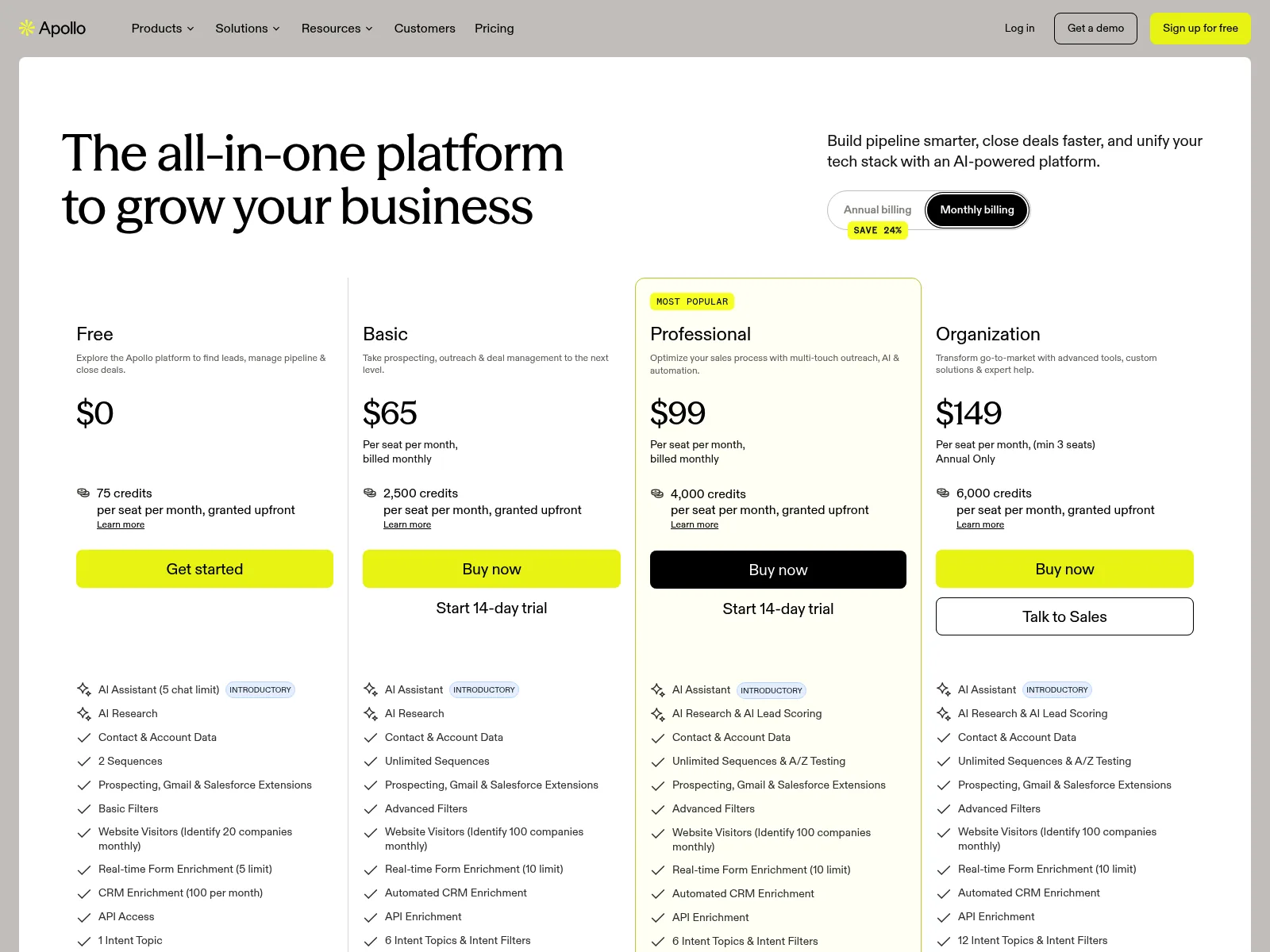
Apollo.io's pricing page on monthly billing, apollo.io (November 2026).
Clay prices the workspace, not the person. Each card splits its price into a yearly allowance of actions and data credits, with larger tiers of each for sale.
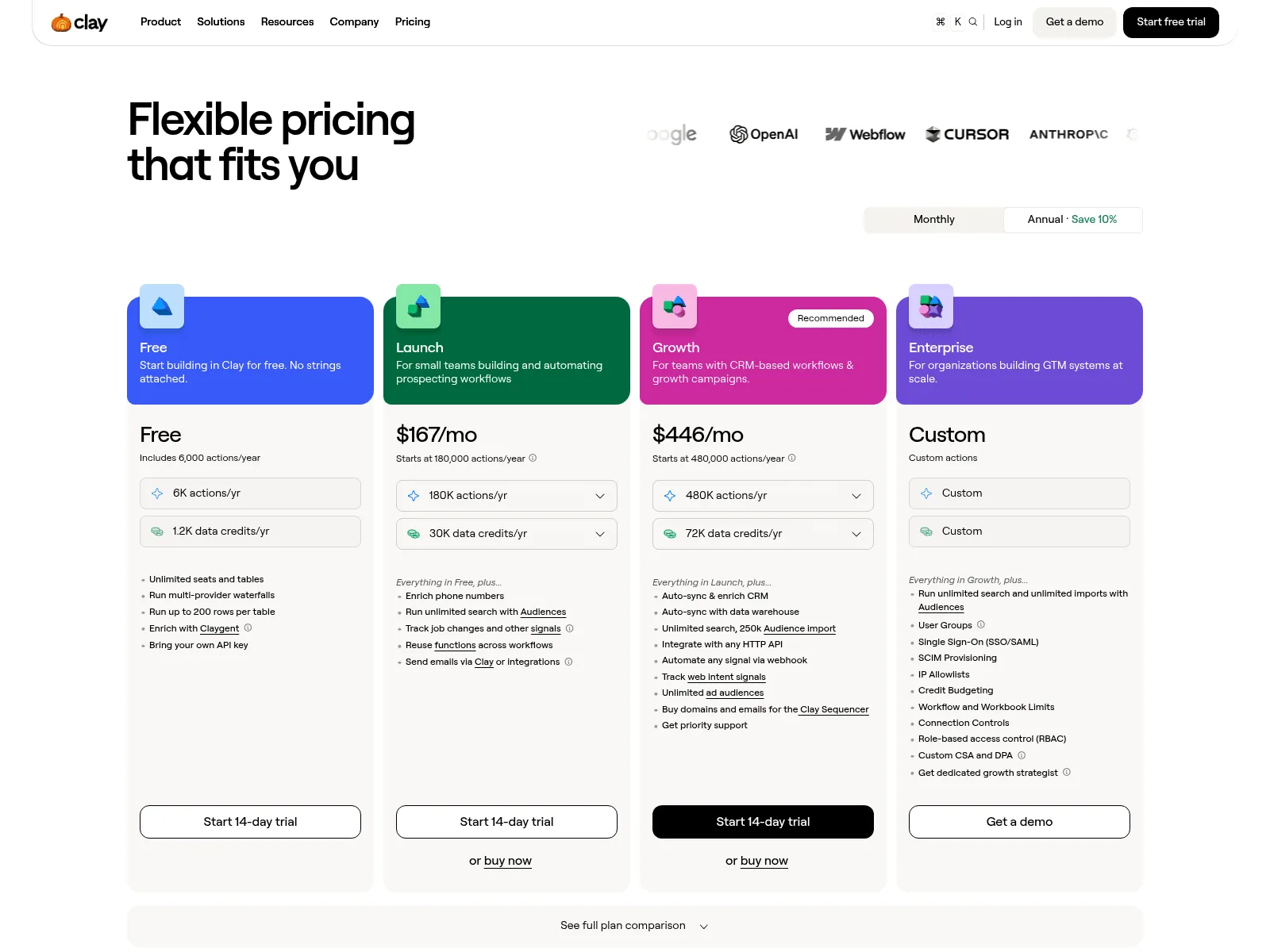
Clay's pricing page on annual billing, clay.com (November 2026).
Clay's annual toggle says "Save 10%," and the monthly view shows allowances per month: Launch at $185 with 15,000 actions and 2,500 data credits, Growth at $495 with 40,000 actions and 6,000 data credits.
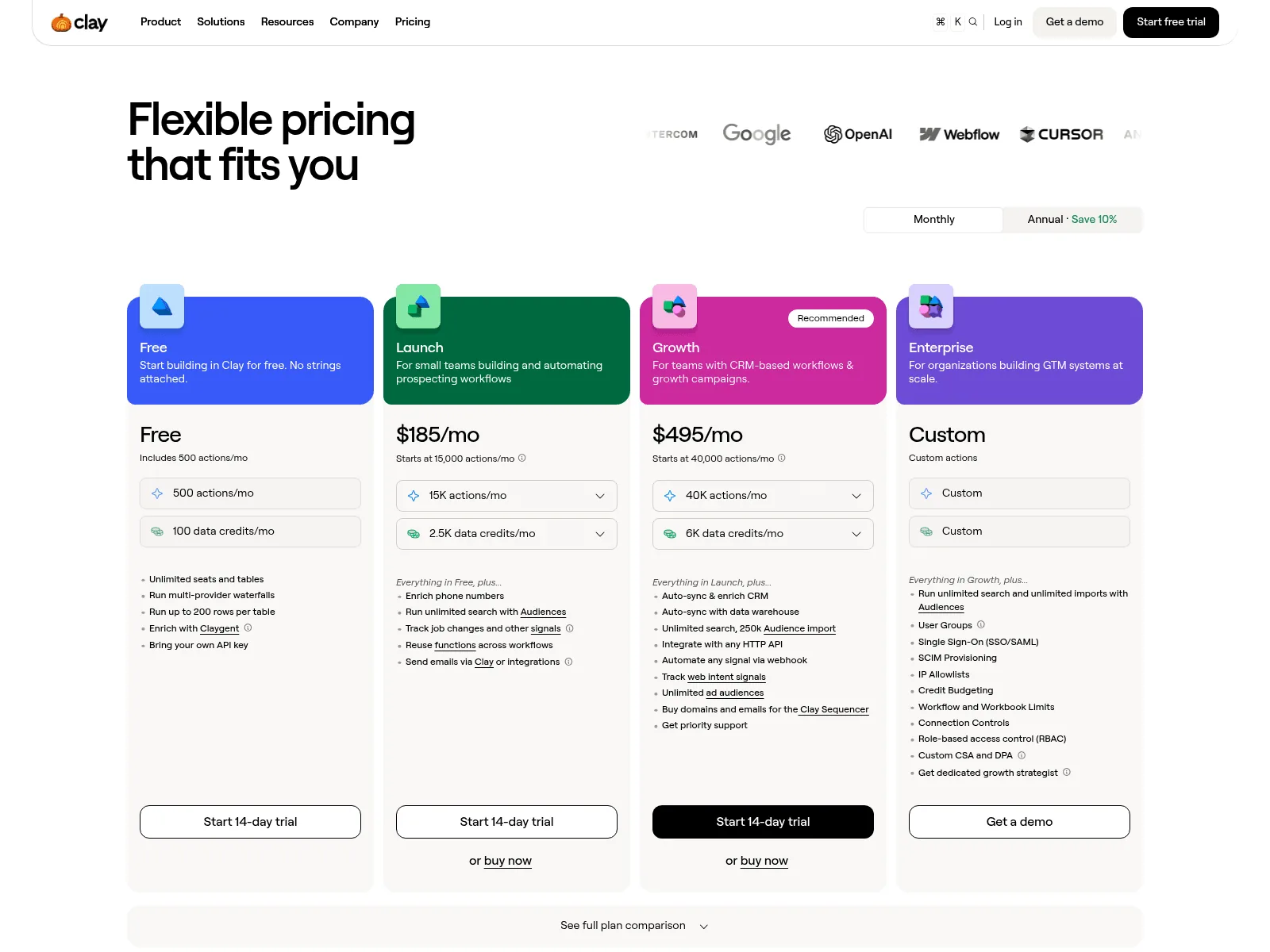
Clay's pricing page on monthly billing, clay.com (November 2026).
Contract terms belong next to the two ladders, because they change what a plan costs over a year. Every line below comes from each vendor's pricing page, pricing FAQ or Terms.
| Apollo.io | Clay | |
|---|---|---|
| Billing basis | Per seat, all seats on one plan | Flat per workspace, unlimited seats |
| Free plan | Yes, 900 credits a seat a year, granted monthly | Yes, 500 actions and 100 data credits a month, no phone enrichment |
| Entry paid plan, annual billing | Basic, $49 a seat a month, 30,000 credits a seat a year upfront | Launch, $167 a month, 180,000 actions and 30,000 data credits a year |
| Entry paid plan, monthly billing | Basic, $65 a seat a month, 2,500 credits a seat a month | Launch, $185 a month |
| Middle plan | Professional, $79 a seat a month annual, or $99 monthly | Growth, $446 a month annual, or $495 monthly |
| Top plan | Organization, $119 a seat a month, annual only, 3 seats minimum | Enterprise, custom |
| Trial | 14 days on Basic and Professional, with 75 credits | 14 days, on the Free, Launch and Growth cards (Enterprise is a demo) |
| Unused credits | Reset every cycle, including purchased add-on credits | Data credits roll over within a cap; actions don't |
| Renewal | On an annual term, auto-renews for another year unless you give written notice 30 days before it ends | Renews at current rates unless canceled before the renewal date |
| Refunds and seats | Fees non-cancelable and non-refundable; seats can't drop mid-term | Fees non-refundable; seats are unlimited |
Two rows matter more than they look. Apollo's seat rule means a rep who leaves in month four stays on the bill until the term ends. And both contracts renew on their own, Clay's at whatever its rates are on the day. Many buyers we speak with re-assess every data vendor at renewal, so put both dates in your calendar the day you sign.
Clay's Two Meters: Actions and Data Credits
Since March 11, 2026, Clay has charged on "two simple usage meters," in its own words. Plenty of older Apollo vs Clay pages still quote Clay's retired Starter and Pro plans.
An action is a unit of platform work. Clay's docs count one action per enrichment, per AI run, per export to another tool, per CRM sync, per HTTP call, and per lead added to the Clay Sequencer, while formulas, filters, imports and CSV downloads use none. The pricing page says actions "start at less than $0.01 each."
A data credit pays for the data itself. Clay's docs put a lookup at between 0.5 and 10+ credits depending on the data type, say a fully enriched record typically costs 6 to 20 data credits, and note that emails are cheap while phone numbers are expensive. The pricing page says data credits "start at $0.05 each."
If an enrichment returns nothing, Clay's FAQ says you're "not charged Data Credits or Actions," but re-running a column bills again, which is why Clay's docs suggest testing a new workflow on 10 to 20 records first.
Running short is where the two meters differ. Data credits can be topped up on Launch and Growth at a 30% premium, up to 4 times the monthly allowance, or bought as a larger tier with no premium, which Clay's docs call more cost-effective for regular needs. Actions can't be topped up, so you move up a plan.
What One Contact Costs in Each Tool
Apollo's unit is simpler. Standard enrichment charges 1 credit per email and 8 per mobile, from a pool the whole team shares. On annual Basic, $49 buys 2,500 credits a seat a month, so an email works out to about 2 cents if you spend every credit.
Clay's unit depends on which provider answers. Its docs example prices a found email at 0.5 data credit plus 1 action, roughly 3 cents at the starting prices above, so a smaller credit count isn't a smaller price.
| Request | Apollo.io | Clay |
|---|---|---|
| A work email | 1 credit standard; waterfall typically 1 to 4 | About 0.5 data credit in Clay's docs example, plus 1 action |
| A mobile number | 8 credits standard; waterfall typically 8 to 25 | Not printed on the pricing page; phones sit at the expensive end of 0.5 to 10+ |
| A full record (email, phone, company) | About 10 credits at standard rates, our sum of 1 for the email, 8 for the mobile and 1 for the company | 6 to 20 data credits, per Clay's docs, plus an action per step |
| A lookup that finds nothing | Standard API enrichment bills only when data is found; waterfall enrichment can bill on a miss | No data credit and no action, per Clay's FAQ |
| A call to your own provider account | Not applicable | 1 action, no data credit |
The table hides one asymmetry. Apollo's standard price assumes its own database holds the record, and once its waterfall steps in, a miss can cost credits too. Clay's price moves with the providers in your waterfall, which is the cost of reaching rows a single database misses.
Neither pricing page publishes a match rate, so a cost per verified contact only comes from running your own records through both, as the two-week test below does.
Seats vs Usage: Where Clay Becomes Cheaper
Divide Clay's flat price by Apollo's seat price and you get the headcount where the two bills meet. Launch at $167 equals 3.4 Basic seats at $49, so a fourth rep tips Apollo above Clay on annual billing. Against Professional at $79 the line falls at 2.1 seats.
Growth at $446 equals 9.1 Basic seats or 5.6 Professional seats. On monthly billing, Launch at $185 is 2.8 Basic seats at $65, so three reps on monthly Basic already cost $195. That's a sticker comparison only, because the two bills buy different things: Apollo's includes a database and a sequencer, Clay's a router and a usage allowance.
The deeper difference is predictability. Deloitte's TMT Predictions 2026 describes seat pricing as "relatively straightforward and predictable" and usage pricing as "less predictable." Deloitte, citing Gartner, expects at least 40% of enterprise SaaS spend to shift toward usage-, agent- or outcome-based pricing by 2030.
Spiky months test both models. Buyers with campaign-driven volume tell us a fixed monthly commitment is the hardest part: a few thousand records one month, far more the next.
Annual billing absorbs the volume swing on both tools, though it deepens the commitment: Apollo grants the year's credits upfront, and Clay's pricing page lists "Get all credits up front" for annual plans, so a heavy month can draw on what a quiet one left behind. On monthly plans, Apollo resets every cycle, while Clay keeps unused data credits within a cap but not spare actions.
Apollo vs Clay Total Cost of Ownership, Worked Out
Seat crossovers ignore credits, and credit tables ignore seats. This example uses both, with our assumptions marked.
The Setup
Picture a Series A company with 3 outbound reps, each working 500 net-new contacts a month: 1,500 contacts a month, 18,000 a year. Prices are list, on annual billing. On Apollo, 3 Basic seats give a pool of 90,000 credits a year, 7,500 a month on average, counted at standard rather than waterfall rates.
On Clay, we assume 3 actions per contact (one enrichment, one export, one sequence add). That's lean: Clay's guide to actions and data credits sizes Launch's actions for about 10,000 records a year and its data credits for about 1,000 records a month, both below this team's volume, so read any Launch fit below as a best case.
The export is a push to another tool, not a CRM sync. Apollo syncs Salesforce, HubSpot and Pipedrive from Basic, but Clay's CRM auto-sync starts on Growth, so if enriched fields must land in your CRM, start Clay's figures at Growth's $446.
Three Scenarios
The scenarios differ only in how much each contact needs, the variable that splits the two bills.
| Scenario, per month | Apollo.io, 3 seats | Clay |
|---|---|---|
| 1. A work email for all 1,500 | 1,500 credits, 20% of the Basic pool: $147 | Up to 750 data credits and 4,500 actions, inside Launch: $167 |
| 2. Scenario 1 plus a mobile for 300 | 3,900 credits, 52% of the Basic pool: still $147 | About 3,750 data credits if a mobile costs 10 (our assumption): Launch plus about $81 of top-ups, so about $248 |
| 3. A full record for all 1,500 | 15,000 credits at 10 a contact: above Basic's 7,500 and Professional's 12,000 a month for 3 seats, so Organization (18,000) at $357 | 9,000 to 30,000 data credits: about $468, up to about $2,006 |
Scenario 3 is our estimate on both sides. Apollo doesn't print an add-on credit price, so a lower plan plus extra credits might undercut Organization. On Clay, 6 credits a record means 9,000 a month, and the cheapest published fit is Launch with its 10,000-credit tier: $54 of actions plus $414 of credits, about $468.
Topping up standard Launch instead, at the 30% premium on the $0.05 starting price, comes to about $590. At 20 credits a record, Growth plus 24,000 topped-up credits sits right at Clay's 4x cap, for about $2,006, an upper bound a larger tier would undercut.
At 3 reps, then, Apollo is the cheaper bill in every scenario. Both bills climb with record depth, Apollo's in plan steps and Clay's in credits, but only Apollo's climbs with headcount, which is where Clay's flat price starts to win.
Add the Person Who Runs It
Neither bill includes the person who builds and maintains the workflow. The Bureau of Labor Statistics' June 2026 compensation release puts the employer cost of a full-time private-industry worker at $54.00 per hour worked, wages and benefits together. Treat that as a floor, because a GTM (go-to-market) engineer or RevOps (revenue operations) hire likely costs more.
The hours are our assumption, not a published figure. At $54.00, 4 hours a month of table-building costs $216, 8 hours costs $432, and 10 hours costs $540. Add 8 hours to Clay Launch and the bill is about $600 a month. Apollo needs fewer hours, but list hygiene and sequence checks still take some: at 2 hours a month, 3 Basic seats come to about $255.
The Hybrid Nobody Prices: Apollo Inside Clay
Clay's blog calls running both "the lowest risk way to evaluate Clay," with Apollo as the contact database and sending layer. Apollo has its own pairing post. Inside Clay, Apollo is a native provider with 14 built-in functions, and Clay's April 2026 post says you need both accounts, because you connect your own.
On list prices, 3 Apollo Basic seats plus Clay Launch cost $314 a month on annual billing, or $3,768 a year. On monthly billing it's $195 plus $185, so $380 a month. A 2025 Reddit reply on r/LeadGeneration describes a common setup: pull lists from Apollo, enrich in Clay, and call Apollo with your own key "to save credits."
Clay's docs back the mechanic in general terms: your own provider connection "will eliminate the Data Credit cost," while an action is still consumed. The Apollo integration pages don't state their billing outright, so prove it on a small batch:
- In Clay, add Apollo as a provider and select your own Apollo account.
- Run the Apollo step first and send only the rows it leaves blank to Clay's waterfall.
- Test 20 rows, then check Clay's usage log shows one action and no data credit per Apollo call.
- Push finished rows back with Clay's "Add contact to sequence" action for Apollo.
If the log matches, Apollo's pool pays for its own lookups and Clay's credits go only to the gaps. Deciding when a new value may overwrite an old one in your CRM is a job of its own in CRM data enrichment.
The hidden cost is admin. Two contracts mean two renewal dates and two sets of terms. Buyers we talk to say each subscription looks small on its own and the total is what hurts.
Clay vs Apollo for Series A Sales Team Staffing: Who Runs It
Clay's own comparison says Apollo fits when there's nobody to own a system. At a Series A company with 3 to 10 reps, ownership comes down to one question: is there a RevOps hire or GTM engineer yet, or does the head of sales build lists between calls?
The buying group is usually tiny too. In our calls, a founder or CEO often approves the data budget while one technical person evaluates the tool, and the GTM engineer is increasingly the person deciding which vendor has better data.
Only Apollo publishes a startup discount percentage. Apollo for Startups offers 50% off Basic or Professional for a year, up to 5 seats, for companies under 20 employees with a partner VC or accelerator and no existing Apollo subscription. If you're still under 20 people and qualify, that halves the Apollo Basic line in our worked example for the first year.
Clay runs Wedge, an accelerator for Series A and earlier startups, where teams earn credits. Clay's 10% discount for paying annually is not a startup offer, and it's already inside the $167 Launch price. If nobody can own a build at all, some teams skip both and buy AI prospecting tools that research accounts and draft outreach without a table for anyone to maintain.
API, MCP and CLI: What Each Tool Exposes
Both tools now reach beyond their own screens. MCP (Model Context Protocol) is the standard that lets an AI assistant such as Claude or ChatGPT call a tool directly.
| Capability | Apollo.io | Clay |
|---|---|---|
| REST API | On every plan including Free (enrichment capped at 50 requests a minute and 600 a day on Free, 1,000 a minute from Basic), but the pricing FAQ puts API access for custom integrations on Custom plans, so check yours | Public API on developers.clay.com, but the pricing FAQ lists "Clay API access" under Enterprise, so check your plan |
| MCP server and CLI (command-line tool) | mcp.apollo.io/mcp, OAuth or API key, spends workspace credits; Apollo also lists a CLI | Clay MCP for Claude, ChatGPT, Microsoft Copilot and Glean, same actions and credits, plus Clay's CLI and an agent plugin for Claude Code, Codex and Cursor |
| CRM sync | Salesforce, HubSpot and Pipedrive from Basic | Auto-sync from Growth |
| Sending | Sequences, mailboxes, US dialer | Clay Sequencer for email, no native dialer |
The practical difference is where the logic lives. Apollo's API returns what Apollo finds, priced by its credit table.
Clay's API and MCP run your Clay functions, so an agent can trigger a whole waterfall, though reading table data back through the API is Enterprise only. If you're comparing raw data enrichment APIs rather than platforms, the questions shift to response format, rate limits and what a miss costs.
Clay vs Apollo for Outbound Prospecting: Which to Pick
Once the costs are on paper, the choice usually comes down to headcount, record depth and whether anyone owns the build. Here's how our numbers sort it, at list prices on annual billing:
- Pick Apollo at 3 reps, our example's size. It's the cheaper bill in all three scenarios: $20 a month less for emails, $147 against about $248 with mobiles on our assumptions, and $357 against about $468 or more for full records.
- Pick Apollo if its database covers your market and nobody will own a Clay workspace in the next six months.
- Pick Clay if someone will own the build and your plays need what one database doesn't hold, such as job-change signals, custom AI research or a waterfall across many providers. Clay's case rests on that orchestration, not on a lower bill.
- Pick Clay on price only if 4 or more people touch prospect data, the work is mostly emails and your workflow stays near our lean 3 actions a contact. Add mobiles for one contact in five and, on our assumptions, 4 Apollo Basic seats (2,000 contacts a month) at $196 still undercut Clay at about $315: $54 for Launch actions plus $261 for the 72,000-credit yearly data tier.
- Pick both if Apollo's data covers most rows and you want Clay's providers or signals only for the gaps.
- Check terms before you pick either if the data will end up inside one of the sales products you sell to customers: Apollo's standard plans exclude it, and Clay's Terms defer to each provider's own.
That last line is about licensing, not features, and the next section covers it.
When the Data Ends Up Inside a Product You Sell
Everything above assumes your own reps use the data. Apollo's pricing FAQ is direct about the other case: its plans cover "internal business use," and putting the data in an external product, handing it to customers or reselling it takes "a separate agreement with custom pricing." With Clay, ask before you build: its Terms say a third-party service's own terms govern its use.
That case is what Reverse Contact is built for, as an API for people and company records rather than a replacement for either tool in outbound. Your code sends an email, a name with a company domain, or a set of filters, and gets matching records back in the same fixed format every time, through our REST API, an MCP server, a CLI or our TypeScript and Python SDKs.
Before you spend, you can count the people or companies that match your filters and check when a profile was last refreshed, both for free (the check needs at least 2 credits in your workspace). Like Apollo's, our self-serve plans cover your own team's use only: once your customers see our data, in your app or resold, you need a Platform contract, which our sales team prices on a call.
We're also available inside Clay: our Clay integration has sat in Clay's marketplace since May 2025, with four actions (find the person behind an email, enrich a profile, find a company from its domain, enrich that company), billed on Clay credits or your own key.
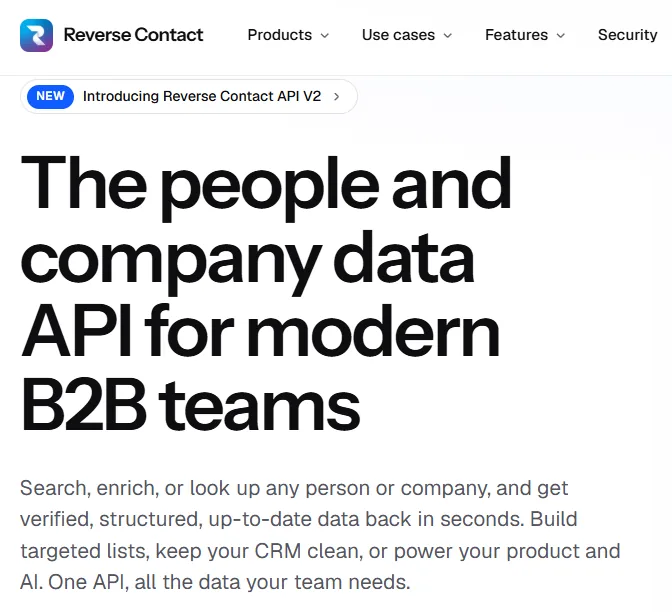
Reverse Contact's homepage, reversecontact.com (November 2026).
allGood shows the product case. Before its marketing automation platform routes a customer's leads, it calls our API to fill in the people and companies behind them, adding company size, industry, role and seniority. The routing itself is allGood's own logic.
Here's what we don't do. We don't send email, run sequences or sell seats to reps, so a team doing its own outbound would still need a tool like Apollo or Clay's Sequencer to reach anyone.
On our self-serve plans, Go at $249 a month gives unlimited cached profile fetches by URL or ID, Plus at $449 adds search, and Max at $699 adds enrichment when all you hold is an email, a name or a company's web domain. That unlimited use stops at 100,000 profiles a day per workspace.
Each plan carries a monthly commitment, and three things draw credits on every plan: live refreshes (2 credits each), business emails (3 credits per email found) and phone lookups (20 credits when one finds a phone). Credit packs, from $100, carry no commitment and expire after three months.
Run a Two-Week Test Before You Sign
Published prices get you to a shortlist, and your own records decide the rest. In our calls, buyers evaluating data tend to cap the field at two or three vendors and give each a few days.
For Apollo vs Clay, a two-week test matches both 14-day trials. Apollo's trial carries only 75 credits, though, enough for about 50 emails and a few phones, so test phones on a paid month. Clay's cards don't state its trial allowance, so check it before you count on it for phones. Here's how to run it:
- Pick 50 contacts your reps will work this quarter, including some outside the US if you sell there.
- Run them through Apollo and through a Clay waterfall in the same week.
- Count found emails, invalid emails and wrong-person matches separately for each tool.
- Note the credits and actions each tool spent per found email, from its usage screen.
- Log the hours someone spent building the Clay table and the Apollo list.
- Multiply by your monthly volume and drop the results into the scenarios above.
Wrong-person matches deserve their own column, because a tool that finds more but gets more wrong costs you in bounced sequences and lost trust with prospects. If your contacts are headed into a product you sell instead of a sequence, run the same 50 contacts through Reverse Contact on free trial credits, no card required, or talk to our team about the product case.
FAQs
Clay vs Apollo for B2B prospecting and outbound: which is better?
For a 3-rep team, Apollo is the cheaper bill in all three of our scenarios: $147 a month for 3 Basic seats on annual billing, sequences and a dialer included, and the gap widens with phones or full records.
Clay's case rests on orchestration, not price. It suits teams with someone to build workflows and needs beyond one database, such as signals or AI research, and on our lean assumption of 3 actions a contact, it undercuts Apollo from 4 reps on mostly-email work.
Can you use Apollo data inside Clay?
Yes. Apollo is a native data provider in Clay with 14 built-in functions, and you connect your own Apollo account, so you pay for both subscriptions. Clay's docs say a call through your own provider connection uses an action but no Clay data credit, so check the usage log on a small batch.
Do Apollo and Clay credits roll over?
Apollo's don't. Its pricing FAQ says credits reset each billing cycle, including purchased add-on credits. Clay says unused data credits roll over within a cap that depends on your plan and term, and actions never do.
How many reps before Clay costs less than Apollo?
On annual list prices, Clay Launch at $167 a month equals 3.4 Apollo Basic seats at $49, so the fourth rep makes Apollo's seat bill higher. Against Professional at $79, Clay is cheaper from the third seat. Credits can move the line back: in our 4-rep example, mobiles for one contact in five keep Apollo cheaper.
What does a Clay vs Apollo setup cost a Series A sales team?
For 3 reps working 1,500 contacts a month, our arithmetic gives $147 a month on Apollo Basic or $167 on Clay Launch for emails only, on annual billing. Running both costs $314 a month. Add the hours of whoever runs it: at the BLS figure of $54.00 an hour, our assumption of 8 hours a month on Clay adds $432.
The data layer behind your GTM engine
Access fresh people and company data through one API and power every enrichment, prospecting, and automation workflow.
- Profiles
- 800M+
- Refreshes / month
- 200M
- Response time (P95)
- 500ms